If you’re considering an Audi Q4 e-tron, or already drive one, the big question is simple: how long will the battery last before range really starts to bother you? The Q4 e-tron’s high‑voltage pack is engineered for the long haul, but real‑world lifespan depends on years, miles, and how you treat it. Let’s unpack what that means in practical terms for daily driving and for buying used.
Key takeaway up front
How long does an Audi Q4 e-tron battery actually last?
There are three different ways to think about Audi Q4 e-tron battery lifespan:
- Calendar age: How many years before degradation meaningfully cuts into your usable range.
- Miles driven: How much driving the pack has done in its life.
- Usable range: The point where reduced range actually changes how you use the car.
Audi Q4 e-tron battery lifespan at a glance
That means that while Audi’s official battery warranty is 8 years/100,000 miles, your Q4 e-tron’s pack is designed to outlast that warranty under normal use. The goal is that you’ll sell or trade out of the car before the battery becomes a daily limitation.
Q4 e-tron battery specs, warranty, and what “end of life” means
All U.S.‑spec Audi Q4 e-tron models use a large lithium‑ion pack mounted under the floor. Newer “55” variants use an 82 kWh gross battery with roughly 77 kWh usable capacity, enough for an EPA‑rated range of up to around 258 miles on certain trims. Earlier and lower‑range variants use similar VW Group packs with different usable energy and range tuning.
Audi Q4 e-tron battery & range snapshot (U.S.)
Approximate figures for common U.S. Q4 e-tron configurations; exact specs vary by model year and trim.
| Model example | Drivetrain | Usable battery (kWh)* | EPA range (mi)* |
|---|---|---|---|
| Q4 40 e-tron | RWD | ~77 | ~265 |
| Q4 55 e-tron | AWD | ~77 | ~258 |
| Q4 Sportback 55 e-tron | AWD | ~77 | ~264 |
These figures are ballpark numbers meant to give you context for how much energy the Q4 e-tron’s pack stores today and how range might feel as it degrades.
About the numbers
From a warranty perspective, most model‑year 2021+ Audi EVs in the U.S. carry a high‑voltage battery warranty of 8 years or 100,000 miles, whichever comes first. That warranty is separate from the 4‑year/50,000‑mile new‑vehicle bumper‑to‑bumper coverage.
Warranty vs. real-world lifespan
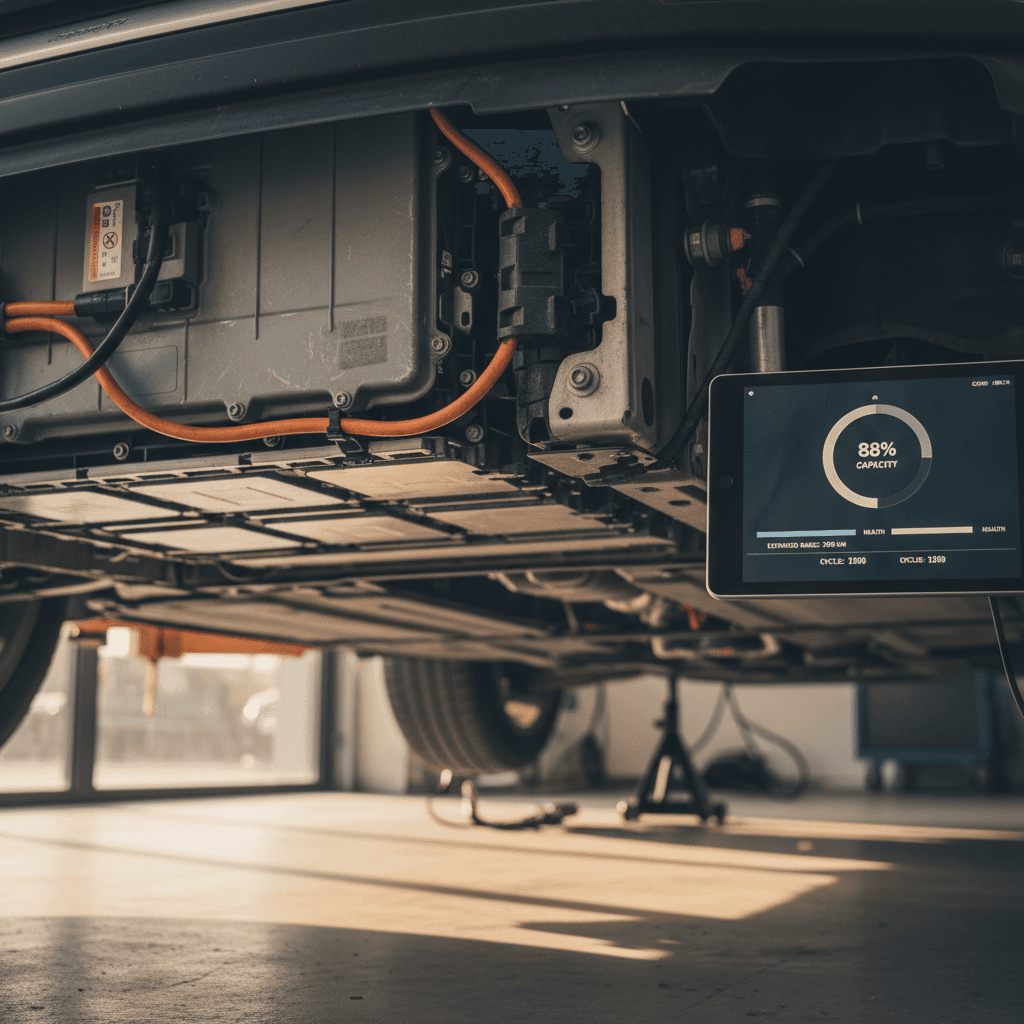
When we talk about "end of life" for an EV battery, we usually mean the point where the pack has around 70–80% of its original usable capacity, not when it stops working. At that point, many drivers start to find the shorter range inconvenient, even though the car still drives normally.
Real‑world battery degradation on the Audi Q4 e-tron
Audi hasn’t released public, model‑specific degradation curves for the Q4 e-tron, and the car is still relatively young (introduced for 2022 in the U.S.). But we can draw on three data points:
- General EV fleet studies that show modern packs often lose roughly 1.5–2% of capacity per year in typical use.
- Owner reports from Q4 and related VW Group models suggesting early, faster "settling" degradation of perhaps 5–10% in the first few years, then a slower decline.
- Real-world range tests that show Q4 e-tron models often get close to their rated range when new, which gives us a baseline to compare against as they age.
A reasonable Q4 e-tron degradation guess
Crucially, very high‑mileage or heavily fast‑charged Q4s, think rideshare in a hot climate hitting DC fast chargers daily, can fall outside those averages. But for a typical North American commuter doing 10,000–15,000 miles a year, mostly charging at home, the pack is set up for long service life.
Range over time: how much will the Q4 e-tron lose?
Let’s translate degradation into something you feel every day: range. Suppose your new Audi Q4 e-tron 55 quattro has an EPA rating of about 258 miles. Here’s what a reasonable, real‑world range path could look like for a typical owner who takes decent care of the battery:
Example Q4 e-tron range over time (typical owner)
Hypothetical illustration based on moderate climate, mostly home Level 2 charging, and mixed driving.
| Vehicle age | Approx. capacity | Approx. EPA-style range | How it feels day-to-day |
|---|---|---|---|
| New (Year 0–1) | 100% | ~258 mi | Full advertised range; road trips easy with planned stops. |
| 4–5 years | ~90–92% | ~235–240 mi | You might notice a slightly smaller buffer on long drives, but daily use is unchanged. |
| 8 years | ~80–85% | ~210–220 mi | You’ll plan fast‑charge stops a bit sooner on long trips; commuting remains easy. |
| 10–12 years | ~70–80% | ~180–205 mi | Cold weather and high speeds hurt more, but still perfectly workable for many U.S. driving patterns. |
Your actual numbers will vary with speed, weather, and driving style, but the pattern of modest early loss followed by a slower decline is common for modern EVs.
Think in trips, not percentages
Habits that shorten your Audi Q4 e-tron battery life
The Q4 e-tron’s battery management system works hard in the background to protect the pack, but your habits still matter. The following patterns can accelerate degradation and shorten practical battery lifespan:
Top Q4 e-tron battery "killers" to avoid
These won’t destroy your pack overnight, but over years, they add up.
Frequent DC fast charging
Extreme heat + high SOC
Living at 100%
Other risk factors
- Constant high‑speed driving at 80+ mph.
- Very frequent deep discharges to near 0%.
- Poor tire maintenance (indirectly increasing load and heat).
What’s mostly fine
- Occasional road‑trip fast charging.
- Regular commuting with Level 2 home charging.
- Charging to 80–90% most days, 100% only when needed.
Heat is the silent battery killer
10 ways to extend your Q4 e-tron’s battery lifespan
You don’t have to baby the car, but a few smart habits can add years of strong performance. Here’s a practical checklist you can actually live with.
Audi Q4 e-tron battery care checklist
1. Target 30–80% for daily use
For everyday commuting, aim to keep the state of charge between roughly 30% and 80%. Use 100% only before longer drives, and hit that full charge as close to departure as possible.
2. Favor Level 2 home charging
Whenever you can, charge at home or work on Level 2 (240V). It’s gentler on the battery than frequent high‑power DC fast charging and usually cheaper per kWh.
3. Use scheduled charging
If your utility offers cheaper off‑peak electricity, schedule charging so the car finishes around the time you leave. That keeps the pack from sitting at high state of charge for hours.
4. Precondition while plugged in
Use cabin preconditioning and seat/steering‑wheel heat while the Q4 is plugged in, especially in winter. That pulls energy from the grid rather than the battery and helps range and longevity.
5. Avoid running to 0%
The car protects itself above true zero, but repeatedly driving down into the last few percent of charge adds stress. Try to recharge when you’re around 10–15% instead of waiting for warnings.
6. Protect it from extreme heat
In hot climates, park in shade or a garage and avoid long stretches parked at high state of charge. If you must leave the car at the airport for a week, 50–60% is safer than 100%.
7. Keep software up to date
Audi regularly refines thermal management and charging logic via updates. Staying current ensures your Q4 benefits from the latest battery‑protection strategies and efficiency tweaks.
8. Mind your tires and alignment
Underinflated or misaligned tires increase rolling resistance, raise consumption, and make the battery work harder. Check pressures monthly and follow rotation and alignment intervals.
9. Use Eco or Efficiency modes when possible
Audi’s drive modes can soften throttle response and optimize climate control. Over years, consistently lower energy usage means fewer deep cycles and milder battery wear.
10. Log your range over time
Once or twice a year, note your typical highway range at a steady speed and temperature. That gives you a personal baseline to spot any unusual degradation early.
Buying a used Audi Q4 e-tron: judging battery health
If you’re shopping used, battery health is the single biggest unknown, and it’s exactly where a Q4 e-tron can be a smart buy if you get the right data. Here’s how to stack the deck in your favor.
How to evaluate a used Q4 e-tron’s battery
Combine paperwork, on‑road checks, and independent diagnostics.
1. Check year, miles, and warranty
2. Do a controlled range drive
3. Look for warning lights or charging quirks
Where Recharged fits in
Ready to find your next EV?
Browse VehiclesWhat "normal" degradation looks like
On a 3–5‑year‑old Q4 e-tron with 40,000–70,000 miles, it’s common to see a modest drop in displayed range versus the original EPA rating. Think in the ballpark of 5–15%, depending on climate and charging history.
A car that originally showed ~258 miles may now hover around 220–240 miles for similar driving. That’s rarely a red flag by itself.
When to be cautious
- Range has dropped dramatically (20–30%+) in just a few years.
- The car regularly charges much more slowly than other Q4s on the same DC fast charger.
- There are unresolved high‑voltage system warnings in the history.
In those cases, you’ll want a professional diagnostic and clear documentation before moving forward.
Will you ever need a full battery replacement, and what does it cost?
In normal use, most Q4 e-tron owners in North America will sell or trade the vehicle before a full pack replacement makes financial sense. That’s by design: the pack is engineered so the car can live a full life, then the battery can go on to a second‑life application (like stationary energy storage) when its automotive usefulness eventually winds down.
So what happens if something does go wrong?
- Within the 8‑year/100,000‑mile battery warranty window, defects in materials or workmanship on the high‑voltage pack are typically covered, subject to Audi’s terms.
- The Q4’s pack is modular, so in some cases individual modules can be replaced instead of the entire pack if a specific area has failed.
- Out‑of‑warranty full pack replacement, if ever needed, can run into the five‑figure range at retail, one reason most owners simply move to another vehicle at that point.
Think total cost of ownership, not worst‑case repair
FAQ: Audi Q4 e-tron battery lifespan & ownership questions
Frequently asked questions
Bottom line: how long the Q4 e-tron battery should last
When you strip away the anxiety and look at the data, the answer to “Audi Q4 e-tron battery lifespan, how long?” is encouraging. Most owners can expect a Q4 e-tron pack to deliver solid, everyday usability well beyond the 8‑year/100,000‑mile warranty, with many vehicles remaining practical for 12–15 years and up to a couple hundred thousand miles.
Your real‑world experience will come down to climate, charging habits, and how demanding your daily driving is. Treat the battery reasonably, favor Level 2, avoid living at 100% in extreme heat, and don’t panic over a modest range drop, and the Q4 e-tron will pay you back with years of quiet, low‑maintenance electric miles.
If you’re shopping used, lean on objective data, not just a quick test drive. A verified battery‑health report, like the Recharged Score included on every EV listed at Recharged, lets you compare Q4 e-tron options apples‑to‑apples and buy with confidence, whether you’re down the street from our Richmond, VA Experience Center or having a car delivered across the country.