If you’re eyeing an Audi e-tron GT, you’re probably wondering how it stacks up in a crash. Search results are confusing: some sites imply a five‑star Audi e-tron GT safety rating, others say it hasn’t been tested at all. Let’s untangle what’s actually known today about crash tests, safety tech, and what that means if you’re buying one new or used.
Key takeaway up front
Audi e-tron GT safety overview
Audi e-tron GT safety snapshot (what we know)
The e-tron GT shares its J1 performance EV platform with the Porsche Taycan, a car engineered from day one around a large battery pack and high crash loads. That gives it inherently strong structure, a very low center of gravity, and short overhangs, all of which help in crash performance and rollover resistance. But until independent labs publish ratings, we need to be honest about where the gaps are.
Has the Audi e-tron GT been crash tested?
Crash‑test status for the Audi e-tron GT (through early 2025)
Where major rating agencies stand today on the Audi e-tron GT.
| Agency | Region | Body style tested | Rating for e-tron GT | Notes |
|---|---|---|---|---|
| Euro NCAP | Europe | Sedan/coupé | No rating | Independent outlets in 2024–2025 confirm the e-tron GT has not yet been tested. |
| IIHS | United States | Sedan | No rating | The e-tron GT does not appear in the IIHS ratings database as of 2025; several Audi SUVs and the A6 e‑tron do. |
| NHTSA | United States | Sedan | No rating | NHTSA’s 5‑Star Safety Ratings site lists no crash results for the e-tron GT. |
| Other NCAP programs | Global | , | No rating | ANCAP and Green NCAP similarly list the car as untested. |
No major agency has published a formal crash rating for the Audi e-tron GT yet.
Ignore “five‑star” claims for now
If you search specifically for “Audi e-tron GT Euro NCAP” you’ll find something interesting: credible databases and reviewers explicitly note that the car is **unrated**, even while other Audi EVs like the Q6 e‑tron and A6 e‑tron have achieved five‑star scores. That’s a strong signal that, if Euro NCAP had run the tests, Audi and the press would be talking loudly about it.
How safe is the e-tron GT without official ratings?
What’s working in its favor
- Shared EV performance platform with the Porsche Taycan, a car engineered from scratch around a large battery pack and high crash loads.
- Low center of gravity thanks to the underfloor battery, which dramatically reduces rollover risk versus tall SUVs.
- Strong passive safety basics – multi-stage airbags, rigid passenger cell, crumple zones, and extensive load paths front and rear.
- Comprehensive ADAS options like adaptive cruise, lane centering and 360° cameras that can help you avoid a crash in the first place.
Where the uncertainty remains
- No star score to benchmark against rivals, which matters if you like hard numbers rather than engineering promises.
- Limited real-world data – the e-tron GT is relatively low‑volume, so we don’t have a deep history of crash statistics yet.
- Tricky visibility (low seating, thick pillars, small rear window) that can make crash avoidance more dependent on cameras and sensors.
- Performance envelope – rapid acceleration plus high weight means crash energies can be significant if things go wrong.
How to think about an unrated EV
Crash protection, structure and airbags
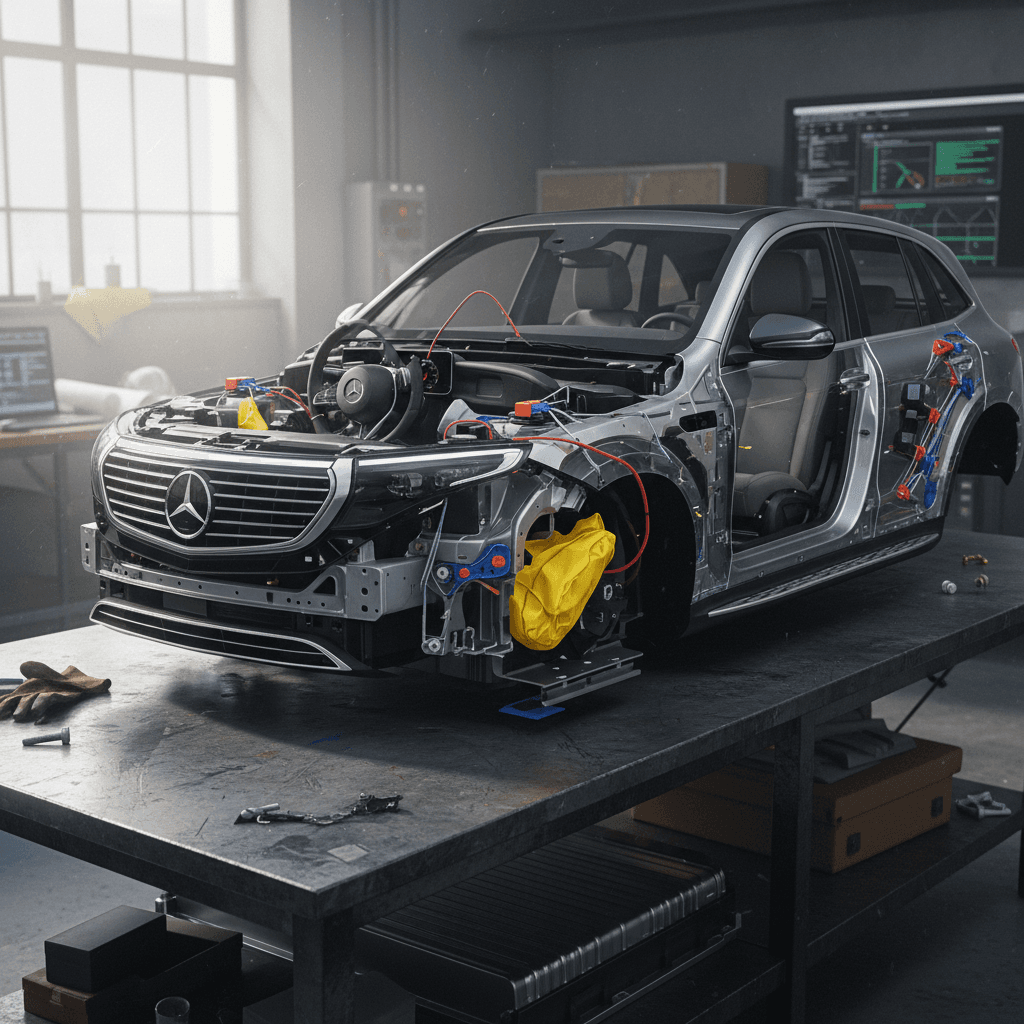
On passive safety, the Audi e-tron GT looks like you’d expect from a modern luxury EV. You get a rigid safety cell, large crush zones and a generous airbag count. Typical configurations include front, side, curtain and additional rear or center airbags depending on model year and market.
- Strong central battery tunnel that doubles as a structural spine, helping maintain cabin integrity in side impacts.
- Front and rear crumple structures tuned to absorb energy before it reaches the passenger compartment.
- Multiple load paths around the battery tray to keep deformation away from high‑voltage components.
- Seven or more airbags including driver and passenger front, front side, full‑length curtains and rear side coverage on many trims.
Taycan DNA matters
Active safety and driver-assistance tech
Where the e-tron GT really leans into safety is on the active side – the tech that helps you avoid a crash in the first place. Even base cars ship with core features like automatic emergency braking and lane‑departure warning, and most real‑world cars you’ll see on the used market have the full driver‑assist packages.
Core active safety and ADAS on most e-tron GTs
Exact equipment varies by year and trim, but these are the big ones to look for.
Automatic emergency braking
Lane keeping & traffic jam assist
Blind‑spot & rear cross‑traffic
Premium safety options worth having
If you’re shopping used, these are good indicators a car was well‑specced.
360° camera & park assist
Matrix LED headlights
Adaptive cruise with stop‑and‑go
Good news for used buyers
Ready to find your next EV?
Browse VehiclesBattery safety and EV-specific protection
EV crash safety isn’t just about people – it’s about managing high‑voltage energy. The e-tron GT follows the same basic high‑voltage protection playbook you’ll see in other modern EVs, and shares a lot of hardware philosophy with Audi’s newer five‑star e‑tron SUVs and the Q6/A6 e‑tron family.
- A rigid aluminum‑steel battery enclosure integrated into the floor, with reinforced side rails to protect against intrusion.
- Automatic high‑voltage disconnect that isolates the pack in moderate to severe crashes to reduce fire or shock risk.
- Multiple crash sensors monitoring deceleration, intrusion and electrical faults, triggering rapid shutdown when needed.
- Post‑crash functions like e‑call, hazard activation and door unlocking to aid rescue (implementation improves further on Audi’s newer PPE‑based EVs).
EV fire risk in context
Recalls and real‑world safety issues
Regulators and independent safety groups track issues that don’t show up in crash‑test scores: recalls, complaints and investigations. For the 2026 model year, the e-tron GT is covered by a broad Volkswagen Group recall for a software glitch that can cause the rear‑view camera image to fail intermittently – an FMVSS 111 rear‑visibility violation – fixed with a software update at dealers.
Don’t ignore “just software” recalls
So far, there’s no pattern of systemic structural failures, airbag non‑deployments or battery‑related defects tied specifically to the e-tron GT. That’s partly a function of its low sales volume, but it’s still a reassuring signal when you cross‑check NHTSA complaints and independent safety‑watchdog databases.
How the e-tron GT compares to other safe Audi EVs
If you look across Audi’s electric lineup, a pattern emerges: the brand’s mainstream EVs that have gone through Euro NCAP and IIHS tend to do very well. The Q6 e‑tron earned five stars from Euro NCAP with especially strong child‑occupant scores, and the A6 e‑tron and Q5 on Audi’s latest platforms have picked up IIHS Top Safety Pick+ awards under tougher 2025 criteria.
Audi EV crash-test benchmarks
Use these models as reference points when thinking about where the e-tron GT is likely to land once it’s tested.
| Model | Type | Euro NCAP rating | IIHS / NHTSA notes | Relevance to e-tron GT |
|---|---|---|---|---|
| Q6 e‑tron | SUV | 5★ overall | IIHS 2025 Top Safety Pick+ | Shows Audi’s PPE EV platform can hit top scores. |
| A6 e‑tron | Sedan | 5★ overall | IIHS 2025 Top Safety Pick+ | Demonstrates that Audi’s latest long‑roof EVs protect adults and kids very well. |
| Q4 e‑tron | SUV | 5★ (Euro NCAP) | Top Safety Pick+ in earlier years | Smaller EV SUV with strong occupant protection and effective ADAS. |
| e‑tron GT | Sedan | No rating yet | No ratings yet | Shares performance EV mindset with Taycan but awaits formal tests. |
Audi’s latest EV platforms have a strong record in independent crash testing.
Why this comparison matters
Used Audi e-tron GT safety checklist
If you’re looking at a used e-tron GT, you can’t lean on a Euro NCAP star graphic. Instead, you should treat safety like any other due‑diligence item: verify the equipment on the car, check for software and recall updates, and get hard data on the battery and high‑voltage system.
Safety checks before you buy a used e-tron GT
1. Confirm all recalls and software updates
Ask the seller for a recall printout or VIN check showing that camera and other software campaigns have been completed. A franchised Audi dealer or a platform like Recharged will typically verify this for you.
2. Verify the full ADAS package
On a test drive, confirm that adaptive cruise, lane‑keeping assist, blind‑spot monitoring and 360° cameras (if equipped) all work smoothly. Look for warning lights in the cluster that might signal disabled sensors.
3. Inspect tires, brakes and suspension
Performance EVs are hard on consumables. Uneven tire wear, tired dampers or worn pads can lengthen stopping distances and compromise stability in emergencies.
4. Check for crash repairs
Have a trusted shop or an inspection service check panel gaps, paint thickness and underbody structure for signs of accident repair. Pay special attention to the battery enclosure and underfloor rails.
5. Get a high‑voltage and battery health report
Ask for documented HV system checks and a recent battery‑health report. On Recharged vehicles, the <strong>Recharged Score</strong> includes verified battery diagnostics so you know how the pack has held up.
6. Review safety‑system fault history
Scan the car for stored or historic fault codes in airbag, ABS/ESC and ADAS modules. Intermittent faults can point to failing sensors, wiring or control units that deserve attention before you sign.
How Recharged simplifies this
FAQ: Audi e-tron GT safety rating & crash tests
Common questions about Audi e-tron GT safety
Is the Audi e-tron GT a safe used EV buy?
The absence of a formal Audi e-tron GT safety rating from Euro NCAP, IIHS or NHTSA doesn’t mean the car is unsafe; it means we don’t yet have the tidy star graphic that simplifies the story. Looking at the underlying Taycan‑derived platform, Audi’s broader EV crash‑test record, and the e-tron GT’s extensive active‑safety tech, there’s every reason to expect strong real‑world protection – especially if you’re disciplined about how and where you drive a 600‑plus‑horsepower EV.
If you’re buying used, the smartest move is to compensate for the lack of public crash scores with more diligence: verify recalls and software updates, insist on a thorough structural and high‑voltage inspection, and prioritize well‑optioned cars with complete driver‑assist suites. That’s exactly the gap a platform like Recharged is designed to fill, with a Recharged Score Report, expert EV guidance, and transparent pricing on every car. Do that, and an e-tron GT can be not just a thrilling performance EV, but a responsibly chosen one too.