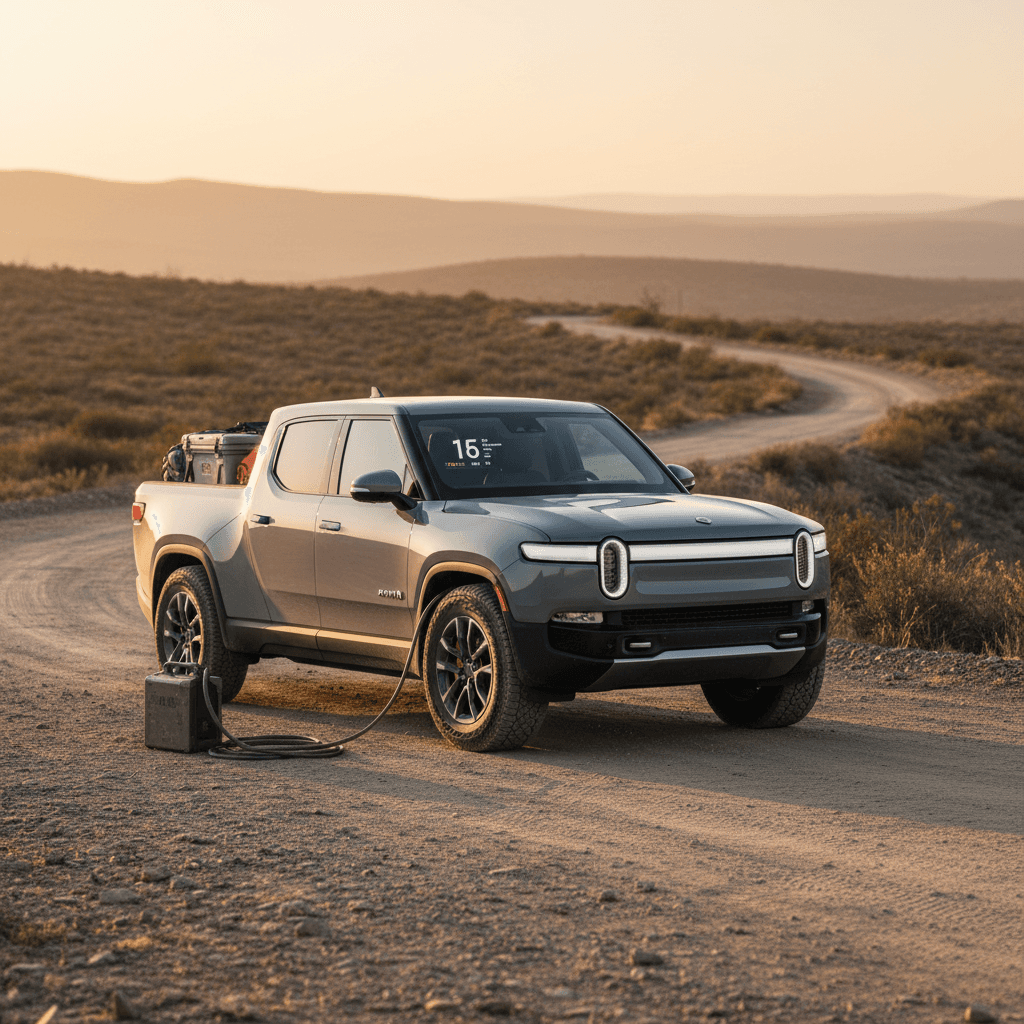
If you’re shopping for a 2024 Rivian R1T, the spec sheet looks incredible: up to 410 miles of EPA-estimated range with the Max pack on 21-inch wheels. But as with every EV, the real question is what a 2024 Rivian R1T range test looks like in the real world, on highways, in winter, and with a trailer hooked up. This guide pulls together lab ratings, early owner reports, and testing norms so you know what to expect and how to get the most from every kWh.
Before we dive into the numbers
Why 2024 Rivian R1T range tests matter
On paper, the 2024 R1T covers an enormous range of use cases: from a 270-mile work truck to a 400+ mile adventure rig. In practice, everything from wheel choice to winter temps can swing your usable range by 30–50%. If you’re planning road trips, towing, or considering a used R1T, relying on the EPA sticker alone is a good way to be disappointed.
Independent highway loops, owner logs, and controlled cold-weather runs all paint a more nuanced picture. The good news: when you set expectations correctly and understand how the truck responds to speed and temperature, the R1T is one of the most capable EV trucks on sale. The bad news: like every tall, heavy pickup, push it at 75+ mph in the cold and the battery will remind you who’s boss.
2024 Rivian R1T range at a glance
2024 Rivian R1T battery packs and EPA range
For 2024, Rivian expanded the R1T lineup with Standard and Standard+ packs alongside the familiar Large and Max options. All of the figures below assume the dual-motor drivetrain; quad-motor setups are generally a bit less efficient but still competitive.
2024 R1T dual‑motor EPA range by battery
Approximate EPA-estimated ranges for the 2024 Rivian R1T dual‑motor lineup. Exact figures vary slightly with wheels and options, but these are the headline numbers most buyers see.
| Battery pack | Approx. usable capacity* | EPA range (R1T) | Typical real‑world highway range at 70–75 mph | Notes |
|---|---|---|---|---|
| Standard | ~108 kWh | ≈270 miles | ~190–215 miles | Entry pack, only with dual motor; best for local use and light road trips. |
| Standard+ | ~120 kWh | ≈315 miles | ~225–250 miles | New for 2024; range target similar to many midsize EV SUVs. |
| Large | ~135 kWh | ≈352 miles | ~255–285 miles | Strong sweet spot for long-distance drivers; widely available in 2024 trucks. |
| Max | ~149–150 kWh | Up to 410 miles | ~295–330 miles | Longest-range R1T; shines on long highway legs or towing with margin. |
Use this table as a baseline. Real-world R1T range tests usually come in 10–20% below these numbers at highway speeds, and more in winter or while towing.
EPA range is not a promise
Real-world 2024 R1T range: what tests are showing
Most independent tests of large, upright EV trucks settle into a predictable pattern: roughly 10–20% below EPA at 70 mph in mild weather, and up to 30–40% below EPA in sustained freeway driving at higher speeds or in the cold. The 2024 R1T is no exception.
How real tests compare to the EPA sticker
Think in ranges, not a single magic number.
Mild-weather highway loop
In 60–75°F weather on relatively flat highway, R1T drivers typically see:
- Max pack: 295–330 miles at 70–75 mph
- Large pack: 255–285 miles
- Standard+: around 225–250 miles
Mixed city & suburban
Lower speeds and more regeneration help:
- City-heavy driving can come closer to EPA range claims.
- Short trips in extreme temps are still hard on efficiency.
Elevation, wind, and weather
Headwinds, sustained climbs, and wet or cold pavement can easily eat:
- 10–15% more range on a given trip
- Especially noticeable with roof racks or a loaded bed
Highway vs city: how speed changes your R1T range
Air resistance grows roughly with the square of speed, which is especially punishing for a boxy pickup on all‑terrain tires. For the 2024 R1T, that means the difference between 65 mph and 80 mph is often the difference between a relaxed day and white‑knuckling it to the next fast charger.
Speed impact on 2024 R1T range
1. 60–65 mph: efficiency sweet spot
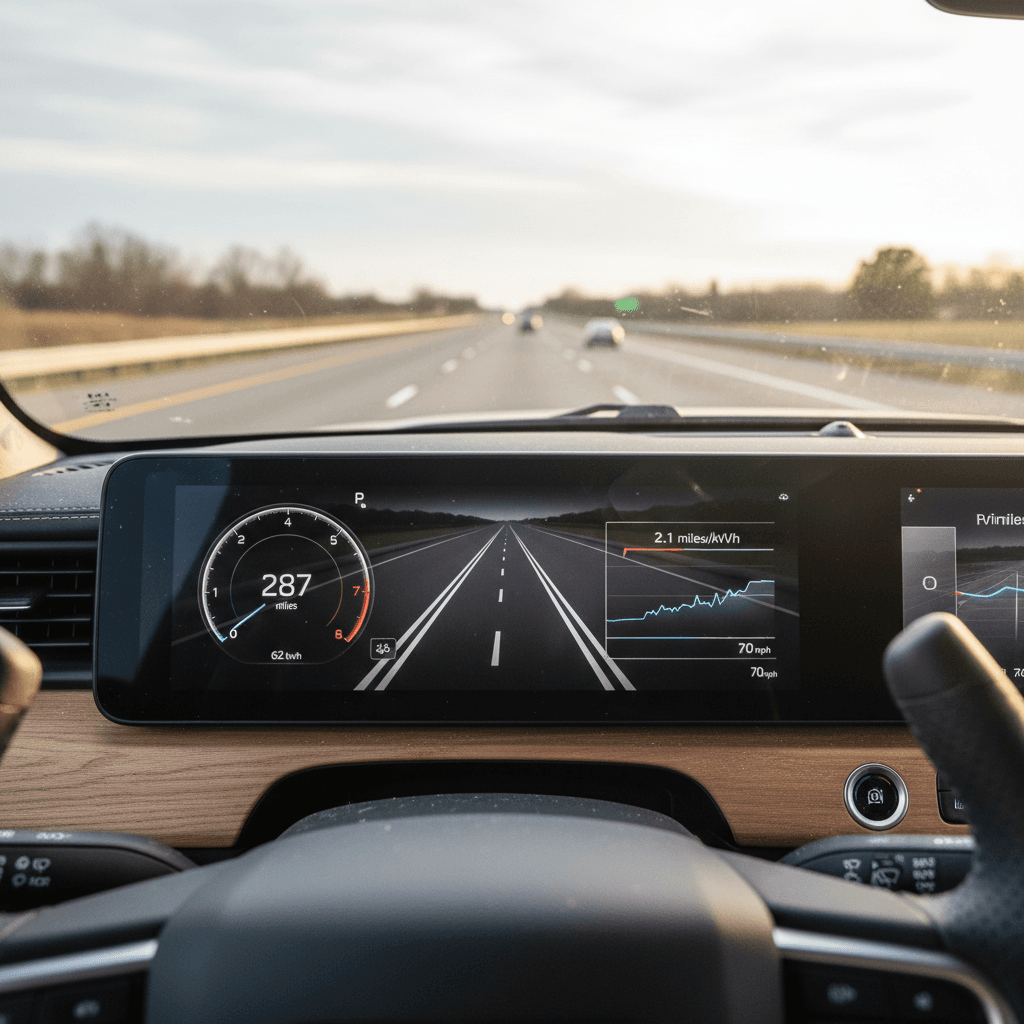
On relatively flat highways in mild weather, this is where you’ll see the closest match to EPA range. A dual‑motor R1T with the Large or Max pack can often run <strong>4–4.2 mi/kWh</strong> at these speeds on road‑biased tires.
2. 70–75 mph: realistic road-trip pace
At typical U.S. freeway speeds, expect <strong>10–20% less range</strong> than the EPA sticker. Many owners report around 3.1–3.5 mi/kWh in good conditions, putting a Max pack R1T in the high‑200s to low‑300s miles of usable range between 10–90% state of charge.
3. 80+ mph: ‘goodbye, EPA’ territory
Push past 80 mph and you’re trading a lot of range for not much time. Consumption can jump to the low‑2s mi/kWh, especially with big wheels or all‑terrain tires. That can pull even a Max pack truck below 250 miles of comfortable highway range.
4. Drafting and eco driving help more than you’d think
Even modest changes, such as setting cruise control at 70 mph instead of 77 mph, removing a roof box, and using <strong>Conserve</strong> or <strong>All‑Purpose</strong> instead of Sport, can buy you 30–50 extra miles on a charge.
Use your trip computer like a range lab
Cold-weather range testing: what happens below freezing
Battery chemistry, cabin heating, and short trips are the perfect storm for reduced range. Owners of 2024‑era R1Ts routinely report 30–50% less real‑world range in extended cold snaps, especially when the truck lives outside and can’t precondition the battery while plugged in.
What cold does to your R1T
- Thicker electrolyte in the pack reduces how efficiently energy moves in and out of the cells.
- Cabin heat and battery conditioning draw several kW, even when you’re not moving fast.
- Short hops are the worst case: you keep paying the warm‑up penalty without ever getting into a steady‑state groove.
Real owner experiences
- In teens and 20s °F, some R1T drivers see 1.3–1.7 mi/kWh in mixed, stop‑and‑go use, cutting practical range almost in half.
- On longer highway runs where the battery stays warm, the hit might be closer to 25–35% versus mild‑weather driving.
These numbers line up with what we’ve seen across other large EV trucks and SUVs.
Don’t plan winter trips off summer range
Towing and hauling: range test expectations
No EV truck cheats physics when it comes to towing. The R1T’s instant torque makes it a fantastic tow vehicle, but the combination of higher drag, extra weight, and frequent elevation changes can chop range dramatically. Think of towing range not as a single number, but as a band based on trailer size and speed.
How different tow setups impact 2024 R1T range
Assuming dual‑motor Large or Max pack, 65–70 mph, calm weather, and fairly flat highway.
Light, low trailer (≤3,000 lb)
- Small utility trailer, lightweight camper, or pair of dirt bikes
- Plan on ~50–60% of your solo highway range
- Max pack: 160–190 miles between 90–10% SOC
Mid-size camper or boat (3,000–6,000 lb)
- Most travel trailers people actually tow behind an R1T
- Expect ~35–50% of solo highway range
- Max pack: 130–165 miles between fast charges
Tall, blunt-front travel trailer
- Where the front wall is a brick at 70 mph
- Range can drop below 1.4–1.8 mi/kWh
- Max pack: think in 100–140-mile legs, especially in hills or wind
Build your tow plan around chargers, not the EPA label
Wheels, tires, and drive modes: quick impact checklist
One of the easiest ways to ruin an otherwise optimistic 2024 Rivian R1T range test is to forget how much wheels, tires, and suspension height matter. Rivian’s own EPA data makes this clear: swapping from 21‑inch road tires to 20‑inch all‑terrain rubber can knock dozens of miles off the rating before you even leave the driveway.
Biggest configuration factors in your R1T’s range
Wheel size & tire type
The 21‑inch wheel with the all‑season tire is your efficiency hero. Jumping to 22s or aggressive all‑terrains means more rolling resistance and aero drag. Realistically, you can lose <strong>20–45 miles of range</strong> versus the most efficient setup.
Ride height and suspension
Cranking the air suspension up for off‑road stance looks cool, but also exposes more of the underbody to airflow. For highway efficiency tests, use <strong>Low</strong> or <strong>Standard</strong> height and an on‑road mode like All‑Purpose or Conserve.
Drive mode selection
Sport mode keeps more power on tap and can also change damping and ride height. It’s great for fun; not for range. Use <strong>All‑Purpose</strong> for everyday driving and <strong>Conserve</strong> on long highway runs when traction allows.
Roof racks and accessories
Roof boxes, bike racks, light bars, and lifted ride heights all add drag. Combine them with higher speeds and cold weather and you can easily give up <strong>another 10–15%</strong> of your usable range.
How to run your own 2024 R1T range test
You don’t need a proving ground to understand your truck’s capabilities. A simple, methodical loop on a familiar route will tell you more than hours of forum browsing. Here’s a structured way to test your 2024 R1T without abusing the battery.
DIY range test procedure for your R1T
1. Pick a consistent route
Choose a highway loop or out‑and‑back that you can repeat, ideally 30–60 miles one way, with speed limits between 60 and 75 mph and minimal elevation change.
2. Start with a safe SOC window
Charge to around 90% and plan to stop testing at 10–15%. This avoids the extremes of the pack while still giving you a big enough sample of energy use to be meaningful.
3. Set tire pressures and mode
Inflate tires to manufacturer spec when cold. Use the same drive mode and ride height throughout the test. Conserve or All‑Purpose at <strong>Standard</strong> or <strong>Low</strong> height is ideal for a highway test.
4. Reset your Energy app
In the R1T’s Energy screen, reset trip history so the projected range is based solely on your test drive, not weeks of mixed driving. This makes the estimate far more honest.
5. Drive a steady speed
Use cruise control to hold a constant target speed, like 70 mph. Avoid drafting or sudden accelerations. The goal is repeatability, not beating the system.
6. Log the results
At the end of the run, record: average speed, outside temperature, average mi/kWh, SOC used, and estimated remaining range. After a few runs in different conditions, you’ll have your own personalized range map.
The most useful range test isn’t the one someone ran across the country with cameras rolling. It’s the one you can quietly repeat on the same road, with the same truck, season after season.
Buying a used Rivian R1T: what range and battery health to expect
Because the R1T launched in 2022, the used market is finally getting interesting, especially for 2023–2024 dual‑motor trucks with the Large pack. Range is central to what you’re paying for, but it’s easy to confuse EPA range, real‑world range, and battery health when you’re scanning listings.
What to look for in a used R1T’s range
- Compare the truck’s indicated 100% range to the original EPA rating for its pack, wheels, and drive unit.
- Look for evidence of consistent road use, not just lots of short urban trips. Those short, cold hops are harder on perceived range.
- Ask for recent screenshots from the Energy app or trip history from a longer drive.
How Recharged helps you de‑risk range
Every used EV on Recharged comes with a Recharged Score Report that includes verified battery health diagnostics and a transparent look at how the pack is performing relative to its original spec.
For a used R1T, that means you’re not guessing what “about 300 miles of range” actually means, you see quantified battery health, fair market pricing, and can talk through real‑world expectations with an EV specialist before you commit.
Considering a used R1T?
Ready to find your next EV?
Browse Vehicles2024 Rivian R1T range test FAQ
Frequently asked questions about 2024 R1T range tests
Key takeaways for 2024 R1T range
- EPA numbers for the 2024 Rivian R1T, 270 to about 410 miles depending on pack, are useful baselines, not guarantees.
- A realistic real‑world 2024 R1T range test at 70–75 mph usually lands 10–20% below EPA in mild weather.
- Cold temps, big wheels, all‑terrain tires, and roof accessories can stack penalties and cut range by a third or more.
- Towing with the R1T is entirely viable if you plan around chargers and assume roughly half your solo range with many trailers.
- The R1T’s Energy app, trip computer, and your own repeatable test loops are more honest than any single viral range test.
- If you’re shopping used, a structured battery health report (like the Recharged Score) is the best way to know whether the truck you’re eyeing can still deliver the kind of range you’re paying for.
Range is where expectations, physics, and marketing all collide, and the 2024 Rivian R1T sits right at that intersection. It’s a genuinely long‑legged electric truck, but its real strengths show when you stop fixating on the single, biggest number on the spec sheet and start thinking in honest ranges for your routes, weather, and loads. Whether you’re configuring a new R1T or comparing used trucks on Recharged, treat EPA ratings as the starting point, your own testing as the truth, and a verified battery health report as the bridge between the two.