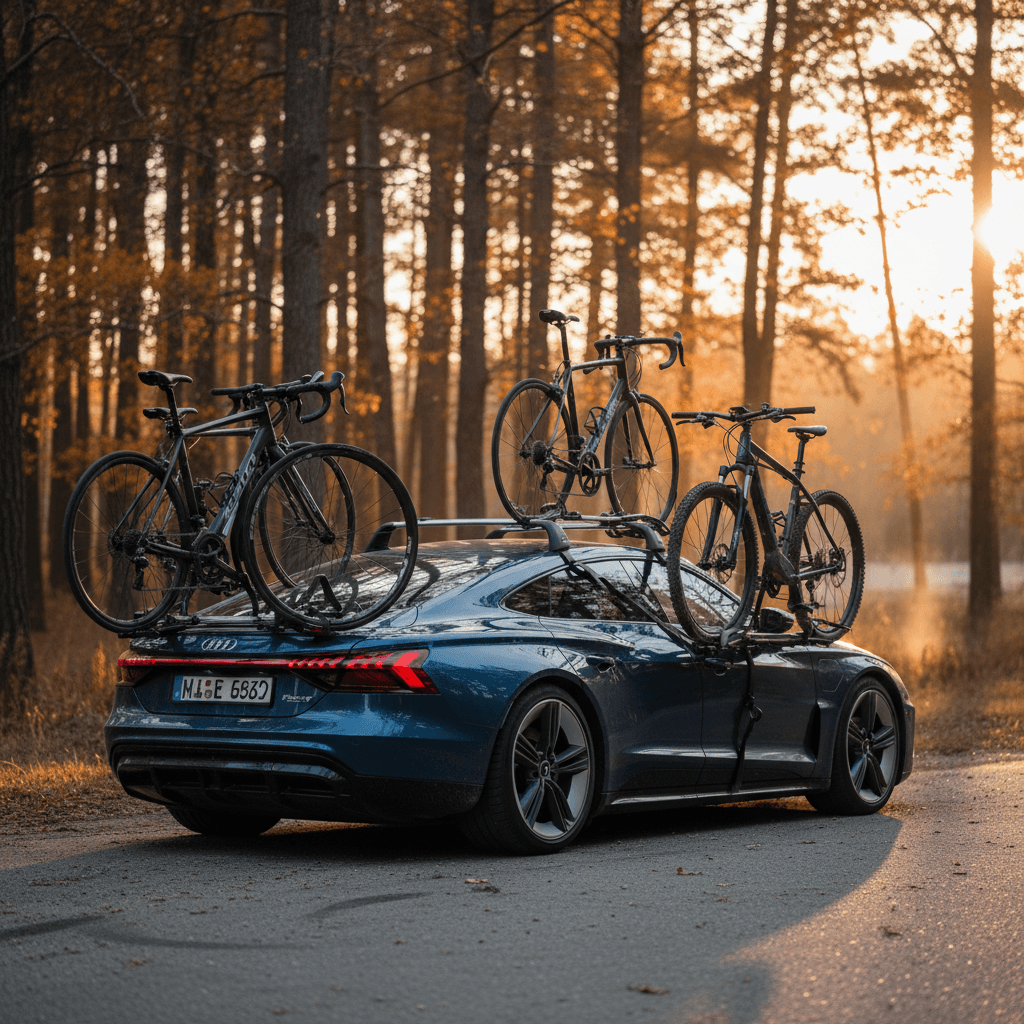
If you own an Audi e-tron GT, you probably didn’t buy it to live a quiet life. It’s a low, wide, electric grand tourer that happens to be surprisingly practical, until you try to carry bikes. This guide walks through the best Audi e-tron GT bike rack options, including OEM roof systems, third‑party hitch setups, trunk‑mount and suction‑cup racks, plus how they affect range, noise and day‑to‑day usability.
The short version
Why bike racks on an Audi e-tron GT are tricky
The e-tron GT is a sleek, low sedan built on the same J1 platform as the Porsche Taycan. It’s engineered for aero efficiency, with a long wheelbase, fastback roofline and a largely closed rear structure. That has two consequences for bikes: first, Audi has focused its official accessories on the roof, not the rear. Second, in most regions the e-tron GT has no factory tow rating and no OEM hitch option, so you can’t just bolt on the usual 2‑inch receiver like an SUV and forget about it.
Roof transport: Audi’s intended solution
Audi sells model‑specific roof carrier bars for the e-tron GT that clamp into fixed points in the roof. From there you can add Audi‑branded (often Thule‑made) bike carriers or third‑party hardware that respects the roof load limit.
Upside: fully supported, clean look, no contact with paint. Downside: lifting heavy bikes overhead onto a low but still wide car.
Rear transport: possible, but unofficial
There’s no official Audi hitch for the e-tron GT and no rear tow rating published in most spec sheets. Aftermarket suppliers offer hidden receivers and euro‑style towbars, and they’re often marketed for bike racks and light cargo instead of trailers.
Upside: easier loading and smaller aero penalty. Downside: more complexity, and you’re now in the gray zone of warranty and legalities.
Always check your owner’s manual
Key weight and load limits for the e-tron GT
Useful capacity numbers for bike transport
The important number for bike racks is the roof load limit. For current e-tron GT and RS e-tron GT models, Audi quotes roughly 75 kg (165 lb) of allowable load on the roof, including crossbars, racks and bikes. That is plenty for two modern mountain bikes or three lighter road bikes on alloy bars, assuming you don’t go wild with heavy steel accessories.
How to do the math
Roof rack bike carriers for the Audi e-tron GT
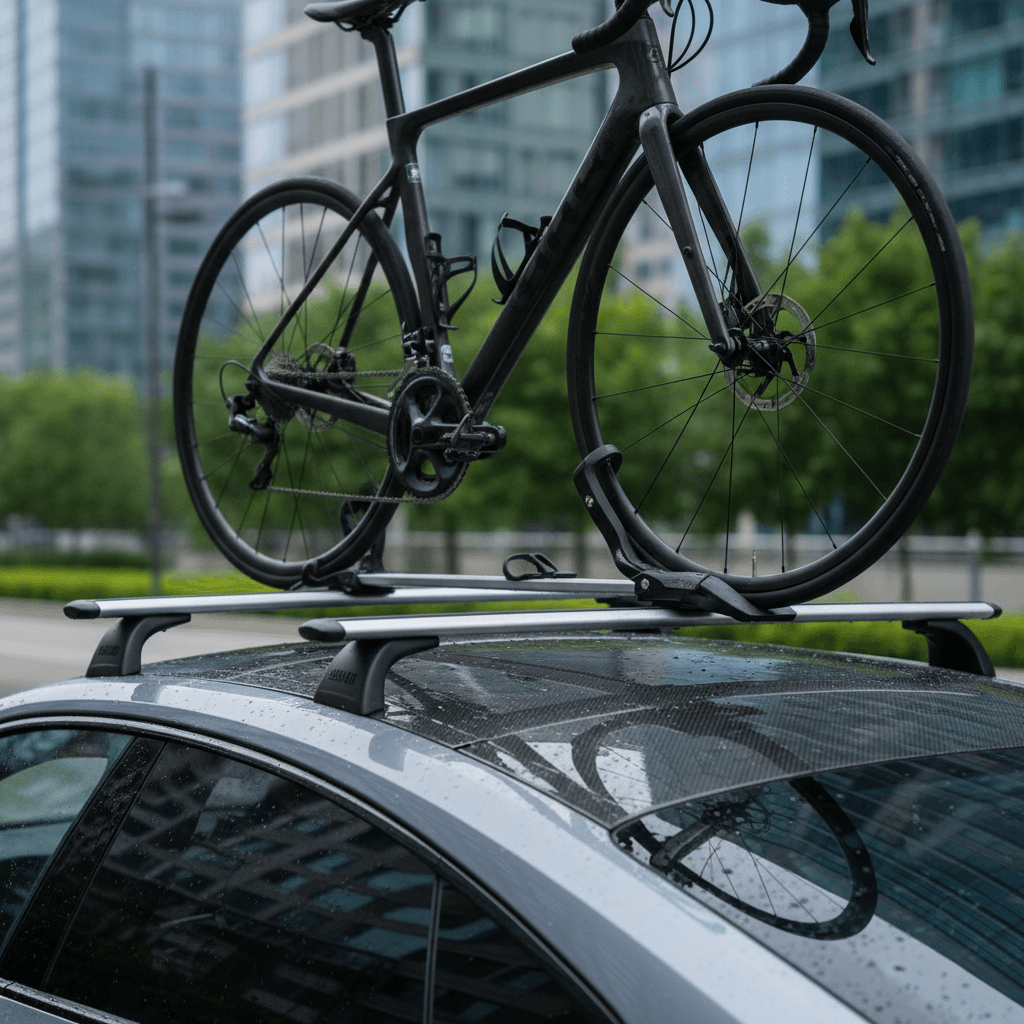
Roof mounting is the cleanest, most factory‑approved way to carry bikes on an Audi e-tron GT. The car has hidden fixed points in the roof for Audi carrier bars, and once those are in place you can run Audi‑branded or third‑party bike trays just like any other premium sedan.
Popular e-tron GT roof rack bike setups
From fully OEM to enthusiast‑grade Thule systems
Audi OEM carrier bars + Audi/Thule trays
Best for: Owners who want plug‑and‑play fit and an Audi part number.
- Model‑specific carrier bars that clamp into roof fixed points.
- Compatible with Audi‑branded Thule® Sidearm and similar upright carriers.
- Perfect paint match and low wind noise by design.
Thule/Yakima crossbars + fork‑ or wheel‑mount
Best for: Riders who already own quality bike trays.
- Use fit kits designed for e-tron GT’s fixed points.
- Wide range of fork‑mount or front‑wheel‑on carriers.
- Great if you swap racks between multiple cars.
Minimalist single‑bike roof setup
Best for: Solo riders who care about noise and efficiency.
- One narrow aero crossbar pair + one lightweight tray.
- Less drag, less wind noise than a full multi‑bike system.
- Good compromise if you only occasionally carry a bike.
Watch that roof height in garages
Upright vs fork‑mount on an e-tron GT
On a tall SUV, upright carriers are an ergonomic nightmare; on the e-tron GT they’re tolerable, but still a stretch. Fork‑mount trays sit the bike slightly lower and reduce side‑wind area, at the cost of removing and storing a front wheel. Upright clamps save time but can be fussier with modern carbon frames. If you regularly carry heavy e‑MTBs, a sturdy upright tray with a wheel‑clamp design (no frame contact) is usually the kinder choice.
Hitch-mounted bike racks on an e-tron GT
This is where things get more nuanced. Officially, most e-tron GT spec sheets list no tow rating, and Audi does not sell a factory receiver hitch in North America. Yet if you browse European accessory sites and independent installers, you’ll see discreet fixed or detachable towbars advertised specifically for the e-tron GT, often pitched for bikes and light trailers rather than serious towing.
Common hitch approaches for the e-tron GT
What owners actually do when they want a hitch-style bike rack.
| Approach | What it is | Pros | Cons |
|---|---|---|---|
| No hitch – roof only | Use roof bars and skip a hitch entirely. | Factory‑correct, no warranty gray area, simple. | Lifting bikes overhead, higher drag and noise. |
| Hidden receiver (Stealth‑style) | Aftermarket 1.25" or 2" receiver tucked behind the bumper, often removable. | Clean look, ideal for a two‑bike platform rack, minimal aero penalty. | Not Audi‑approved; installation quality is critical. |
| Euro fixed towbar | Flange‑ball or swan‑neck towbar engineered for light towing and bike racks. | Often well‑engineered with vehicle‑specific mounting points. | Usually sold outside the U.S.; can require bumper trimming and coding. |
None of these override Audi’s official guidance; you assume the risk when adding a hitch to a car without an OEM tow rating.
Important disclaimer on hitches
Choosing a hitch bike rack if you go that route
If you decide a receiver is worth the trade‑offs, aim small and conservative. A two‑bike platform rack with a moderate weight rating is a smart match for the e-tron GT. Avoid four‑bike hanging racks, they exaggerate leverage on the hitch and can drag on steep driveways thanks to the car’s long rear overhang. Look for racks with tool‑free tilt so you can still access the trunk, and use a hitch‑tightening system to cut down on wobble.
Trunk, suction-cup and strap racks: pros and cons
The third path is to avoid both roof bars and a hitch and go with a trunk‑mount or suction‑cup rack. You’ll see brands pitching vacuum‑cup systems that sit on the glass roof and trunk, plus traditional strap‑on carriers that hook over the decklid. On a coupe‑ish EV with expensive paint and lots of glass, these are very much a compromise.
Non-permanent bike rack styles for the e-tron GT
When you absolutely, positively don’t want bars or a hitch
Suction‑cup racks
High‑quality vacuum cups can hold serious loads when used correctly.
- Fast to install and remove.
- No permanent hardware on the car.
- Demand meticulous cleaning of paint and glass.
Trunk strap racks
Old‑school, webbing‑strap carriers that hook under the trunk edges.
- Cheap, widely available.
- Lots of contact points with paint and trim.
- Can interfere with rear camera and lights.
Interior transport
For short trips, you can remove wheels and carry bikes inside.
- Zero aero penalty, zero exterior hardware.
- Protect the interior with blankets and straps.
- Best for smaller road bikes, not long‑travel MTBs.
Mind the glass roof
Range impact: how bike racks affect your EV efficiency
Audi spent big money teaching the e-tron GT to slip through the air; your bikes did not attend that class. Any external rack will cost you range, but the shape and position matter just as much as the weight.
Roof racks: the aero penalty
A bare set of aero bars might cost you a few percent of range. Add two square‑shouldered trail bikes aboard and you can see 10–20% higher consumption at highway speeds, especially with headwinds.
The effect is most noticeable above 60 mph; around town the difference is smaller but still there.
Rear racks: better, not magic
A compact two‑bike platform rack tucked in the e-tron GT’s wake generally has a milder aero hit than roof bikes. You’ll still use more energy, but think single‑digit percentages instead of double, assuming you’re not carrying a full downhill fleet.
Either way, expect to charge a bit more often on road trips and plan stops accordingly.
Three easy ways to claw back range
How to choose the right bike rack for your e-tron GT
Questions to answer before you buy
1. How many bikes, and what kind?
Two road bikes are a very different proposition from two 55 lb e‑MTBs. Add up actual bike weights and consider future upgrades; build in headroom rather than buying right at the limit.
2. How often will you carry them?
If bikes are a once‑a‑month thing, an OEM roof system that lives in the garage may be ideal. If you ride every weekend, a hitch platform, if you’re comfortable with aftermarket, can make life much easier.
3. Who has to lift the bikes?
If your riding partner isn’t keen on shoulder‑pressing a 40 lb trail bike over a wide roof, don’t force the issue. A low, tilt‑down rear platform rack will get far more use, even if it’s more complex to install initially.
4. Where do you park and charge?
Tight urban parking and low garages favor hitch or interior transport. If you mostly charge at home in a driveway, a roof system is less of a headache.
5. How much risk are you willing to own?
Roof bars and OEM‑approved carriers sit squarely inside Audi’s comfort zone. Aftermarket hitches and suction‑cup solutions can be excellent but shift responsibility onto you if anything goes wrong.
Installation, safety and daily-use tips
- Have the first install done by a specialist if you’re new to racks, especially with glass roofs.
- Torque roof‑bar feet to the manufacturer’s spec and re‑check after the first few drives.
- Load heavier bikes closer to the middle of the car (center of the roof or closest to the bumper on a hitch rack).
- Secure all loose items, pumps, bags, lights, so they don’t become projectiles or noise machines.
- Do a short, low‑speed shakedown run after any change, then stop and retighten straps and clamps.
- Clean the contact areas on paint and glass religiously if you use suction‑cup or strap racks. Dirt is what causes damage, not the hardware itself.
- Take the racks off in winter road‑salt states if you’re not using them; it’s kinder to your hardware and the car.
Good news for used e-tron GT shoppers
Ready to find your next EV?
Browse VehiclesFAQ: Audi e-tron GT bike rack options
Frequently asked questions
Where a used e-tron GT fits into your bike life
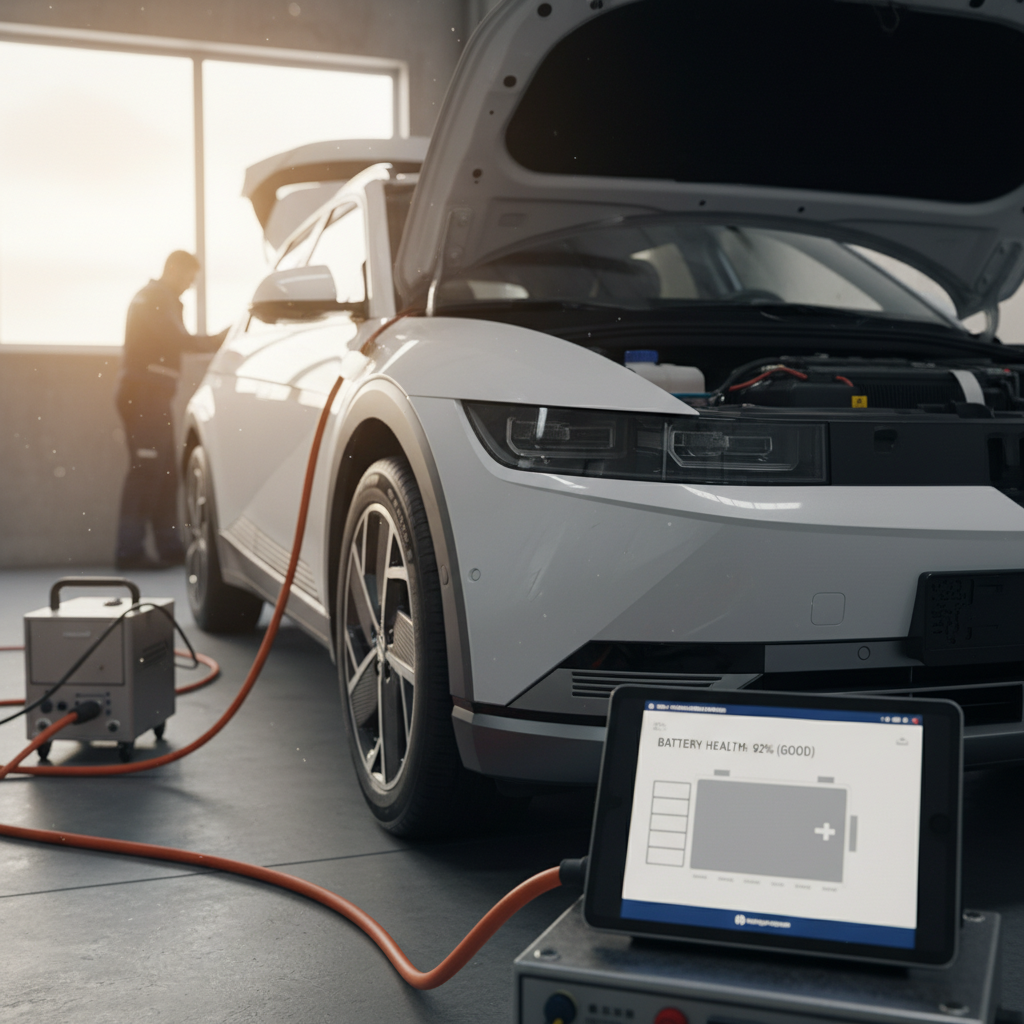
The Audi e-tron GT is a rare thing: an EV that looks like science fiction but behaves like a grown‑up GT car. With the right rack setup, it can also be your shuttle to the trailhead or the start of the Sunday group ride. Roof bars and quality trays are the most straightforward path; discreet hitches and suction‑cup racks live in a more adventurous, owner‑beware neighborhood. If you’re eyeing a used e-tron GT for bike duty, a battery‑health‑verified car from Recharged, paired with a thoughtfully chosen rack system, gives you the best of both worlds: big‑mile electric performance and room for the toys that make the miles worthwhile.
When you’re ready to shop, Recharged can help you compare used e-tron GTs, understand real‑world battery health through the Recharged Score, arrange financing and delivery, and even help you sanity‑check how a particular rack setup fits into your daily charging routine. The car is the canvas; your bikes are the art, just make sure the mounting hardware is worthy of both.