If you’ve heard arguments on both sides, it’s fair to wonder: are electric cars really better for the environment, or are we just swapping tailpipes for hidden pollution in power plants and mines? The honest answer is reassuring, but it’s not as simple as a slogan on a bumper sticker.
The big picture in one sentence
Short answer: yes, but the details matter
EVs vs gas: what the numbers look like
- How the car and its battery are manufactured
- How clean your local electricity mix is
- How far you drive over the vehicle’s life
- How large and efficient the vehicle is (EVs and gas cars alike)
- What happens to the battery at end of life (reuse, recycling, or waste)
How scientists actually measure whether EVs are better
When experts ask whether electric cars are better for the environment, they don’t just compare tailpipes. They look at “lifecycle emissions”, sometimes called cradle‑to‑grave analysis.
- Raw materials: mining and processing lithium, nickel, cobalt, steel, aluminum, plastics, etc.
- Manufacturing: assembling the vehicle and especially the battery pack.
- Use phase: gasoline or diesel burned in an engine vs. electricity consumed by an EV over its driven miles.
- Maintenance: oil changes, filters, brake wear, and tires.
- End of life: scrapping, reuse, and recycling of metals and battery materials.
Why this matters to you
Manufacturing & batteries: EVs start with a bigger footprint
Here’s where many EV critics start: it takes more energy and more raw materials to build an electric car, especially its battery, than a comparable gasoline vehicle. That’s true, and it shows up clearly in the data.
How manufacturing compares: EV vs gas
The exact numbers vary by study, but the pattern is consistent.
Gasoline car manufacturing
- Lower production emissions up front, largely from steel, aluminum, and plastics.
- Typical compact or midsize car manufacturing might emit several tons of CO₂ before it ever leaves the factory.
- Engine and exhaust system add complexity but not nearly the footprint of a large battery pack.
Electric car manufacturing
- Battery production is energy‑intensive; many analyses estimate roughly 50–100 kg of CO₂ per kWh of battery capacity, depending on where and how it’s made.
- A 70–80 kWh pack can add several extra tons of CO₂ versus a gas car at the factory gate.
- As battery plants switch to renewables and scale up, those manufacturing emissions are trending down year by year.
The “battery penalty” is real, but temporary
Driving emissions: where electric cars pull ahead
Once you hit the road, the story flips. A gasoline engine wastes most of its energy as heat. An electric motor is extremely efficient and can also recapture energy through regenerative braking. That’s why, even when you account for power‑plant emissions, each mile in an EV usually emits far less CO₂ than a mile in a gas car.
Illustrative per‑mile emissions: EV vs typical gas car
These are ballpark figures to show directionally what many studies find under current U.S. conditions, not exact numbers for every model.
| Metric | Typical gas car | Typical EV (US grid avg) |
|---|---|---|
| Energy per mile | ~0.11 gal gasoline | ~0.30 kWh electricity |
| CO₂ per mile (tailpipe or grid) | ~0.9 lb (about 400 g) | ~0.25–0.35 lb (about 110–160 g) |
| Local air pollution | High (NOx, particulates) | Near‑zero at point of use |
Assumes a mid‑size gasoline car at ~30 mpg and a reasonably efficient EV at ~0.30 kWh/mile on the average U.S. grid.
Lifecycle studies that combine manufacturing and use typically find that an EV’s extra factory emissions are offset within the first 15,000–25,000 miles of driving under current U.S. conditions. After that, the EV keeps widening its lead for as long as it stays on the road.
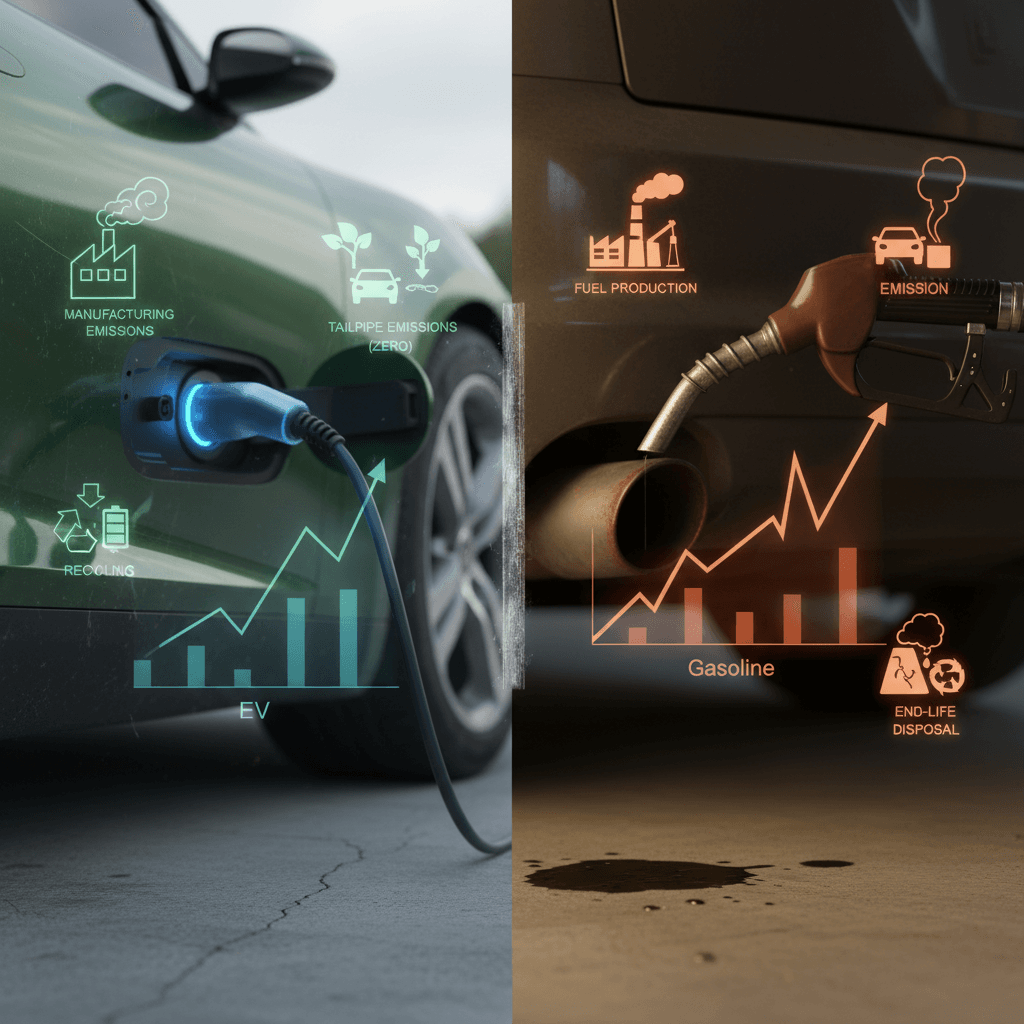
Across thousands of comparative cases and future energy scenarios, battery electric vehicles consistently have the lowest carbon footprints among passenger cars.
What if your electricity comes from coal or gas?
Another common objection is, “Sure, EVs are clean in California. But what if my power comes from coal?” It’s a fair question, because EVs move emissions from the tailpipe to the smokestack. Whether that’s an improvement depends on how carbon‑intensive your grid is.
Today’s U.S. average grid
- The U.S. electricity mix is steadily cleaning up as coal is replaced by natural gas, wind, solar, and nuclear.
- By 2022–2023, the U.S. power sector averaged roughly 360–380 g CO₂ per kWh of electricity.
- At that intensity, a typical EV driven on the U.S. grid still emits substantially less CO₂ per mile than a typical gasoline car.
Coal‑heavy vs renewable‑heavy regions
- In coal‑reliant regions, the advantage shrinks but usually doesn’t disappear, especially over high mileages.
- In cleaner‑grid regions (with lots of hydro, nuclear, wind, or solar), an EV can cut per‑mile emissions by two‑thirds or more versus a gas car.
- As more renewables are added, an EV you buy today will usually get cleaner over its lifetime without you doing anything.
Your personal grid mix matters
Beyond CO₂: other environmental pros and cons
Climate impact is central, but it’s not the only environmental dimension that matters. Electric cars change where and how pollution shows up.
Environmental tradeoffs: where EVs win and where they raise concerns
A balanced view across different impact categories.
Local air quality and health
- EVs have no tailpipe, no exhaust, no NOx, and virtually zero local particulate emissions from combustion.
- This is a major health benefit in cities, school zones, and neighborhoods near busy roads.
- Some particulates from tires and road dust remain for all vehicles, but EVs help eliminate the dirtiest exhaust pollutants.
Mining and land impacts
- Battery materials like lithium, nickel, and cobalt require intensive mining that can affect land, water, and communities if not managed responsibly.
- Many automakers are moving toward chemistries that use less cobalt or shift to iron‑based batteries for some models.
- Better regulation, certification programs, and battery recycling are critical to keeping these impacts in check.
Recycling and circularity
- EV batteries are recyclable, and a fast‑growing industry is recovering valuable materials like lithium, nickel, and cobalt.
- As recycling scales, it can significantly cut the need for new mining and lower manufacturing emissions.
- Gasoline, by contrast, is burned once and gone forever.
Water and ecosystem effects
- Both oil production and battery‑metal mining can stress freshwater resources and ecosystems.
- Many newer battery plants are sited closer to renewable energy and designed with stringent water‑management standards.
- From a systems view, shifting away from oil extraction and combustion reduces a host of chronic pollution risks.
Important nuance
When an electric car is not automatically “better”
There are real‑world situations where an EV isn’t automatically a clear environmental upgrade, at least in the short term. Understanding these edge cases can keep you from over‑ or under‑estimating the benefits.
- Very low annual mileage: If you only drive a couple of thousand miles a year, it takes longer to “repay” the extra manufacturing emissions of a brand‑new EV. In that scenario, keeping an efficient existing car and driving less can sometimes be greener than buying anything new.
- Oversized, overpowered EVs: The bigger and heavier the battery, the more energy it takes to build and move it. A huge, 9,000‑lb electric truck driven mostly solo in the city may not deliver the same percentage savings as a modest electric hatchback or crossover.
- Extremely dirty electricity: In places where most power still comes from old, inefficient coal plants and is likely to stay that way for years, the climate advantage of an EV shrinks. (That said, many of the health benefits from cutting tailpipe emissions still apply.)
- Short hold periods: If a brand‑new EV is built, driven only lightly, then scrapped early instead of staying in the fleet for a decade or more, it doesn’t fully realize its potential environmental advantage. Fortunately, EVs are proving durable, and strong used‑EV markets help keep them on the road.
Don’t ignore “the car you already own”
How buying a used EV changes the environmental equation
Here’s where things get especially interesting for shoppers: when you choose a used EV, you’re not “ordering” a new battery to be mined and manufactured just for you. Most of that manufacturing footprint was booked years ago when the car first left the factory.
Buying a new EV
- You trigger new manufacturing: more battery cells, more materials, more factory energy use.
- The upside is you get the latest tech, range, and efficiency, and your EV will likely stay on the road a long time.
- From a climate perspective, you want to put plenty of miles on it over its life to harvest the maximum emissions savings.
Buying a used EV
- You’re extending the life of an existing vehicle rather than creating demand for a brand‑new one.
- Most of the environmental “cost” of manufacturing is in the past, but you still get the benefit of lower‑emissions driving going forward.
- That makes used EVs one of the most compelling options if your goal is to reduce your footprint without over‑consuming new resources.
Where Recharged fits in
Ready to find your next EV?
Browse VehiclesIf you’re focused on environmental impact and value, a well‑vetted used EV can hit a sweet spot: you avoid the upfront emissions of building a brand‑new vehicle while still cutting your driving emissions dramatically compared with a gasoline car.
How to make your EV as clean as possible
8 practical ways to shrink your EV’s footprint
1. Right‑size your vehicle
Choose the smallest, most efficient EV that still meets your needs. A compact crossover or hatchback with a moderate battery generally has much lower manufacturing and use‑phase emissions than a huge, heavy truck.
2. Drive it for the long haul
The environmental payoff grows the longer the car stays in service. Plan to keep your EV for many years, or buy used and keep it in good shape so the next owner can drive it confidently.
3. Charge smart at home
If your utility offers a renewable or “green power” plan, enroll and charge overnight when demand is lower. Even without a special plan, setting your EV to charge during off‑peak hours often aligns with cleaner generation.
4. Use public fast charging strategically
DC fast charging has a larger grid impact and can be less efficient than slower Level 2 charging. Use it for road trips and occasional needs, but do most of your charging at home or work when possible.
5. Keep your tires properly inflated
Tire pressure has a surprisingly big effect on efficiency. Proper inflation reduces rolling resistance, extends tire life, and cuts energy use, good for your wallet and the planet.
6. Protect battery health
Extreme heat, repeated 0–100% charging, and constant fast charging can all stress a battery. Using moderate charge levels (for example, 20–80% for daily use) and avoiding frequent deep discharges can help your pack last longer.
7. Combine trips and drive smoothly
Eco‑driving techniques, gentle acceleration, anticipating stops, using regenerative braking, can boost efficiency substantially. Fewer, smoother trips reduce both energy use and wear‑and‑tear.
8. Plan for end‑of‑life responsibly
When your EV eventually reaches the end of its automotive life, look for trade‑in and recycling programs that ensure the battery is either reused in stationary storage or properly recycled for materials recovery.
FAQ: Are electric cars really better for the environment?
Frequently asked questions about EVs and the environment
The bottom line for shoppers today
When you look at the full lifecycle, not just the tailpipe, electric cars are really better for the environment in most real‑world situations today, and their advantage grows as power grids add more clean energy and as battery manufacturing and recycling improve. They’re not a silver bullet, and they don’t erase the environmental costs of building and owning a personal vehicle, but they are a major step forward compared with burning gasoline for another decade or two.
If you’re weighing a switch, consider not just whether to go electric, but how to do it: the right‑sized vehicle, a plan to keep it in service for many years, and, if you’re environmentally and budget‑conscious, perhaps a used EV with verified battery health. That’s where companies like Recharged aim to make the decision easier, with transparent battery diagnostics, fair pricing, financing options, trade‑ins, and even an Experience Center in Richmond, VA if you prefer to see and drive the car before it comes to your driveway. However you choose to get there, the evidence is clear: for most drivers, your next car being electric is a move in the right direction, for your wallet over time, and for the climate.