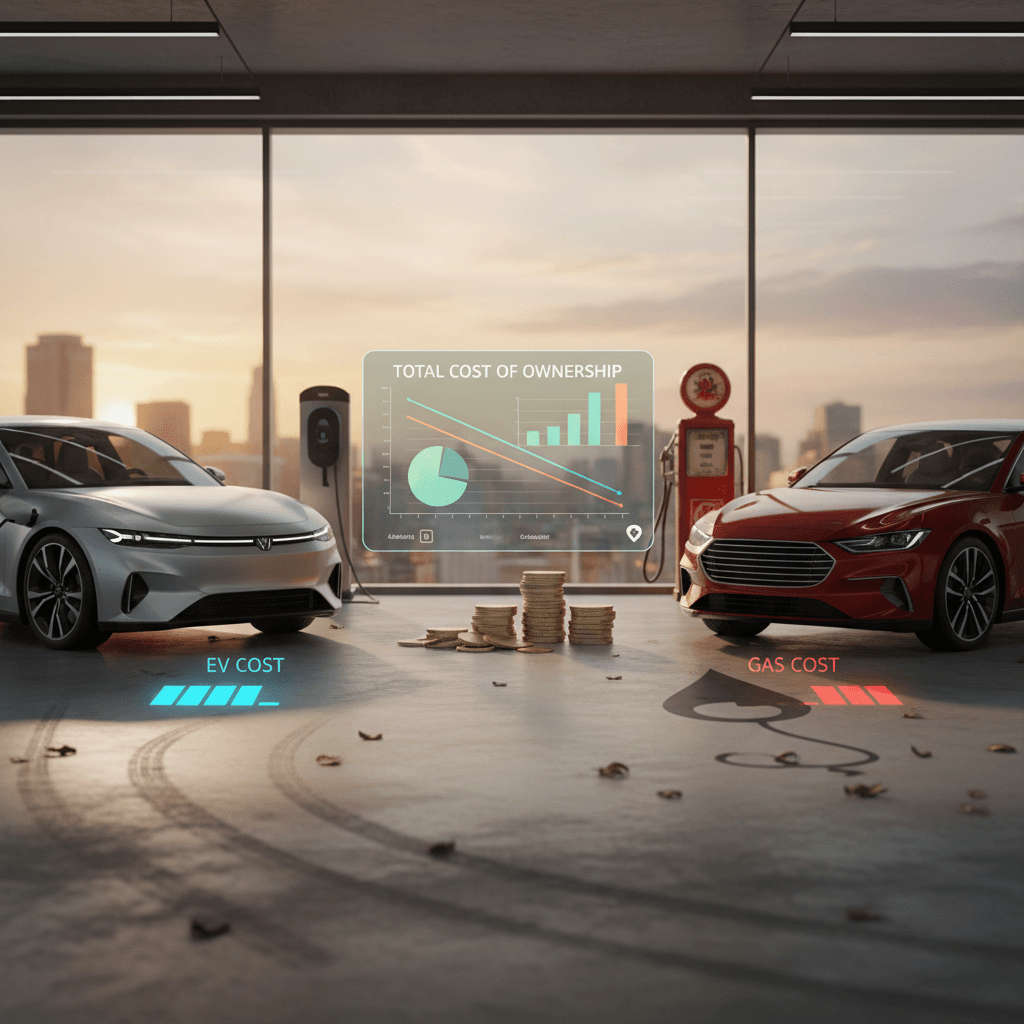
Are electric cars cheaper than gas cars? In 2025, the honest answer is: it depends what you count and how long you keep the car. New EVs still tend to cost more up front than comparable gas models, but they’re usually cheaper to fuel and maintain. Over 5–10 years, the right electric car can save you thousands, especially if you buy used and have easy home charging.
Short Answer
Do EVs Actually Save Money vs Gas Cars?
2025 Snapshot: EV vs Gas Costs in the U.S.
The key concept here is total cost of ownership (TCO). Instead of just asking what the monthly payment is, you want to look at: - Purchase price (minus tax credits and incentives) - Fuel or electricity - Maintenance and repairs - Insurance, taxes, and fees - Depreciation (what the car will be worth later) When you roll these together, many EVs, especially used EVs bought at today’s lower prices, come out cheaper than gas cars over a 5–10‑year span. New EVs are more of a mixed bag: they win strongly on operating costs but can lose ground on purchase price and depreciation.
Don’t Just Compare Sticker Prices
Sticker Price: Why EVs Often Cost More Up Front
Most shoppers feel the cost pinch the moment they step onto a lot or open a configurator. In 2025, the average new EV transaction price is still higher than the average new gas car, largely because of battery costs and tech-heavy trims. Think of it this way: - A mainstream gas compact or small SUV may land around $27,000–$32,000 new. - A comparable electric model is often $4,000–$8,000 more before incentives. On the flip side, price gaps have narrowed versus a few years ago, and aggressive discounts plus tax credits can erase a big chunk of that difference for qualifying models.
- Many new EVs still qualify for up to a $7,500 federal tax credit when income and vehicle rules are met.
- Some states and utilities offer $500–$5,000 in additional rebates, or help pay for home chargers.
- Automakers frequently run 0% or low‑rate financing on EVs to move inventory.
Look Beyond New: Consider Lightly Used EVs
Fuel vs Electricity: What You’ll Spend Per Year
Fuel is where electric cars quietly win day after day. While gas prices bounce around with global events, electricity rates move more slowly and are often lower on off‑peak overnight plans. Let’s look at an illustrative example for a typical U.S. driver putting 12,000 miles per year on the odometer.
Annual Fuel vs Electricity Cost (Typical U.S. Driver, 2025)
Illustrative comparison using national‑average prices and typical efficiency for each type of vehicle.
| Category | Gas Car (30 MPG) | Electric Car (~3 mi/kWh) |
|---|---|---|
| Annual miles driven | 12,000 | 12,000 |
| Energy price (national avg.) | ~$3.20 per gallon | ~$0.17 per kWh |
| Units used per year | 400 gallons | 4,000 kWh |
| Estimated annual cost | ≈$1,300 | ≈$700–$800 |
Your exact numbers will vary by location, utility plan, and driving style, but the gap in annual fuel cost is hard to miss.
That’s roughly $500–$800 per year in fuel savings for the EV in a fairly typical scenario. Drive more than 12,000 miles, or pay higher‑than‑average gas prices, and the savings scale up. Charge mostly at expensive DC fast chargers, and the gap shrinks.
Maximize Your Electricity Savings
Maintenance and Repairs: Where EVs Really Shine
Maintenance is the quietly powerful part of the EV story. A modern gas car has hundreds of moving parts in the engine and transmission. An EV’s powertrain has a fraction of that complexity, no oil changes, no spark plugs, no exhaust system, and far fewer fluids to service. That simplicity shows up in the annual budget.
Typical Annual Maintenance Costs: EV vs Gas Car
Representative 2025 estimates for an average mid‑size vehicle, assuming routine service only.
| Item | Gas Car (Per Year) | Electric Car (Per Year) |
|---|---|---|
| Oil changes, filters | $150–$250 | $0 |
| Engine & exhaust work (average) | $300–$500 | $0 |
| Brake service | $150–$250 | $50–$100 (thanks to regenerative braking) |
| Other fluids & misc. | $300–$500 | $75–$150 |
| Estimated annual total | ≈$900–$1,500 | ≈$250–$400 |
Individual experiences vary, but most major studies show <strong>35–50% lower maintenance spending</strong> for EVs over the first years of ownership.
Over a 5‑year period, that difference is hard to ignore. A typical gas car might easily rack up $4,500–$7,500 in maintenance and light repairs, while many EV owners report just $1,000–$2,000 over the same period. For high‑mileage drivers, that gap can be wider.
What About Battery Replacement?
Insurance, Taxes, and Fees: The Hidden Line Items
This is where electric cars can give back some of the savings they earned on fuel and maintenance. On average in 2025, many EVs cost 10–25% more to insure than a comparable gas car. Reasons include higher MSRP, expensive sensors in bumpers and fenders, and a still‑maturing repair ecosystem.
- Expect $200–$500 more per year in insurance for many popular EVs vs similar gas models.
- Some states charge extra registration fees for EVs to replace lost gas tax revenue.
- On the plus side, some metro areas still offer reduced tolls, HOV access, or free parking for EV drivers, which can offset costs for commuters.
How to Keep Insurance Costs in Check
Depreciation and Resale Value: New vs Used EVs
Depreciation, the rate at which your car loses value, is the single biggest cost of ownership for most vehicles. Historically, new EVs have depreciated faster than gas cars, largely because technology improves quickly and buyers worry about battery life. That created some painful resale values for early adopters, but it’s also why used EVs look so attractive right now.
New EVs
- Often lose value faster in the first 3–4 years than comparable gas models.
- Rapid tech advances (range, charging speed) can make older models seem dated more quickly.
- Higher purchase price means more dollars at stake when values drop.
Used EVs
- Have already taken the steepest depreciation hit for you.
- Often priced well below similar‑age gas models once fuel and maintenance are considered.
- Many still carry years of battery warranty coverage.
Why Depreciation Matters So Much
5-Year Cost Comparison: Example EV vs Gas Car
Let’s put some realistic numbers next to each other. These figures are illustrative, but they align with what many owners are seeing in 2025 for compact crossovers, America’s most popular segment.
Illustrative 5-Year Cost of Ownership: EV vs Gas Compact SUV
Assumes 12,000 miles/year, mostly home charging, and average U.S. prices. Your mileage, incentives, and local costs will vary.
| Cost Category (5 Years) | Gas Compact SUV | Electric Compact SUV |
|---|---|---|
| Purchase price (after incentives) | $28,000 | $32,000 |
| Fuel / electricity | $6,500 | $4,000 |
| Maintenance & repairs | $4,500 | $2,000 |
| Insurance (5-year total) | $7,000 | $8,000 |
| Taxes & fees | $3,000 | $3,200 |
| Estimated resale value | $10,000 | $13,000 |
| Net 5‑year cost | ≈$39,000 | ≈$36,200 |
The EV starts out more expensive but claws back ground every year through fuel and maintenance savings, plus stronger resale.
In this scenario, the EV ends up about $2,500–$3,000 cheaper over 5 years despite the higher upfront price and slightly higher insurance. That’s before you factor in any perks like cheaper off‑peak electricity or workplace charging. If you drive more miles per year (say 15,000–20,000), the EV’s advantage grows. If you drive very little, or rely heavily on pricey public fast charging, the gap narrows or can even flip in favor of gas.
When an Electric Car Is Cheaper, and When It Isn’t
Scenarios: EV vs Gas Costs
Use these quick profiles to see where you fit.
Where EVs Usually Win
- Home charging is easy (garage, driveway, or reliable overnight access).
- You drive at least 10,000–15,000 miles per year.
- Your local electricity rate is reasonable and you can use off‑peak pricing.
- You’re open to buying used or taking advantage of strong new‑car incentives.
- You plan to keep the car 5–10 years, long enough for fuel and maintenance savings to compound.
Where Gas May Still Be Cheaper
- You can’t reliably charge at home and rely mostly on public DC fast chargers.
- You drive very low miles each year, so fuel savings don’t add up.
- Local EV incentives are minimal, but gas models are deeply discounted.
- You plan to own the car only 2–3 years, where fast EV depreciation can sting.
Match the Car to Your Life, Not the Other Way Around
How Used EVs Change the Math
If you’re value‑focused, the used EV market is arguably the sweet spot of car buying in 2025. New EVs took steep price cuts in 2023–2024 and depreciated faster than gas cars. That’s bad news if you bought new at the peak, but excellent news if you’re shopping now.
Why a Used EV Can Be Cheaper Than a Used Gas Car
1. Lower Purchase Price for Similar Age
Because new EVs depreciated quickly, a 3‑year‑old electric crossover can often be priced <strong>similar to, or below, a gas model</strong> of the same age and equipment.
2. Remaining Battery Warranty
Most used EVs under 8 years old still have factory <strong>battery coverage</strong>, shielding you from the biggest potential repair bill.
3. Fuel and Maintenance Savings Still Apply
Even at used‑car prices, you continue to enjoy <strong>cheaper electricity and lower maintenance</strong>, which stack up year after year.
4. Slower Depreciation After the Big Drop
Once the initial steep drop is behind it, a used EV’s depreciation curve tends to flatten, reducing the “hidden” cost of ownership.
How Recharged Helps with Used EV Math
FAQ: Electric vs Gas Car Costs
Frequently Asked Questions About EV vs Gas Costs
Bottom Line: Should You Choose Electric or Gas?
When you step back from the headlines and look at the full ownership picture, the pattern is clear: electric cars are often cheaper to own than gas cars, but not for every driver and not in every scenario. New EVs can still sting on MSRP and depreciation. Yet for drivers with home charging and average‑to‑high annual mileage, the savings in fuel and maintenance typically tip the scales in favor of electric, especially if you’re willing to shop used.
If you’re curious where you stand, start by sketching your own 5‑year numbers: miles per year, local gas and electricity prices, insurance quotes, and realistic resale values. Then compare a couple of EVs to the gas cars you’re considering. And if you want help running that math on real cars, a used EV marketplace like Recharged can pair verified battery health, transparent pricing, and EV‑savvy guidance so you’re not guessing about which option will truly be cheaper for you.