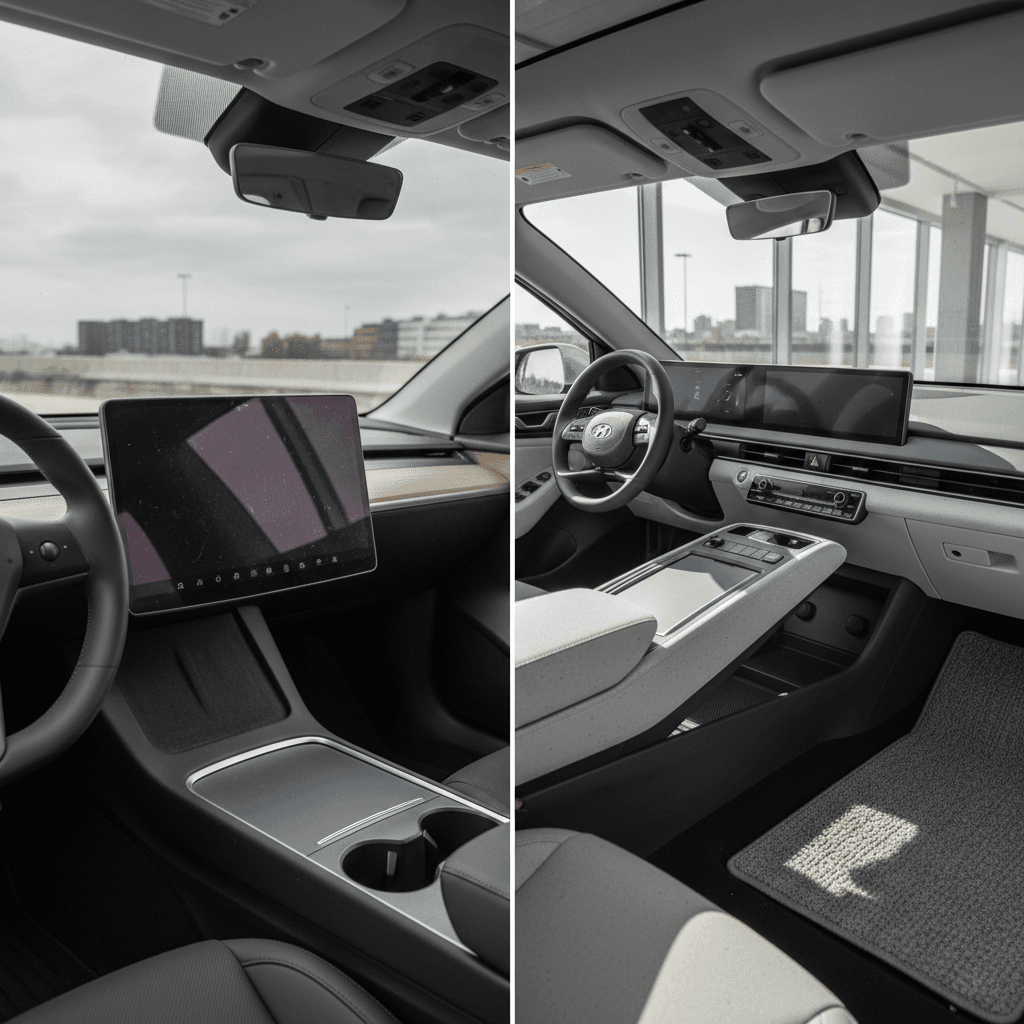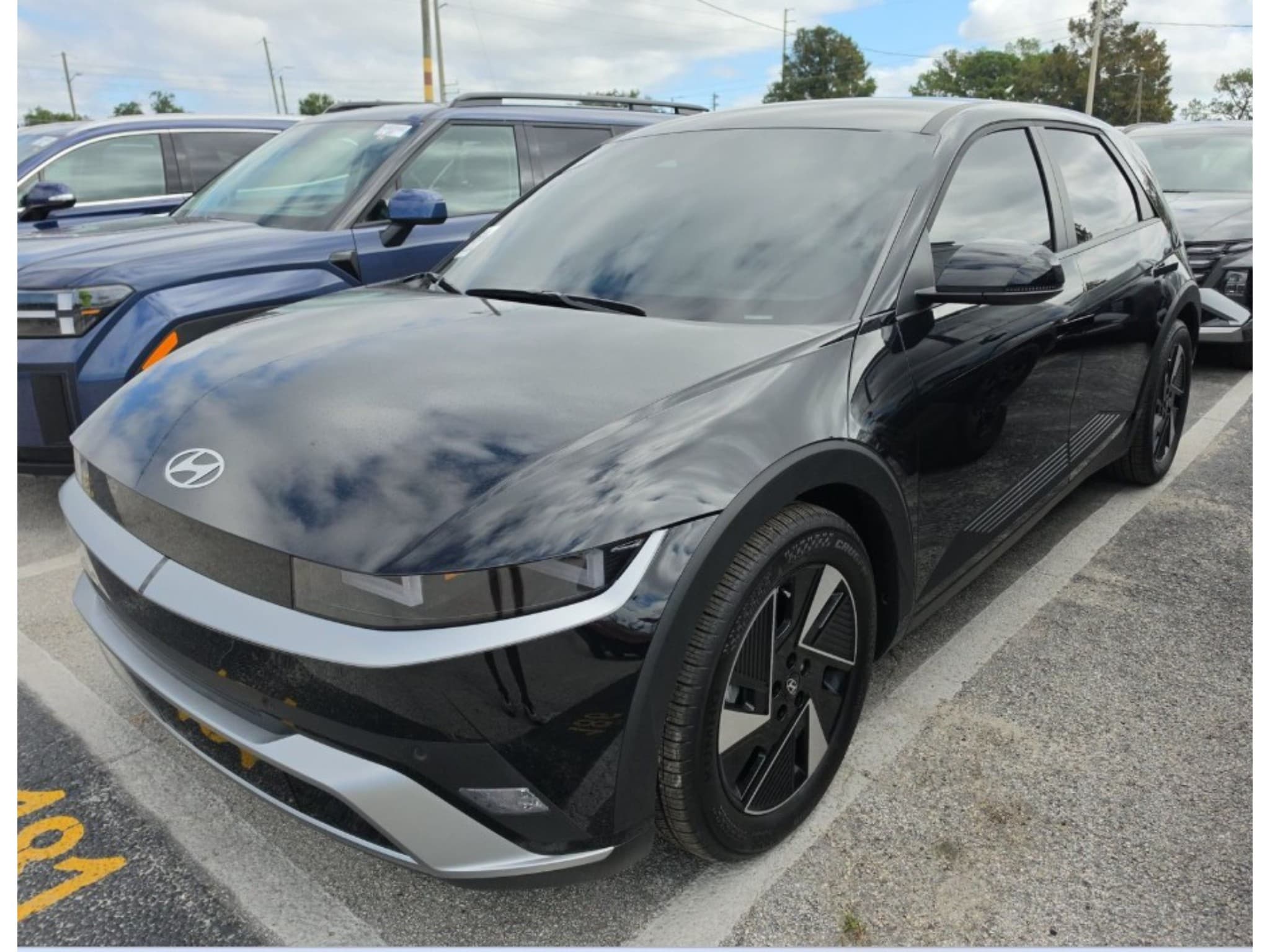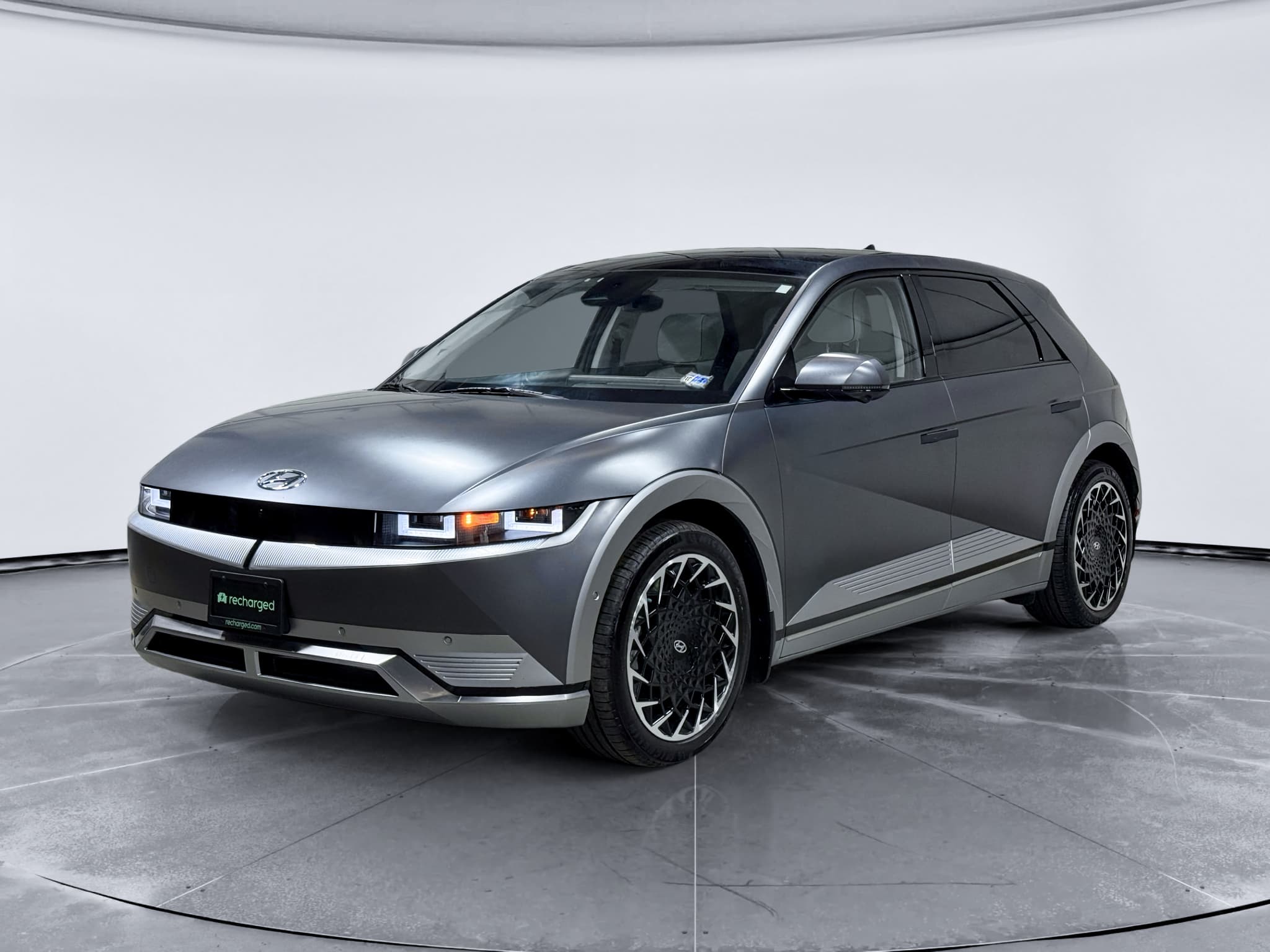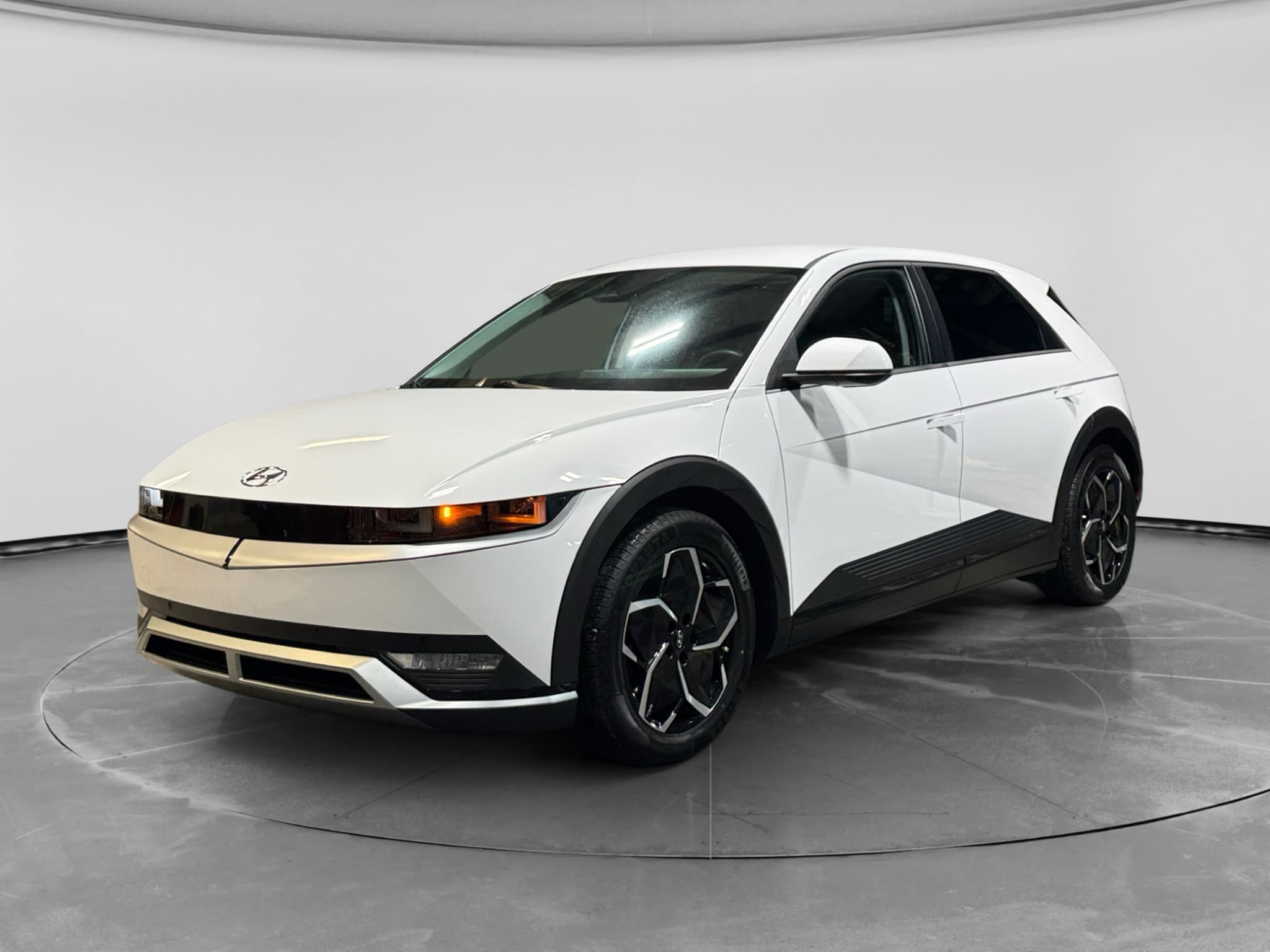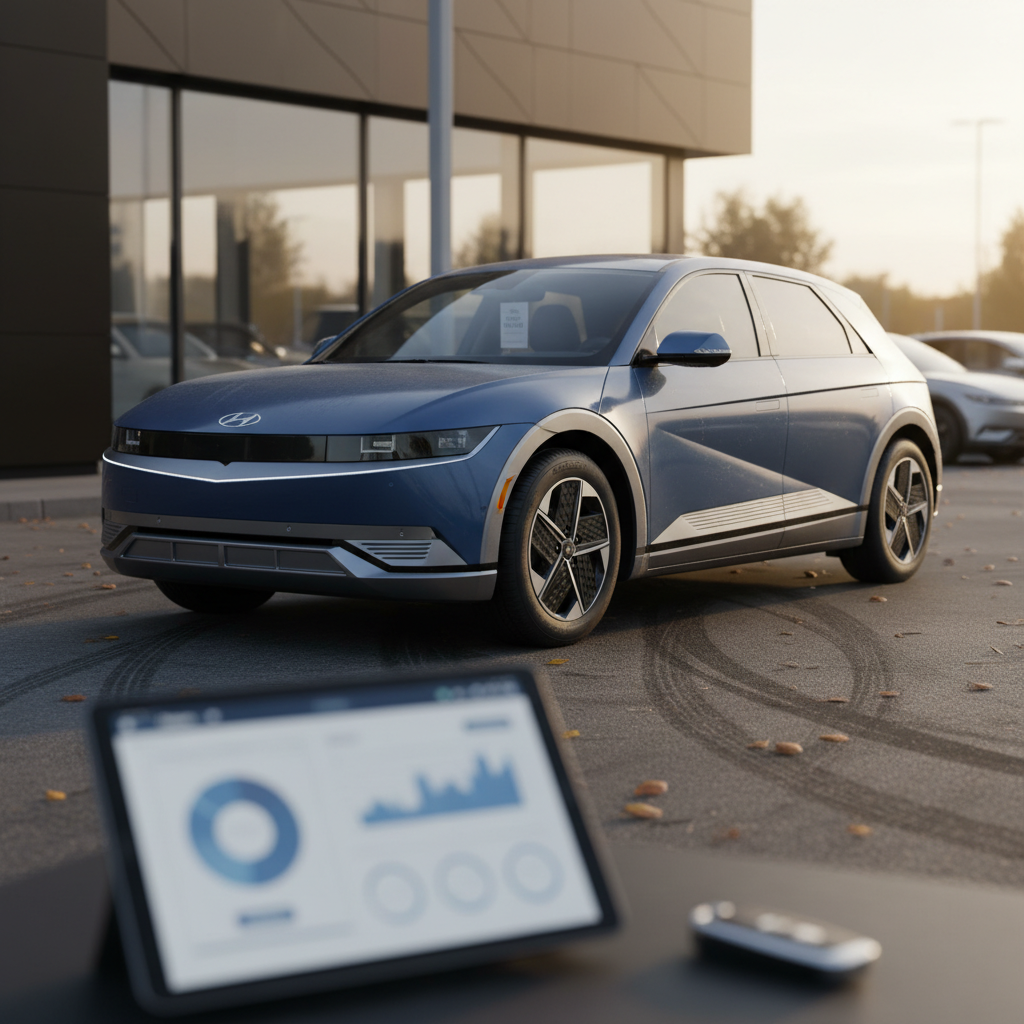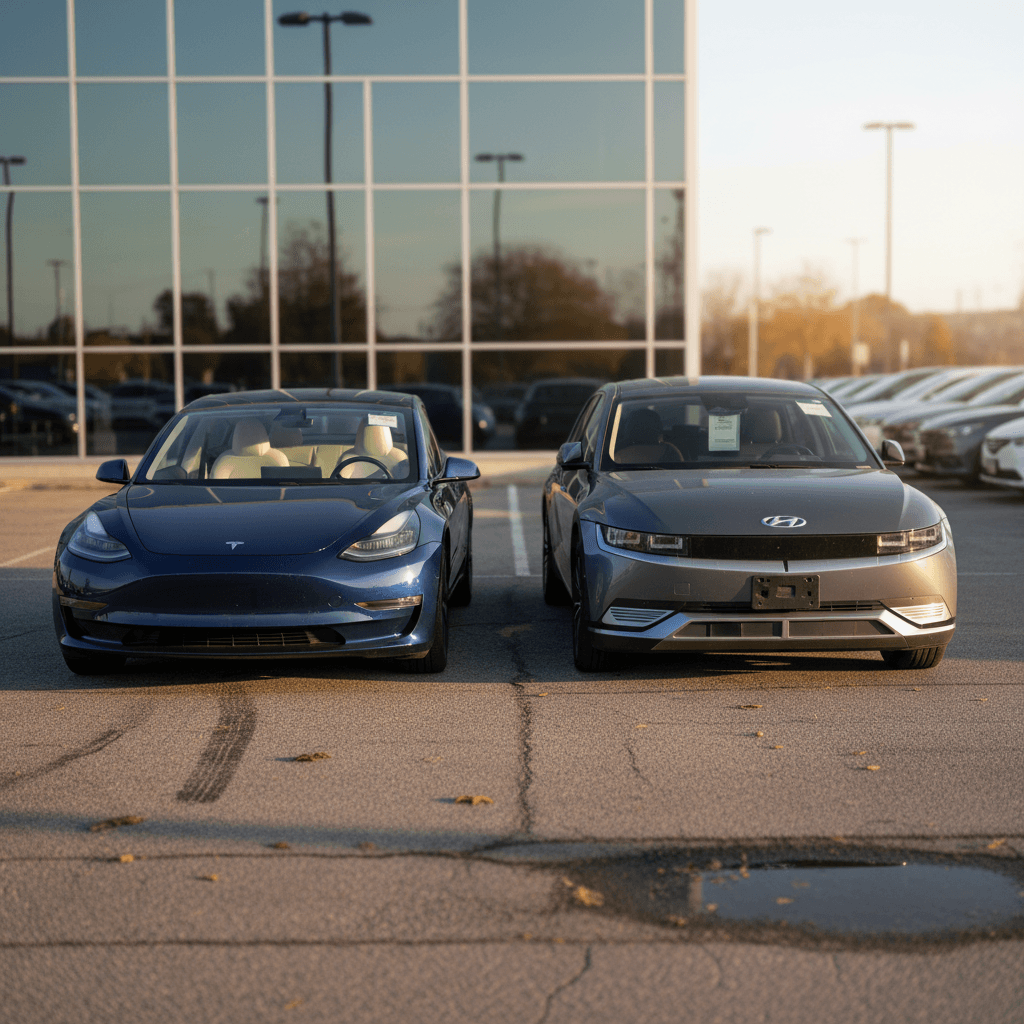
Shopping the used EV market with about $25,000 to spend inevitably leads to one big question: should you buy a Tesla Model 3 or a Hyundai Ioniq 5? Both show up in that price range today, usually as older or higher‑mileage Model 3 sedans and newer, lower‑mileage Ioniq 5 crossovers. This guide walks you through how a $25,000 Tesla Model 3 vs $25,000 Hyundai Ioniq 5 really compare for everyday life, road trips, and long‑term ownership.
Ground rules for this comparison
Why Compare a $25,000 Model 3 and Ioniq 5?
The Model 3 and Ioniq 5 overlap in price but target slightly different buyers. The Tesla is a low‑slung, highly efficient sedan with direct access to Tesla’s Supercharger network. The Hyundai Ioniq 5 is a roomy, boxier crossover with cutting‑edge 800‑volt fast‑charging and an interior that feels more like a lounge than a cockpit. On the used market around $25k, you’re often cross‑shopping them without realizing the tradeoffs.
- You want maximum range and charging coverage for road trips
- You need family‑friendly space and easy loading
- You care about tech features and software experience
- You’re worried about long‑term battery health and depreciation
- You’d like to keep total ownership costs predictable
Think budget first, trim second
What Does $25,000 Actually Buy Today?
Prices move quickly, but by spring 2026, $25,000 tends to put you into different segments of the Model 3 and Ioniq 5 universes.
Typical $25,000 Listings: Model 3 vs Ioniq 5
Broad look at what you’re likely to see around $25k in the U.S. used market.
| Model | Typical years at $25k | Common trims at $25k | Typical mileage | Notes |
|---|---|---|---|---|
| Tesla Model 3 | 2018–2020 | Standard Range / Standard Range Plus, some Mid Range | 60,000–100,000+ miles | Often out of basic warranty, some with partial battery/drive‑unit coverage left. |
| Hyundai Ioniq 5 | 2022–2024 | SE Standard Range, some SE/SEL RWD | 20,000–60,000 miles | Much newer, often with long warranty and modern safety/infotainment. |
Exact pricing will depend on mileage, condition, incentives, and regional demand, but these patterns show up consistently in listings and auction data.
Watch for salvage and fleet cars
Battery, Range and Efficiency Compared
Battery size, real‑world range and efficiency are where the Tesla Model 3 and Hyundai Ioniq 5 start to diverge. In general, a similarly priced Model 3 will go a bit farther on a charge and use less energy, while the Ioniq 5 counters with a larger physical pack and newer chemistry at the same price point.
High‑Level Battery & Range Snapshot
Typical Battery & Range Specs at $25k
Actual specs depend on exact trim and year; this table reflects common configurations in today’s $25k market.
| Model / trim (typical) | Usable battery (approx.) | EPA range when new | Drivetrain | Notable trait |
|---|---|---|---|---|
| 2019–2020 Tesla Model 3 Standard Range Plus | ~50 kWh | 240–250 miles | RWD | Very efficient; smaller pack, low energy use. |
| 2018 Tesla Model 3 Long Range (high miles) | ~75 kWh | ~310 miles | RWD | Shows up near $25k only with very high mileage. |
| 2022–2023 Hyundai Ioniq 5 SE Standard Range | ~58–63 kWh | ~220–240 miles | RWD | Smaller pack but 800‑V charging hardware already onboard. |
| 2022–2023 Hyundai Ioniq 5 SE/SEL RWD (larger pack) | ~77–84 kWh | ~303–318 miles | RWD | Longer range, but usually a bit above $25k unless mileage is higher. |
Assumes U.S. models with original EPA ratings when new.
EPA range vs real life
Tesla Model 3: Efficiency first
- Sleek sedan shape and low weight help the Model 3 stretch every kWh.
- Older Standard Range Plus cars are among the most efficient EVs of their era.
- If your priority is minimizing charging stops on long trips, the Tesla usually wins.
Hyundai Ioniq 5: Larger pack, higher drag
- The Ioniq 5’s crossover body and bigger frontal area cost some efficiency, especially at highway speeds.
- Higher‑capacity packs on SE/SEL trims offset that with more total energy onboard.
- If you drive mostly in town, the efficiency gap matters less day‑to‑day.
Charging and Road-Trip Ability
Range is only half the story. How quickly and easily you can add that range, especially on road trips, may be the deciding factor between a $25,000 Model 3 and a $25,000 Ioniq 5.

Fast-Charging: Network vs Pure Speed
Tesla’s Superchargers vs Hyundai’s 800‑V hardware
Tesla Model 3 at Superchargers
- Native access to Tesla’s Supercharger network from day one.
- Reliable, dense coverage along major U.S. corridors.
- Later‑model Superchargers are opening to non‑Teslas, but a Tesla still gets the smoothest experience.
Hyundai Ioniq 5 at DC fast chargers
- 800‑V architecture allows very fast 10–80% charges on high‑power DC stations.
- On a good 250 kW unit, the Ioniq 5 can add a big chunk of range in ~20 minutes.
- Relies on third‑party networks (Electrify America, EVgo, etc.), which can vary station to station.
Think about your actual routes
Home Charging Considerations for Each EV
Confirm you have (or can add) 240‑V power
Both cars are happiest on a Level 2 charger. A typical 40‑ or 48‑amp unit will refill overnight, even from low state of charge.
Match charger output to vehicle limits
The Model 3 and Ioniq 5 both top out around 32–48 amps AC depending on trim/year. Oversizing your home charger doesn’t make charging faster if the car can’t use it.
Plan for off‑peak rates
Use scheduled charging in either car to take advantage of cheaper nighttime or time‑of‑use electricity plans.
Factor in driveway vs garage
The Ioniq 5’s taller hatch and larger footprint may matter in short garages; cable routing and charger placement will be a bit different from a low sedan like the Model 3.
Space, Comfort and Practicality
Here’s where the Hyundai Ioniq 5 starts to pull away for many families. At the same $25k, a typical Ioniq 5 will give you noticeably more usable interior volume than a comparably priced Model 3.
Practicality Snapshot: Sedan vs Crossover
Approximate interior and cargo comparisons based on common U.S. trims.
| Metric | Tesla Model 3 (typical at $25k) | Hyundai Ioniq 5 (typical at $25k) | What it means in real life |
|---|---|---|---|
| Seating position | Low, sedan‑like | Higher, crossover‑like | Ioniq 5 makes entry/exit easier for many drivers. |
| Rear legroom | Good, but sloping roof | Very generous, sliding rear bench | Ioniq 5 feels airier and friendlier for tall passengers or child seats. |
| Cargo space | Smaller trunk + frunk | Big hatch opening + flat floor | Ioniq 5 wins for strollers, dogs, sports gear and IKEA runs. |
| Visibility | Lower seating, smaller rear window | Boxier greenhouse, larger glass area | Ioniq 5 offers a more SUV‑like view out. |
Exact dimensions vary slightly by year and wheel/tire choice, but the overall size relationship is clear.
Family‑friendly advantage: Ioniq 5
When a Model 3 still makes sense
- You mostly drive solo or with one passenger.
- You prefer sportier, car‑like handling.
- You value a smaller footprint for urban parking and tight garages.
When the Ioniq 5 is the obvious pick
- You regularly haul kids, bikes, camping gear or bulky cargo.
- You want easier ingress/egress for older family members.
- You’re coming from a compact SUV and don’t want to "downsize" too much.
Tech Features and Driving Experience
Tesla has long owned the software and user‑experience story, but Hyundai has quietly closed a lot of the gap. At $25k, you’re often comparing an older‑software Model 3 with a much newer Ioniq 5 that benefits from Hyundai’s latest UI, safety tech and comfort features.
How the Tech Stacks Up at $25,000
Infotainment, driver assists and driving feel
Infotainment & apps
- Tesla Model 3: Large central screen, frequent OTA updates on newer cars, tight integration with Supercharger routing.
- Ioniq 5: Dual screens, wireless smartphone integration on many trims, more traditional menus and buttons.
Driver-assistance features
- Tesla: Autopilot standard; some cars have paid upgrades. Capability depends on hardware generation.
- Hyundai: Highway assist, adaptive cruise and lane‑centering common even on mid‑trims.
Driving character
- Tesla: Sharper steering, more planted feel, especially on Long Range trims.
- Hyundai: Softer ride, more relaxed; still quick, but tuned for comfort first.
Older software vs newer hardware
Ownership Costs and Resale Value
When you zoom out beyond the test drive, you care about three things: what you’ll spend to keep the car running, how protected you are against big repair bills and what the EV might be worth when you’re ready to sell or trade.
Warranty & Depreciation Snapshot
Key Ownership Factors at $25k
Broad comparison of costs and risk exposure over the next 3–5 years.
| Factor | Tesla Model 3 (older, higher miles) | Hyundai Ioniq 5 (newer, lower miles) | Takeaway |
|---|---|---|---|
| Warranty coverage | Battery/drive‑unit warranty may be partially used up; basic warranty likely expired. | Many still within basic 5‑yr warranty and early in 10‑yr EV battery coverage. | Ioniq 5 often carries more remaining factory protection. |
| Insurance | Typically moderate; some carriers rate Teslas higher on repair cost. | Hyundai rates are usually similar or slightly lower than Tesla in many regions. | Quotes can flip depending on ZIP code and driver profile, always compare. |
| Maintenance | No oil changes; watch for tires, brakes, suspension and MCU/sensor issues on older cars. | Similar low EV maintenance; newer hardware, potentially fewer age‑related issues. | Both are cheap to maintain vs gas cars; age and mileage matter more than badge. |
| Depreciation from here | Much of the Model 3’s early depreciation has already happened. | Ioniq 5s are still working through first few years of price discovery. | Ioniq 5 may lose more absolute dollars from $25k, but that can mean good buying value today. |
Exact numbers vary by state, insurance company and how you drive, but patterns are consistent across the used market.
Don’t ignore battery health
Which Used EV Fits You Better?
There’s no universal winner. The right choice comes down to how you drive, who rides with you and how much risk you’re comfortable taking on an older, higher‑mileage car versus a newer one with more warranty left.
Choose Your Path: $25k Model 3 vs $25k Ioniq 5
You should lean Tesla Model 3 if…
You prioritize road‑trip efficiency and Supercharger convenience over cargo space.
You mostly drive solo or as a couple and rarely max out the back seat or trunk.
You’re comfortable owning a higher‑mileage car if the price is right and battery health checks out.
You like Tesla’s minimalist interface and frequent software updates.
You live near strong Tesla service coverage and independent EV shops.
You should lean Hyundai Ioniq 5 if…
You want a roomier, more upright crossover for kids, pets or outdoor gear.
You care about having more factory warranty coverage left on the drivetrain and battery.
You use CCS fast‑charging networks regularly and have reliable stations nearby.
You prefer physical buttons, familiar smartphone integration and a softer ride.
You’re thinking in terms of total risk: newer hardware, lower miles, more warranty.
How to “test‑drive” both fairly
How Recharged Helps You Compare Real Cars
It’s one thing to compare spec sheets; it’s another to choose between two actual used vehicles on a lot or online. That’s where Recharged focuses: turning EV uncertainty into clear, side‑by‑side decisions.
Why Shop Used Model 3 and Ioniq 5 on Recharged
Clarity on battery health, pricing and the fine print
Recharged Score battery diagnostics
Fair market pricing and trade‑ins
EV‑specialist support & delivery
Ready to find your next EV?
Browse VehiclesIf your budget is locked at $25,000, both the Tesla Model 3 and Hyundai Ioniq 5 can be smart buys, but for very different reasons. The Model 3 usually wins on efficiency and Supercharger convenience; the Ioniq 5 typically wins on space, comfort and remaining warranty. With tools like the Recharged Score Report, expert EV guidance and transparent pricing, you can focus less on guessing and more on picking the used EV that’s truly right for how you drive.