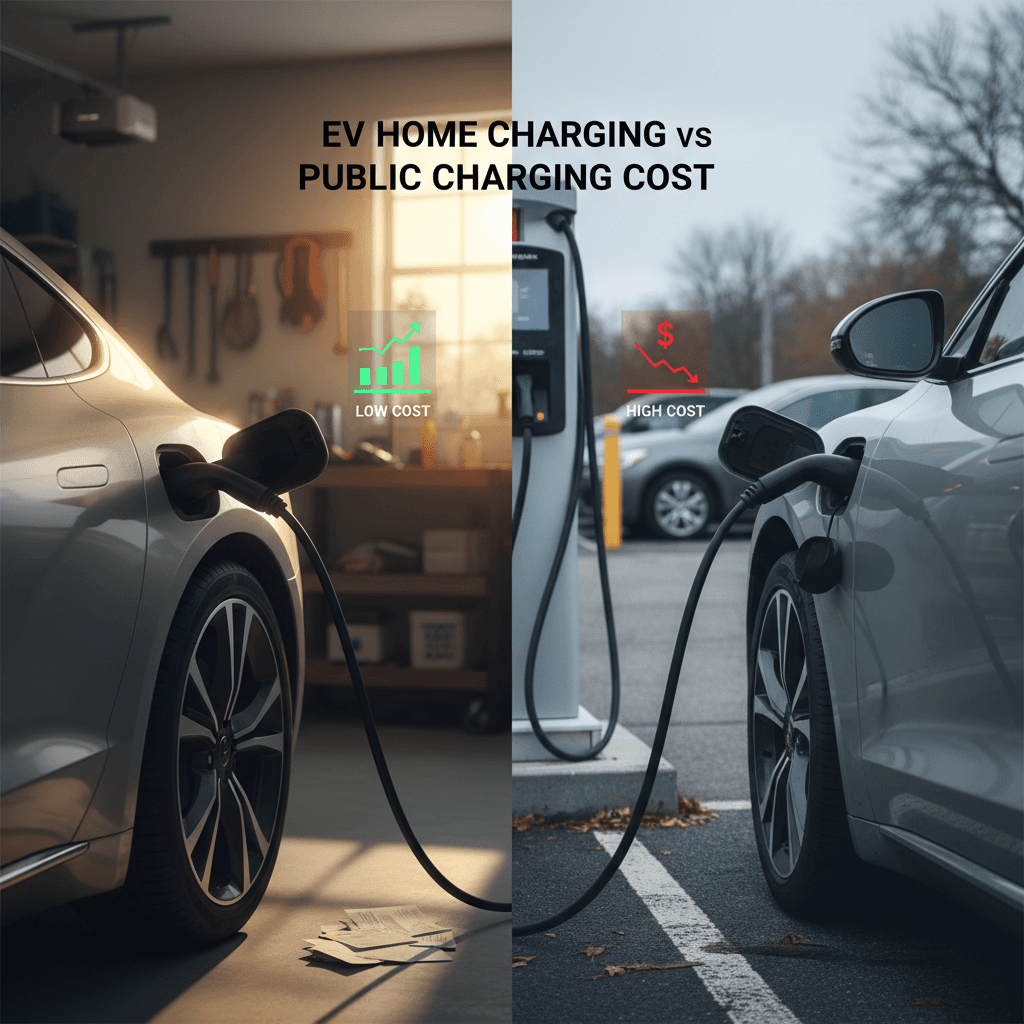
If you’re trying to make the math pencil out on an electric car, the phrase you keep hearing is that home charging is cheaper than public charging. That’s broadly true, but how much cheaper depends on your utility rate, how efficient your EV is, and how often you lean on pricey DC fast chargers. Let’s walk through what EV home charging vs public charging cost actually looks like in 2025, in dollars per kWh, per mile, and per month.
The short version
Why EV home vs public charging cost really matters
Electric vehicles flip the script on fuel costs. Instead of paying the corner gas station, you’re paying your electric utility, unless you’re swiping a card at a DC fast charger on the highway. For many drivers, especially in the used EV market where budgets are tighter, the difference between mostly home charging and mostly public charging can mean hundreds of dollars a year either staying in your pocket or wandering off to the nearest charging network.
Total cost of ownership
Fuel is one of the big three costs of owning any car, alongside depreciation and insurance. With an EV, fuel costs are mostly about how and where you charge. Two owners of the same car can have fuel bills that look nothing alike if one has a garage and the other lives on public chargers.
Why this matters for used EVs
If you’re shopping used, exactly the world Recharged lives in, the charging story is part of the value story. A reasonably priced EV with good battery health plus cheap overnight home charging can undercut a comparable gasoline car by a wide margin on running costs.
Home vs public EV charging: 2024–2025 snapshot (U.S.)
Quick answer: Is home charging cheaper than public?
Yes. For most U.S. drivers in 2025, home charging is dramatically cheaper per mile than public charging. Think of home charging as supermarket groceries and DC fast charging as airport food, same calories, very different line items on your bank statement.
- Average U.S. home charging: roughly $0.16–$0.20 per kWh, depending on your state and time of use.
- Average U.S. public charging: roughly $0.30–$0.40 per kWh when you blend Level 2 and DC fast chargers, often more on pay‑as‑you‑go plans.
- If you drive a reasonably efficient EV (about 25 kWh/100 miles), that works out to roughly $4–$5 to drive 100 miles at home vs $8–$10 on public chargers.
Rule of thumb
How EV charging prices are actually set
Before we throw more numbers around, it helps to know who is setting these prices. EV charging isn’t one big monolithic rate sheet; it’s a patchwork of utilities, networks, and business models all trying to get you electrons at a profit.
What drives EV charging prices?
Home and public charging live in two very different worlds.
Utility rates at home
Your home charging cost is anchored to your residential rate, on average around 17¢/kWh nationally, but anywhere from about 10¢ in the cheapest states to 40¢+ in the most expensive.
Some utilities offer cheaper time‑of‑use rates overnight, which can significantly undercut daytime prices.
Network pricing in public
Public chargers are run by networks and site hosts. They may price by kWh, by minute, or with session fees. DC fast chargers command the highest rates because the hardware and demand charges are expensive.
Speed & convenience premium
The faster the charger, the higher the price. A slow Level 2 unit in a parking garage might be modestly marked up over retail power. A 350 kW highway charger, on the other hand, is priced like you’re buying time, not just energy.
Watch for non‑energy fees
What EV home charging really costs
At home, your EV is just another appliance. A big, silent, 7‑kilowatt toaster. Your cost is almost entirely driven by your residential electricity rate and whether your car is efficient or gluttonous.
Home EV charging cost examples
Illustrative national‑average numbers for 2025. Your state’s rate may be lower or higher.
| Scenario | kWh per 100 miles | Cost per kWh | Cost per 100 miles | Annual energy cost |
|---|---|---|---|---|
| Efficient sedan (Model 3, Ioniq 6 type) | 25 | $0.17 | $4.25 | ≈$510 |
| Average crossover (Model Y, bZ4X type) | 28 | $0.17 | $4.76 | ≈$570 |
| Large truck/SUV (Lightning, R1T type) | 50 | $0.17 | $8.50 | ≈$1,020 |
Assumes national average home electricity of ~17¢/kWh and 12,000 miles per year.
Notice the spread: same electricity price, totally different annual cost just based on the vehicle. A big electric pickup charged entirely at home can still cost about twice as much in energy per year as a slippery mid‑size sedan, but it’s still generally cheaper than feeding a similar gasoline truck.
Use off‑peak hours if you can
What public Level 2 and DC fast charging cost
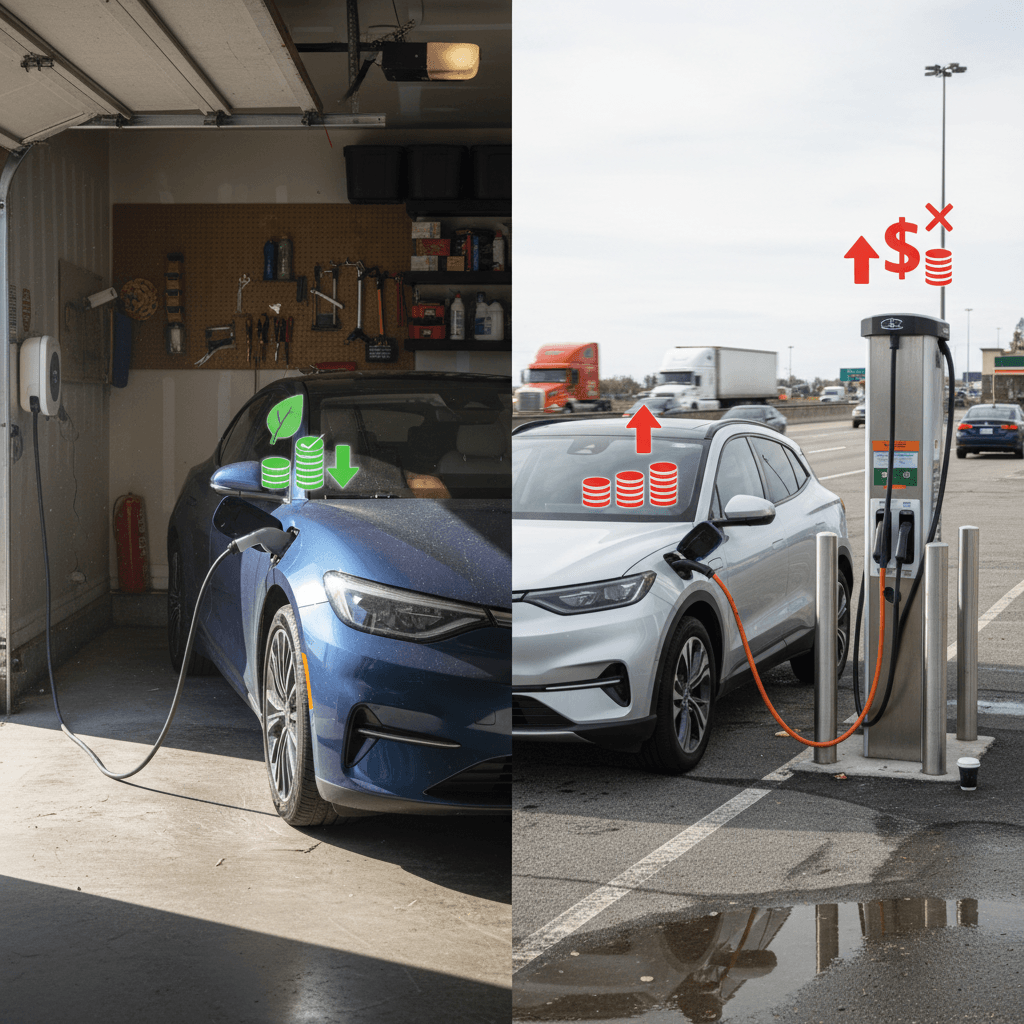
Public charging lives on a different planet entirely. You’re paying not just for electricity, but for hardware, maintenance, credit‑card processing, and the privilege of filling up quickly in a place where land isn’t cheap. That’s why national studies put the average public and commercial charging price around the mid‑30‑cents‑per‑kWh mark, roughly double typical home rates.
Typical public charging price ranges (U.S. 2024–2025)
Real‑world ballparks; exact pricing varies by network, membership, and state regulations.
| Charger type | Typical pricing model | Approx. price range | Notes |
|---|---|---|---|
| Public Level 2 (workplace, parking garage) | Per kWh or flat session | Free – $0.30/kWh | Some employers and retailers eat the cost; others charge a modest premium over local power rates. |
| Network Level 2 (destination chargers) | Per kWh or per hour | $0.20–$0.40/kWh | Hotels and city garages often price similar to the local utility plus a markup. |
| DC fast charging (50–150 kW) | Per kWh or per minute | $0.35–$0.55/kWh | Common for highway corridors; prices spike in high‑cost electricity states. |
| Ultra‑fast DC (200–350 kW) | Per kWh or per minute + fees | $0.40–$0.70+/kWh | You’re paying for speed and convenience; session and idle fees are more common here. |
Many networks offer slightly lower prices for members or subscriptions; non‑members often pay at the top end of these ranges.
The road‑trip reality check
Cost per mile: real‑world examples by EV type
Let’s put some flesh on these bones. We’ll take three rough categories, efficient sedan, average crossover, big truck/SUV, and compare home Level 2 with public DC fast charging using national‑average prices.
Illustrative cost per 100 miles: home vs public DC fast charging
Uses 17¢/kWh for home, 40¢/kWh for DC fast charging to keep numbers simple.
| Vehicle type | Consumption (kWh/100 mi) | Home cost / 100 mi | DC fast cost / 100 mi | Home cost per mile | DC fast cost per mile |
|---|---|---|---|---|---|
| Efficient sedan | 25 | $4.25 | $10.00 | ≈4.3¢ | 10.0¢ |
| Average crossover | 30 | $5.10 | $12.00 | ≈5.1¢ | 12.0¢ |
| Large truck/SUV | 50 | $8.50 | $20.00 | ≈8.5¢ | 20.0¢ |
Real networks and utilities will differ, but the ratios are what matter.
If you split your driving 80/20 between home and DC fast charging, your blended cost per mile lands somewhere in between. That’s the way most EV owners live: home is the workhorse, public charging is the safety net.
The sweet spot
When paying more for public charging is worth it
Public charging is not the villain in this story. It’s the expensive corner store that keeps the neighborhood running. You’ll pay more per kWh, but sometimes it’s absolutely the right call.
Scenarios where public charging earns its keep
It’s not just about cost per kWh, it’s about the value of your time and flexibility.
Apartment or street parking
If you don’t have a driveway or garage, public and workplace chargers may be your main fuel source. In that case, hunt for discounted memberships, workplace deals, or slower Level 2 stations with more reasonable pricing.
Long‑distance road trips
A good DC fast‑charging network turns a used EV into a credible road‑trip car. You’ll pay a premium per mile, but you’re buying time and reach. Think of it as a special‑occasion expense, not the default.
Occasional top‑ups
Maybe you mostly charge at home, but every now and then a busy week or a surprise detour calls for a quick public top‑up. A couple of DC fast sessions a month won’t wreck the budget.
What doesn’t pencil out
Home vs public charging for used EV buyers
If you’re shopping the used market, charging costs aren’t just about today’s bill, they’re part of how you evaluate the car itself. A past life spent chain‑fast‑charging on the highway looks different, from a battery‑health perspective, than a commuter that trickled along on home Level 2 its whole life.
Battery health and fast charging
Regular DC fast charging is a bit like living on espresso. It’s fine in moderation, but day in, day out, it’s harsher on the hardware. That’s why a good battery health report is gold when you’re considering a used EV.
Where Recharged fits in
Every vehicle sold through Recharged comes with a Recharged Score Report that includes verified battery diagnostics and fair‑market pricing. Combine that with a clear plan for how much of your driving will be on home vs public charging, and you’ve got a realistic picture of long‑term ownership costs.
Questions to ask when buying used
Strategies to cut your EV charging costs
The good news is that you have more control over your EV’s fuel bill than most gas‑car owners do. A few structural decisions, where you park, what outlet you install, which plan you choose, do most of the heavy lifting.
Smart ways to shrink your charging bill
1. Lock in a sensible home setup
If you can, install a <strong>Level 2 home charger</strong> on a properly wired 240‑volt circuit. It’s the sweet spot for convenience and overnight, off‑peak pricing. Even if your daily miles are modest, having that capacity keeps you off expensive DC fast chargers.
2. Explore time‑of‑use rates
Call your utility or check its website to see if it offers <strong>EV‑friendly or off‑peak plans</strong>. Then set a charging schedule in your car or wallbox so most charging happens when rates are lowest.
3. Favor free or cheap Level 2 when you’re out
Many workplaces, hotels, and shopping centers offer <strong>reduced‑rate or free Level 2 charging</strong>. Treat those as bonus miles that lower your overall cost per kWh without hammering the battery the way repeated fast charging can.
4. Use DC fast charging strategically
Reserve DC fast charging for <strong>road trips, emergencies, and rare busy weeks</strong>. When you do use it, charge to just enough to comfortably reach your next stop; the last 20% of a fast charge is slower and often the least efficient use of your money and time.
5. Drive like electricity costs money
Efficiency still matters. Smooth acceleration, sane highway speeds, and properly inflated tires can swing your consumption by 10–20%. That’s like getting a permanent discount on every kilowatt‑hour you buy.
Thinking ahead about financing
FAQ: EV home charging vs public charging cost
Frequently asked questions
Bottom line: Choose your charging mix on purpose
Electric vehicles don’t magically cost less to run; they cost less when you use them the right way. For most drivers, that means building your routine around affordable home charging, seasoning it with a little workplace or public Level 2 when it’s free or cheap, and saving DC fast charging for the moments when time matters more than money.
If you’re looking at a used EV, run the numbers both ways: what ownership looks like with a Level 2 charger in your driveway, and what it looks like if public charging has to carry more of the load. Tools like Recharged’s battery‑health‑driven pricing, financing, and trade‑in support can help you line up the right car with the right charging plan, so the savings you’ve heard about actually show up in your monthly budget.