If you bought a 2025 Volkswagen ID. Buzz, you probably paid real money for the privilege. Now, with discounts stacking up on new inventory and talk of VW pausing U.S. imports for 2026 before a refresh, a lot of owners are asking a blunt question: what is my 2025 ID. Buzz actually worth on trade‑in?
Why this matters now
Overview: 2025 ID. Buzz prices and why trade‑in values are weird
2025 VW ID. Buzz pricing & value snapshot (U.S.)
On paper, a 2025 ID. Buzz looks like it should hold value: it’s a distinctive three‑row electric van with strong brand nostalgia and a limited competitive set. In practice, soft demand, aggressive discounts, and uncertainty about future updates are dragging trade‑in values down faster than many early buyers expected.
Sticker shock in reverse
How much is a 2025 VW ID. Buzz worth on trade‑in today?
Every van and every market is a little different, but based on dealer asking prices, auction chatter, and early appraisal data, here’s a reasonable way to think about 2025 Volkswagen ID. Buzz trade‑in value in the U.S. as of spring 2026:
Illustrative 2025 ID. Buzz trade‑in value ranges (U.S., 2026)
These are directional examples, not offers. Expect real numbers to move with incentives, mileage, and regional demand.
| Scenario | Miles | Condition | Original Transaction Price* | Illustrative Trade‑In Range |
|---|---|---|---|---|
| Bought with big discounts (late 2025) | 8,000–12,000 | Excellent | $55,000–$60,000 | $45,000–$52,000 |
| Bought near MSRP (early 2025) | 10,000–18,000 | Good | $65,000–$72,000 | $43,000–$50,000 |
| Very low miles, 1st Edition | <7,000 | Excellent | $70,000+ | $50,000–$56,000 |
| High miles rideshare / delivery | 20,000–30,000+ | Fair | $60,000–$70,000 | $38,000–$46,000 |
Assumes one year of use, typical mileage (10–15k/year), clean history, and no major defects.
About these numbers
If you plug your VIN into a generic trade‑in tool and it spits out something in the low‑to‑mid‑$40,000s for a fairly loaded Buzz you paid $70,000 for, that doesn’t mean you’re being uniquely punished. It means you bought into a niche EV right as the market turned and new‑vehicle discounts reset the baseline.
Why 2025 ID. Buzz depreciation is so steep
Four forces pushing 2025 ID. Buzz values down
Understanding them helps you judge whether to sell now or hold.
1. High MSRP, higher expectations
2. Aggressive discounts on new stock
3. Only average range for the price
4. Product‑plan uncertainty
When steep depreciation can work in your favor
What dealers actually look at when pricing an ID. Buzz trade
From the outside, trade‑in values can feel arbitrary. Under the hood, most dealer and online‑buyer appraisal systems share the same basic logic: what can we realistically sell this for within 45–60 days, and what margin do we need to make that worth doing? For a 2025 ID. Buzz, the main inputs look like this:
Dealer appraisal checklist for a 2025 ID. Buzz
Model, trim, and options
A well‑equipped Pro S or 1st Edition in desirable colors will trade stronger than a base spec, especially if it has popular features like panoramic roof, upgraded audio, or driver‑assist packages. But with discounts widespread, even loaded vans can’t escape broader market pressure.
Mileage and use pattern
Most tools assume ~12,000–15,000 miles per year. If you’re well below that, you get a bump. If you racked up 25,000+ miles doing ride‑share, your Buzz will be priced more like a commercial van than a family car.
Vehicle history & cosmetic condition
Accidents, paintwork, curb‑rashed wheels, or interior damage all get priced in. Dealers don’t just think about the cost to repair; they think about how quickly that van will move once it hits the website.
Tires, brakes, and maintenance
A fresh set of tires, clean service record, and no warning lights make a Buzz easier to certify and resell. Worn consumables or overdue maintenance get deducted at wholesale reconditioning cost, not the retail price you’d pay down the street.
Region and buyer pool
Family‑friendly EVs can do better in coastal metros and dense suburbs than in rural markets where fast‑charging coverage or EV adoption is weaker. A dealer staring at a lot already full of slow‑moving EVs will shade your number down.
Real‑time auction & listing data
Most modern appraisal tools tap into live wholesale auction feeds and retail listing data. If similar Buzz vans are struggling to bring $48,000 at auction, it’s unrealistic to expect a $55,000 trade‑in number.
Don’t anchor on original MSRP
Battery health: how much it moves your ID. Buzz trade‑in value
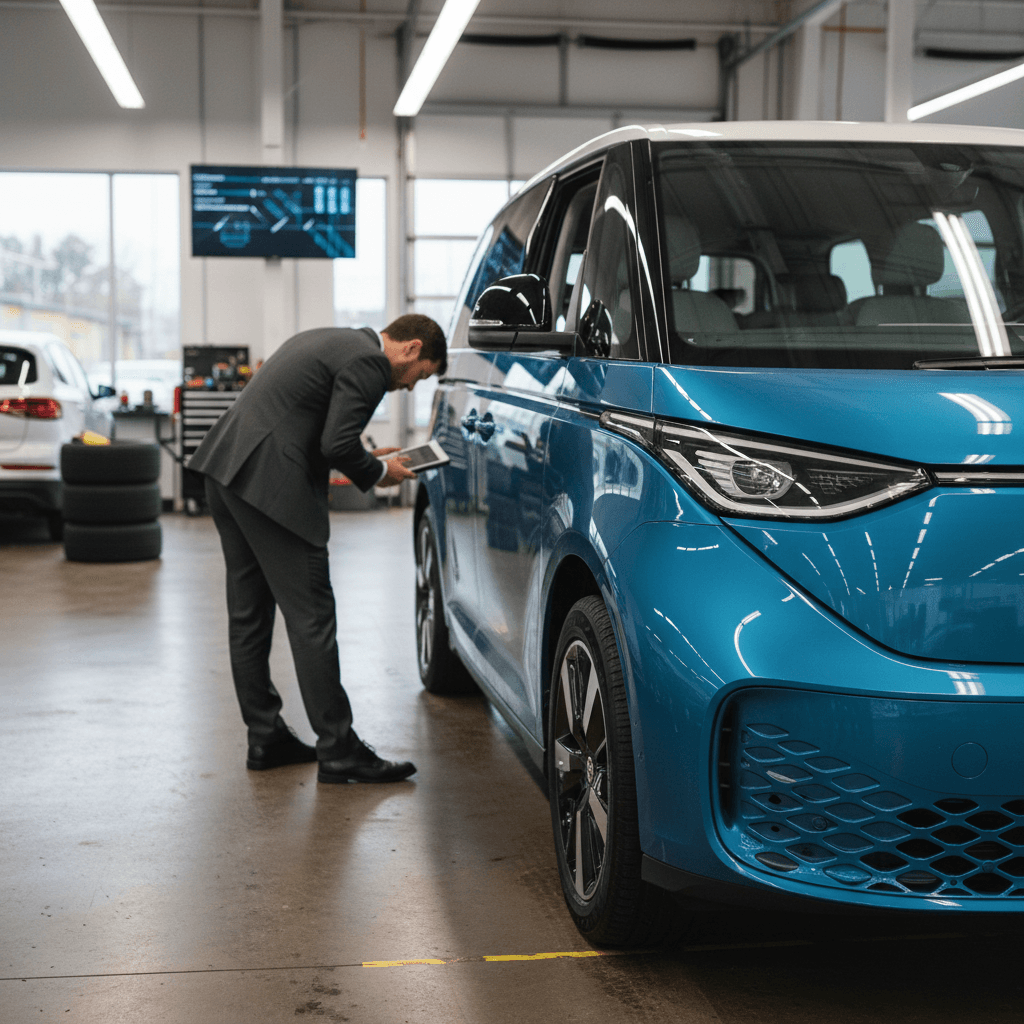
Every 2025 ID. Buzz sold in the U.S. carries an 8‑year/100,000‑mile high‑voltage battery warranty, with Volkswagen promising at least 70% of original usable capacity during that period. That warranty floor gives buyers (and lenders) some confidence, but it doesn’t mean all Buzz packs are created equal in the eyes of the used‑EV market.
What “normal” looks like
So far, there’s no evidence of systemic fast degradation in VW’s MEB‑platform packs when they’re used normally. Long‑term testing of related VW batteries suggests single‑digit capacity loss over the first few years is typical when owners avoid chronic 100% fast‑charge abuse.
That means many 2025 Buzz vans will still show healthy range numbers after a few years, and dealers will treat them like any other modern EV: assume the pack is fine unless there’s data suggesting otherwise.
When battery health really matters
- Outlier low range: If your van’s indicated range at a given state of charge is noticeably lower than peers, a savvy buyer will either discount harder or walk away altogether.
- High DC‑fast‑charge share: A usage history dominated by DC fast charging, especially in hot climates, can raise eyebrows even if the pack is under warranty.
- Out‑of‑warranty edge: As early Buzz vans age past warranty down the road, verified state‑of‑health (SoH) data becomes a major value driver.
How Recharged handles ID. Buzz battery health
Lease buyout vs. trade‑in on a financed ID. Buzz
Because Volkswagen’s battery warranty is long and resale was uncertain, a lot of Buzz shoppers chose to lease first and decide later. Others financed at or near sticker early in the launch. Both groups are running into the same problem: the market correction hit before their payoff balance caught up.
How your path into a 2025 ID. Buzz shapes your exit
Same van, very different math depending on whether you leased or financed.
If you leased your ID. Buzz
- Check your residual: Many early leases assumed optimistic residual values. In a weak used market, the residual may now be higher than what the van is actually worth.
- Trading early: Dealers can roll a lease into a new deal, but if the market value is below the residual, the negative equity gets baked into your next payment.
- Letting the bank take the risk: If values stay weak, it can be rational to simply drive the Buzz, stay within mileage limits, and hand it back. The bank, not you, eats the residual miss.
If you financed your ID. Buzz
- Know your payoff: Get a precise payoff quote from VW Credit or your lender before shopping trade‑in offers.
- Watch for negative equity: If your payoff is $60,000 and the best trade‑in offer is $48,000, you’re $12,000 underwater. That gap will either be paid in cash or rolled into your next loan.
- Consider holding longer: If you can live with the van, an extra 12–24 months of payments plus ongoing VW discounts on new models can help your equity position catch up.
Don’t chase bad money with worse money
How to get the strongest trade‑in offer for your 2025 ID. Buzz
You can’t change Volkswagen’s pricing strategy or macro‑level EV demand, but you can control how your specific van looks to an appraiser. The goal is simple: make your Buzz look like the safest, easiest‑to‑sell example in your region.
7 steps to maximize your 2025 ID. Buzz trade‑in value
1. Fix cheap, obvious stuff first
Professional detailing, paintless dent repair, and fixing minor trim issues are almost always worth it on a $50,000+ van. A clean, odor‑free interior and fresh‑looking exterior can swing offers by thousands, not hundreds.
2. Gather documents and service records
Have your purchase paperwork, service history, recall records, and charging equipment ready. A complete story, especially showing routine maintenance and software updates, reduces the perceived risk for the buyer.
3. Be realistic about mileage and use
If you’ve put 30,000 miles on the van in a year, no amount of wishful thinking will make your Buzz price like a garage queen. Anchor your expectations on real‑world comps, not a best‑case scenario.
4. Get multiple instant offers
Start with a few online instant‑offer tools to map the low‑to‑mid end of the market. Then talk to a couple of local Volkswagen and non‑VW dealers. <strong>The spread between offers is your leverage</strong>.
5. Time your trade around incentives
If Volkswagen is running heavy programs on new Buzz inventory, some dealers will be hungrier for clean trade‑ins they can CPO and sell. Others will be stuffed with stock and lowball you. A little shopping around at the right moment goes a long way.
6. Separate trade value from new‑car discount
When you negotiate a swap into another vehicle, ask the dealer to show your trade value and discount as separate line items. That makes it harder to inflate one while quietly shrinking the other.
7. Consider selling before your warranty edge fades
The closer you get to the end of the 4‑year/50,000‑mile bumper‑to‑bumper coverage window, the more uncertainty creeps into used‑buyer calculations. Trading out while your Buzz is still well inside both basic and battery warranty can support a better number.
Should you sell your ID. Buzz to a dealer, online buyer, or private party?
Where you sell matters almost as much as what you sell. The ID. Buzz is a niche EV with a very specific buyer profile, which makes the trade‑off between convenience and price starker than with, say, a used Honda CR‑V.
Ways to sell a 2025 VW ID. Buzz: pros and cons
Use this to decide which path matches your priorities for speed, effort, and price.
| Channel | Typical Price vs. Trade‑In | Speed | Effort & Risk | Best If… |
|---|---|---|---|---|
| Franchise VW dealer trade‑in | Baseline | Fastest (same day) | Low effort, lowest transparency on back‑end numbers | You’re buying another VW and value convenience over squeezing out every dollar. |
| Non‑VW dealer trade‑in | Similar or slightly lower | Fast | Low effort, may be conservative on a niche EV | You’re switching brands and the dealer is motivated to close a deal. |
| Online instant‑offer buyer | Often slightly above local trade | Fast (days) | Low effort, moderate price transparency | You want to separate selling from buying and avoid dealership haggling. |
| Private‑party sale | Highest potential but widest range | Slow (days to weeks) | High effort, scams and financing risk | You’re comfortable marketing a $50k+ EV, handling test drives, and waiting for the right buyer. |
| Specialist EV marketplace like Recharged | Typically between top trade and strong private party | Fast‑to‑moderate | Moderate effort; EV‑specific expertise reduces surprises | You want professional help pricing a niche EV and buyers who understand battery health. |
Reality check on private‑party premiums
How Recharged valuates a used ID. Buzz
A 2025 ID. Buzz isn’t just another line item in a generic book. It’s a high‑dollar, high‑visibility EV with a still‑developing resale story. At Recharged, we lean on EV‑specific data rather than treating it like a random minivan with a plug.
What goes into a Recharged offer on a 2025 ID. Buzz
Beyond mileage and accident history, we care about how your EV has actually lived.
Verified battery health
Real‑world usage profile
Regional EV demand
Transparent, data‑driven pricing
Trade, sell, or consign
Specialist EV support
Ready to find your next EV?
Browse VehiclesIf you’re holding a 2025 Volkswagen ID. Buzz in 2026, the trade‑in math can feel harsh, especially if you bought early at or near sticker. But understanding why the market is where it is, how appraisers think, and how battery health plays into the story gives you back some control. Whether you ultimately sell through a local dealer, an online buyer, or a specialist marketplace like Recharged, the same rules apply: know your payoff, know your real‑world value range, tidy up the van, and make sure whoever is pricing it actually understands EVs.