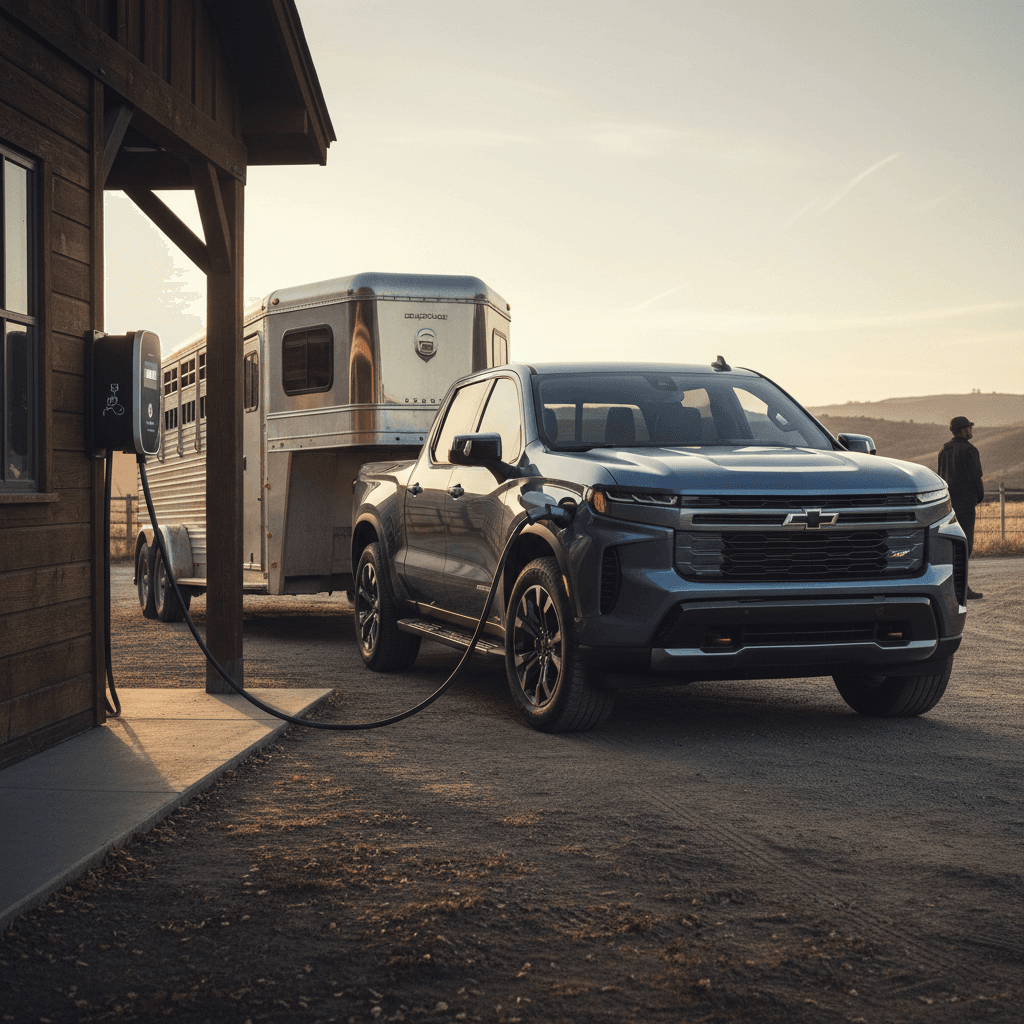
If you’ve been waiting for a full-size electric pickup that behaves like a “real truck,” the 2025 Chevy Silverado EV is GM’s big swing. It promises up to nearly 500 miles of range, serious towing muscle, fast DC charging and the practicality of a crew-cab Silverado. But does it deliver in everyday use, and is it the right electric truck for you compared with Ford’s F-150 Lightning, Rivian’s R1T, or even Tesla’s Cybertruck?
At a glance
2025 Chevy Silverado EV overview
Key 2025 Silverado EV numbers
Chevrolet’s first full-size electric pickup rides on the dedicated Ultium EV platform, not a converted gas chassis. That gives the Silverado EV a long wheelbase, flat battery pack under the floor, and a cabin that feels more like a full-size SUV than a traditional truck. For 2025, Chevy is offering distinct trims, Work Truck (WT), LT, and RST, with different battery sizes, range targets, and feature sets aimed at fleet buyers, mainstream truck owners, and tech-hungry early adopters.
- Crew-cab, short-bed layout only (no regular or extended cab, for now).
- All-wheel drive on retail trims, with dual motors and up to roughly mid-700s horsepower in performance-oriented versions.
- Battery packs around the 170–200+ kWh range depending on version, enabling class-leading range but also significant weight.
- Bidirectional power capability and accessory power bars that can turn the truck into a mobile generator for a jobsite or home backup.
Tip for shoppers
Real-world range and efficiency
Range is the Silverado EV’s headline act. Depending on configuration, GM quotes roughly 282 miles (WT Standard Range), around 400+ miles (Extended Range), and up to about 492 miles EPA-estimated in the Max Range WT. Retail-focused LT and RST trims sit mostly in the 390–460 mile neighborhood, still ahead of most rival electric pickups on paper.
Silverado EV range by configuration (approximate)
Actual EPA estimates vary slightly by trim and options; always verify the exact truck you’re buying.
WT Standard Range
- Approx. 282 miles EPA-estimated
- Lowest price, smallest pack
- Best for mixed city/highway work routes
WT & LT Extended Range
- Roughly 400–422 miles EPA-estimated
- Good balance of range and price
- Ideal for regional fleets and commuters who tow occasionally
Max Range (WT & RST)
- Up to ~492 miles EPA-estimated (WT)
- GM-est. ~460 miles in some RST trims
- Built for long-distance drivers and heavy-duty users
Range vs reality
Daily commuting & light duty
In everyday suburban use, owners report that the Silverado EV behaves more like a large electric SUV than a traditional pickup. On a typical 30–60 mile daily commute with no trailer, even a mid-range battery truck will usually return enough range that you only need to charge a couple of times a week at home. The long wheelbase and big battery also smooth out minor range swings from weather or short trips.
Highway & towing
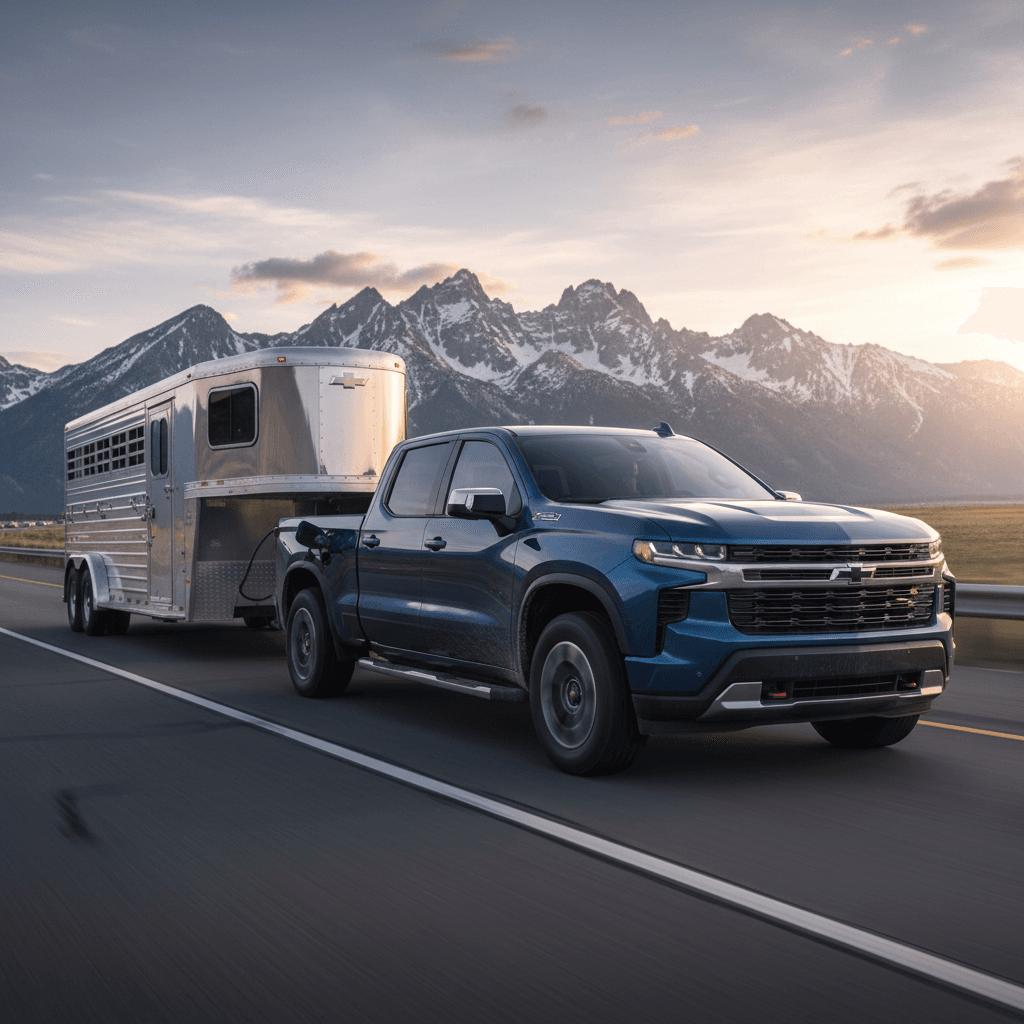
Take the Silverado EV on a long highway run at 70–80 mph, and consumption climbs. Add a tall trailer and headwinds, and you can easily see real-world range near half the EPA rating. That means a Max Range truck rated close to 500 miles might be stopping every 180–250 miles to DC fast charge when towing a heavy camper, still workable, but something you must plan around.
Towing, payload, and work-truck duty
Chevrolet clearly designed the Silverado EV to handle actual truck tasks. Properly equipped versions offer up to about 12,500 pounds of towing capacity and roughly 2,000+ pounds of payload, putting it in the hunt with gas and diesel half-tons and ahead of some rival EVs. The flat battery pack and low-mounted weight also help stability when you’ve got a big trailer on the hitch.
Towing & payload snapshot (selected configurations)
Exact numbers vary by trim, battery, and equipment, always confirm the door-jamb sticker and owner’s manual for the specific truck you’re considering.
| Trim / Battery | Max Towing (approx.) | Payload (approx.) | Best Use Case |
|---|---|---|---|
| WT Standard Range | Up to ~8,000 lb | ~1,800–2,000 lb | Urban fleets, local contractors, lighter trailers |
| WT Extended / Max Range | Up to ~12,500 lb | ~2,000+ lb | Regional work, heavier equipment trailers |
| LT Extended Range | Around 10,000–12,000 lb | ~1,800–2,000 lb | Family truck that still works hard on weekends |
| RST Max Range | Up to ~12,500 lb | ~1,800–2,000 lb | High-feature lifestyle truck that can tow toys and campers |
Towing and payload trade-offs are more pronounced in EVs because heavy loads hit range so hard.
Towing and range caution
The Silverado EV also leans into work-truck functionality. Depending on trim and options, you can get up to around 10 kW or more of offboard power through bed-mounted 120V and 240V outlets, plus an accessory power bar. That can run tools on a jobsite, keep a campsite lit, or help power critical home circuits during an outage. Think of it as a rolling battery bank that also happens to be your daily truck.
Charging speeds and real charging costs
On paper, the Silverado EV is one of the fastest-charging trucks you can buy. Ultium hardware supports up to 350 kW DC fast charging on suitable stations, and Chevy claims roughly 100 miles of range can be added in about 10 minutes under ideal conditions. Level 2 AC charging at home can reach around 19 kW on high-amperage setups, fully replenishing a big battery overnight.
Charging options for Silverado EV owners
How long you’ll wait, and what you might pay, depends heavily on where you plug in.
Level 1 (120V)
- ~3–4 miles of range per hour
- Best for emergencies or topping off overnight
- Impractical for regularly filling a 170+ kWh pack
Level 2 (240V)
- Often 20–30 miles of range per hour
- Full charge typically in 8–12 hours at home
- Sweet spot for most owners, install a 40–80 amp Level 2 in your garage if you can
DC Fast (public)
- Peak up to ~350 kW on capable chargers
- 10–80% in about 40 minutes in independent tests
- Great for road trips, but energy costs can be eye-opening during peak rates
The $89 fast-charge reality check
Questions to ask yourself about charging
1. Can I install Level 2 at home?
If you own your home and have a garage or driveway, a 40–80 amp Level 2 charger is almost a must for a large-battery truck like the Silverado EV. It keeps costs down and convenience high.
2. How often will I fast-charge?
If your life involves frequent 300–400-mile days, understand that you’ll rely on public DC fast chargers and pay more per kWh than at home, especially during peak hours.
3. Are local public chargers reliable?
Before committing to an electric truck, test the major networks along your common routes. A giant battery is only useful if you can reliably refill it when you’re away from home.
4. Do I have off-peak utility rates?
Many utilities offer cheaper overnight electricity. Combine that with scheduled charging and you can dramatically undercut the cost per mile of a comparable gas truck.
Trim levels: WT vs LT vs RST
For 2025, Chevrolet positions the Silverado EV lineup to serve work fleets, mainstream buyers, and premium-truck shoppers. While exact equipment depends on packages, you can think of the trims this way:
Which Silverado EV trim fits you?
All trims share the same basic Ultium architecture but target very different buyers.
Work Truck (WT)
- Lowest starting MSRP, around the mid–$50Ks to $70Ks depending on battery
- Durable interior, fewer luxury touches
- Multiple battery sizes, including Max Range
- Ideal for fleets and value-focused owners who prioritize utility
LT
- More comfort and tech than WT
- Extended Range battery standard on many builds
- Available premium packages with upgraded audio, interior trim, and driver assists
- Sweet spot for family buyers who still want a work-capable truck
RST
- Most upscale and tech-heavy Silverado EV
- Available Max Range battery and higher-output dual motors
- Features like Super Cruise, advanced parking assists, and Multi-Flex Midgate
- Pricing that can push well into the $80K–$90K range with options
Approximate 2025 Silverado EV pricing ladder
Manufacturer pricing shifts frequently with incentives and equipment. Treat these as directional guides, not firm quotes.
| Trim | Battery focus | Approx. starting price (before incentives) | Best for |
|---|---|---|---|
| WT Standard Range | Smaller pack, lower range | ~$57,000 | Fleets, budget-conscious buyers with shorter daily routes |
| WT Extended / Max Range | Largest packs, longest range | Low–mid $70Ks+ | Contractors and fleets that run long days or tow regionally |
| LT Extended Range | Mid–large packs | Mid–high $70Ks+ | Households wanting comfort and range without going full luxury |
| RST Extended / Max Range | Largest packs, highest content | High $80Ks–$90Ks+ | Tech-focused early adopters and premium truck buyers |
Consider total cost of ownership, fuel, maintenance, and potential tax credits, rather than just the sticker price.
Interior, technology, and driving experience
Step into a Silverado EV and it’s immediately apparent this isn’t a converted gas truck. The floor is flat, rear legroom is generous, and the cabin feels wide and airy. Higher trims get a large 17.7-inch central touchscreen paired with an 11-inch digital driver display, running a modern Google-based infotainment system with built-in Maps, Assistant, and app support. WT and lower-content trucks use more basic finishes but still benefit from the roomy layout.
Ride & handling
The massive battery pack sits low in the chassis, which calms body motions compared with some traditional half-tons. Weight is still significant, so you feel the truck’s mass in quick maneuvers or tight parking lots, but on the highway the Silverado EV is composed and quiet. Four-wheel steering and air suspension, when equipped, help maneuverability and ride quality, especially on top trims.
Power & performance
Even non-performance versions of the Silverado EV offer brisk acceleration thanks to instant electric torque. Wide Open Watts launch modes on some models unlock sports-car quickness in a straight line, while towing-focused calibrations trade outright speed for smooth, confident pull. For daily driving, you’ll find merging, passing, and on-ramp sprints effortless, even with a light trailer in tow.
Tech highlight: Hands-free driving
Daily ownership: Who the Silverado EV fits best
The 2025 Silverado EV is not a one-size-fits-all truck. It excels for some owners and misses the mark for others. The key is to be honest about how you really use your truck today, and how often you’re willing to plan charging stops.
Is the Silverado EV a good fit for you?
Four common buyer profiles, and how well the truck serves them.
Suburban family truck
If your daily use is school runs, commuting, home-center trips, and the occasional weekend tow, the Silverado EV can be a terrific fit. Home Level 2 charging eliminates gas-station stops, and the long-range versions mean you rarely worry about topping up. Just remember that a full-size EV truck can be overkill if you don’t actually need its size or capability.
Contractor or small business
For tradespeople with predictable routes and reliable overnight charging, the Silverado EV WT makes a compelling work tool. Offboard power can run tools and lights, and the long range reduces mid-day charging breaks. But if your jobsites move far beyond public charging coverage, a gas or diesel truck may still be the lower-stress choice, for now.
RV & toy hauler
If you regularly tow a travel trailer or large boat long distances, the Silverado EV’s enormous battery and high tow rating are tempting. Just understand that your effective highway range with a big trailer could fall into the 180–250-mile window, with 40–60 minute fast-charge stops. For some owners, that’s an acceptable trade; for others, it’s a deal-breaker.
First-time EV buyer
Moving from a gas half-ton straight into a Silverado EV is a big step. If you’re excited about lower fueling and maintenance costs and you have a good home-charging plan, the learning curve is manageable. If the idea of route planning and public charging anxiety keeps you up at night, consider starting with a smaller EV or plug-in hybrid first.
Total cost of ownership perspective
Silverado EV vs F-150 Lightning, Cybertruck & others
Electric truck shoppers don’t lack choices anymore. Ford’s F-150 Lightning, Rivian’s R1T, GMC’s Hummer EV Pickup, and Tesla’s Cybertruck all offer different blends of capability, styling, and price. The 2025 Silverado EV stakes its ground with range and work-oriented practicality rather than wild styling or gimmicks.
How the 2025 Silverado EV stacks up
An illustrative comparison of where Chevy’s electric truck stands relative to key rivals in broad strokes.
| Model | Headline strength | Range feel | Towing focus | Interior vibe |
|---|---|---|---|---|
| Chevy Silverado EV | Best-in-class range and strong towing | Long legs, especially in Max Range form | Serious work capability plus offboard power | Conventional, truck-like, familiar to Silverado owners |
| Ford F-150 Lightning | Familiar F-150 cabin, strong dealer network | Shorter range, especially when towing | Good tow numbers but smaller battery | Very F-150 inside, easy switch for Ford loyalists |
| Rivian R1T | Adventure styling, clever storage | Good range but smaller pack | Capable, but bed is shorter | Modern, upscale, more SUV-ish |
| Tesla Cybertruck | Bold styling, Tesla Supercharger access | Varies by configuration | Strong on-paper numbers, still maturing | Futuristic and polarizing |
| GMC Hummer EV Pickup | Off-road prowess, performance | Large battery, but very heavy | Tows, but range takes a big hit when working | Futuristic luxury with off-road flair |
Exact specs change often, but this gives you a directional sense of each truck’s character.
How to compare fairly
Buying new vs used, and how Recharged can help
Early in its lifecycle, most 2025 Silverado EV inventory will live on new-car lots and in commercial fleets. But as these trucks age out of first ownership, they’ll become some of the most interesting used EVs on the market: long-range workhorses with huge batteries and modern tech. That’s where understanding battery health and pricing really matters.
Key questions before you buy a used Silverado EV
1. What’s the verified battery health?
A large pack can hide degradation for a while, but you still want objective data. A <strong>Recharged Score battery health report</strong> can show you how the pack is aging and help you avoid unpleasant surprises down the line.
2. How was the truck used?
A former fleet WT that towed daily at max capacity has lived a very different life from a lightly used suburban LT. Ask about prior use, charging patterns, and any DC fast-charging-heavy histories.
3. Are software and recalls up to date?
EVs evolve through over-the-air updates and service campaigns. Make sure the truck you’re considering has current software, up-to-date charging calibrations, and any recall work completed.
4. Does the price reflect tax credits and incentives?
Some used EVs can still qualify buyers for incentives, and many new Silverado EVs may have benefited from federal or state programs. Understanding the net cost vs a comparable gas truck is essential.
Where Recharged fits in
Ready to find your next EV?
Browse Vehicles2025 Chevy Silverado EV FAQ
Frequently asked questions about the 2025 Silverado EV
Bottom line: Should you buy a 2025 Silverado EV?
The 2025 Chevy Silverado EV is one of the most convincing electric trucks yet for people who actually use their pickups like trucks. It delivers class-leading range, real towing and payload capability, and useful work-friendly features like offboard power and available Super Cruise. The trade-offs are a very large battery that takes time and money to refill on public fast chargers, substantial weight, and pricing that can climb quickly on higher trims.
If you have reliable home Level 2 charging, regularly drive long distances without always towing at the limit, and value range and capability over wild styling, the Silverado EV deserves a serious look. Fleet operators and contractors with predictable routes will find a lot to like in WT models, while LT and RST trims cater to families and premium-truck buyers who want cutting-edge tech. And as these trucks find their way into the pre-owned market, Recharged will be ready to help you compare options, understand battery health with a Recharged Score, arrange financing or trade-in, and ultimately decide whether this electric workhorse is the right next truck for your driveway or jobsite.