If you’re considering a 2025 Chevy Silverado EV, you’ve probably also heard stories about battery codes, “service high-voltage system” warnings, software bugs, and long parts delays. The reality is more nuanced than the horror stories and the marketing would suggest. This guide breaks down real‑world 2024–2025 Silverado EV problems, how worried you should be, and what to look for if you’re shopping one used.
Context: very new truck, very small sample size
2025 Silverado EV problems: what we actually know so far
Early Silverado EV reliability snapshot (2024–2025 builds)
From owner reports and early service data, the 2025 Chevy Silverado EV doesn’t look like a disaster, but it’s not trouble‑free either. The pattern looks similar to other first‑generation EV trucks: core drivetrain hardware is generally solid, while software maturity, parts availability, and dealer EV expertise lag behind. That means your risk isn’t so much “this truck will definitely strand me” as “if something goes wrong, it may take time and coordination to make it right.”
Why the Silverado EV behaves differently than a gas Silverado
Ultium platform, not a converted gas truck
The Silverado EV rides on GM’s Ultium EV platform, shared with the GMC Hummer EV and upcoming Sierra EV, not on the traditional body‑on‑frame Silverado. That means:
- Large structural battery pack integrated into the floor
- Dual motors, all‑wheel drive, and four‑wheel steering on many trims
- High‑voltage heat pump HVAC and complex thermal management
These systems bring incredible performance and range, but they’re also newer and more software‑defined than what most truck techs are used to.
Heavily software‑defined truck
The 2025 Silverado EV leans hard into software‑controlled everything, from lighting and HVAC to Super Cruise and GM’s Ultifi infotainment platform (without Apple CarPlay or Android Auto on higher trims). That allows for meaningful over‑the‑air (OTA) updates, but it also means many “problems” show up as:
- Warning lights that clear themselves days later
- Features temporarily disabled pending an update
- Dealer visits that are mostly about flashing modules, not replacing parts
Tip if you’re coming from a gas truck
Battery & charging problems on the Silverado EV
Battery and charging problems are the scariest category because they threaten the most expensive component on the truck. The good news: outright pack failures still appear rare. The bad news: when they do happen, they can be complicated, slow, and stressful to resolve.
Common high‑voltage and charging complaints
What owners and techs are actually seeing on 2024–2025 trucks
“Service high voltage system”
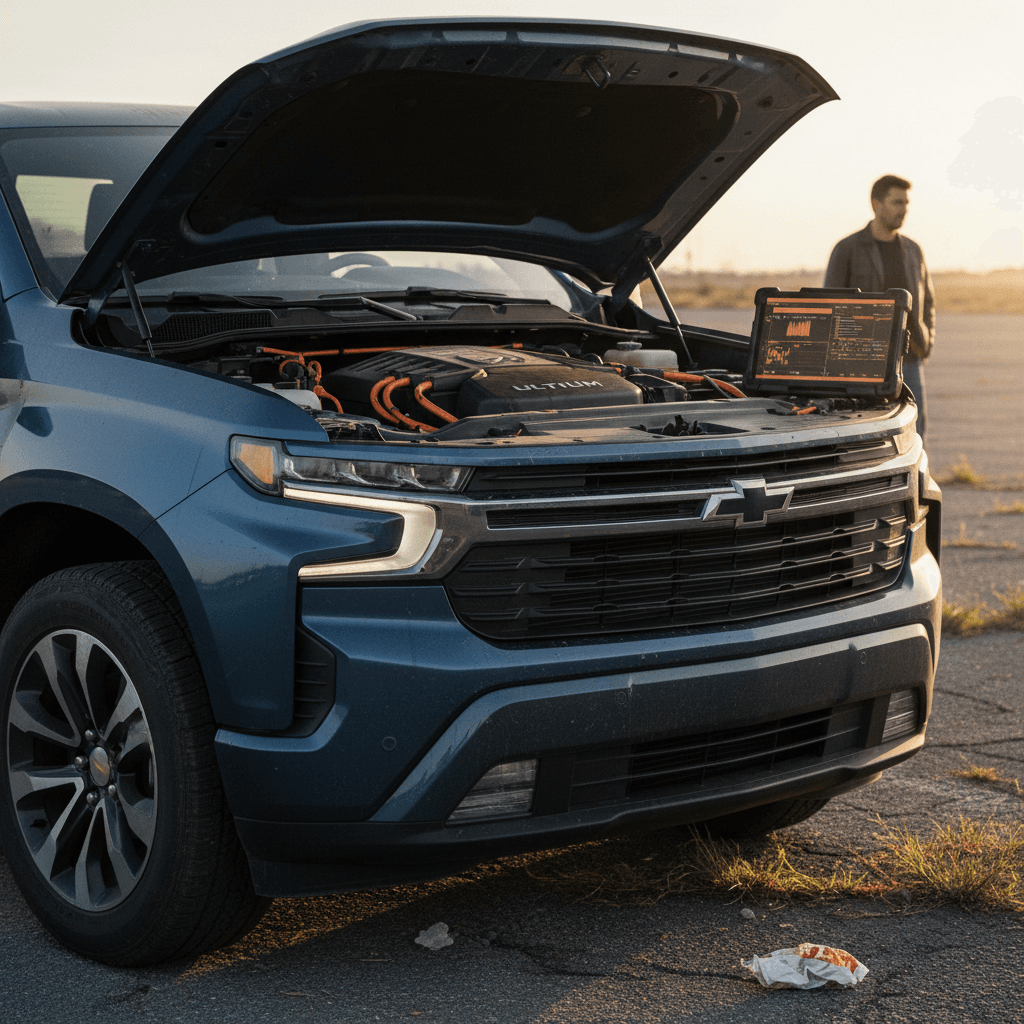
Several owners have reported intermittent or persistent “Service High Voltage System” messages that:
- Prevent the truck from charging
- May come with burning smells or cooling‑system alerts
- Can lead to tow‑ins and long diagnostic stays
In some cases, the fix has involved replacing high‑voltage components or even the full battery pack under warranty.
Coolant leaks & battery codes
On some early trucks, dealers have traced battery fault codes to coolant leaks into the pack or related plumbing. Symptoms include:
- Battery voltage error codes
- Range reduction or shutdown protection
- Extended downtime awaiting parts and specialized labor
Charging controller & DC fast‑charge faults
A smaller number of owners have seen charging controller failures or repeated DC fast‑charging errors. Trucks may:
- Charge fine at home Level 2 but fail at some DC stations
- Throw multiple pages of diagnostic codes
- Require replacement of onboard charge hardware
Battery issues aren’t always battery failures
If you’re shopping a used 2025 Silverado EV, the single most important thing you can do is pull the service history and scan for repeated high‑voltage complaints. One warning that was promptly fixed and never came back is very different from a truck that’s been in three different dealerships for the same unresolved battery fault.
Software, apps & tech: the most common day-to-day annoyances
GM made the Silverado EV a showcase for its new software stack, and it shows, in both good and bad ways. The cabin tech is slick when it works, but software oddities are by far the most common everyday complaint from owners.
Typical software & tech problems on Silverado EV
Annoying more often than they’re dangerous
Infotainment & CarPlay/Android Auto
The RST and some higher trims launched without Apple CarPlay or Android Auto, despite lower trims and most rivals offering them. Owners also report:
- Occasional screen freezes or reboots
- Needing multiple taps to access simple settings (e.g., lights)
- Bugs that are gradually addressed via OTA or dealer updates
Telematics & connectivity modules
Several owners have needed telematics module replacements after losing navigation, voice commands, or remote app functions. These issues don’t usually affect driving, but parts can be back‑ordered, leaving you without connected features for weeks.
Cameras, Super Cruise & driver assist
Reports include:
- Surround‑view cameras intermittently failing until a restart
- Super Cruise disabled for extended periods while GM works on fixes
- Warning lights that point to software configuration rather than physical sensor failures
Plan for software updates like routine maintenance
Build quality, hardware failures & parts delays
Beyond EV‑specific systems, the Silverado EV is still a full‑size truck, with all the usual opportunities for rattles, trim issues, and wear‑and‑tear. Early owners report a mix of minor annoyances and a few more serious hardware problems.
- Interior rattles and squeaks, especially around the headliner and trim pieces, showing up on some higher‑mileage trucks.
- Exterior trim issues like tailgate emblems or black trim panels coming loose or falling off.
- Window regulators and mirrors that behave inconsistently, clicking, sticking, or needing adjustment/replacement under warranty.
- HVAC quirks, including loud compressor noises and, more seriously, faults in the heat‑pump system that can cut cabin heat in cold weather until a sensor or component is replaced.
- Frunk latches occasionally failing to open cleanly, then resealing themselves, annoying more than dangerous, but worth testing carefully on a used truck.
The real pain point: long repair times, not just failures
Recalls and known campaigns touching Silverado EV
As of early 2026, the Silverado EV hasn’t seen a catastrophic recall on the scale of GM’s earlier Bolt battery campaigns, but it has begun to appear in smaller, software‑driven actions alongside its platform siblings.
Examples of recall themes relevant to Silverado EV owners
Always run the VIN through official tools before buying used, this table is illustrative, not exhaustive.
| Issue type | Typical fix | Why it matters for you |
|---|---|---|
| Stability control warning light logic | Software update to correct indicator behavior | Ensures you’re actually warned if the truck’s stability control has a fault, not just once. |
| Pedestrian warning sounds (on other GM EVs) | Software calibration to meet noise rules at low speed | Shows how often GM is using recalls to fine‑tune EV software compliance rather than hardware. |
| OTA vs. dealer‑only campaigns | Some trucks need physical dealer visits for updates others get over the air | A used truck may be "behind" on critical updates if a previous owner ignored or missed dealer notices. |
Use this as a checklist of issues to ask about, not a complete recall list.
How to check recall status before you buy
What 2025 Silverado EV owners are actually reporting
Strip away the outliers, and a more balanced picture of 2024–2025 Silverado EV ownership emerges. Many drivers are quietly racking up 15,000–30,000 miles with few issues beyond software updates and minor trim complaints, while a smaller group is fighting repeated high‑voltage warnings or long repair stays.
Positive patterns
- Owners with 15k–30k miles on 2024–2025 trucks reporting no major mechanical or battery issues, just routine tire rotations and cabin filters.
- Drivers praising range, ride quality, and towing capability, often comparing favorably against prior gas pickups.
- Some early one‑off glitches (like a high‑voltage warning) that never reappear after software updates.
Negative patterns
- Isolated but serious cases of persistent battery codes, coolant leaks, or service‑high‑voltage messages leading to multiple dealer visits and lemon‑law claims.
- Frustration with dealers who lack EV‑trained techs, forcing trucks to bounce between stores while GM engineers advise remotely.
- Annoyance about missing features (CarPlay/Android Auto on some trims) and the learning curve of an always‑online software platform.
The pattern isn’t that every Silverado EV is a problem child; it’s that if you get a bad one, the fix is slower, more centralized, and more software‑dependent than most truck buyers are used to.
Should you worry about 2025 Silverado EV reliability as a used buyer?
From a used‑buyer standpoint, the Silverado EV sits in the same category as other first‑generation electric trucks: higher variance than a proven gas Silverado, but not a universal disaster. The key isn’t to avoid the truck entirely; it’s to avoid the small share of trucks with persistent, poorly resolved issues.
- If you get a good copy, the Silverado EV can be a fantastic long‑range electric truck with relatively low running costs and minimal maintenance.
- If you get a bad copy, your risk is less about catastrophic failure and more about repeat visits, diagnostic limbo, and long waits for parts or EV tech time.
- The warranty coverage on the battery and electric drivetrain is strong, but it doesn’t compensate you for lost time if the truck spends a month at the dealer.
- Used pricing on early trucks has started to soften, which can make the risk/return math more attractive if you buy carefully and keep strong documentation.
Bottom line if you’re EV‑curious but cautious
Pre-purchase checklist for a used Silverado EV
Used 2025 Silverado EV problem‑spotting checklist
1. Pull full service & recall history
Ask for dealer service printouts and check for repeated entries mentioning <strong>“service high voltage system,” battery conditioning faults, coolant leaks, or charging controller replacements</strong>. One resolved incident is fine; a pattern is a red flag.
2. Confirm battery warranty and mileage
Verify the in‑service date and odometer. You want as much of the <strong>8‑year/100,000‑mile battery and EV system warranty</strong> remaining as possible, especially if you’ll tow or road‑trip heavily.
3. Test DC fast charging and home charging
If you can, plug into both a Level 2 charger and a DC fast charger during your test drive. Watch for <strong>error messages, unusually slow charging speeds, or refusal to initiate a session</strong> at more than one station brand.
4. Drive it cold and hot (if possible)
Pay attention to HVAC behavior. Does the cabin heat or cool normally? Any <strong>loud compressor noises or “battery conditioning” errors</strong>? Heat‑pump issues can be expensive and slow to repair, even under warranty.
5. Inspect for trim and water‑ingress issues
Check the <strong>tailgate, bed fins, roof rails, glass, and frunk</strong> for loose trim, rattles, or signs of water intrusion. Minor issues aren’t deal‑breakers, but they can indicate build‑quality variation.
6. Evaluate software status
Look for pending OTA updates, then ask the seller or dealer to <strong>apply all outstanding EV‑related TSBs</strong> before you take delivery. Verify that cameras, parking sensors, and driver‑assist features (including Super Cruise, if equipped) work consistently.
7. Scan for warning lights or stored codes
During inspection, cycle the truck on and off a few times and look for <strong>intermittent warning messages</strong>. If you’re working with a seller who allows it, a pre‑purchase scan with a compatible diagnostic tool can reveal hidden history.
8. Consider your downtime tolerance
Be realistic: if this is your only vehicle and you can’t tolerate multi‑week repairs, you may want a more mature EV, or work with a retailer who offers <strong>strong support, loaners, or buyback options</strong> if a serious issue emerges.
How Recharged reduces the risk on a used Silverado EV
At Recharged, we built our entire model around making used EVs, including complex trucks like the Silverado EV, more transparent and less stressful to own. With a truck this new and this software‑heavy, having an independent view of its health matters even more.
What Recharged adds on top of a normal used‑truck purchase
Especially important for early‑generation EV trucks
Recharged Score battery health report
Every truck we list comes with a Recharged Score that includes verified battery health. We use diagnostics and data, not just a dashboard range estimate, to flag abnormal degradation or pack behavior.
Service & recall transparency
We pull service history, open recalls, and campaign data so you see past high‑voltage faults, module replacements, and whether crucial software updates have been applied.
EV‑specialist support & digital buying
Our EV specialists walk you through charging, range expectations, and ownership costs before you buy. You can finance, trade in, or sell your current vehicle entirely online, with optional nationwide delivery or a visit to our Experience Center in Richmond, VA.
Ready to find your next EV?
Browse VehiclesIf you’re cross‑shopping trucks
FAQ: 2025 Chevy Silverado EV problems
Frequently asked questions about 2025 Silverado EV problems
The 2025 Chevy Silverado EV is exactly what you’d expect from a first‑wave electric truck from a legacy automaker: ambitious, capable, and occasionally rough around the edges. It’s not the apocalypse some forum threads describe, nor is it the flawless future GM’s marketing implies. If you respect that nuance, by vetting each individual truck carefully, understanding the trade‑off between cutting‑edge capability and repair complexity, and working with a seller who’s fluent in EVs, you can stack the odds heavily in your favor. That’s the mindset we bring to every Silverado EV we list at Recharged.