If you bought a 2024 Hyundai Kona Electric in the last year or two, you already know how quickly EV prices move. Incentives change, new models arrive, and your trade-in offer can swing by thousands of dollars in a single quarter. This guide breaks down what a realistic 2024 Hyundai Kona Electric trade in value looks like today in the U.S., why the numbers are what they are, and how to put yourself at the top of the value range instead of the bottom.
A quick reality check
2024 Kona Electric trade-in value at a glance
Current 2024 Kona Electric value snapshot (U.S.)
Across major pricing guides, a 2024 Hyundai Kona Electric with typical U.S. mileage and in good, accident-free condition usually appraises in the low‑ to low‑$20,000s retail, and roughly mid‑ to high‑$10,000s to low‑$20,000s on trade, depending heavily on trim and region. National guides like Kelley Blue Book show sample trade‑in numbers around $18,000 for SE, with higher values for Limited models, while Edmunds appraisals often start in the high‑$16,000s and climb with options and cleaner history. Think of those as a compass, not a verdict.
Why your quote might be lower than KBB
How much is a 2024 Hyundai Kona Electric worth right now?
Let’s put some stakes in the ground. As of spring 2026 in the U.S., most 2024 Kona Electrics are between 1 and 2 years old, usually with 8,000–30,000 miles on the odometer. Original MSRPs landed roughly around $34,000 for SE, $38,000 for SEL, and just over $42,000 for Limited before destination and fees. Heavy discounts and lease incentives, especially that much‑discussed $7,500 Hyundai support, mean many buyers effectively paid less than sticker.
Illustrative 2024 Kona Electric value ranges (U.S., spring 2026)
Broad bands for a single‑owner, clean‑title 2024 Kona Electric. These are directional, not offers.
| Trim & mileage | Rough trade-in band | Likely private-party band | Notes |
|---|---|---|---|
| SE · ~15,000 mi | $17,000–$18,500 | $18,500–$20,500 | Shorter-range pack, lower MSRP to start |
| SEL · ~15,000 mi | $17,500–$19,500 | $19,500–$21,500 | More equipment, 64.8‑kWh battery |
| Limited · ~15,000 mi | $19,000–$21,000 | $21,000–$23,000 | Top trim, strongest demand |
| Any trim · 30,000–40,000 mi | $1,000–$2,000 under above | $1,000–$1,500 under above | Higher miles compress the spread |
| Any trim · under 5,000 mi | $500–$1,500 over above | $1,000–$2,000 over above | Effectively nearly‑new pricing |
Your exact offer can land outside these ranges based on region, options, and condition.
Guides vs. your driveway
What actually drives your Kona Electric trade-in value
The six levers behind your 2024 Kona Electric offer
Some you can’t change, some you absolutely can.
Model year & trim
Mileage & usage
Condition & history
Battery health & range
Market & incentives
Channel you choose
Most owners obsess over mileage and options, but for a 2024 Kona Electric the real decision‑makers are trim, battery health, and where you sell. A Limited with strong range sold through the right channel can easily bring thousands more than a high‑mileage SE pushed through a fast, one‑click trade‑in widget.
Trim, mileage, and condition: where your Kona lands in the range
Trim hierarchy: SE vs. SEL vs. Limited
The Kona Electric doesn’t hide its pecking order. Limited gets the most toys and the strongest resale pull, especially with buyers who want the big‑battery, big‑screen, big‑comfort spec in one shot. SEL sits in the sweet spot for value – enough features, 64.8‑kWh pack, but not fully loaded pricing. The SE is the budget entry; lower MSRP new means a lower ceiling on trade-in later.
If two cars are otherwise identical, expect a Limited to bring roughly $1,500–$3,000 more on trade than an SE, with SEL landing in the middle.
Mileage and visible wear
On a 2024, mileage hasn’t had time to become catastrophic, but the curve is already there. A dealer appraiser will quietly put your car in one of three buckets:
- Low miles: under ~10,000 – priced as nearly new.
- Average: 10,000–25,000 – the guidebook norm.
- High: 25,000+ – discounts start compounding.
Add in cosmetic wear – scraped bumpers, windshield chips, curbed alloys – and the appraisal software starts subtracting line items. Most of those dings are fixable; the question is whether you fix them or the dealer does (and charges you for it in the offer).
“Good” vs “Excellent” condition is real money
Why battery health matters more than the window sticker
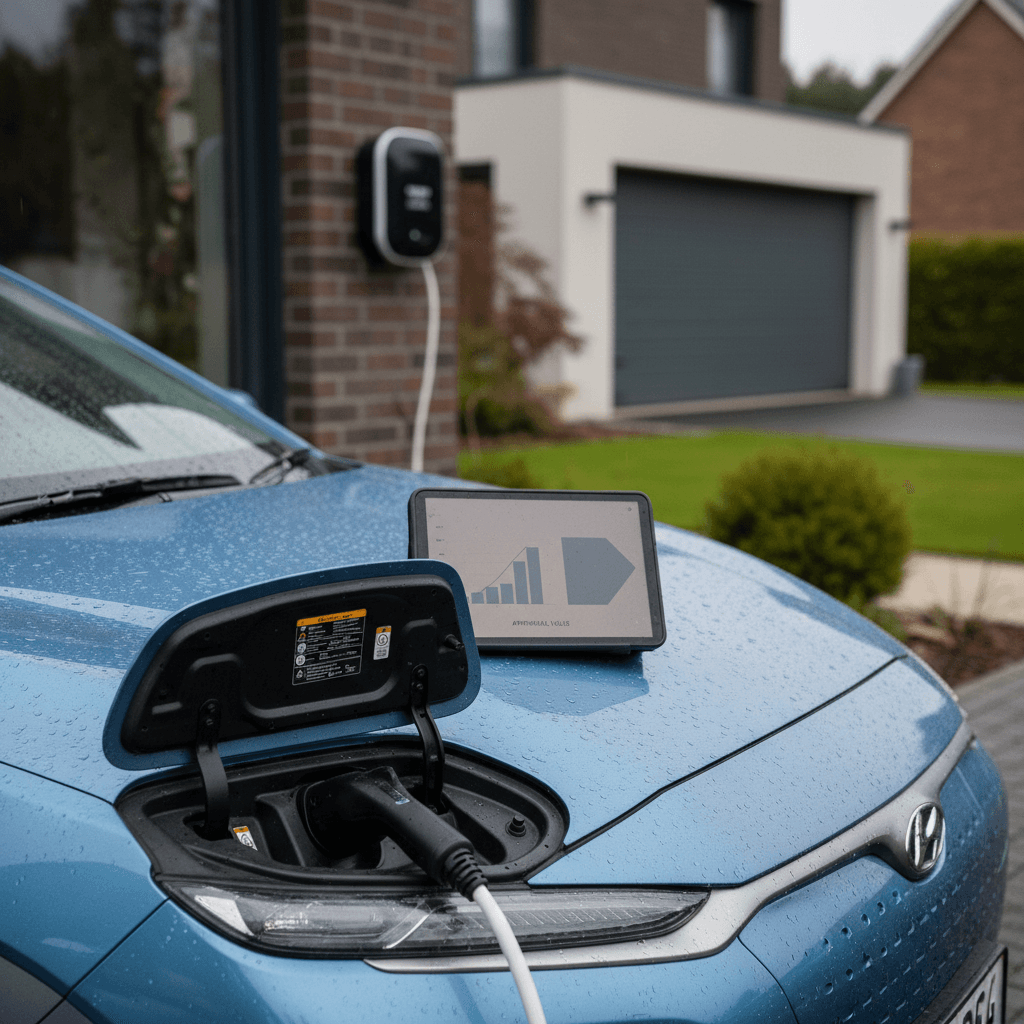
Underneath the styling updates and color choices, the 2024 Kona Electric is, fundamentally, a lithium‑ion battery pack with seats attached. That’s where the value lives. Buyers don’t pay for the number printed on the tailgate; they pay for the real range they can get on a cold Monday morning with the heater on.
- A 2024 SEL or Limited that still delivers very close to its original real‑world range looks attractive to the next owner – and to any smart buyer or marketplace.
- If your car’s usable range has sagged noticeably (frequent DC fast‑charging, lots of high‑heat use, or just bad luck), expect sharper discounts.
- Savvy dealers are starting to differentiate bids based on pack health, not just mileage. Two Konas with 20,000 miles may have very different futures if one has lived on a DC fast‑charge diet and the other has been gently sipping Level 2 at home.
Where Recharged fits in
Trade-in vs sell outright: where to take your 2024 Kona Electric
Four common ways to get rid of your 2024 Kona Electric
Each one trades dollars for convenience in a slightly different way.
Traditional dealer trade-in
Pros: Fast, easy; rolls equity straight into your next purchase; handles payoff paperwork.
Cons: Often the lowest dollar amount. Dealers may be conservative on EVs if they don’t sell many of them.
Instant online cash offer
Pros: Quick quote from your couch; multiple buyers with one form; no haggling in a showroom.
Cons: Subject to in‑person inspection; offers tend to cluster at the wholesale end of your Kona’s value range.
Private-party sale
Pros: Highest potential price; you capture the retail margin.
Cons: Requires photos, listings, test drives, paperwork, and a bit of nerves meeting strangers with a $20K+ EV.
Specialist EV marketplace (like Recharged)
Pros: EV‑savvy pricing, battery diagnostics, national buyer pool, and options like instant offer or consignment.
Cons: You may wait a bit longer than a same‑day dealer trade if you choose a consignment route to chase a stronger sale price.
If your priority is pure convenience, a dealer trade‑in or instant offer is hard to beat – you’re trading a chunk of equity for not having to think about it. If you’d like to maximize what your 2024 Kona Electric is actually worth, a dedicated EV marketplace or a private sale usually gets you closer to the top of the band, especially for well‑specced Limited and SEL cars.
7 ways to boost your 2024 Kona Electric trade-in offer
Pre‑trade checklist: small moves, real money
1. Get a professional detail
A clean, odor‑free interior and a polished exterior make your Kona Electric look like it’s been loved, not used. Appraisers are human – the nicer it feels, the easier it is to check the “Excellent” box in their software.
2. Fix obvious, cheap cosmetics
Think paintless dent repair, wheel rash touch‑up, and a cracked windshield. If a dealer sees $800 of reconditioning, they won’t subtract $800 – they’ll subtract more to cover hassle and margin. Doing the easy fixes yourself can narrow that gap.
3. Gather every key, charger, and accessory
Missing a key fob or the original portable charger? Those are instant deductions. Bring both keys, the charging cable, manuals, and any roof racks or cargo covers that came with the car.
4. Document service and recalls
Print or download service history, especially battery‑related warranty work, software updates, and tire rotations. A tidy paper trail reassures buyers that your Kona has been kept in spec.
5. Charge it sensibly before appraisal
You don’t need 100%, but you also don’t want to roll in with 3% state of charge and warnings flashing. Around 60–80% shows normal use, lets the appraiser verify range, and avoids the “this owner abuses the pack” narrative.
6. Get at least three real offers
Use a mix of dealer trades, online cash offers, and an EV specialist like Recharged. When you can put three written numbers side by side, suddenly everyone becomes more flexible.
7. Consider timing around incentives
If your state is about to introduce or sunset an EV tax credit, or if a new Kona Electric update has just been announced, values can shift. Sometimes waiting 60 days, or moving 60 days sooner, is worth thousands.
You don’t have to guess alone
Ready to find your next EV?
Browse VehiclesHow Recharged approaches 2024 Kona Electric valuation
Most mainstream dealers still treat EVs like slightly weird gas cars: book value in, a few adjustments out, and a shrug for anything involving kilowatt‑hours. At Recharged, the 2024 Kona Electric is home turf. It shows up in our data every week across trims, miles, and battery conditions, both at auction and in our own marketplace.
Battery first, then everything else
Because every Recharged vehicle gets a Recharged Score Report, we’re able to separate strong‑battery Konas from the pack. If your 2024 SEL still delivers range like a new car, we don’t punish it based on some worst‑case depreciation curve. That can push your valuation meaningfully above a generic wholesale bid.
Multiple ways to sell, one point of contact
You can come to Recharged for a straight instant offer, use your 2024 Kona Electric as a trade‑in toward another used EV, or place it on consignment and let us market it nationwide while you keep driving it. Our EV‑specialist team based in Richmond, VA, walks you through the numbers either way.
And because our retail buyers see the same transparent battery and pricing data, they’re more willing to pay real money for a well‑kept Kona than a random shopper on a generic classifieds site.
Watch out for the “EV penalty”
FAQ: 2024 Hyundai Kona Electric trade-in value
Frequently asked questions about 2024 Kona Electric trade-in value
Bottom line: when to trade your 2024 Kona Electric
The 2024 Hyundai Kona Electric is a clever, efficient little crossover, but the market doesn’t care how clever it is. It cares about what it can be flipped for at auction next Tuesday, how healthy the battery looks, and what the next owner will pay for the promise of painless electric miles. For most owners, that translates into a trade-in value somewhere in the high‑$10,000s to low‑$20,000s today, with Limited and clean‑battery examples pressing the high end of the band.
Your job is to decide how much you’re willing to trade for convenience. A fast dealer swap on your next gas SUV is one end of the spectrum; a carefully staged sale or EV‑specialist marketplace like Recharged sits at the other, where clean, well‑documented 2024 Kona Electrics are treated like the sharply efficient machines they are, priced not just by the badge, but by the real range and real demand. If you’re curious where your own car will land, that conversation is usually worth having before the odometer ticks any higher.