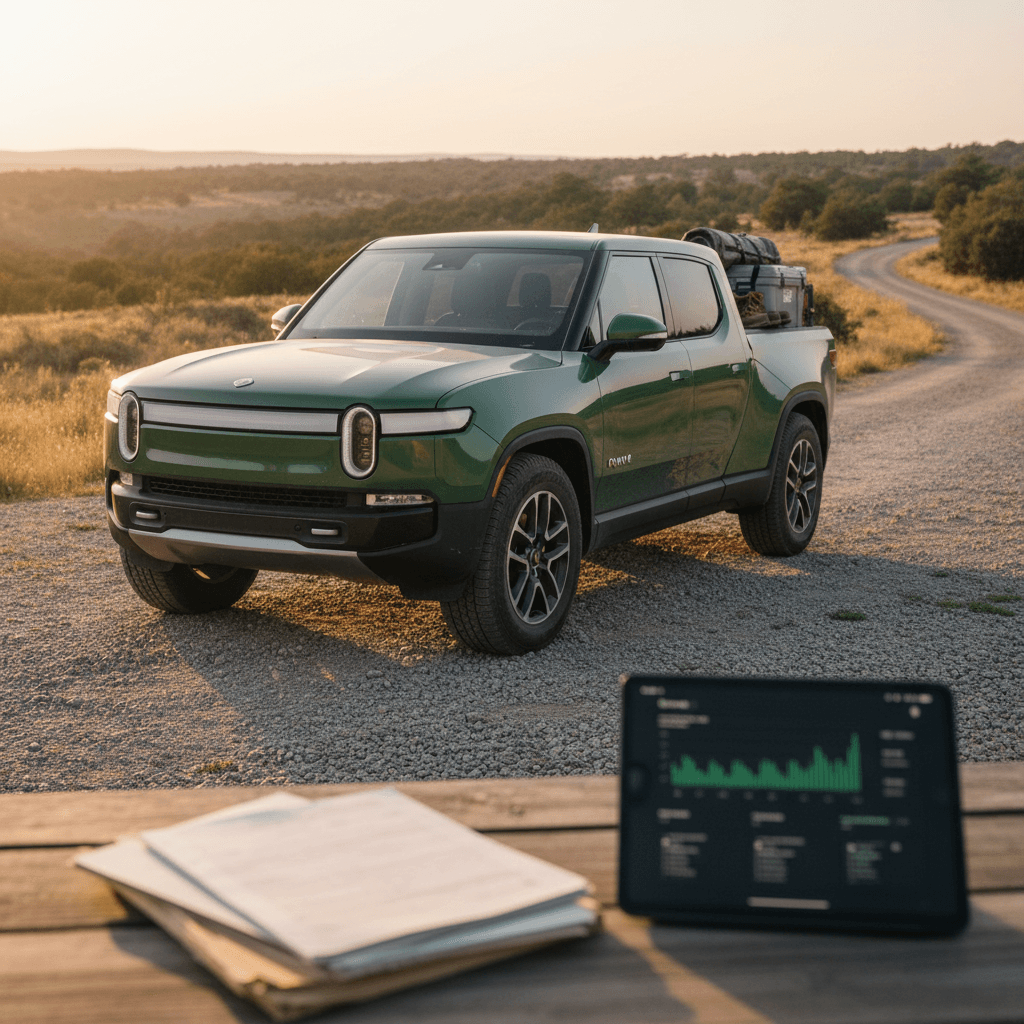
The 2023 Rivian R1T is the electric truck that proved EVs could be more than commuter appliances. With supercar‑level acceleration, legit off‑road hardware, clever storage, and a premium cabin, it targets both adventure gearheads and tech‑curious truck buyers. But how does the 2023 R1T actually perform on range, towing, and day‑to‑day livability, and what should you know if you’re shopping one used today?
Who this review is for
2023 Rivian R1T overview
Rivian launched the R1T as one of the first modern electric pickups, and the 2023 model year is effectively the second full year of production. By 2023, Rivian had expanded beyond the original quad‑motor “Launch Edition” into a broader lineup with dual‑motor options and three battery packs: Standard, Large, and Max. That makes 2023 a sweet spot: you get more choice than early builds, without the major platform changes that arrived for 2025.
2023 Rivian R1T key numbers at a glance
Don’t ignore wheel and tire choice
Trims, motors, and battery packs explained
For 2023, Rivian simplified the R1T lineup around a single main trim, Adventure, with multiple drive and battery options, plus the earlier Launch Edition still in circulation. Understanding these combinations is crucial when you’re browsing used listings, because they dramatically change performance, range, and price.
2023 Rivian R1T configurations
Common 2023 R1T builds you’ll see on the used market and what they mean in practice.
| Configuration | Motors / Drive | Battery pack | EPA range (approx.) | 0–60 mph (approx.) | Notes |
|---|---|---|---|---|---|
| Adventure Dual‑Motor Standard | Dual‑motor AWD | Standard | ≈270 mi | ≈4.5 s | Lower price, enough range for many commuters |
| Adventure Dual‑Motor Large | Dual‑motor AWD | Large | ≈340–350 mi | ≈4.5 s | Great mix of range and cost; common spec |
| Adventure Dual‑Motor Max | Dual‑motor AWD | Max | ≈390–410 mi | ≈4.5 s | Longest‑range R1T; limited availability in 2023 |
| Launch / Adventure Quad‑Motor Large | Quad‑motor AWD | Large | ≈314–340 mi | ≈3.1–3.4 s | Flagship performance; more complex and less efficient |
Exact EPA range varies by wheel size and tire; use these as ballpark guides rather than absolutes.
Dual‑motor vs. quad‑motor: what used buyers should know
Performance, driving experience, and off-road capability
From behind the wheel, the 2023 Rivian R1T feels like a mash‑up of a luxury SUV and an off‑road toy, with performance that would embarrass a lot of sports cars. Quad‑motor trucks tested with the Large pack can sprint to 60 mph in a bit over 3 seconds, and even the dual‑motor setups post mid‑4‑second times, still wildly quick for a 6,500‑plus‑pound pickup.
On‑road manners
- Adaptive air suspension and continuously variable dampers smooth out most pavement seams.
- Low center of gravity from the battery pack gives the R1T a planted, almost SUV‑like feel in corners.
- Steering is light but precise enough; there’s far less body roll than a body‑on‑frame gas truck.
- Instant torque makes passing effortless, even when loaded with gear.
Off‑road capability
- Up to ~14 inches of ground clearance in Off‑Road mode with air suspension at full height.
- Quad‑motor trucks can independently vector torque at each wheel for impressive traction.
- Multiple drive modes (All‑Purpose, Sport, Off‑Road, Tow, Conserve) tailor ride height and power delivery.
- Standard underbody shielding and available all‑terrain tires support real trail use, not just trailhead parking.
Kneel & Camp modes
Range and real‑world efficiency
Paper range numbers for the 2023 Rivian R1T span from around 270 miles (dual‑motor Standard pack) up to roughly 410 miles (dual‑motor Max pack in its most efficient configuration). In independent instrumented testing, a quad‑motor Large‑pack R1T on 22‑inch street tires returned about 280 miles at a steady 75 mph highway cruise, roughly in line with EPA expectations for that setup. Trucks on 20‑inch all‑terrains have shown materially lower real‑world range at the same speeds.
- Quad‑motor Large pack: real‑world highway range often lands in the ~220–280 mile window depending on wheels and tires.
- Dual‑motor Large pack: generally a bit more efficient; plan on ~260–300 miles at 70–75 mph in good conditions.
- Standard pack: better suited to shorter commutes and regional weekend use than 400‑mile road‑warrior duty.
- Max pack: designed for long‑distance drivers and towers; think of it as the R1T’s true “road trip” spec.
Range swings more than in smaller EVs
Towing, hauling, and everyday utility
If you’re considering a 2023 R1T, you’ve probably seen the 11,000‑pound towing headline. That number is real: every R1T configuration is rated to tow that maximum, with payload around 1,700–1,760 pounds. Where things get trickier is how towing interacts with battery range and charging logistics.
What towing in a 2023 R1T really looks like
How the truck behaves when you hitch up a trailer
Impressive control
Owners consistently report that the R1T tows with more confidence and stability than comparable gas trucks. Instant torque and regenerative braking help manage grades without drama.
Big range penalties
Independent tests and owner reports show a 30–60% range hit when towing, depending on trailer size, speed, and terrain. A heavy camper at 70 mph can cut practical range close to 100–150 miles between charges.
Charging with a trailer
Most public DC fast chargers aren’t laid out for pull‑through towing. You’ll often need to drop the trailer or block multiple stalls, something to plan around on busy corridors.
Where the R1T shines is everyday utility beyond towing. The bed hides an under‑floor storage well big enough for a spare or an ice‑filled cooler, there’s an 11‑plus‑cubic‑foot frunk, and the signature Gear Tunnel between the cab and bed adds another ~12 cubic feet with side access doors that double as steps or seats. For camping and outdoor use, those touches make the R1T feel far more versatile than its mid‑size footprint suggests.
Think in legs, not total trip distance
Charging experience and road‑tripping in an R1T

The 2023 R1T charges using the CCS standard in North America and comes with an 11.5‑kW onboard AC charger. On a 240‑volt Level 2 home or workplace charger, that’s good for roughly 25 miles of range per hour, enough to refill even a big battery overnight. For road trips, Rivian’s stated peak DC fast‑charge rate is around 220 kW, with well‑specced trucks adding about 140 miles of range in roughly 20 minutes on a strong charger.
- Rivian’s own DC fast‑charging network (Rivian Adventure Network) offers plug‑and‑charge convenience and tends to be in scenic, outdoors‑oriented locations.
- CCS compatibility means you can also use major third‑party networks like Electrify America and EVgo with the correct payment apps or cards.
- The truck supports scheduled charging and charge‑limit settings so you can stop at ~70–80% for everyday use to preserve long‑term battery health.
Home charging is non‑negotiable for most owners
Interior, tech, and comfort
Inside, the 2023 Rivian R1T feels more like a Scandinavian‑inspired luxury SUV than a work truck. Materials are generally high‑quality, with open‑pore wood, synthetic leather, and textured fabrics. The driving position is upright but comfortable, and the cabin is quiet even at highway speeds thanks to the EV powertrain and double‑pane glass on many builds.
Tech highlights in the 2023 R1T
What stands out, and what’s missing
Big screens everywhere
A 12.3‑inch digital gauge cluster and a 15.6‑inch central touchscreen run Rivian’s in‑house software, while rear passengers get a smaller climate control display.
Driver+ assistance suite
Standard Driver+ includes adaptive cruise control, lane keeping, blind‑spot monitoring, automatic emergency braking, and a hands‑free highway assist feature on mapped roads.
Limited phone integration
There’s built‑in navigation, Bluetooth, and wireless phone charging, but no Apple CarPlay or Android Auto. If you live inside those ecosystems, that’s a real trade‑off.
Software UX is opinionated
Reliability, ownership costs, and used pricing
Any early EV startup invites questions about long‑term durability and service coverage. The good news is that long‑term testing and early‑owner data on the first‑gen R1T suggests the fundamentals, battery, motors, and chassis, have held up well over high mileage. A 40,000‑mile test truck, for example, retained its blistering acceleration and braking performance with no catastrophic failures, though it did require software updates and minor fixes along the way.
- Rivian’s warranty for 2023 trucks includes 5 years/60,000 miles bumper‑to‑bumper and 8 years/175,000 miles on the battery and drivetrain for the R1T.
- Routine maintenance is lighter than a gas truck (no oil changes, spark plugs, etc.), but you still have wear items like tires, brakes, and suspension components, and the R1T is heavy, so budget accordingly.
- Service is a mix of mobile technicians and service centers; coverage is good in many metro areas but can be sparse in rural regions, so factor travel time into your ownership expectations.
Used pricing snapshot (early 2026)
Buying a used 2023 Rivian R1T: what to look for
Because the 2023 R1T sits at the intersection of luxury truck and high‑performance EV, a smart used purchase starts with battery health and build configuration, then moves to how, and where, the truck has been used. Here’s how to stack the deck in your favor.
Key checks before you buy a 2023 R1T used
1. Confirm battery pack and motor setup
Verify whether you’re looking at a Standard, Large, or Max pack and whether it’s dual‑ or quad‑motor. This determines not just performance and range, but also long‑term energy costs.
2. Evaluate real battery health, not just range guess
Range readouts can be influenced by recent driving. Whenever possible, look for a third‑party battery health report, like the <strong>Recharged Score</strong>, that measures usable capacity and pack condition directly rather than relying on the dash estimate.
3. Check tire type and wheel size
Confirm whether the truck is on 20‑inch all‑terrains or 21/22‑inch street tires. If a prior owner swapped to aggressive tires without updating the configuration, reported range can be inaccurate and efficiency worse than expected.
4. Ask about towing and off‑road usage
A truck that has spent its life towing near max rating or hammering off‑road trails isn’t necessarily a bad buy, but it increases the importance of a thorough inspection of suspension, brakes, and tires.
5. Review software and service history
Make sure the truck is on current Rivian software and ask for records of warranty work, recalls, and any collision repairs. Software updates can materially change behavior, efficiency, and Driver+ performance.
6. Inspect for water and dust intrusion
Given the R1T’s outdoor mission, check the bed, Gear Tunnel, frunk seals, and underbody shielding for signs of water ingress, corrosion, or damage from trail use.
How Recharged helps de‑risk a used R1T purchase
Ready to find your next EV?
Browse Vehicles2023 Rivian R1T FAQ
Frequently asked questions about the 2023 Rivian R1T
Final thoughts: is the 2023 R1T right for you?
The 2023 Rivian R1T is not a traditional pickup with an electric powertrain tacked on, it’s a clean‑sheet rethink of what a truck can be. It delivers staggering straight‑line performance, real off‑road chops, and clever packaging, wrapped in a design that looks as at home downtown as it does at a trailhead. In return, you accept a more complex software experience, meaningful range penalties at high speed or when towing, and a younger service network than legacy brands.
If your life involves regular towing of big trailers over long distances, a diesel or hybrid truck may still be the rational choice. But if your mix is daily commuting, weekend road trips, mountain bikes, kayaks, and the occasional camper, the 2023 R1T is one of the most compelling, and now, on the used market, surprisingly attainable, EVs you can buy. And with tools like the Recharged Score battery health report, expert EV guidance, and nationwide delivery, Recharged can help you find a used R1T that fits your range needs, budget, and appetite for adventure with far fewer unknowns than going it alone.