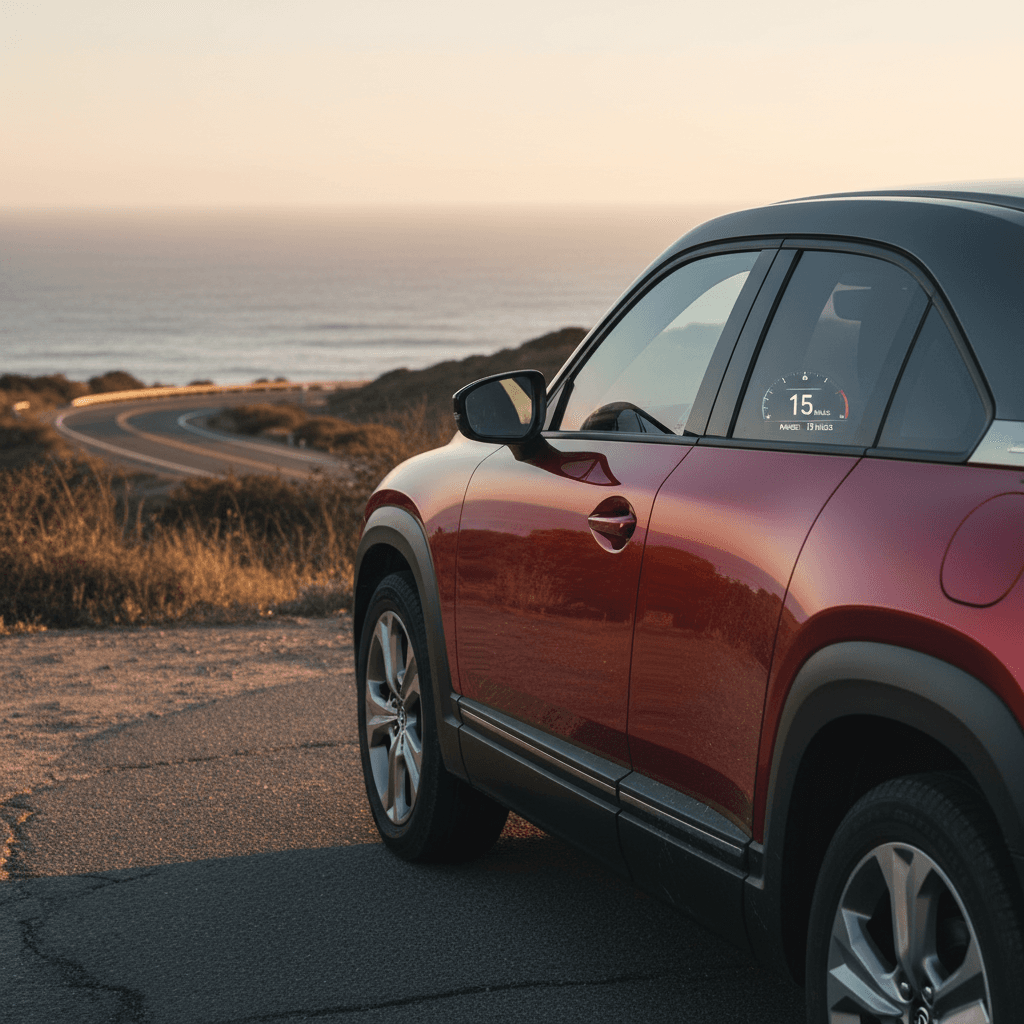
Among modern EVs, the 2023 Mazda MX-30 is a contrarian. Where rivals chase 250‑ to 300‑mile ratings, Mazda shrugged and gave its first U.S. EV a 100‑mile EPA range and a small battery, arguing that’s enough for urban life. Our 2023 Mazda MX-30 range test dives into what that number really looks like in everyday driving, and whether this charming misfit makes sense for you as a used EV in 2026.
Key takeaway
2023 Mazda MX-30 range at a glance
MX-30 range snapshot (2023 EV, U.S.-spec)
On paper, the MX-30 is outgunned. The EPA rates it at 100 miles of total range on a full charge with combined efficiency of 92 MPGe (about 37 kWh/100 miles). Its battery is just 35.5 kWh, roughly half the size of the packs you’ll find in mainstream crossovers that travel 240–300 miles between stops. Yet in independent testing, careful drivers have eked out about 114 miles before the pack gives up, nudging past the sticker number but not transforming the car into a road-tripper.
Battery size and EPA range rating explained
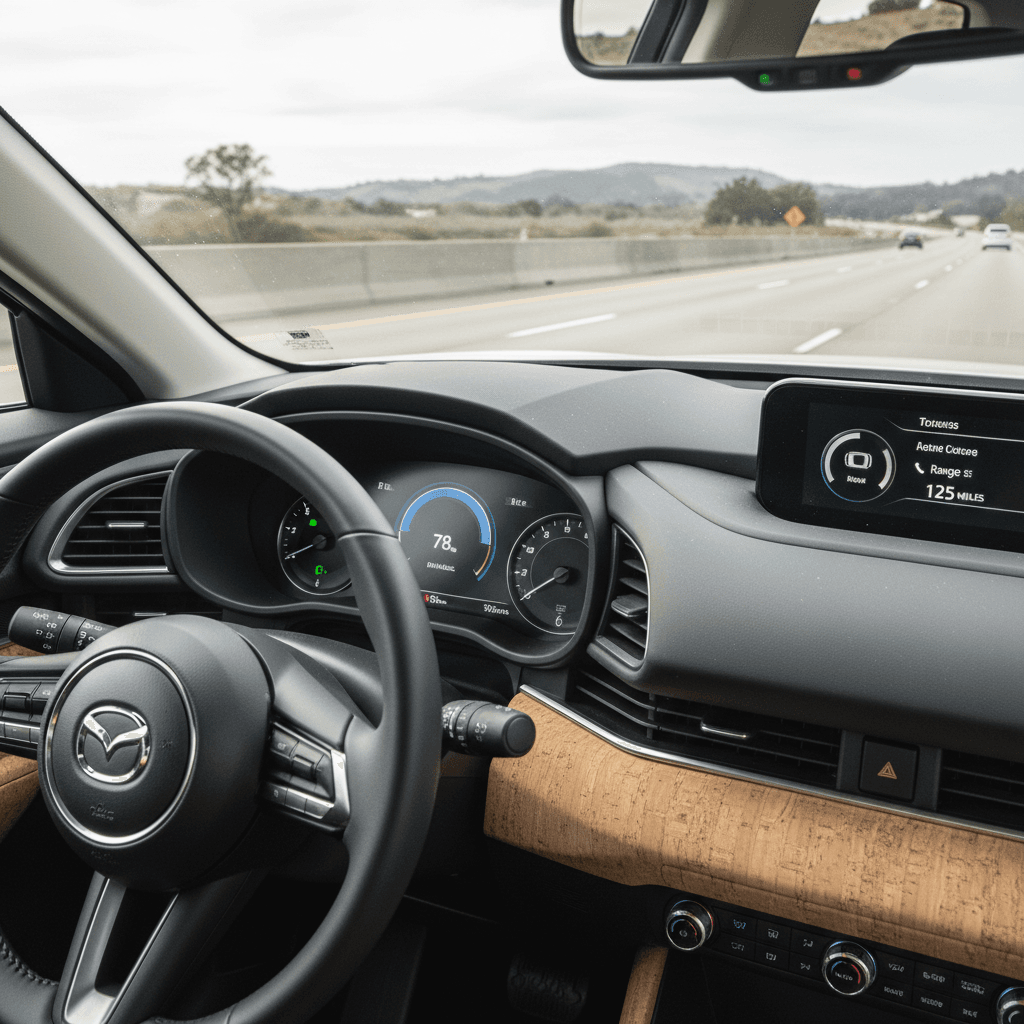
Mazda built the MX-30 around a 35.5 kWh lithium-ion battery and a single front-mounted electric motor. Think of that battery as a starter pack in a world where 60–80 kWh is the norm. The EPA translates that usable capacity into a 100‑mile official range, with city driving slightly favored over the highway in efficiency.
- Battery: 35.5 kWh total (about 33–34 kWh usable in real life)
- EPA range: 100 miles combined (98 MPGe city, 85 MPGe highway)
- EPA energy use: ~37 kWh per 100 miles, on the thirsty side for a compact EV
- AC onboard charger: 6.6 kW (Level 2), DC fast charge peak around 36–50 kW
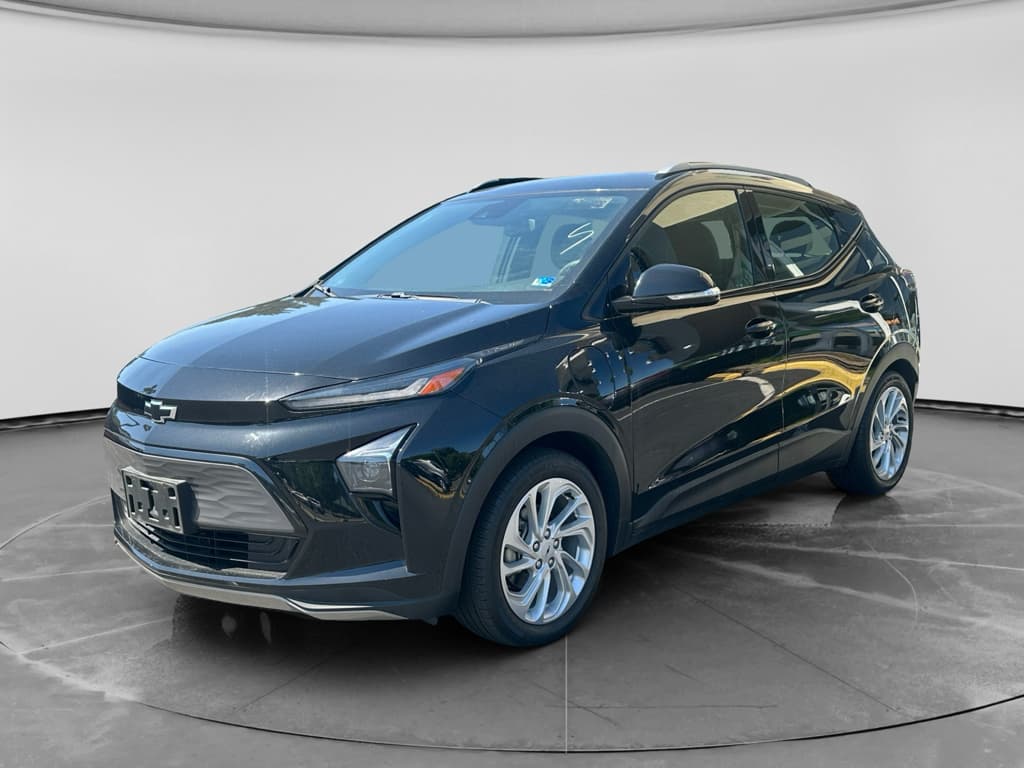
The small pack was a deliberate philosophical move by Mazda. Instead of a big, heavy battery you rarely fully use, they chose a lighter pack that fits daily commuting and claims a smaller materials footprint. It’s an honorable idea, but one complicated by the reality of U.S. distances and infrastructure, and by the fact that the MX-30 isn’t particularly efficient for its size. Compact EVs like the Hyundai Kona Electric and Chevy Bolt travel more than twice as far on a slightly larger battery while using less energy per mile.
Don’t confuse EPA with guaranteed range
City vs highway: how the MX-30 behaves in real-world tests
In the city: the MX-30’s comfort zone
At low to moderate speeds with lots of deceleration, the MX-30 can slightly beat its EPA rating. Independent mixed-driving tests have reached around 114 miles on a charge by leaning into urban routes, gentle acceleration, and smart use of regenerative braking.
- Stop‑and‑go traffic recovers energy through regen
- Speeds under 45 mph dramatically lower drag
- Climate control demand is lower in mild weather
Drive it like a city hatchback, and the car rewards you with range that feels closer to what the dashboard promises when you unplug.
On the highway: the air is your enemy
Take the MX-30 out onto a 70–75 mph interstate and you see its limitations fast. In steady highway range testing at typical U.S. speeds, the effective range drops toward 70–90 miles before you’re nervously hunting for the next charger.
- Aerodynamic drag rises with the square of speed
- The MX-30’s efficiency lags best‑in‑class EVs
- There’s little buffer: 10–15 miles of range can vanish quickly in a headwind or uphill stretch
If your weekly routine includes long freeway slogs, this is the wrong Mazda for the job.
How to stretch MX-30 range on your commute
What happens to MX-30 range in cold weather?
Small batteries swing the biggest. Because the MX-30 starts with just 35.5 kWh, any seasonal penalty shows up as a bigger percentage hit to usable range compared with a 77 kWh pack in, say, a Volkswagen ID.4. In winter, you’re battling three things: denser cold air, a cold-soaked battery chemistry that can’t deliver full punch, and a resistive cabin heater that gulps electrons.
Typical winter impacts on MX-30 range
Exact losses depend on climate, speed, and how you heat the cabin, but the trend is clear.
Mild cold (40–50°F)
Expect 10–15% range loss if you’re mostly on city streets and using seat and wheel heaters more than the full cabin heater.
Freezing temps (20–32°F)
On mixed driving, a realistic hit is 20–30%, pushing a rated 100‑mile pack toward the 70–80 mile window.
Sub‑freezing at highway speeds
Combine 75 mph, a stiff headwind, and the heater on full and you can see 30–40% shaved off the dash estimate. This is how you end up looking for a charger after only an hour on the road.
Worst-case scenario to avoid
Is the MX-30’s 100‑mile range enough for you?
Whether the MX-30’s range works depends less on the car and more on your life. For a certain narrow band of drivers, it’s oddly perfect: people with consistent, short commutes, easy access to home or workplace charging, and another long‑range vehicle in the household. For everyone else, it feels like a beautifully made jacket in the wrong size.
Quick ownership fit check: should you consider an MX-30?
Your daily round trip is under 60 miles
If your full day of errands and commuting rarely tops 40–60 miles, the MX-30’s effective 90–120 mile envelope (season- and speed-dependent) leaves a comfortable buffer.
You can charge at home or work
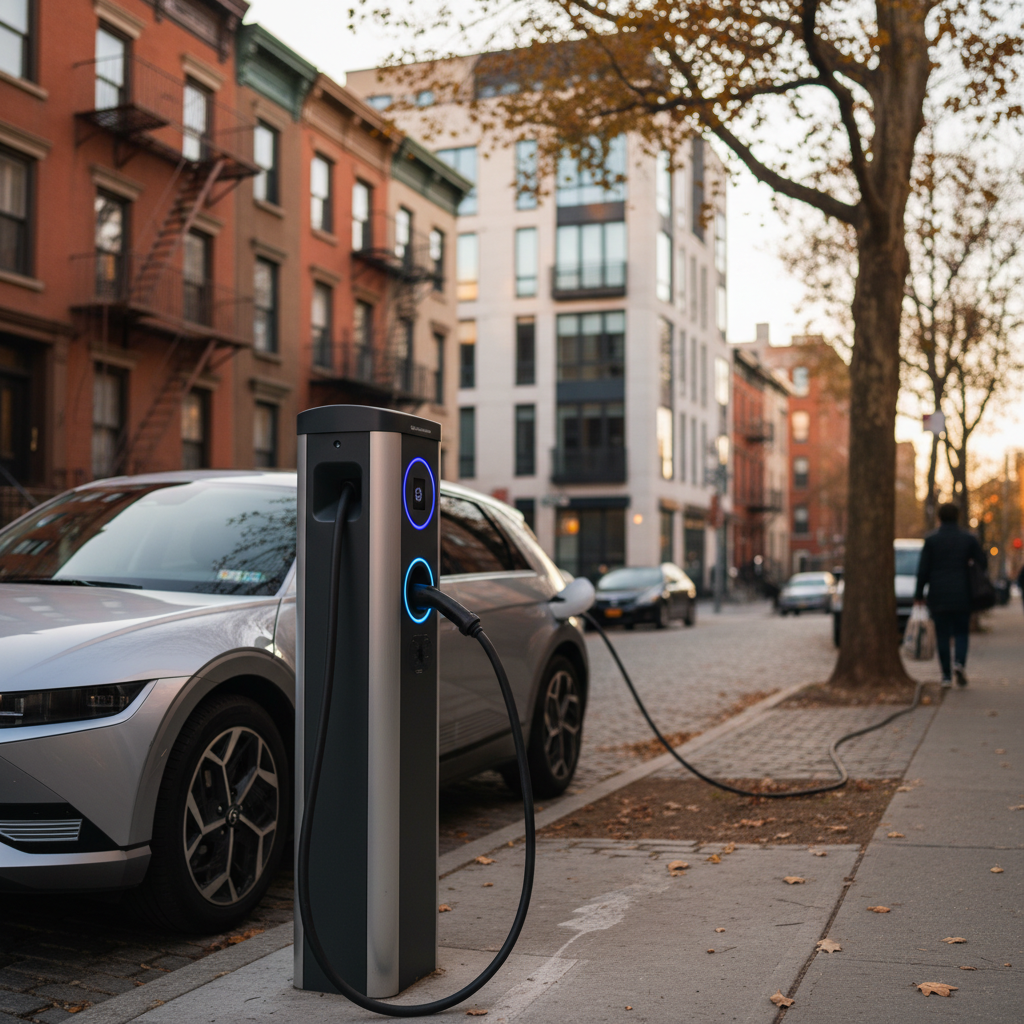
Relying only on public charging with such a small pack gets old fast. A reliable Level 2 in your garage or at the office makes the MX-30 feel far less claustrophobic.
You own (or keep) a gas car or long‑range EV
Think of the MX-30 as an urban runabout. For cross‑state trips, airport runs in bad weather, or visiting family 150 miles away, you’ll want another vehicle in the stable.
You value handling more than highway legs
Mazda tuned the MX-30 to feel tossable and refined at city speeds. If you care more about steering feel and ride quality than 0–60 times or range bragging rights, that matters.
You live in a charger-dense metro
Dense networks in places like California’s Bay Area, Portland, or the Northeast corridor can soften the car’s limitations. Rural areas with 50–100 mile gaps between fast chargers? Not so much.
Where the MX-30 makes real sense
Charging times and living with a 35 kWh pack
The upside of a tiny battery is fast top‑ups. The MX-30’s 6.6 kW onboard AC charger and modest pack mean you can go from nearly empty to full much faster than big‑battery SUVs, even on relatively modest home hardware.
2023 Mazda MX-30 charging times (approximate)
Real-world times vary with temperature, state of charge, and charger behavior, but this is what to expect day to day.
| Charging method | Power | 0–100% time | 20–80% time | Best use case |
|---|---|---|---|---|
| Standard wall outlet (Level 1) | 120V ~1.4 kW | 13–14 hours | +10 hours | Emergency top‑ups only |
| Home Level 2 (typical) | 240V 6.6 kW | ~5–5.5 hours | ~2.5–3 hours | Overnight or workday charging |
| Public Level 2 | Up to 6.6 kW (car-limited) | Similar to home | Similar to home | Destination charging at malls, hotels |
| DC fast charger | Up to ~50 kW peak | ~45–60 minutes | ~30–40 minutes | Quick midday boost or stretch between errands |
Level 2 at home is where the MX-30 feels easiest to live with.
Pro move: treat 20–80% as your working band
If you’re cross‑shopping used EVs, note that the MX-30’s DC fast‑charging speed is modest, peaking around 36–50 kW. That’s fine when you’re only stuffing 20 kWh back into the pack, but it means you’re not buying time back with brute charging power the way you might in a Hyundai Ioniq 5 or Tesla Model 3.
Buying used: MX-30 battery health and degradation
The silver lining of a short-range EV is that it’s hard to rack up punishing miles. The vast majority of 2022–2023 MX-30s sold in the U.S. lived as lease specials and low‑mileage commuters. That’s good news for battery health, but you still want data, not vibes, when you’re shopping used.
How to sanity‑check a used MX-30’s battery
A small battery magnifies any loss, so verify before you sign.
Get a quantified health report
Ask for a recent battery health report rather than a casual “feels fine.” At Recharged, every EV gets a Recharged Score that includes lab‑grade pack diagnostics, so you can see how much usable capacity remains compared with new.
Compare real range to the original 100 mi
On a full charge in mild weather, an MX-30 in good shape should still show a range estimate in the 90–110 mile window. If you’re seeing much less with similar conditions and driving style, dig deeper before you buy.
Why small packs demand better inspections
When you shop through a specialist marketplace like Recharged, you also get EV‑focused guidance on day‑to‑day costs, charging options at your address, and trade‑in or consignment options if you’re moving from a gas car. That context matters more with a niche EV like the MX-30, where lifestyle fit is everything.
MX-30 vs other short‑range EVs
Context is cruel. In today’s EV market, the MX-30 sits at the absolute bottom of the range table, even among small, older designs. Here’s how it stacks up against other short‑range used EVs you might be considering.
How the 2023 MX-30 compares to other short‑range EVs
Approximate EPA ranges for U.S.-spec models.
| Model & year | EPA range (mi) | Battery size (kWh, approx.) | Notable trait |
|---|---|---|---|
| Mazda MX-30 (2023) | 100 | 35.5 | Best steering feel; worst range |
| Mini Cooper SE (2023) | 114 | 32.6 | Fun, quick, short‑legged city car |
| Nissan Leaf S (40 kWh, 2023) | 149 | 40 | Aging but practical compact hatch |
| Hyundai Kona Electric (2023) | 258 | 64 | Class‑leading range and efficiency |
| Chevy Bolt EV (2023) | 259 | 65 | Outstanding value and range combo |
Only the MX-30 dips into triple‑digit territory in 2023; most rivals clear 150 miles or more.
When the MX-30 is still the right answer
- You find a very attractively priced used example with low miles.
- Your driving is strictly urban/suburban with home charging.
- You care more about ride, refinement, and styling than range.
- You view it as a three‑ to five‑year solution, not a decade‑long partner.
When another used EV fits better
- You ever say the words “road trip” or “airport two hours away.”
- You can’t install a Level 2 charger at home or work.
- You want a single do‑everything EV for a small family.
- You’d rather trade a bit of Mazda charm for twice the range in a Bolt or Kona.
FAQ: 2023 Mazda MX-30 range questions
Frequently asked questions about MX-30 range
Verdict: who the MX-30 actually suits
The 2023 Mazda MX-30 is a lovely answer to a very specific question: “What if my entire driving life fits neatly inside a 30‑mile radius?” Its steering is crisp, the cabin is thoughtfully designed, and in tight city streets it feels right‑sized and honest. But as our range testing makes plain, its 100‑mile EPA rating and modest efficiency leave it badly exposed in a market where 250 miles is the new normal.
If you’re shopping for a used EV and live in a dense, charger‑rich metro with another vehicle in the driveway, a well‑priced MX-30 can make a charming, sustainable little runabout, especially if you buy with verified battery health data and a clear-eyed understanding of its limits. Browse options on platforms like Recharged, where every EV includes a Recharged Score report, transparent pricing, and EV‑specialist support, and you can decide whether Mazda’s short‑range experiment fits your life or whether you’re better served by a longer‑legged alternative.