If you’re shopping for an affordable used EV, the 2023 Chevrolet Bolt EV will land on your shortlist quickly. The obvious next question is: **how reliable is it really**, especially given the Bolt’s very public battery‑fire recall history? This guide breaks down the 2023 Chevrolet Bolt EV reliability rating, what the major agencies and owners are seeing, and what you should look for before signing anything.
Quick reliability snapshot
Overview: 2023 Bolt EV reliability rating in one look
2023 Chevrolet Bolt EV at a glance
From a distance, the 2023 Bolt EV looks like a **late‑cycle, sorted‑out product**. It’s the final year of the original Bolt hatchback, built after GM reworked the battery supply chain and recall procedures. Major survey data and owner forums generally show **solid daily reliability**, with issues clustering in three places: battery history (because of the earlier fire recalls), climate control, and random electronics glitches.
Important context for reliability scores
How major rating agencies score the 2023 Bolt EV
You’ll see different numbers depending on where you look, but they generally tell a similar story: the 2023 Bolt EV is **no longer a reliability outlier**, good or bad. It tends to land near the middle of the compact‑car pack, edging above average in some surveys.
Key reliability rating sources for the 2023 Bolt EV
How different agencies and data sets frame the same car
Consumer survey data
Large consumer‑survey programs report that the **2023 Bolt is more reliable than the average 2023 vehicle**, but not trouble‑free. Reported problem spots are battery‑related events, climate system quirks, and some suspension/steering items.
Quality & dependability studies
Industry dependability studies that break out the Bolt EV typically place **2019–2023 Bolts in the "average" zone** for long‑term dependability. That’s a major improvement over early‑recall years and puts the 2023 car in the same general neighborhood as many mainstream compacts.
Owner reviews & forums
Owner reviews on shopping sites and forums skew positive: many 2023 owners report **trouble‑free daily use** beyond routine maintenance, while a smaller but vocal minority mention climate system failures, infotainment glitches, or recall‑related downtime.
How to read these scores as a buyer
Battery history and recalls: what changed by 2023
You can’t talk about Bolt reliability without addressing the **battery‑fire recalls**. The good news: the most serious recall campaigns focused on **2017–2022 Bolt EV and 2022 Bolt EUV** packs built with specific LG Chem modules. The 2023 Bolt EV arrived after GM had already shut down production, re‑engineered the battery manufacturing process, and restarted the line with updated packs and monitoring software.
- Earlier Bolts (2017–2022) saw a series of recalls for rare but serious **thermal‑runaway battery fires**, often triggered at high states of charge when parked.
- Remedies included **software that limited state of charge**, additional diagnostic monitoring, and in many cases **complete battery pack replacement** under warranty.
- By the 2023 model year, GM was installing **revised battery packs and updated software from the factory**, and the fire‑related recall campaigns largely stopped at 2022.
Battery warranty still matters
That doesn’t mean battery‑related work is off the table. GM continues to issue **technical service bulletins and software campaigns** to refine battery monitoring and, in rare cases, replace modules or packs. The difference for 2023 is that you’re generally starting with a **post‑recall‑era pack and smarter software**, not a first‑generation design that still needs to be proven.
Common issues reported on the 2023 Bolt EV
In owner forums, complaint databases, and service bulletins, there’s no single, widespread failure that defines the 2023 Bolt EV. Instead, you see a **scatter of smaller issues** that are annoying but rarely terminal. When you’re scanning listings or inspecting a car, these are the themes to watch for.
Most commonly reported 2023 Bolt EV issues
Patterns seen across owner reports and service campaigns
| Area | Typical symptom | Reliability impact | What to do |
|---|---|---|---|
| Battery/charging | Occasional charging interruptions, SOC limited after software update, rare pack replacements | Usually low; serious issues tend to be caught under warranty | Confirm all **battery recalls/software updates** are done; review capacity and DC fast‑charge history. |
| Climate system | AC stops blowing cold, intermittent heat, compressor or HVAC control failures | Medium; uncomfortable and not cheap to fix out of warranty | Test AC and heat thoroughly; scan for HVAC‑related trouble codes. |
| Electronics & screens | Frozen infotainment, random reboots, Bluetooth dropouts, camera glitches | Low to medium; frustrating but often fixed by updates | Check for latest **infotainment and module software**; test all functions on a long drive. |
| Driver‑assist features | Lane‑keep assist warnings, camera or sensor faults, steering‑column sensor issues | Low safety impact if caught; systems usually fail safe | Verify adaptive cruise, lane‑keep and camera systems work as advertised. |
| Suspension/steering | Clunks over bumps, premature bushing or strut wear | Low; typical wear‑and‑tear for compact cars | Listen on rough roads; check for uneven tire wear and alignment reports. |
Not every 2023 Bolt EV will experience these problems, but they’re worth checking on a test drive and during a pre‑purchase inspection.
Red flags to take seriously
Real‑world owner experience and high‑mileage data
Survey scores tell one story; **high‑mileage cars tell another**. By 2026, many 2023 Bolt EVs have piled on serious miles as commuter workhorses, rideshare vehicles, and fleet cars. Those that were built with updated packs and kept current on software are starting to show **encouraging long‑term behavior**.
- Multiple documented 2023 Bolt EVs have crossed **70,000–100,000 miles** with only routine maintenance and minor software or HVAC fixes.
- A high‑mileage 2023 Bolt EV report at roughly **90,000+ miles** measured just a few percent loss in displayed battery capacity, suggesting relatively **slow degradation** when fast‑charging and deep cycling are managed responsibly.
- On the flip side, owners who did run into problems tend to cite **dealership knowledge gaps and parts delays** more than fundamental design flaws, especially for battery or high‑voltage work. The repair itself is usually covered; the downtime is the pain point.
“The Bolt EV may not charge the fastest or boast the longest range in its class, but reliability and predictability often matter more than peak specifications once the novelty wears off.”
What this means for you
How 2023 Bolt EV reliability compares to other affordable EVs
In the 2023 model year, the Bolt EV sat in a small but growing field of **budget‑friendly compact EVs**, Hyundai Kona Electric, Nissan Leaf, Kia Niro EV and a few others. None of them are perfect; all juggle some mix of software quirks, charging‑curve complaints, or build‑quality nitpicks.
Where the 2023 Bolt EV looks strong
- Mature powertrain: The motor, single‑speed gearbox and core EV hardware were largely carry‑over and already well‑proven by 2023.
- Battery warranty support: GM’s history of replacing complete packs under recall reassured many owners, even if the process could be slow.
- Simple cooling/heating layout: Fewer complex plumbing systems than some heat‑pump competitors can mean fewer exotic failures.
Where rivals may have an edge
- Thermal management sophistication: Some newer‑platform EVs launched in 2023–2024 benefit from more modern heat‑pump systems and updated electronics architectures.
- Recall reputation: Shoppers who followed the Bolt battery saga closely may perceive rivals as “safer bets,” even if their hard‑data scores look similar.
- Fast‑charge performance: The Bolt’s modest DC fast‑charge speeds are reliable but slower than many peers, which some owners interpret as a downside.
Bottom‑line comparison
Used 2023 Bolt EV buyer’s reliability checklist
If you’re evaluating a used 2023 Chevrolet Bolt EV, focus less on paint swirls and more on **battery health, recall status and software history**. Here’s a practical checklist you can take to a dealership or private‑party seller.
Reliability checklist for a used 2023 Bolt EV
1. Confirm all battery and software campaigns
Ask the seller for a **printout of completed recalls and service campaigns**, especially anything involving the high‑voltage battery or battery‑monitoring software. If anything is open, insist it be completed before delivery.
2. Get a real battery‑health read
Don’t rely only on the dash range number. A tool such as the **Recharged Score battery health report** pulls real diagnostic data to show how much capacity the pack is holding versus new and whether it has been heavily fast‑charged.
3. Review fast‑charging and mileage patterns
A 2023 Bolt EV that lived its life as a **200‑mile‑a‑day DC‑fast‑charge commuter** may have a tougher future than one that saw mostly home Level 2 charging and moderate mileage. High mileage isn’t bad by itself if the battery still tests strong.
4. Test HVAC and comfort features thoroughly
Let the car sit running while you test **AC, heat, defrost, heated seats and steering wheel**. Sudden loss of cold air or inconsistent heat can signal HVAC issues that are expensive to chase down out of warranty.
5. Drive it long enough to expose glitches
Plan a **20–30 minute mixed test drive**. Cycle through drive modes, one‑pedal driving, cruise control, lane‑keep assist and infotainment functions. Watch for warning lights, odd noises or “propulsion power reduced” messages.
6. Scan for diagnostic trouble codes (DTCs)
Have a trusted shop or EV‑savvy seller scan the car. Soft codes related to **battery performance, DC fast‑charging or drivetrain torque limits** can give you a preview of problems that haven’t fully surfaced yet.
7. Verify remaining warranty coverage
Confirm in writing the exact **in‑service date**, remaining basic warranty (if any), and battery warranty horizon. For many 2023 cars, you should still have years of high‑voltage coverage left.
Negotiating with reliability data
How Recharged evaluates a used 2023 Bolt EV
Because of the Bolt’s recall history and the importance of battery health to long‑term value, Recharged takes a **data‑heavy approach** to every 2023 Bolt EV we list. The goal is simple: remove as much guesswork as possible for used‑EV shoppers.
Inside the Recharged Score for a 2023 Bolt EV
What happens before a Bolt ever hits our site
Battery & charging diagnostics
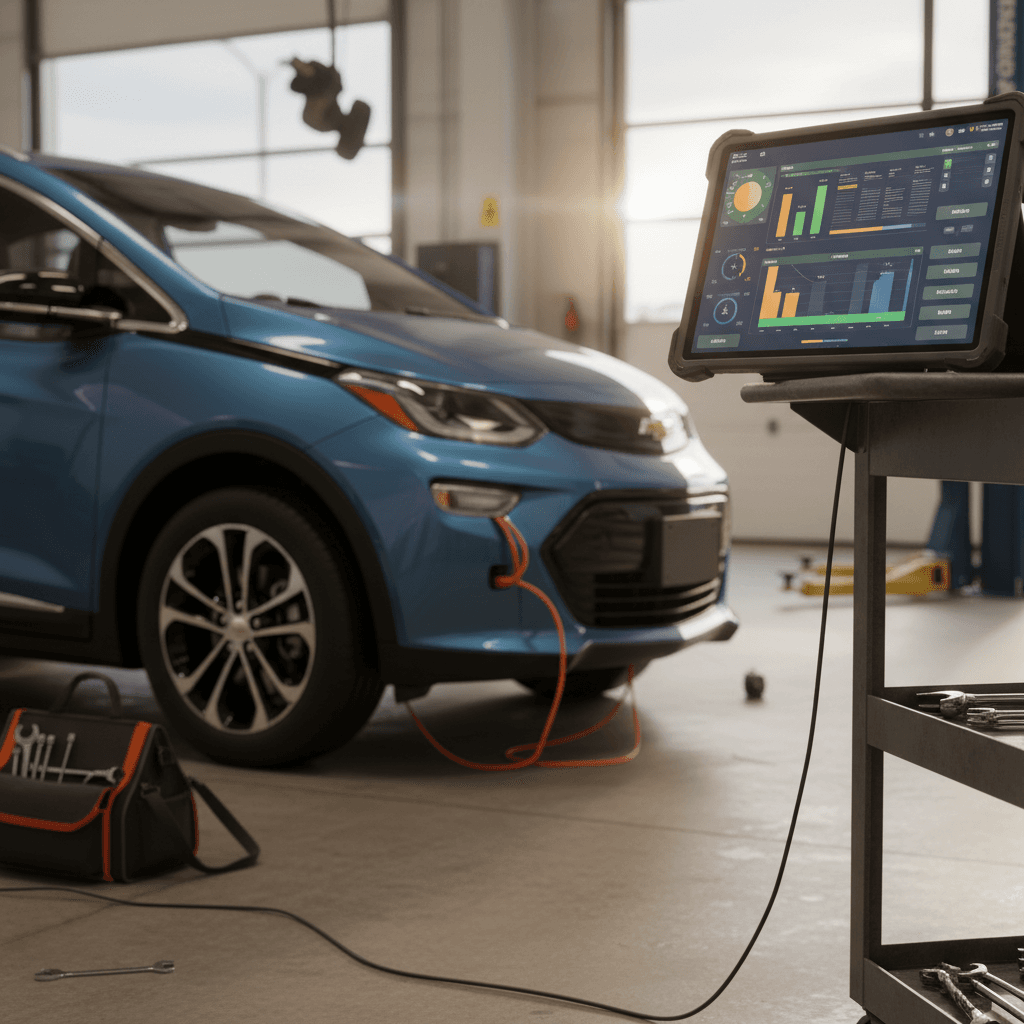
We connect directly to the car to capture **state of health, charging history and fault codes**. That feeds the Recharged Score, so you can see at a glance how the pack is aging and whether it has any concerning patterns.
Recall & campaign verification
Every Bolt is checked against GM’s recall and campaign database. Open items, especially anything related to the high‑voltage battery or critical safety systems, must be **resolved before sale**.
Road test & drivability check
Our inspectors perform a **structured road test**, checking for warning messages, one‑pedal behavior, HVAC function, noise and vibration, and driver‑assist performance. Anything out of line is documented and addressed or the car doesn’t make the cut.
Ready to find your next EV?
Browse VehiclesFrom there, we pair that technical snapshot with **fair‑market pricing, financing options, trade‑in support, and nationwide delivery**. If you’re comparing multiple 2023 Bolt EVs, or cross‑shopping other used EVs, the Recharged Score report makes it much easier to line up reliability risk against price.
FAQ: 2023 Chevrolet Bolt EV reliability rating
Frequently asked questions about 2023 Bolt EV reliability
Bottom line: Is the 2023 Bolt EV a safe used bet?
Taken in isolation, the 2023 Chevrolet Bolt EV’s reliability rating isn’t headline‑grabbing, it’s a **solidly competent, late‑cycle EV** that has outgrown the worst of its early battery issues. For shoppers, that’s actually good news. It means you can focus on the **specific car in front of you**: its battery health, service records, and how it’s been used, instead of worrying that the entire model line is a roll of the dice.
If you prioritize value, low running costs, and a proven daily‑driver EV over the latest charging speeds or cutting‑edge tech, a well‑vetted 2023 Bolt EV can be a **smart used purchase**. Just be disciplined: verify recalls, demand clear battery‑health data, and don’t be afraid to walk away from cars with gaps in their story. And if you’d rather have that homework done for you, shopping 2023 Bolts that already carry a **Recharged Score battery‑health report, fair‑market pricing and EV‑specialist support** can make the reliability question much easier to answer.