If you own, or are eyeing, a used 2021 Ford Mustang Mach‑E, you’ve almost certainly heard about recalls. The first model year of Ford’s headline EV has seen multiple campaigns for its battery system, software, door latches, and more. This guide walks through the full 2021 Ford Mustang Mach‑E recalls list in plain English so you know what each recall means, how serious it is, and what to do before you buy or sell a Mach‑E.
Quick context
Overview: How many 2021 Mach-E recalls are there?
Across NHTSA and Ford data, the 2021 Mustang Mach‑E has been covered by several major recalls that fall into a few themes: - High‑voltage battery contactors that can overheat and cause a loss of power - Battery safety software that could allow unintended acceleration or deceleration - A low 12‑volt battery issue that can leave the electronic door locks stuck closed - Door latch concerns that could trap passengers - Rearview camera problems tied to the infotainment system Not every 2021 Mach‑E is affected by every recall. Campaigns are limited by production dates, battery type, and previous repair history, which is why checking by VIN is critical.
2021 Mustang Mach-E recall picture at a glance
2021 Ford Mustang Mach-E recalls list (quick reference)
Major 2021 Mustang Mach-E recall campaigns
These are the core safety recalls that most often affect 2021 Mach‑E owners and used‑EV shoppers. Exact applicability depends on your VIN.
| Issue / System | Typical NHTSA / Ford ID | Main Risk | Fix Type | Affects 2021? |
|---|---|---|---|---|
| High‑voltage battery main contactor overheating (power loss) | 22V412, 23V687, Ford 22S41, 23S56 (and related rework recalls) | Sudden loss of drive power while driving | Software update plus, in some cases, hardware repair to battery junction box/contactor | Yes – core 2021 recall |
| Battery safety software may not detect errors | 23V123 (Ford PCM functional safety software) | Unintended acceleration, unintended deceleration, or loss of drive power if errors go undetected | Powertrain control module (PCM) software update | Yes – selected 2021 builds |
| Low 12‑volt battery can leave doors locked | 25V404 / Ford 25S65 (12‑V & door locks) | Doors may remain locked, potentially trapping occupants if 12‑V battery is discharged | Software update to body control modules and door locking logic; in rare cases 12‑V battery replacement | Yes – 2021–2025 Mach‑E, including 2021 |
| Door latches may not release properly in cold / specific conditions | Part of broader 25V404/25S65 campaign detail | Occupants could be trapped inside if doors will not open | Latch and/or software remedy depending on build and parts | Yes – many 2021 units |
| Rearview camera / display may fail | 25S72 and related infotainment/camera software recalls | Loss of rear visibility when reversing, raising crash risk | Over‑the‑air or dealer software update to infotainment system | Yes – many 2021 units with affected camera software/hardware |
Always confirm details with your VIN on the NHTSA site or Ford’s owner portal, as campaigns can be superseded or expanded over time.
Important
High-voltage battery contactors & sudden power loss (23V687 & 22V412)
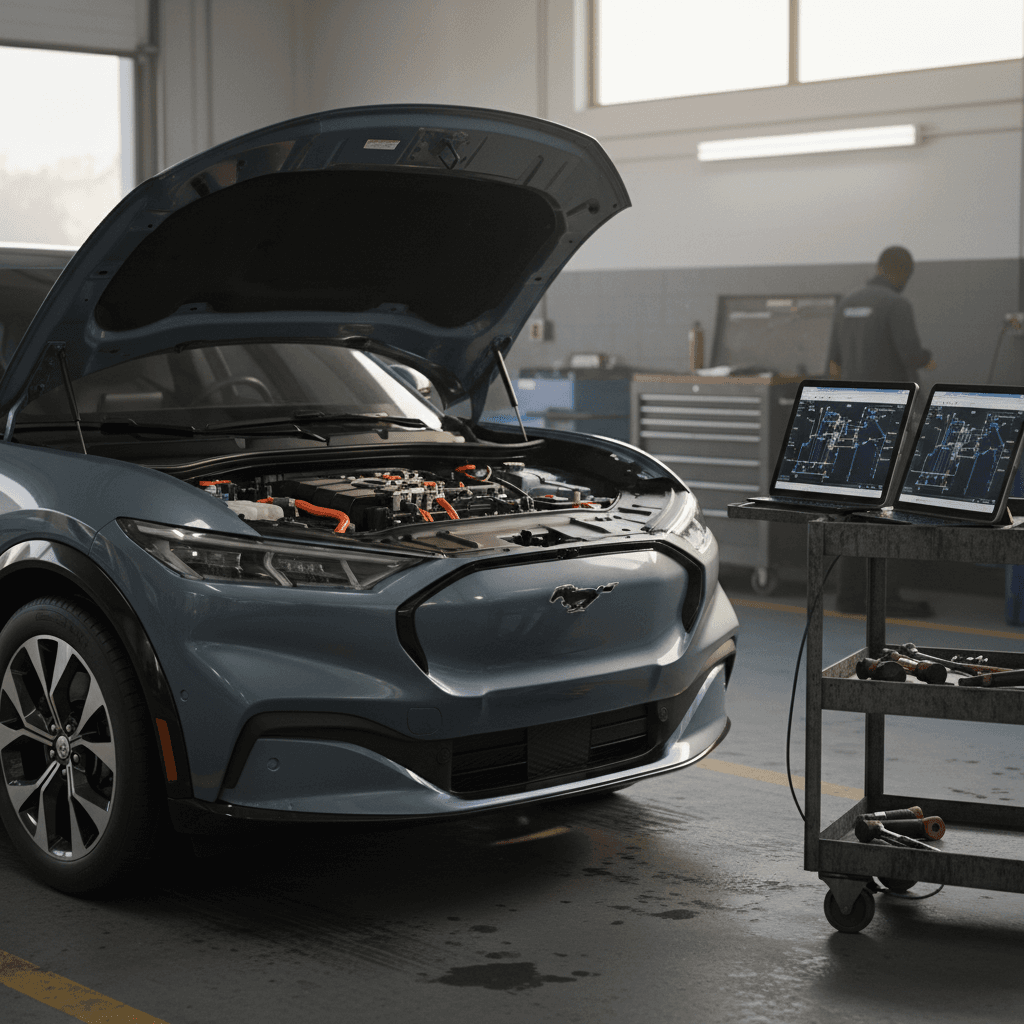
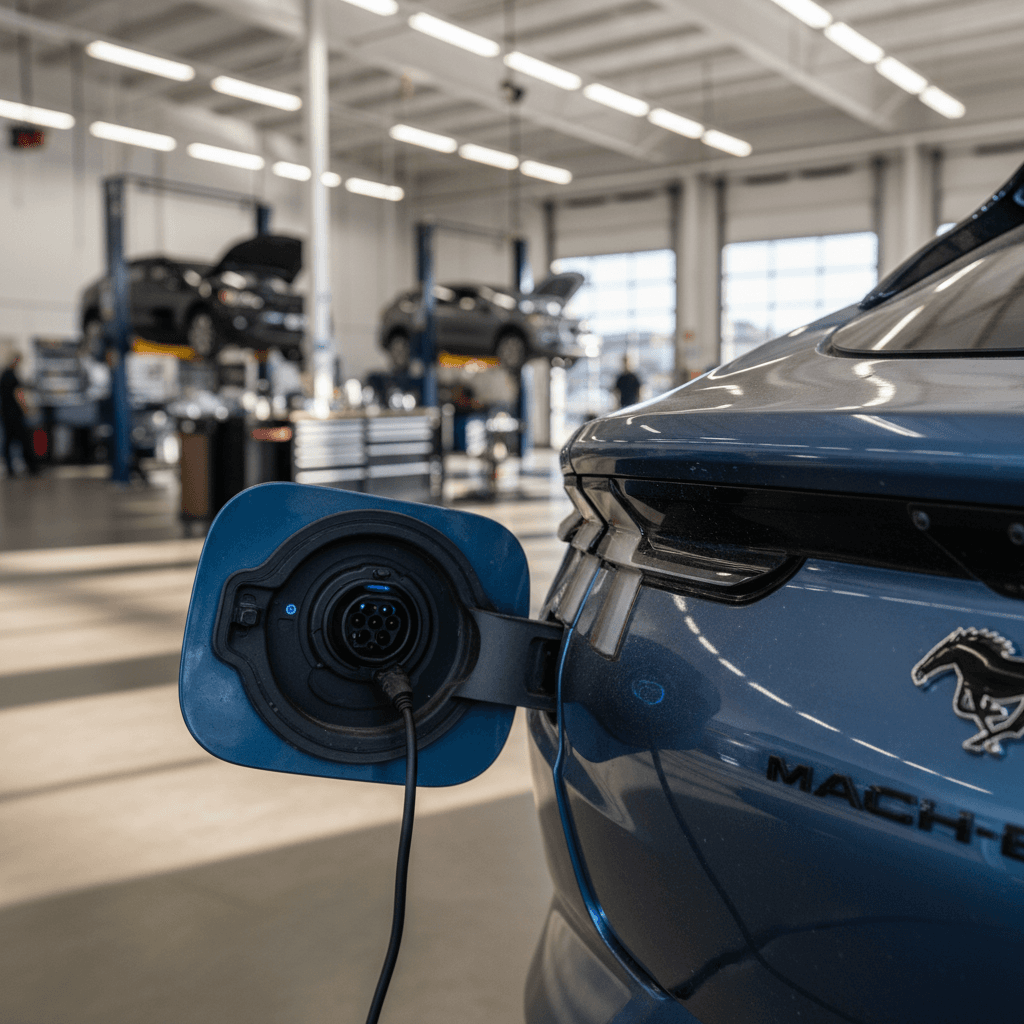
The best‑known 2021 Mustang Mach‑E recall involves the high‑voltage battery main contactors. These are heavy‑duty electronic switches inside the battery pack that connect the pack to the rest of the car. On some 2021–2022 Mach‑Es, especially early builds and extended‑range batteries, the contactors can overheat during hard acceleration or repeated DC fast‑charging. In worst cases, the car can lose drive power while moving.
- Symptoms: warning messages, power‑reduced or “stop safely now” alerts, or the car suddenly dropping into a low‑power mode.
- Root cause: overheating and eventual damage to the contactor or junction box under high load.
- Initial fix: software updates to limit maximum current and monitor contactor temperature.
- Follow‑up fix: additional recall on vehicles where software‑only repairs weren’t enough, sometimes requiring replacement of the high‑voltage battery junction box or related hardware.
Safety impact
For buyers, this recall is less a reason to walk away and more a reason to look for good documentation. A well‑maintained Mach‑E with proof of updated software and, where required, hardware replacement is the one you want, not the car that never went back to the dealer.
Battery safety software & unintended acceleration (23V123)
A later campaign addressed the functional safety logic in the powertrain control module (PCM). In certain 2021–2022 Mach‑Es, the PCM software might not reliably detect internal software faults. If an error slipped through, the result could be unintended acceleration, unintended deceleration, or a loss of drive power.
- Risk: low likelihood but high consequence, anytime software can misinterpret signals managing hundreds of volts, you don’t ignore it.
- Fix: a dealer‑installed software update that tightens diagnostic checks and fault responses inside the PCM.
- Owner experience: most drivers notice this only as a short service visit or scheduled update; there’s no change in everyday drive feel when the repair is done correctly.
Is this the same as the contactor recall?
12‑volt battery & stuck door locks (25V404 / 25S65)
Another big headline for Mach‑E owners is the recall tied to the 12‑volt battery and electronic door locks. On nearly 200,000 Mach‑Es built from 2021 through 2025, a discharged 12‑V battery can leave the door locks in a state where they won’t unlock electronically. In a worst‑case scenario, say, a garage fire or crash, you could have a passenger trapped inside, particularly if they’re unfamiliar with the manual release.
- Symptoms: dead 12‑V battery, doors that won’t unlock with normal controls, sometimes combined with warning lights or no‑start condition.
- Core risk: occupants trapped because the electronic latches stay locked when the 12‑V system goes down.
- Fix: updated software for the body control and door modules so doors default to a safe state even if the 12‑V battery is weak or discharged; some vehicles may also receive 12‑V battery checks or replacements.
What you should do today
Frozen door latches and trapped passengers (25V404 – latch campaign)
Alongside the 12‑V recall, regulators also flagged concerns with door latches on 2021–2025 Mustang Mach‑E SUVs. In some conditions, especially cold weather, latches may not release or may fail in a way that keeps a door from opening from the inside. This is another path to the same ugly outcome: someone stuck in the car when they want out.
How serious is it?
If a door won’t open from the inside, that’s a safety issue, not a minor annoyance. For 2021 Mach‑Es that see snow and ice, you want this checked and documented.
What does the fix involve?
Depending on build and parts, Ford may update latch hardware, adjust linkages, and/or combine this work with the 12‑V/door‑lock software campaign. Your dealer can decode the exact repair from your VIN.
Good news for shoppers
Rearview camera failures and parking safety (25S72)
Ford has also recalled a large group of vehicles, including many 2021–2023 Mustang Mach‑E SUVs, for rearview camera problems. A software defect in the infotainment system can cause the camera image to cut out or never appear when you shift into reverse. Backing up a tall crossover with no camera view isn’t just inconvenient, it can be dangerous in driveways and parking lots.
- Symptoms: black screen, frozen image, or intermittent camera feed when reversing.
- Risk: reduced visibility behind the vehicle, especially for children, pets, or low obstacles.
- Fix: software update for the display/infotainment system, often delivered over‑the‑air (OTA) but sometimes done at the dealer.
Quick driveway test
How serious are the 2021 Mach-E recalls?
Putting 2021 Mach-E recalls in perspective
Not all recalls are created equal, here’s how to think about the big ones.
High-voltage battery issues
Severity: High. Sudden power loss at highway speed is serious, even if you can still steer and brake.
Buyer take: Walk away from cars that haven’t had the 22V412/23V687‑type campaigns completed.
Door locks & latches
Severity: High in emergencies. The odds you’ll be trapped are low, but you don’t gamble with exits.
Buyer take: Insist on proof of 25V404 / 25S65 completion and test every door yourself.
Rearview camera
Severity: Moderate. Annoying in daily use and riskier in crowded areas, but easier to live with short‑term.
Buyer take: Acceptable if fix is scheduled, but it should not be ignored indefinitely.
When you roll everything together, the 2021 Mustang Mach‑E doesn’t look like a hopeless first‑year experiment. It looks like a modern EV that hit the market fast, learned some hard lessons, and has been steadily corrected through software and targeted hardware updates. A 2021 that’s fully up to date on recalls, with healthy battery diagnostics, can still be an excellent long‑term EV.
How to check your 2021 Mach-E for open recalls
Every recall story starts, and ends, with your VIN. Before you panic about headlines or walk away from a promising used Mach‑E, take five minutes to see what actually applies to your specific SUV.
Step-by-step: checking recall status on a 2021 Mach-E
1. Find the full 17-digit VIN
You’ll see it on the driver’s side of the windshield, the driver’s door jamb label, your registration, or your insurance card. Snap a photo so you don’t mistype it.
2. Run it through NHTSA’s recall lookup
Go to the NHTSA recall lookup tool and enter the VIN. You’ll see all <strong>open safety recalls</strong> that have not yet been marked completed for that vehicle.
3. Check Ford’s owner site or app
Create or log into a Ford owner account, add the VIN, and look for open campaigns. Ford sometimes shows customer satisfaction programs and software campaigns that don’t appear as formal NHTSA recalls.
4. Call a Ford EV‑certified dealer
Read the service advisor your VIN and ask for a printed list of <strong>open and completed</strong> recalls. This is the easiest way to confirm that earlier campaigns, like the high‑voltage contactor fix, were actually done.
5. Ask for service records
If you’re buying used, ask the seller for dealer invoices or digital service history. You’re looking for line items that reference recall numbers or software updates tied to the campaigns listed above.
6. Document everything
Save screenshots, PDFs, or printouts with dates. If you ever sell the vehicle later, this paperwork is part of your story that says: “this Mach‑E has been cared for properly.”
Paper trail pays you back
Buying a used 2021 Mach-E? Recall checklist
If you’re shopping used, you’re juggling range, features, price, and now, a stack of recall headlines. Here’s how to make recall reality simple when you’re looking at a 2021 Mach‑E on a dealer lot or in someone’s driveway.
- Confirm the VIN matches the paperwork and online listing.
- Run the VIN through NHTSA and Ford’s tools for open recalls.
- Ask for proof of completed high‑voltage battery contactor recalls (22V412/23V687‑type campaigns).
- Confirm the PCM safety‑logic update and any related software recalls are complete.
- Ask whether the 12‑V battery and door‑lock/door‑latch campaigns have been performed and if any parts were replaced.
- Test each door from inside and out, with the vehicle both powered on and off.
- Shift into reverse several times and verify the rearview camera works consistently.
- Take a long enough test drive to see if any warning lights, wrench icons, or power‑reduced messages appear.
Red flags when you’re shopping
How Recharged helps you decode recall and battery history
Sorting through recall codes and battery jargon isn’t everyone’s idea of a good Saturday. That’s why every used EV sold through Recharged comes with a Recharged Score Report that includes verified battery health, fair‑market pricing, and a clear view of key service history, including recall status where it’s available.
Verified battery health, not just dash guesses
The big question on a 2021 Mach‑E isn’t just, “Are the recalls done?” It’s also, “How is the pack holding up?” Recharged uses specialized diagnostics to measure real‑world battery health so you’re not buying blind.
Guided support from EV specialists
Whether you’re trading in, selling outright, or buying your first used EV, Recharged’s specialists walk you through what each recall and service entry actually means. You can handle everything digitally, financing, paperwork, even nationwide delivery, or visit the Recharged Experience Center in Richmond, VA.
Why this matters for a 2021 Mach-E
Ready to find your next EV?
Browse VehiclesFrequently asked questions about 2021 Mach-E recalls
2021 Mustang Mach-E recall FAQ
The 2021 Ford Mustang Mach‑E has had a busy recall history, but that doesn’t make it a bad EV. It makes it a thoroughly debugged one, if you choose a car that’s been kept current on campaigns and software. Whether you already own a 2021 Mach‑E or you’re considering buying one used, your best tools are a VIN lookup, solid documentation, and an honest assessment of the battery’s health. Get those pieces right, and you’ll spend your time enjoying instant torque and silent road trips rather than worrying about recall codes.