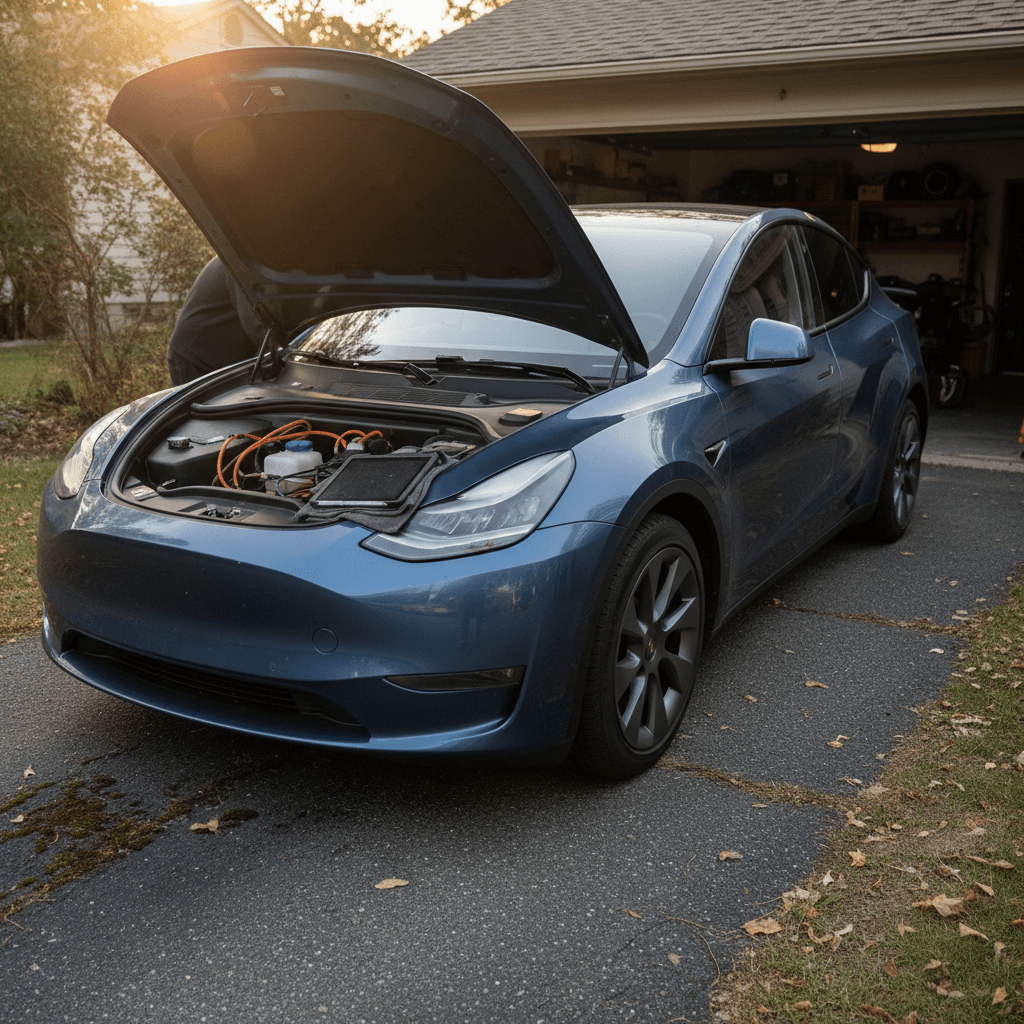
If you’re shopping used, the 2020 Tesla Model Y is tempting: it’s the first model year of Tesla’s best-selling SUV, often the cheapest way into a Model Y, and still delivers strong range and performance. But 2020 Tesla Model Y reliability is a mixed bag. Early build quality issues, an above-average recall count, and maturing software mean you’ll want to go in with your eyes open.
Bottom line up front
2020 Tesla Model Y reliability at a glance
Key 2020 Model Y reliability signals
Those numbers tell a nuanced story. Statistically, the 2020 Model Y isn’t a disaster, but it also isn’t a Toyota RAV4 in terms of set‑it‑and‑forget‑it durability. The good news: once early build issues are sorted, many owners report **stable day‑to‑day reliability and low running costs**, especially compared with gas SUVs.
How reliable is the 2020 Tesla Model Y?
The 2020 Model Y launched in spring 2020, built mainly at Tesla’s Fremont, California plant. As with many first‑year vehicles, early cars had **more defects leaving the factory**, panel gaps, paint blemishes, trim alignment, and occasional water leaks. Consumer Reports’ first reliability survey for the Model Y rated it **“much worse than average”**, citing paint, body hardware, and misaligned rear hatches that sometimes wouldn’t close properly.
Over time, many of these issues were addressed under warranty or improved in production, so a late‑build 2020 Model Y can be noticeably better than an early VIN. Owner forums and complaint databases show that by mileage, **2020s do not catastrophically fail**, they accumulate software quirks and hardware fixes rather than engine‑out or transmission failures you’d see on some gas SUVs.
Look at build date, not just model year
2020 Model Y recalls and safety issues
When people ask about 2020 Tesla Model Y reliability, recall count is usually their first stop. The 2020 Model Y has logged **more than 20 recalls** with NHTSA, one of the higher totals in the segment. That sounds alarming, but context matters: Tesla pushes many safety‑related changes through **over‑the‑air software updates**, which still count as recalls even if you never visit a service center.
Major recall themes for the 2020 Model Y
Not a complete list, but a look at the types of issues that have triggered recalls on the 2020 Tesla Model Y.
| Area | Typical Issue | How It’s Fixed | What To Check When Buying |
|---|---|---|---|
| Autopilot / Forward collision | Incorrect or overly aggressive automatic braking; potential crash‑avoidance behavior issues | Software update to driver‑assistance logic | Confirm all software is up to date; test drive on a familiar route and see if behavior feels predictable. |
| Speed control / OTA safety updates | Warnings or limitations added to features like Full Self‑Driving (FSD) or Autosteer | Software recall; no hardware replacement | Ask seller to show recall completion status in the app or service history. |
| Suspension & steering hardware | Loose suspension or steering arm fasteners on a small subset of vehicles | Physical inspection and torque check, sometimes component replacement | Look for service records showing suspension‑related recalls were completed; listen for clunks over bumps. |
| Exterior trim & glass | Trim that may detach; rear hatch alignment; occasional roof glass bonding concerns | Physical inspection, revised parts, resealing | Inspect all glass edges and body seams closely for cracks, uneven gaps, or sloppy sealant. |
| Seat belts & child restraints | Incorrectly secured seat belt fasteners in certain build ranges | Service visit to inspect and re‑secure | Verify seat belt recalls were addressed; tug on belts and check for proper locking behavior. |
Many 2020 Model Y recalls were fixed via software, but a few required physical repairs.
Don’t ignore door & latch behavior
Common 2020 Model Y problems to know about
Typical issues 2020 Model Y owners report
Not every car will have these, but they’re patterns you should screen for.
Paint & panel alignment
Cameras & sensors
Weather sealing & glass
12‑V system quirks
Door handles & child access
HVAC & noise
Most of these issues are not catastrophic, but they can be frustrating if you expect Lexus‑level refinement. The upside is that **Tesla’s powertrain and battery have comparatively few mechanical failure points**, so once build defects are sorted, many 2020 Ys settle into a predictable rhythm: charge, drive, repeat.
Battery life & degradation on 2020 Model Y
Battery health is often the biggest question for any used EV. On paper, the 2020 Model Y Long Range launched with an EPA‑rated range around 316 miles. Real‑world data across thousands of Teslas suggests **Model Y packs degrade relatively slowly**, roughly **1.1% capacity loss per year on average**, leaving about 89% capacity at 100,000 miles when well maintained.
What owners are seeing in the wild
- Several 2020 Model Y owners report 4–8% capacity loss by roughly 70,000–80,000 miles based on apps like TeslaFi.
- Others at around 150,000 km (~93,000 miles) report about 7% loss, still delivering useful road‑trip range.
- A small number of drivers have reported much steeper drops (30–40% range loss) that they believe are defects rather than normal aging.
What’s “normal” vs. a red flag?
- Up to ~10–12% loss by 100,000 miles is generally considered typical for a healthy Tesla pack.
- If a 2020 Model Y shows more than 20% loss well under 100,000 miles, that’s worth deeper investigation.
- Extreme degradation (30%+ loss) may indicate a defective pack, thermal‑management problems, or software limits, and justifies a professional battery health test.
How Recharged checks Model Y battery health
- Avoid charging to 100% daily unless you need full range; 70–80% is healthier for day‑to‑day use.
- Minimize frequent DC fast‑charging when convenient home or workplace AC charging is available.
- Keep the car plugged in during temperature extremes so thermal management can protect the pack.
- Check lifetime fast‑charge vs. AC‑charge ratio when possible, road‑trip use is fine, but exclusive fast‑charging accelerates wear.
Ownership costs, maintenance & repairs
Despite its recall record, the 2020 Model Y is still an EV, so its **routine maintenance needs are lighter than a comparable gas SUV**. There’s no oil to change, no timing belt, and no exhaust system to rust out. Instead, you’re mainly watching tires, brakes, cabin air filters, and the occasional 12‑V battery.
Where 2020 Model Y owners spend money
Think in terms of tires, alignment, and occasional hardware fixes, especially on early builds.
Tires & alignment
Suspension & rattles
HVAC & filters
Out‑of‑warranty repairs
Why used EVs can still be cheap to own
What to check when buying a used 2020 Model Y
Because the 2020 Model Y is a first‑year vehicle, inspection matters more than on a mature model. You’re not just checking mileage, you’re verifying how well this particular car made it through Tesla’s early production learning curve and how its battery has aged.
Pre‑purchase checklist for a 2020 Model Y
1. Scan for panel gaps & paint defects
Walk the car in good daylight. Look along the sides for inconsistent gaps at doors, hatch, and charge port, plus mismatched paint, overspray, or clearcoat haze. Cosmetic issues don’t always kill a deal, but they should be priced in.
2. Inspect glass, seals & signs of leaks
Check roof glass edges, windshield corners, and the hatch opening for cracks, sloppy sealant, or water staining in the headliner. Ask the seller about any past windshield or roof replacements and who performed the work.
3. Verify recall and software update status
From the Tesla app or service menu, confirm that all open recalls have been completed and that the car is running current software. A vehicle that’s been consistently updated is safer and usually more pleasant to live with.
4. Test Autopilot and driver‑assistance
On a multi‑mile test drive, enable Autopilot where legal. Note any harsh braking, erratic steering, or warnings. Some level of conservative braking is normal, but wild behavior could signal camera, sensor, or calibration problems.
5. Check real‑world range vs. odometer
Ask the seller for a near‑full charge, then compare the displayed range to the car’s original EPA rating. Pair that with actual road‑test consumption to get a sense of **usable highway range today**, not just what the sticker promised in 2020.
6. Review service history & tire wear
Look for records of alignment, suspension work, glass or seal repairs, and 12‑V battery replacement. Uneven tire wear can hint at unresolved alignment or suspension issues that you’ll inherit if you buy the car.
How Recharged simplifies the inspection step
How the 2020 Model Y compares to other years
If you’re cross‑shopping multiple years, it’s helpful to see where 2020 fits on the reliability spectrum. Consumer Reports’ data shows **2020 Model Y starting off weak**, improving in 2021, wobbling again in later years, and then stabilizing as Tesla refined the platform. Complaint databases show 2020 isn’t actually the worst offender, that distinction often goes to 2021–2023, which logged more problems as Tesla ramped volume.
Model Y model years vs. reported problems & recalls
Broad patterns, based on public complaint statistics and recall counts.
| Model Year | Reported Problems (approx.) | Recall Count | High‑Level Takeaway |
|---|---|---|---|
| 2020 | ~431 | 20+ | First model year; elevated build‑quality issues but total complaints still lower than some later years. |
| 2021 | 1,575+ | High teens | Higher volume and more complaints; some owners report better build than early 2020 but still inconsistent. |
| 2022 | 1,250+ | Teens | Production maturing; software and hardware tweaks improve day‑to‑day experience for many drivers. |
| 2023 | 1,500+ | 10+ | Very high volume and more complex software; reliability scores dip again in some surveys. |
| 2024–2025 | Hundreds and climbing | Fewer recalls so far | Too early for a final verdict, but early data suggests incremental gains over the earliest years. |
Early‑build 2020s had more quality issues per vehicle, while later high‑volume years racked up more total complaints.
Reasons to choose a 2020 Model Y
- Typically lower purchase price than 2021–2023 for similar equipment.
- Simpler feature set than some later years, with fewer experimental additions.
- Many early build issues may already be addressed under warranty by prior owners.
Reasons to consider a later year
- Potentially better factory build consistency (especially mid‑cycle 2022+).
- Updated interior materials, sound insulation, and minor hardware changes.
- More remaining factory warranty on younger vehicles, reducing your risk window.
Is a 2020 Model Y right for you?
So where does that leave the 2020 Model Y on reliability? It’s not the sure‑thing pick of the used EV world, but with proper vetting, it can be a smart buy. Think of it as a **high‑tech compact SUV with some first‑year rough edges**, not as an unreliable vehicle that will constantly leave you stranded.
- You want the **lowest entry price** into a Model Y and are comfortable spending extra time on inspection and test drives.
- You prioritize **range, charging network access, and software experience** over perfect interior refinement.
- You live near a Tesla service center or an independent EV specialist and don’t mind the occasional app‑scheduled visit.
- You’re comparing against a gas SUV where fuel savings and lower routine maintenance are a big part of your math.
When to walk away from a 2020 Y
Handled thoughtfully, a 2020 Tesla Model Y can deliver years of efficient, low‑emission driving at a lower price point than newer examples. The key is to treat reliability as something you can actively manage: verify recalls, scrutinize build quality, and insist on objective battery‑health data rather than gut feel. If you’d like help finding a solid 2020 Model Y, Recharged can pair you with **battery‑verified vehicles, transparent pricing, nationwide delivery, and EV‑specialist guidance** from your first search to the day it shows up in your driveway.