You’re not imagining it: electric SUVs have been on a financial roller coaster the last few years, and the Chevy Blazer EV is right in the middle of it. If you’re wondering, “What is my Chevy Blazer EV worth?” in early 2026, the answer is: it depends heavily on trim, mileage, battery health, and how you choose to sell, but there are clear benchmarks and patterns you can use.
A quick reality check
How Much Is My Chevy Blazer EV Worth Today?
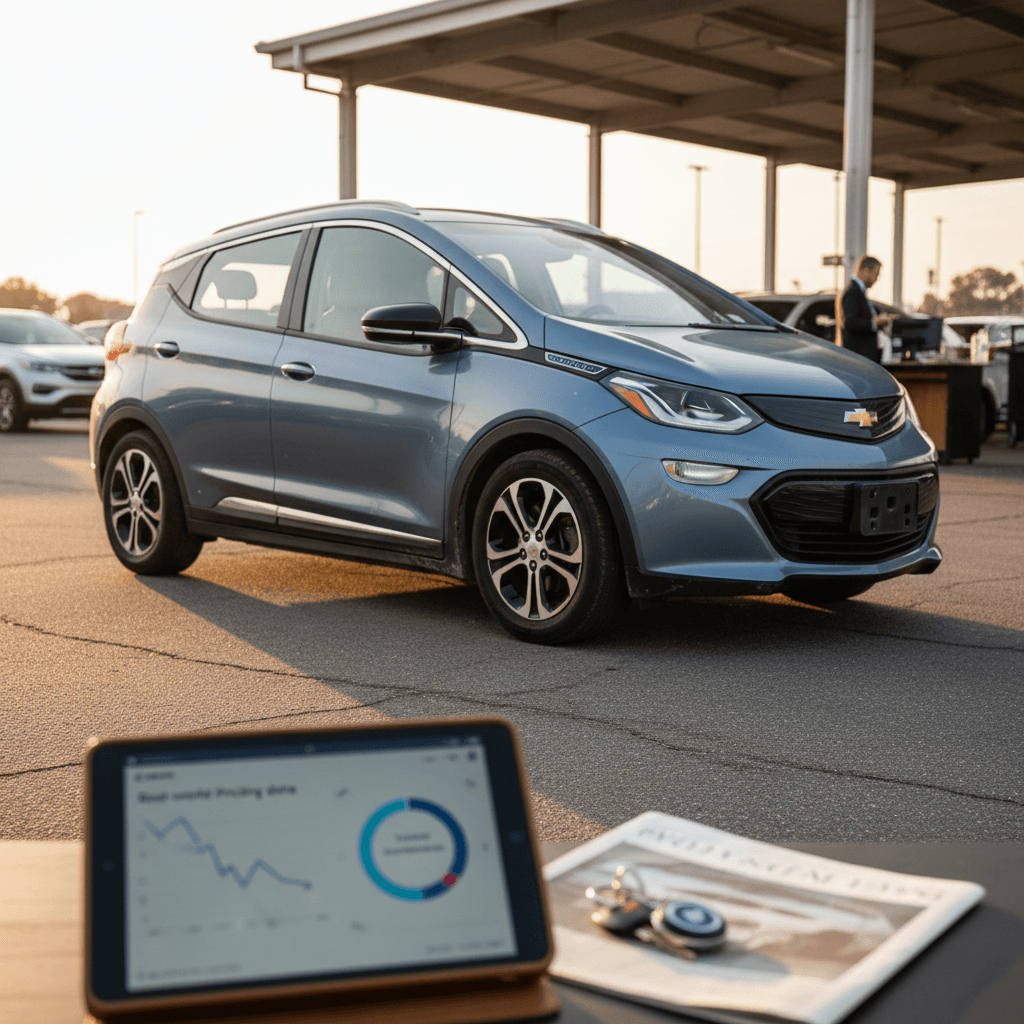
Let’s start with a directional answer. As of early 2026, a 2025 Chevy Blazer EV with typical mileage and in clean condition is often worth somewhere in the mid-$30,000s to mid-$40,000s as a trade-in, and more as a private sale, depending on trim and options. Pricing tools like Edmunds show trade‑in ranges roughly from the high-$20,000s to high‑$40,000s for 2025 Blazer EVs, with LT models toward the bottom and RS/SS toward the top of that spread.
Remember that’s just for guidance. Your exact number will move up or down based on your ZIP code, mileage, service history, battery condition, and demand in your region. A low‑mileage RS in a hot EV market can bring a very different number than a high‑mileage LT in a region where charging is still sparse.
Don’t anchor on the first number you see
Chevy Blazer EV Prices: New vs. Used
Blazer EV Market Snapshot (Early 2026)
Brand‑new, the Blazer EV LT has been positioned in the mid‑$40,000s, with RS and SS trims stretching well above $50,000 when new. Discounting, rebates, and federal or state incentives can move those real‑world transaction prices down, but as a seller you’re competing with those new‑car deals.
On the used side, early resale data suggests that the Blazer EV doesn’t escape the wider EV pattern: quicker depreciation than comparable gas SUVs. That stings if you bought new, but if you’re selling a used Blazer EV today, it also means there’s genuine value for price‑savvy second‑owners, especially if your battery is in good shape.
Why EVs Like the Blazer EV Depreciate Differently
1. Tech moves faster than design
The Blazer EV’s body style will still look current a decade from now. What ages faster is the invisible stuff: battery chemistry, charging speed, driver‑assist software. Newer EVs arrive with better range or quicker DC fast‑charging, and used values have to adjust down to keep up.
2. Incentives distort the starting point
Federal and state EV incentives can quietly chop thousands off a Blazer EV’s effective new price. When that happens, your used price has to be competitive with a subsidized new one. On paper, it looks like steep depreciation; in reality, the market is correcting for the incentives baked into the new‑car deal.
3. Buyer anxiety about batteries
Many shoppers still assume an EV battery is a ticking time bomb. They imagine a sudden, catastrophic failure rather than the slow, predictable degradation that actually happens. That fear pulls prices down, unless you can prove your battery’s health with real diagnostics.
4. Rapid swings in new‑EV pricing
The last few years have seen whiplash‑level price cuts from several EV makers. When a new competitor’s sticker drops, or Chevy discounts remaining inventory, used prices can take an instant step down to follow. It’s not fair, but it’s the gravity your Blazer EV has to live under.
Use depreciation to your advantage
6 Key Factors That Shape Your Blazer EV’s Value
What Buyers (and Algorithms) Care About Most
Six levers that move your Blazer EV’s price up or down
1. Trim & options
LT vs. RS vs. SS matters. RS and SS trims with larger wheels, upgraded interiors, or performance packages typically command higher prices, especially with sought‑after colors.
2. Mileage & usage
EV shoppers are extremely mileage‑sensitive. A 15,000‑mile difference can move value by thousands. Highway‑heavy miles are generally kinder to batteries than constant DC fast‑charging.
3. Battery health
This is the make‑or‑break factor unique to EVs. A Blazer EV that still delivers close to its original range is worth more than one that’s lost a big chunk of capacity.
4. Service & recall history
Up‑to‑date software updates, recall work completed, and documented maintenance all build confidence. Missing recall work or error lights will spook serious buyers.
5. Where you live
In EV‑dense states with strong charging infrastructure, demand for used EVs, including the Blazer EV, can be higher. In truck‑heavy or rural markets, the same car may sit longer and sell for less.
6. Market timing
Gas prices, interest rates, and EV incentives shift demand quickly. A spike in fuel prices or a new incentive program can suddenly make your Blazer EV more attractive, and more valuable.
Battery Health: How Much Does It Matter?
For a used EV, battery health is the new mileage That’s why Recharged builds every listing around a Recharged Score battery health report. Using EV‑specific diagnostics, we verify real‑world capacity and charging behavior and convert that into an easy‑to‑understand score. For buyers, it answers, “How long will this battery last for me?” For you, it’s hard evidence that your Blazer EV is worth more than a blind guess. These are example ranges assuming average mileage (~12,000 miles/year), clean condition, and typical U.S. markets in early 2026. Your actual number will vary. Use this table as a directional guide, not a guaranteed offer. Look at your window sticker or Chevy app: LT, RS, or SS? FWD or AWD? Note big‑ticket options like upgraded wheels, Super Cruise, or premium audio. Round to the nearest 500 miles and be honest with yourself. Crossing mileage thresholds (20K, 40K, 60K) can nudge values downward. Use sites like KBB, Edmunds, or others to get rough trade‑in and private‑party numbers. Choose your true condition, not “outstanding” unless it’s genuinely pristine. Charge to 100% (or your normal max) and note the estimated range. Compare it to your Blazer EV’s original EPA rating to get a feel for degradation. Pull up digital service history from your Chevy dealer account or saved invoices. Having recalls and software updates completed calms buyer nerves. A generic inspection won’t cut it. At <strong>Recharged</strong>, our Recharged Score gives you a quantified battery‑health metric that can justify a higher asking price. Each path trades convenience for money in a slightly different way. Recharged was built around a simple idea: EVs shouldn’t be punished for being misunderstood. A Chevy Blazer EV with a healthy battery, clean history, and up‑to‑date software deserves more than a generic SUV trade‑in number spit out by a legacy system. Ready to find your next EV? Your Chevy Blazer EV doesn’t have a single, fixed “book value.” It has a value story made up of trim, mileage, options, charging habits, software history, local demand, and, above all, battery health. Generic pricing tools can sketch the outline of that story, but they miss the plot twist that matters most to modern EV buyers: how healthy the pack really is. If you want to pressure‑test an offer, aim for the top of the rough ranges we’ve outlined, then be ready to defend that price with documentation: photos, service records, and a credible battery report. And if you’d rather not become a part‑time used‑car dealer, Recharged can help you price, market, and sell your Blazer EV with the transparency today’s EV shoppers expect, so you walk away confident you got what it was truly worth.Where sellers get burned
Quick Value Ranges: What Owners Are Seeing
Illustrative Value Ranges for 2025 Blazer EVs
Trim / Scenario Approx. Trade‑In Range Approx. Private Sale Range Notes 2025 Blazer EV LT, higher miles $29,000 – $33,000 $31,000 – $35,000 Base trim, above‑average mileage, basic options. 2025 Blazer EV LT, low miles $32,000 – $36,000 $34,000 – $38,000 Stronger demand in urban EV markets. 2025 Blazer EV RS, average miles $34,000 – $40,000 $37,000 – $43,000 Desirable trim; ranges widen with options. 2025 Blazer EV SS, low miles $40,000 – $47,000 $44,000 – $52,000 Performance model with limited supply can command a premium. Any trim with weak battery health $3,000+ less $3,000+ less Noticeable range loss or DC‑fast‑charging abuse pushes values down. How to use these ranges
How to Check Your Own Blazer EV Value (Step-by-Step)
DIY Valuation Checklist for Your Chevy Blazer EV
1. Confirm your trim and major options
2. Log your actual mileage
3. Run 2–3 online appraisals
4. Capture your real‑world range
5. Gather maintenance & recall records
6. Get an EV‑specific battery health report
You now have your value envelope
Selling Options: Dealer Trade-In, Private Sale, or Marketplace?
Compare Your Selling Paths
Dealer trade‑in
Private sale
EV‑focused marketplace
Watch out for “mystery EV deductions”
How Recharged Helps Blazer EV Owners Capture Their EV’s Real Worth
Turn your Blazer EV’s strengths into dollars
FAQs: What Owners Ask About Blazer EV Values
Frequently Asked Questions About Chevy Blazer EV Values
Bottom Line on Your Chevy Blazer EV’s Worth