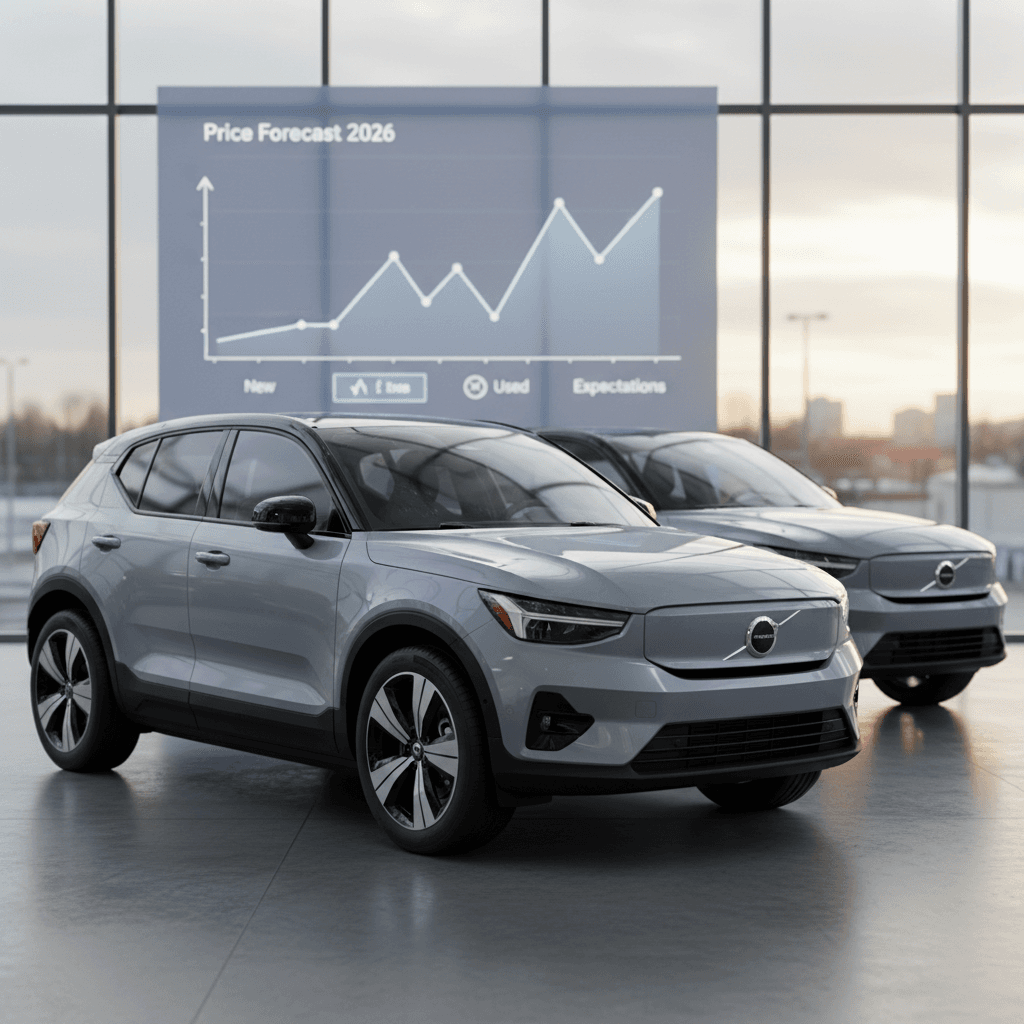
If you’re watching the Volvo EX30 price forecast for 2026, you’ve picked one of the trickiest EVs to analyze. The EX30 launched with attention‑grabbing MSRPs, then ran into shipping delays, tariff pressure, cancelled orders, and, most recently, signs that Volvo could wind down U.S. imports by the end of the 2026 model year. That cocktail makes price planning much more complicated than with a typical compact SUV.
Before we dive in
Why Volvo EX30 prices are so hard to predict
- The EX30 arrived in the U.S. later than originally promised, with trims and pricing shifting along the way.
- Higher tariffs on imported EVs from Europe and China have pushed costs up and forced Volvo to rethink its strategy.
- Some early buyers outside the U.S. have already seen steep dealer discounts and noticeable depreciation.
- News reports in 2025–2026 suggest U.S. volumes are lower than Volvo hoped, and U.S. imports may end after the 2026 model year.
- Battery‑related recalls and software updates in some markets have added one more wrinkle for future buyers.
Put that together and you get a model that’s desirable on paper, quick, stylish, relatively affordable for a premium badge, but living in a turbulent EV market. That’s exactly the kind of car where buyers and sellers should go in with their eyes wide open on pricing and depreciation.
Volvo EX30 pricing snapshot & depreciation
Where Volvo EX30 pricing stands today (Spring 2026 snapshot)
To understand any 2026 Volvo EX30 price forecast, you first need a baseline. By early 2026 in the U.S., the picture looks roughly like this:
Current U.S. Volvo EX30 pricing landscape (early 2026)
Approximate national‑average price positioning by configuration. Destination charges and local fees not included.
| Configuration | Model years on the road | Typical new MSRP window* | Typical used asking range* |
|---|---|---|---|
| Single Motor Extended Range (Core/Plus/Ultra) | 2025–2026 | Mid‑$30Ks to low‑$40Ks | High‑$20Ks to mid‑$30Ks |
| Twin Motor Performance (Plus/Ultra) | 2025–2026 | Mid‑$40Ks to upper‑$40Ks | Mid‑$30Ks to low‑$40Ks |
| EX30 Cross Country (where available) | 2026 | Upper‑$40Ks to around $50K | Too early for consistent used data |
These are broad market bands, not offers; always check current dealer and marketplace listings.
Why these numbers move quickly
On the used side, early depreciation has been steeper than many compact gas SUVs and a bit sharper than some higher‑volume EVs. The car is still relatively new, so every additional quarter of sales data can nudge value curves up or down.
New Volvo EX30 price forecast for 2026
Most shoppers asking about the Volvo EX30 2026 price really want to know two things: will new‑car prices keep rising, and will Volvo or dealers be forced into deeper discounts? The answer is: a bit of both, depending on when you shop and what happens with tariffs.
Three plausible 2026 pricing paths for new EX30s
How different economic and policy outcomes could affect MSRPs and real‑world transaction prices.
Scenario 1: Tariffs stay high
What it looks like: Import tariffs on European and Chinese EVs remain elevated, and federal tax treatment stays patchy.
- Sticker prices creep up another 2–4% versus early‑2026 window stickers.
- Discounts remain modest on low‑supply trims, bigger on slow‑moving inventory.
- Effective “out‑the‑door” prices sit near, or slightly above, today’s levels.
Scenario 2: Policy relief & stable economy
What it looks like: Trade tensions ease a bit and EV demand stabilizes.
- MSRPs hold steady or rise only with inflation (1–2%).
- More room for dealer discounts and targeted incentives.
- Real‑world prices drift slightly below today’s averages, especially on higher trims.
Scenario 3: Softer EV demand
What it looks like: Broader EV demand cools as buyers wait for new models or focus on hybrids.
- Volvo holds list prices but quietly increases rebates or lease support.
- More aggressive year‑end clearance deals on 2026 EX30s if U.S. exit rumors grow.
- Shoppers with flexibility get the best deals by late 2026.
Across those scenarios, a reasonable working forecast for late‑2026 new EX30 pricing in the U.S. would be:
- Single Motor Extended Range: transaction prices clustering roughly in the mid‑$30Ks to very low‑$40Ks for well‑equipped trims, before taxes and fees.
- Twin Motor Performance: transaction prices running from the low‑$40Ks to the upper‑$40Ks, with larger discounts on slower‑moving colors or options.
- Cross Country (if stocked in your region): often priced at or just above Twin Motor Ultra levels, but potentially more negotiable if Volvo reduces U.S. volume.
Timing matters more than trim
Used Volvo EX30 price forecast for 2026
Used buyers care less about MSRP and more about where the market will settle on real transaction prices. Here’s where things are likely headed if you’re shopping a pre‑owned Volvo EX30 in 2026.
Forecast: used Volvo EX30 price bands by model year (late 2026)
Approximate retail asking ranges for clean, average‑mileage examples sold through dealers and curated marketplaces.
| Model year | Typical miles by end of 2026 | Expected retail range (Single Motor) | Expected retail range (Twin Motor) |
|---|---|---|---|
| 2025 | 15,000–25,000 | $27,000–$33,000 | $32,000–$38,000 |
| 2026 (early build) | 5,000–15,000 | $30,000–$36,000 | $35,000–$41,000 |
Mileage assumptions: 10,000–15,000 miles per year, no major accidents, up‑to‑date service.
How this compares to mainstream EVs
Battery health, software history, and whether the car was caught up in any recall campaigns will play an outsized role in pricing. That’s why tools like the Recharged Score, which includes verified battery diagnostics and fair‑market pricing analysis, are especially valuable on newer EVs that don’t yet have a long resale track record.
EX30 configurations likely to hold value better
- Single Motor Extended Range Plus/Ultra in balanced colors (white, silver, gray, blue).
- Cars with documented software updates and clean service history.
- Examples sold with a third‑party battery health report or marketplace score.
Configurations that may soften faster
- Unusual color combos or heavily optioned cars priced far above market.
- High‑mileage Twin Motor cars in regions with limited fast‑charging.
- Vehicles with incomplete recall work or spotty service histories.
Lease payments and incentives: what to expect
Leasing has been a wild card for EX30 shoppers. Some early U.S. lessees saw big swings between quoted and final payments as money factors, residuals, and federal credit passthroughs shifted during the long delay from reservation to delivery.
What 2026 EX30 lessees should watch closely
1. Residual values in the contract
Because long‑term EX30 resale is still cloudy, residual assumptions vary widely. A higher residual usually means lower monthly payments, but only if the forecast is realistic and you don’t plan to buy at lease‑end.
2. How the federal EV credit is applied
If an EX30 lease qualifies for a federal incentive, the benefit may show up as a capitalized‑cost reduction instead of a check to you. Confirm how much is being applied and where it appears in the quote.
3. Money factor vs. APR
A tiny change in the money factor can add $40–$60 a month on a compact EV. Ask for both the money factor and its equivalent APR so you can compare offers across lenders.
4. Excess‑wear terms
Some early EV leases carried stricter battery condition clauses. Read the fine print around range loss, software modifications, or charging behavior if you plan to keep the car hard‑working during the lease.
5. Lease‑to‑own option
On a model that may leave the U.S. market, having a clearly‑priced buyout option can be valuable, particularly if values stabilize better than expected and you end up loving the car.
When leasing an EX30 makes sense
How tariffs and policy could shift EX30 prices
The EX30’s U.S. pricing doesn’t live in a vacuum. It’s deeply tied to where the car is built, how it’s shipped, and what Washington and Brussels decide about trade and EV incentives. That’s why some reports in 2025–2026 have suggested Volvo might scale back or even end EX30 imports for the U.S. after the 2026 model year.
Key policy levers that can move EX30 prices
These factors are outside your control, but you can plan around them.
Import tariffs
Higher tariffs on EVs built outside North America directly push landed costs up.
Impact: Higher MSRPs, less room for discounts, and potentially shorter product lifecycles in the U.S.
Federal & state incentives
Eligibility for federal or state EV incentives can change with sourcing, battery content, or political shifts.
Impact: The same sticker price can feel thousands cheaper, or more expensive, overnight.
Competing EV launches
New compact EV SUVs from mainstream brands can force price realignments.
Impact: If rivals undercut the EX30, Volvo and dealers may respond with richer incentives or lean more on leases.
What if Volvo exits the U.S. EX30 market?
Smart shopping strategies if you like the EX30
Despite the noise, the EX30 remains a compelling package: premium badge, quick acceleration, tidy size, and competitive range. The key is to buy, or sell, with a playbook that acknowledges its unique market risks.
Checklist: Getting a fair deal on a Volvo EX30 in 2026
1. Start with total cost of ownership, not just price
Compare energy costs, insurance, maintenance, and expected depreciation against alternatives like the Tesla Model Y, Hyundai Kona Electric, or Volvo XC40 Recharge. A cheap payment can still be an expensive car if it collapses in value.
2. Insist on objective battery health data
Modern EVs live or die on their packs. Look for a <strong>third‑party battery health report</strong>, like the Recharged Score, showing usable capacity, fast‑charge history, and any trouble codes, not just a dashboard range estimate.
3. Compare against the broader used‑EV market
Don’t evaluate a used EX30 in a vacuum. Price it against similar‑size EVs with comparable range and equipment. If a car is thousands above that pack, it needs to justify the premium in condition and equipment.
4. Pay attention to software and recall history
Ask for documentation of completed software updates and recall work, especially anything related to the high‑voltage battery or charging safety. A car that’s up to date is easier to insure, finance, and resell.
5. Use multiple financing and trade‑in quotes
Because lenders and dealers still view EV risk differently, payments and trade‑in offers can vary more than you’d expect. Get at least two quotes for both your financing and your trade‑in before you sign.
6. If you’re flexible, let the market come to you
If you don’t need a car immediately, monitor prices over a few months. You may find that EX30 deals improve toward the end of the 2026 model year as Volvo and dealers align inventory with their long‑term U.S. strategy.
How Recharged helps you navigate volatile EV prices
When a model has as much uncertainty baked in as the EX30, you want more than a guess and a Carfax. That’s where a specialized EV marketplace like Recharged changes the experience.
Why shop a used EX30 through Recharged?
Data, diagnostics, and EV‑specialist guidance, baked into the buying process.
Recharged Score battery diagnostics
Fair market pricing & depreciation insight
Financing, trade‑in, and nationwide delivery
Ready to find your next EV?
Browse VehiclesThe bottom line on the Volvo EX30 price forecast for 2026 is that this is not a set‑and‑forget purchase. New‑car MSRPs are dancing with tariffs and incentives. Used values are still finding their footing. If you’re thoughtful about battery health, policy risk, and total cost of ownership, and lean on objective data instead of hype, the EX30 can still be a sharp buy in a crowded EV field. And if you prefer a curated, EV‑first experience, Recharged is built to help you make that decision with confidence.