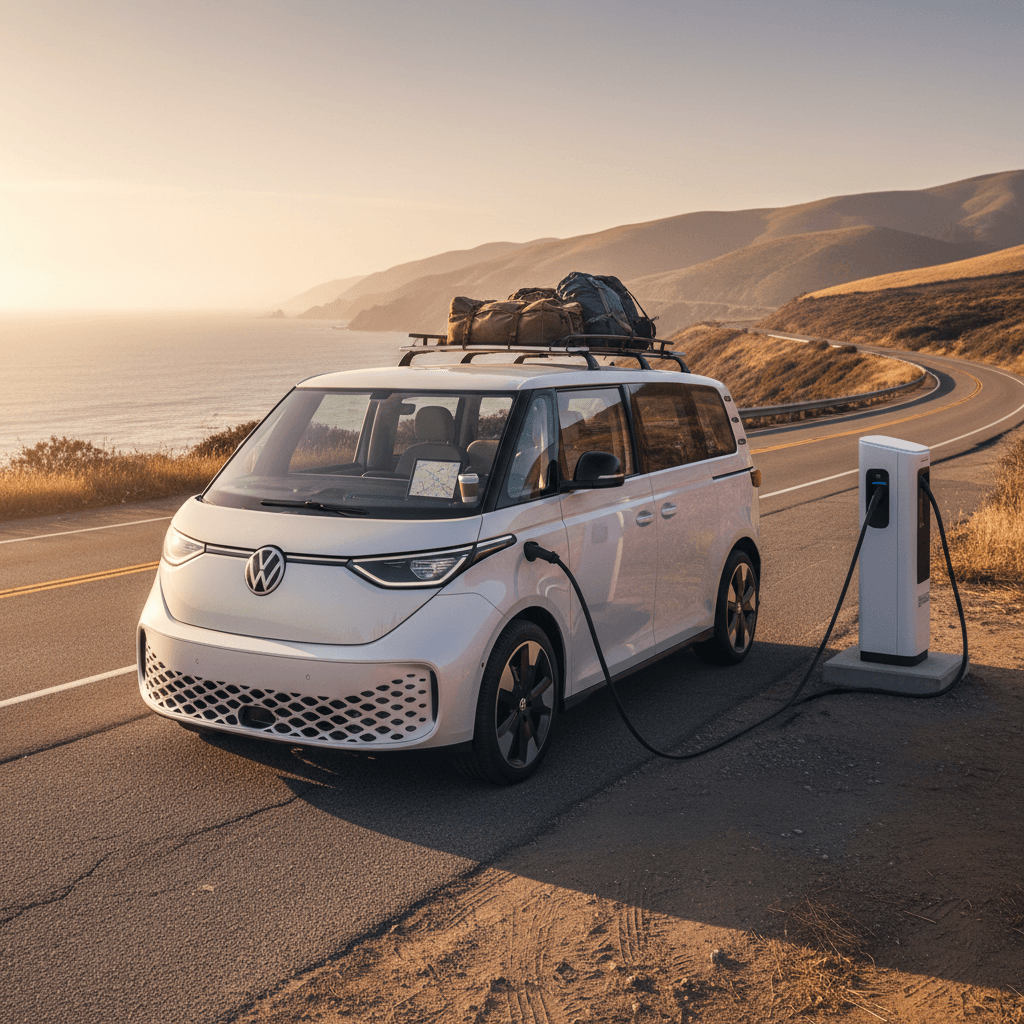
If you’re eyeing a Volkswagen ID. Buzz as the family road trip machine, you’re not alone. The retro-inspired electric van was built to eat highway miles in comfort, but to enjoy long-distance driving, you need to understand its real-world range, charging behavior, and how to plan your stops. This guide walks through practical Volkswagen ID. Buzz long-distance driving tips based on testing and owner experiences so you can hit the road without guesswork.
Big picture
Is the Volkswagen ID. Buzz good for long-distance driving?
What the ID. Buzz does really well
- Comfort-first cabin: High seating position, great visibility, and tons of space make long days easier on your body.
- DC fast charging: The 91 kWh U.S.-spec battery can go from around 10–80% in roughly 25–30 minutes on a strong DC fast charger when the pack is warm.
- Smart driver aids: Adaptive cruise, lane keeping, and navigation‑linked route planning reduce fatigue.
Where you need to plan ahead
- Range at speed: EPA combined range for U.S. long‑wheelbase models is in the mid‑200‑mile ballpark, but sustained 70–75 mph highway driving usually means closer to ~200–230 miles per full charge in good weather.
- Aerodynamics: It’s a big, boxy van; pushing it at 80+ mph will punish your range.
- Charger availability: CCS fast charging is widespread but still uneven, especially in rural areas, so advance planning matters.
Bottom line
Know your ID. Buzz range before you leave
Volkswagen publishes official range numbers (WLTP in Europe, EPA in the U.S.), but what matters on a road trip is your real-world highway range. That depends on your battery size, speed, weather, and how heavily you load the van.
Typical real-world ID. Buzz range benchmarks
Approximate ranges you can plan around in mild weather with a healthy battery, starting from 100% and driving down to about 5–10% state of charge.
| Configuration | Battery (usable) | Official rating (approx.) | Practical highway range (65–70 mph) |
|---|---|---|---|
| Europe SWB Pro (RWD) | ~77 kWh | Around 250–260 miles WLTP | 185–215 miles |
| U.S. LWB RWD | ~86 kWh | Mid‑230s miles EPA combined | 200–230 miles |
| U.S. LWB AWD (4MOTION) | ~86 kWh | Slightly lower than RWD | 190–220 miles |
Use these as planning numbers, not promises, your driving style and conditions will shift things up or down.
Create your own baseline
Best cruising speeds for efficient highway driving
Because the ID. Buzz is tall and boxy, aerodynamic drag climbs quickly as speed rises. You absolutely can cruise at 75–80 mph, but you’ll pay for it in extra charging stops.
How speed affects your ID. Buzz range
Use this as a directional guide when you choose your cruising speed.
65 mph: Efficiency sweet spot
- Often the best compromise between time and range.
- Expect your best highway efficiency here in most conditions.
- Great target for long legs between fewer charging stops.
70–75 mph: U.S. real-world norm
- Most U.S. owners run here to match traffic.
- Figure on roughly 10–20% less range than at 65 mph.
- Still reasonable if chargers are frequent along your route.
80+ mph: Range killer
- Drag increases dramatically; think 25–30% shorter range versus 65 mph.
- You’ll spend more total time charging, even if you feel faster between stops.
- Reserve for short bursts, not all‑day cruising.
Watch the conditions
Smart charging strategy for ID. Buzz road trips
With any modern EV, long-distance speed isn’t just about top range, it’s about how you work with the charging curve. The ID. Buzz charges fastest when the battery is low and slows dramatically above ~80%.
ID. Buzz DC fast charging highlights
Road-trip charging pattern that works
1. Start day one at (or near) 100%
At home or your hotel, charge to 100% right before departure. That gives you a long first leg while the battery is cool and you’re fresh. It’s fine to occasionally charge to 100% for trips.
2. Aim to arrive at fast chargers with 10–20%
Don’t panic if you see 15% or even 8% on arrival, that’s where the ID. Buzz charges quickest, and you maximize miles added per minute stopped.
3. Usually charge only to 70–80%
Above ~80%, the charging rate falls off. On active driving days, it’s more time‑efficient to stop a bit more often but keep sessions in that 10–80% window.
4. Use 90–100% only when needed
If you’re crossing a charger desert or climbing into the mountains, topping to 90–100% at one stop can make sense. Just budget extra time and don’t sit at 100% for hours afterward.
5. Precondition the battery when possible
When available in your region and software version, use navigation to a DC fast charger so the van warms the battery on the way, improving your initial charge speed.
6. Pair charging with real breaks
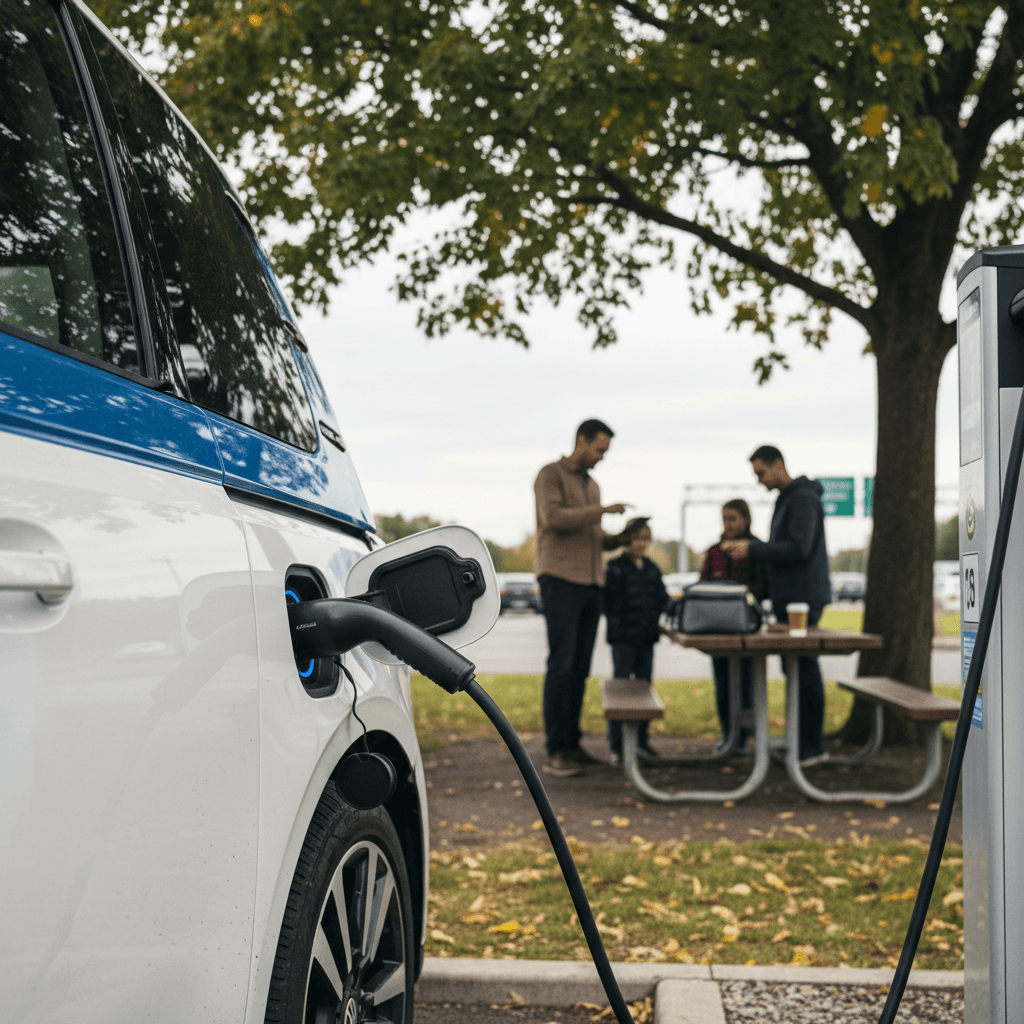
Plan stops at locations with food, restrooms, and safe walking for kids or pets. A 25‑minute fast charge that lines up with a meal or stretch break rarely feels like wasted time.
Avoid this common mistake
Using charging networks with the ID. Buzz
In North America, the ID. Buzz uses the CCS1 DC fast charging connector. Most public fast‑charging hubs you’ll see along interstates, Electrify America, EVgo, many utility‑run sites, support it. Volkswagen has also announced Supercharger access via a NACS adapter, so over time you’ll have even more options.
Key ways to charge your ID. Buzz on the road
Mix and match based on what’s strongest in the region you’re driving through.
Electrify America & other CCS hubs
- Primary high‑power option today for ID. Buzz owners in the U.S.
- Look for 150–350 kW stations along major interstates.
- Install their app and create an account before your trip.
Level 2 at hotels & destinations
- Perfect overnight top‑ups at 7–11 kW.
- Even 6–8 hours can refill most of your battery.
- Filter for “lodging with EV charging" in apps like PlugShare.
Future Tesla Supercharger + NACS
- As adapters and NACS ports roll out, more Superchargers will open to VW.
- Plan to test this close to home before relying on it for a major road trip.
- Check for live updates in VW and charging‑network communications.
Set up accounts before the trip
How to plan your route like a pro
Long-distance EV driving is easiest when you let software do the math but keep a human eye on the plan. The ID. Buzz’s native navigation is a solid starting point, and third‑party tools add redundancy.
- Enter your final destination in the ID. Buzz navigation and enable EV route planning so it can suggest charging stops with target arrival state of charge.
- Cross‑check the plan in a phone app such as A Better Routeplanner or your preferred mapping app with charging overlays.
- Look at each day’s longest gap between chargers. If you see a 160–180‑mile stretch with few options, plan to leave a prior stop at 80–90% instead of 60–70%.
- If you’re traveling with kids or pets, bias your charging stops toward parks, malls, or big‑box stores rather than tiny highway pull‑offs.
- Keep an eye on arrival SOC during each leg; if it drops faster than expected because of wind or rain, slow down a few mph and you’ll often stabilize it without an extra stop.
Be conservative in unfamiliar territory
Driving style, weather, and other range killers
You don’t have to hypermile your ID. Buzz, but a handful of habits can easily swing your highway range by 20–30%. That’s the difference between a relaxed two‑stop day and an anxious three‑stop day.
Top factors that shrink your ID. Buzz range
You can’t control the weather, but you can adapt to it.
Cold weather
- Below‑freezing temps reduce both battery capacity and efficiency.
- Expect 20–30% less range on truly cold days; more if it’s also windy and snowy.
- Precondition the cabin while plugged in and use seat/wheel heaters instead of cranking cabin heat.
Heavy rain & wind
- Standing water and strong headwinds dramatically increase rolling and aero resistance.
- If you see consumption spike, slow down 5–10 mph and give yourself a bigger buffer to the next charger.
- Side winds can nudge steering; let driver‑assist systems help but keep both hands on the wheel.
Weight & roof accessories
- A fully loaded van plus cargo box or bikes adds drag and mass.
- Remove empty racks or boxes when you don’t need them.
- Pack heavy items low and centered to keep handling predictable.
Aggressive driving
- Hard acceleration and abrupt braking waste energy the regen system can’t fully recover.
- Use Eco mode when it fits your driving style; smooth inputs help the most.
- Think “train engineer” more than “sports car” and your range will reward you.
Use B-mode strategically
Packing, comfort, and using the cabin efficiently
One of the ID. Buzz’s superpowers is how easy it makes long hours in the cabin. You’ve got space for people, luggage, and road‑trip junk, use it well, and your days feel shorter and less tiring.
Cabin comfort tips
- Rotate drivers every charge: On 500–700‑mile days, swap drivers at most charging stops so nobody gets worn out.
- Use climate zones wisely: Don’t over‑cool the entire cabin for one warm passenger; adjust zoned temperatures and fan speed instead.
- Leverage seat and wheel heaters: They’re more energy‑efficient than blasting hot air, especially in shoulder seasons.
- Keep the cabin tidy: Designate bins or soft bags for snacks, toys, and cables to avoid clutter fatigue.
Packing for range and convenience
- Avoid tall roof loads: A cargo box costs you efficiency; if you must use one, keep speeds moderate.
- Secure heavy luggage: Use tie‑downs and keep weight low between the axles for stability.
- Keep charging gear accessible: Store your portable Level 2 unit, adapter, and gloves near the rear hatch so they’re easy to grab at night or in bad weather.
- Bring a backup key solution: Losing keys in a hotel or park is a trip‑killer, set a routine and consider a safe spot in the van for spares.
Battery care on long trips: What’s actually important
Modern ID. Buzz battery packs are designed to handle plenty of fast‑charge cycles. Your job on a road trip is less about babying the pack and more about avoiding extreme habits that add up over years.
- Using DC fast charging heavily on a multi‑day trip is fine; frequent road‑trippers all over Europe and the U.S. do it without drama.
- Day to day, try to live in the roughly 20–80% window when possible; reserve repeated 100% charges for actual trips.
- Avoid leaving the van parked for days on end at or near 0% or 100%; if you arrive home depleted, plug in soon and let it climb back into a comfortable mid‑range.
- If you notice long‑term range dropping more than expected, have the battery evaluated. With used ID. Buzz models, ask for objective battery‑health data rather than guessing from the dash gauge.
How Recharged handles battery health
Pre-trip checklist for a smooth ID. Buzz road trip
ID. Buzz long-distance driving checklist
Confirm software updates and navigation data
Before leaving, check for available software updates, especially those related to charging and navigation, and make sure your maps are current for accurate EV routing.
Test your charging accounts and cards
Plug into a local DC fast charger a few days before departure to prove your apps, RFID cards, and payment methods all work with the ID. Buzz.
Inspect tires and set proper pressure
Check tread depth and inflate to the recommended pressures listed on your door jamb. Under‑inflated tires sap range and can overheat on long highway stints.
Plan your first two charging stops
Even if your nav does the rest, pre‑select at least the first two chargers with amenities you like. That takes stress off the early part of the day.
Build a charging buffer plan
Decide in advance your minimum comfortable arrival SOC, say 10–15%, and stick to it unless you have a very high‑confidence charger coming up.
Pack a charging toolkit
Include your portable Level 2 EVSE, gloves, flashlight or headlamp, glass wipes for cameras, and a small power bank for phones in case a charger app drains your battery.
Volkswagen ID. Buzz long-distance driving FAQ
Frequently asked questions about long-distance driving in the ID. Buzz
When a used ID. Buzz from Recharged makes sense
If the idea of a quiet, spacious electric van that can handle school runs on Monday and multi‑state drives on Friday appeals to you, the ID. Buzz is worth serious consideration. The long‑distance driving experience comes down to understanding its realistic highway range, planning smart charging stops, and embracing a slightly different rhythm than you might be used to with a gas minivan.
Where many shoppers get stuck is evaluating used examples. Battery health, DC fast‑charging history, and pricing versus newer competitors are tricky to judge from a typical listing. Every EV sold through Recharged comes with a Recharged Score Report that includes verified battery diagnostics, transparent market‑based pricing, and EV‑specialist guidance on whether a particular ID. Buzz fits your road‑trip plans. If you’re ready to put one in your driveway, that kind of data‑backed clarity can make the difference between a nervous first road trip and a van your family looks forward to driving for years.