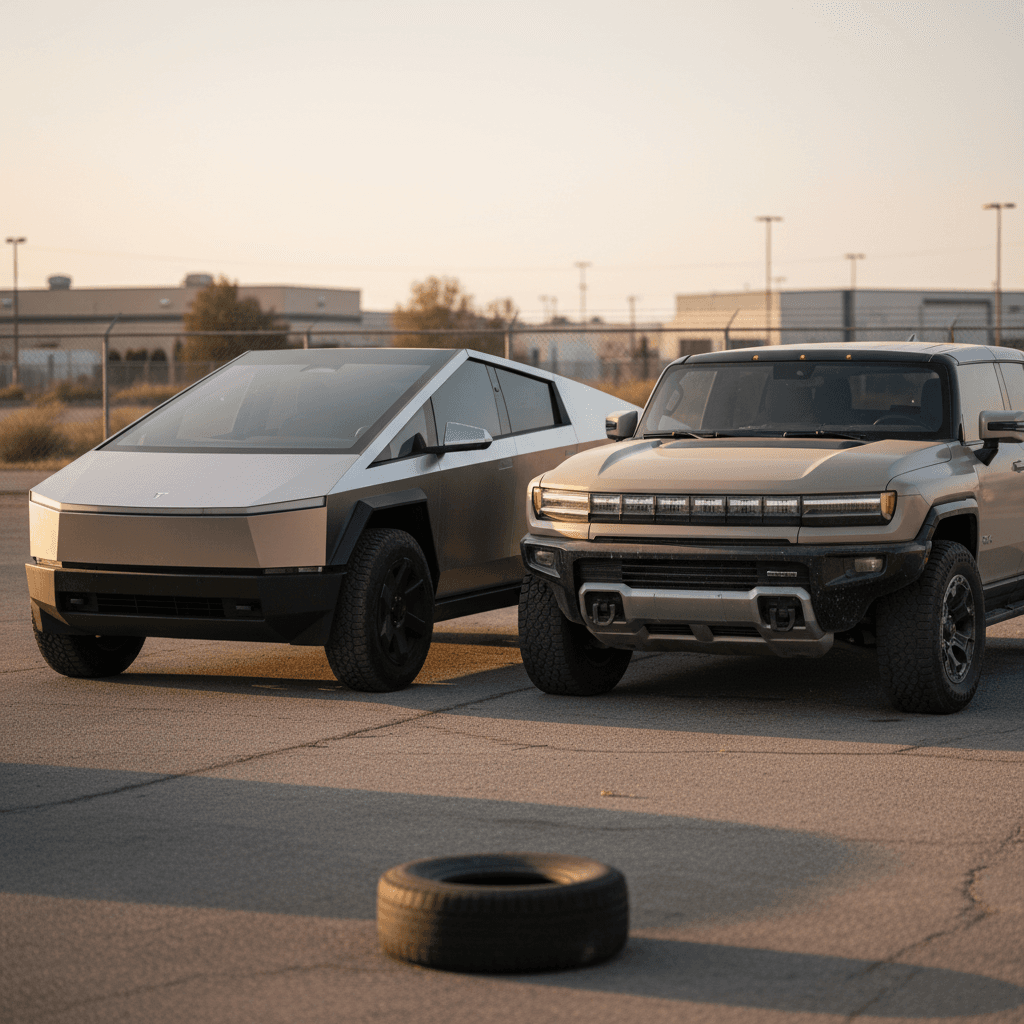
If you’re shopping the wild end of the EV spectrum, a used Tesla Cybertruck vs GMC Hummer EV comparison is probably already on your mind. Both are outrageous electric super‑trucks, but they’re very different tools once you get past the memes: one is a stainless‑steel wedge built around Tesla’s software and Supercharger ecosystem, the other is a 9,000‑pound off‑road bruiser loaded with luxury and gimmicks. On the used market, those differences show up not just in how they drive, but in what they cost to own long term.
Context: model years you’re likely to see used
Why compare the Cybertruck vs Hummer EV on the used market?
New, both of these trucks are expensive enough to make your eyes water. On the used market, though, early depreciation and shifting EV demand mean you can sometimes find a lightly driven Cybertruck or Hummer EV for tens of thousands less than original MSRP. That opens the door for shoppers who want max drama and capability without paying full sticker.
- You want super‑truck performance (0–60 in roughly 3 seconds) with zero tailpipe emissions.
- You tow occasionally and want the easiest possible highway passing power.
- You like the idea of an EV that stands out more than a typical crossover.
- You’re weighing Tesla’s software and charging ecosystem vs GM’s more traditional truck feel.
Where Recharged fits in
Specs showdown: range, towing, and performance
On paper, both the Cybertruck and Hummer EV deliver supercar‑level acceleration and legitimate truck capability. But they do it in different ways, and those differences matter a lot when you’re buying used.
Tesla Cybertruck vs GMC Hummer EV: key specs (typical trims)
Representative specs for commonly available trims on the used market. Always confirm exact numbers for the specific truck you’re considering.
| Model / Trim | Motors / hp | Official range (mi) | Max towing (lbs) | Approx. curb weight |
|---|---|---|---|---|
| Tesla Cybertruck Dual Motor AWD | 2 motors / ~600+ hp | ~340 mi (Tesla estimate for new) | 11,000 | ≈ 6,900 lbs |
| Tesla Cybertruck Cyberbeast (Tri‑motor) | 3 motors / ~845 hp | ~301 mi (Tesla estimate) | 11,000 | ≈ 6,900+ lbs |
| Discontinued Cybertruck RWD Long Range | Single motor / 321 hp | ~250 mi tested highway | 7,500 | Similar to AWD |
| GMC Hummer EV Edition 1 Pickup (Tri‑motor) | 3 motors / ~1,000 hp | ~329 mi GM est. | 7,500 | ≈ 9,000+ lbs |
| GMC Hummer EV 3X Pickup (22" wheels) | 3 motors / ~1,000 hp | Up to ~355 mi GM est. | 8,500 | ≈ 9,000+ lbs |
Cybertruck tends to win on efficiency and towing; Hummer EV wins on shock value and off‑road add‑ons.
Range numbers vs reality
Performance comparison at a glance
Both trucks are fast, but they feel different on the road.
Tesla Cybertruck
- Acceleration: Cyberbeast can do around 2.6 seconds 0–60 mph, supercar territory.
- Towing: Up to 11,000 lbs on dual‑ and tri‑motor trucks.
- Efficiency: Lighter and more aerodynamic than the Hummer, so you get more miles per kWh.
GMC Hummer EV
- Acceleration: 0–60 mph around 3 seconds in “Watts to Freedom” mode, still bonkers for a 9,000‑lb truck.
- Towing: 7,500–8,500 lbs depending on trim and wheels.
- Weight penalty: Massive battery and curb weight mean efficiency and braking distances suffer compared with the Cybertruck.
Bottom line on specs
Real-world ownership: size, comfort, and usability
Specs are one thing; living with these trucks every day is another. Before you pull the trigger on a used Cybertruck or Hummer EV, think about where you park, how many passengers you carry, and how much you value visibility and maneuverability.
Everyday driving & size
- Cybertruck: Long and wide, but lower and lighter than the Hummer. Air suspension can help with loading and parking, and the all‑glass roof makes the cabin feel airy.
- Hummer EV: Feels huge in tight parking lots and older garages. Four‑wheel steering helps, but you’re still maneuvering a 9,000‑lb brick with very wide hips.
Comfort & interior feel
- Cybertruck: Minimalist, almost sci‑fi interior. Big central screen runs nearly everything, with rear passenger screen on higher trims. Some buyers love the simplicity; others miss physical buttons and traditional luxury cues.
- Hummer EV: More conventional truck‑like layout with big screens, lots of switchgear, and chunky design. Feels plusher and more familiar if you’re coming out of a premium gas pickup or SUV.
Test fit your life, not just your garage

Off-road capability: cool tricks vs practical trail use
Used or new, both of these trucks were engineered to conquer more than pavement. But again, they do it with different philosophies.
How Cybertruck and Hummer EV tackle the dirt
Both can get you to the trailhead. One is more of an off‑road showpiece.
Cybertruck off-road strengths
- Adaptive air suspension for adjustable ride height.
- Good approach and departure angles, especially in high‑clearance modes.
- Electric torque delivery and traction control handle loose surfaces well.
- Better efficiency off‑road, so you preserve more usable range.
Hummer EV off-road party tricks
- CrabWalk (diagonal driving using four‑wheel steering) for tight trails and parking‑lot flexing.
- Available Extreme Off‑Road Package with underbody cameras, skid plates, rock sliders, and 35‑inch mud‑terrain tires.
- Massive ground clearance and short overhangs, but also massive weight.
- Brilliant low‑speed control, but range falls quickly in technical terrain.
Weight is the silent off-road enemy
Charging experience and road-trip confidence
For many buyers cross‑shopping a used Cybertruck vs Hummer EV, charging is the deciding factor. A great truck with a frustrating charging experience is hard to live with.
What to look for in charging, by truck
1. Tesla Cybertruck: Supercharger access
Cybertruck owners get native access to Tesla’s Supercharger network, including the growing number of high‑power NACS stalls across the U.S. That means simpler road‑tripping, predictable pricing in the Tesla app, and generally reliable uptime.
2. Tesla Cybertruck: Home charging setup
At home, the Cybertruck is just another Tesla: a 240‑volt Level 2 setup (like a Tesla Wall Connector) will let you easily recharge overnight. When you’re evaluating a used truck, ask if the previous owner is including any home charging hardware.
3. Hummer EV: Public fast‑charging networks
The Hummer EV uses CCS fast charging. It can take advantage of high‑power DC fast chargers (up to around 350 kW on compatible stations), but network reliability and station availability can vary more than with Superchargers, especially in rural areas.
4. Hummer EV: Big battery, big energy needs
The Hummer’s huge Ultium battery gives solid rated range, but its size and weight mean you’ll spend more time plugged into Level 2 and DC fast chargers to add the same miles of range compared with the Cybertruck.
5. Future adapters and NACS transition
GM has committed to NACS access, so over time many Hummer EV owners will be able to use Superchargers with an adapter. On a used truck, confirm whether an adapter is included and whether the vehicle has had all relevant software updates.
Plan around where you actually drive
Used prices, depreciation, and value
Because both trucks launched at eye‑watering prices and in relatively low volumes, the used market is still thin and volatile. But a few clear patterns are emerging as of 2025–2026.
What the early used market looks like
How Recharged evaluates value
Value considerations: Cybertruck vs Hummer EV
Where your money actually goes on the used market.
Used Cybertruck value notes
- Early “Foundation Series” and Cyberbeast trucks still command a premium for their rarity and spec.
- As more volume trims arrive, expect sharper deals on dual‑motor trucks with moderate miles.
- Tesla brand perception moves fast, news cycles and software updates can nudge used prices up or down quickly.
Used Hummer EV value notes
- Original MSRPs were commonly in the high‑$90k to $100k+ range, but used values typically run well under that, especially for higher‑mile trucks.
- Special colors, off‑road packages, and Edition 1 status can still carry a noticeable premium.
- Long waitlists for new orders once kept used prices sky‑high; as supply improves, patience usually pays off.
Battery health and longevity on used super-trucks
With any used EV, especially a heavy, high‑performance truck, the traction battery is the single most important component. It’s also the most expensive to repair or replace. Both Tesla and GM designed these battery packs with long service life in mind, but how the previous owner treated the truck still matters.
How to evaluate battery health on a used Cybertruck or Hummer EV
1. Check DC fast‑charging history
Frequent high‑power DC fast charging isn’t an automatic dealbreaker, but heavy road‑trip use can add more wear than mostly home Level 2 charging. Ask the seller directly and review service history when possible.
2. Compare displayed range to original estimates
Look at the indicated full‑charge range and compare it to original EPA or manufacturer estimates. A modest drop is normal; a dramatic drop can signal issues or aggressive past use.
3. Look for battery and high‑voltage system repairs
Review service records for any battery replacements, high‑voltage component repairs, or repeated drivetrain fault codes. These can hint at underlying issues or, in some cases, a fresh pack under warranty.
4. Get independent diagnostics
A third‑party scan of the battery’s state of health gives you hard numbers instead of guesswork. Every EV on Recharged receives a <strong>Recharged Score battery health check</strong> so you can compare trucks with confidence.
Why battery diagnostics are non‑negotiable here
Ownership costs: insurance, maintenance, and repairs
Sticker price is only part of the story. Insurance, tires, maintenance, and repair economics all look different for these halo trucks than for a used Model 3 or Chevy Bolt.
What it really costs to live with these trucks
Think beyond the payment.
Insurance
Both vehicles are high‑value, high‑performance trucks. Expect insurance premiums closer to a luxury SUV than a midsize pickup. The Hummer’s weight and parts costs can push quotes even higher in some ZIP codes.
Tires & brakes
Oversized all‑terrain tires are not cheap, especially on the Hummer’s 35‑inch setups. Weight also impacts brake wear. Budget accordingly, particularly if you plan to off‑road or tow frequently.
Maintenance & repairs
Neither truck needs oil changes, but specialty parts and labor add up. Tesla owners are tied to Tesla’s service ecosystem; Hummer EV owners will rely on GMC dealers familiar with Ultium vehicles. In both cases, choose shops with EV expertise.
Use total cost of ownership, not just price
Which used truck is right for you?
Both the used Cybertruck and used Hummer EV deliver outrageous performance and presence. Choosing between them comes down to how you’ll actually use the truck, how often you road‑trip, and how much you value charging convenience versus interior luxury and off‑road theatrics.
Match the truck to your priorities
You should lean Cybertruck if…
You road‑trip often and want native Supercharger access and better efficiency.
You tow regularly and care about preserving as much usable range as possible.
You prefer Tesla’s software‑first cockpit and over‑the‑air updates.
You want something wild but still a bit easier to park and maneuver than a Hummer EV.
You’re comfortable inside a minimalist, almost concept‑car interior.
You should lean Hummer EV if…
You value dramatic styling and a more traditional, premium truck interior.
You’ll use the truck as a weekend toy more than a daily commuting appliance.
You want serious off‑road hardware and love features like CrabWalk and underbody cameras.
You mostly charge at home and don’t mind planning CCS fast‑charging on longer trips, at least until NACS adapters are widespread.
You’re okay with very large, very heavy‑duty tires and a truly massive footprint.
How Recharged can help you decide
Ready to find your next EV?
Browse VehiclesFAQ: Used Tesla Cybertruck vs GMC Hummer EV
Frequently asked questions
At this end of the EV market, there’s no purely rational choice. A used Tesla Cybertruck vs GMC Hummer EV comparison is about picking the kind of outrageous that fits your life: efficient, tech‑forward wedge with unmatched charging access, or colossal off‑road showpiece with a more traditional luxury‑truck feel. If you take the time to understand battery health, charging where you live, and total ownership costs, either can be deeply satisfying. And if you want help turning internet research into the right truck in your driveway, Recharged is built to guide you from first question to final delivery with clarity, data, and zero guesswork.