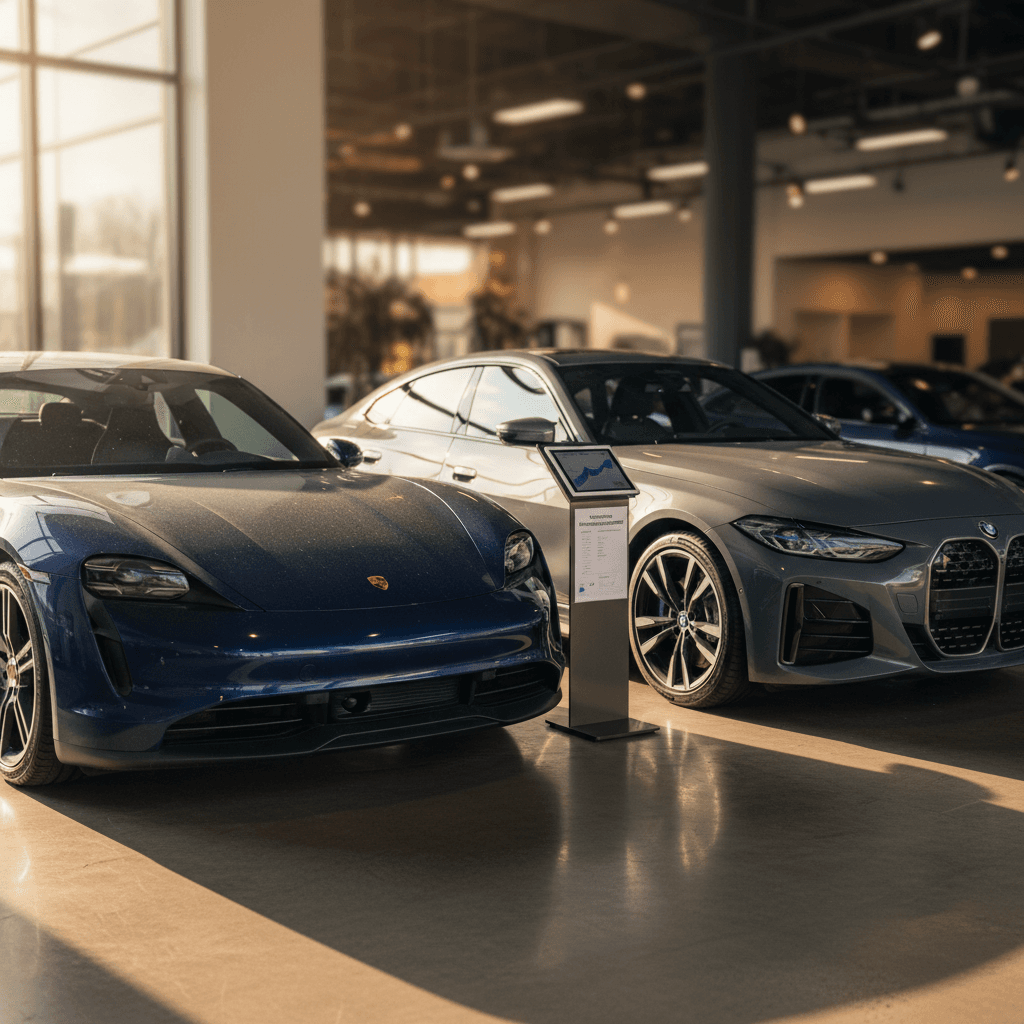
If you’re shopping the **used luxury EV** market in 2026, a **used Porsche Taycan vs BMW i4 comparison** is probably near the top of your list. Both offer serious performance, premium cabins, and real long‑distance capability, but they behave very differently on your driveway, on a fast charger, and on your balance sheet.
Why this comparison matters in 2026
Overview: Used Taycan vs BMW i4 in 2026
Porsche Taycan (2020–present, major 2025 refresh)
- Positioning: True performance car first, EV second.
- Body styles: Low-slung sedan and wagon‑like Cross/ Sport Turismo.
- Strengths: Handling, repeatable fast charging, build quality, brand prestige.
- Weak spots: Steep depreciation on early cars, complex options, can be expensive to run out of warranty.
BMW i4 (2022–present)
- Positioning: Electric 4 Series Gran Coupé, sporty but more comfort‑oriented.
- Body style: Practical hatchback with a conventional sedan profile.
- Strengths: Lower price, friendlier daily use, solid range on most trims.
- Weak spots: Slower DC charging vs Taycan, some trims have modest range, typical BMW luxury‑car depreciation.
Used Taycan vs BMW i4: key numbers at a glance (typical U.S. used examples in 2026)
Quick take: which used EV fits you?
Which used EV is better for you in 2026?
Match the car to your priorities before you fall in love with a badge.
Choose a used Porsche Taycan if…
- You value driving feel and brand cachet above all.
- You regularly use DC fast charging and want class‑leading charge curves.
- Your budget can handle higher maintenance and insurance costs.
- You’re OK with a lower trunk opening for the sake of design, or you pick a Cross/Sport Turismo.
- You plan to buy with a strong warranty story (CPO or extended protection).
Choose a used BMW i4 if…
- You want a more affordable entry point to a premium EV.
- Most of your driving is commuting and road trips on CCS/NACS fast chargers, not track days.
- You prefer a hatchback practicality with a big rear opening.
- You’re sensitive to total cost of ownership and want friendlier service and tire bills.
- You still care about performance, but don’t need Porsche‑level sharpness.
Model lineups and which years to target
By 2026, you’ll see a wide spread of Taycans and i4s on the used market, from early builds with shorter range to newer cars with updated batteries and software. Targeting the right model years can get you more range, better charging, and fewer early‑production quirks.
Used Porsche Taycan vs BMW i4: key years and trims to know
Not exhaustive, but a helpful roadmap to the trims you’ll see most often on U.S. used‑car listings.
| Model | Common used years (2026) | Notable trims | Headline traits for shoppers |
|---|---|---|---|
| Porsche Taycan | 2020–2024 | Base, 4S, GTS, Turbo, Turbo S, 4 Cross Turismo | 2020–2021 cars are the value play; 2022–2024 add incremental range and features. |
| BMW i4 | 2022–2025 | eDrive35, eDrive40, xDrive40, M50 | RWD eDrive trims focus on range/efficiency; M50 is the performance hero with AWD. |
Focus on 2021–2024 Taycans and 2022–2024 i4s for the best mix of price and modern tech.
Model‑year sweet spots
Performance and driving feel
The Taycan and i4 both deliver serious speed, but they feel very different once you’re behind the wheel. One is purpose‑built as a clean‑sheet EV sports sedan; the other is an electrified take on a familiar BMW platform.
Porsche Taycan: benchmark EV dynamics
- Architecture: 800‑V dedicated EV platform with low center of gravity.
- 0–60 mph: Roughly mid‑4‑second range for many 4S trims; Turbo and Turbo S can dip well into the 2‑second range on launch control.
- Ride and handling: Very composed at speed. Adaptive air suspension and optional rear‑axle steering make it feel smaller and more agile than its size suggests.
- Brakes and repeatability: Strong mechanical brakes and excellent thermal management make it comfortable with repeated hard use.
If you care about precision steering, stable high‑speed behavior, and track‑day capability, the Taycan is in another league, even against strong cars like the i4 M50.
BMW i4: quick, confident, but more conventional
- Architecture: EV built on BMW’s CLAR platform, shared roots with 3/4 Series.
- 0–60 mph: eDrive40 sits around the mid‑5‑second mark; M50 models push into the low‑4s or better with launch control.
- Ride and handling: Sporty enough for daily fun but tuned more for comfort and quiet cruising than for lap times.
- Weight and feel: Heavier than an equivalent gas 4 Series, with a bit more body roll and softer steering feedback than the Taycan.
For most drivers, the i4 feels like a fast, familiar BMW with instant EV torque, less exotic than the Taycan but also less demanding.
Performance verdict
Range and charging: real-world used experience
Official range figures don’t tell the whole story, especially with used cars. Driving style, climate, wheel size, and software all play a role. But some patterns are clear when you compare used Taycans and i4s.
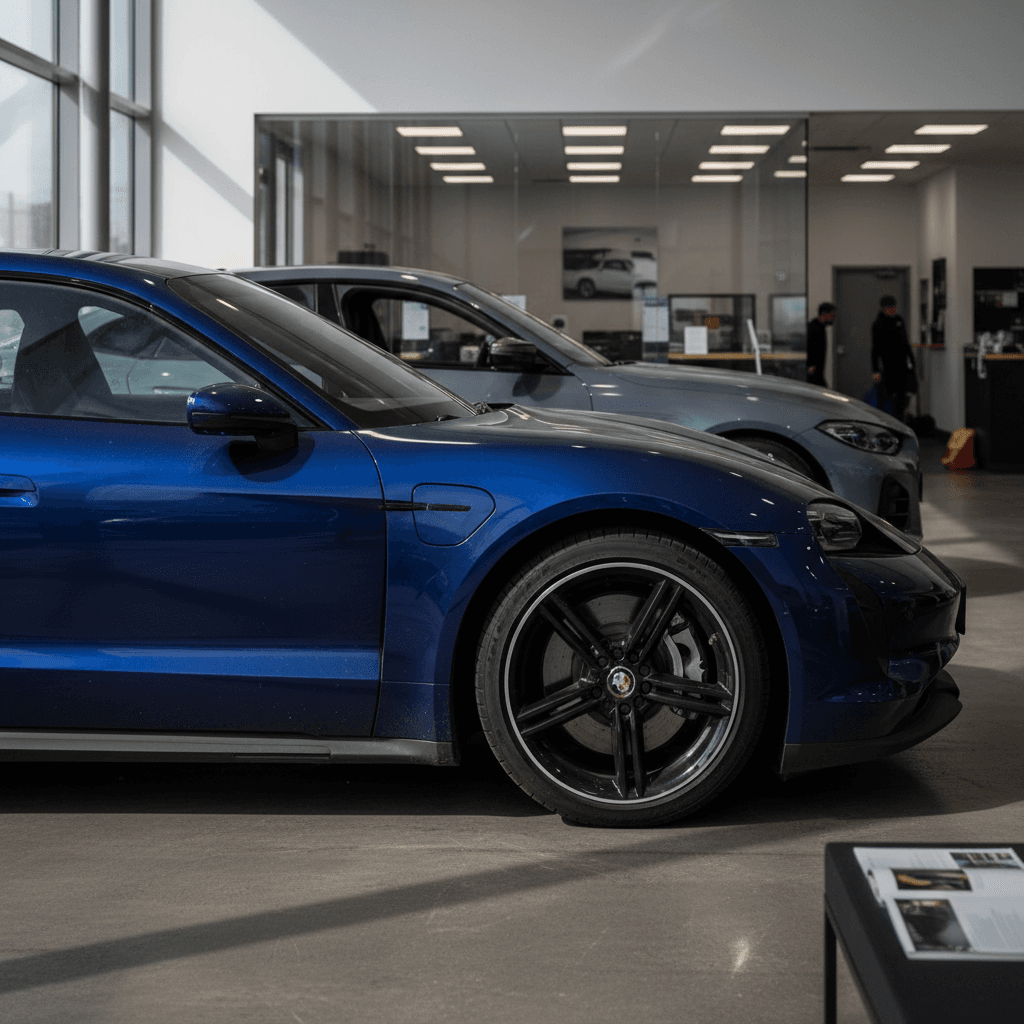
Typical real‑world range and DC charging behavior (when new)
Approximate figures to help you compare; expect some variation on used cars depending on battery health and conditions.
| Model / trim | Approx. real‑world highway range when new | DC fast‑charge peak (ideal conditions) | Notable charging traits |
|---|---|---|---|
| Taycan base / 4 / 4S | ~210–260 miles | Up to ~270–320 kW on 800‑V chargers (later years) | Very strong, flat charge curve; excellent 10–80% times. |
| Taycan GTS / Turbo | ~230–280 miles | Similar high peaks, strong repeatability | Higher performance, slightly more consumption at speed. |
| BMW i4 eDrive35 | ~180–200 miles | ~130–140 kW | Cheapest way into an i4, but range can feel tight on winter road trips. |
| BMW i4 eDrive40 | ~220–260 miles | ~180 kW | Sweet spot for most buyers; good mix of range and price. |
| BMW i4 M50 | ~200–230 miles | ~180 kW | Big power and AWD, but range drops vs eDrive40, especially with enthusiastic driving. |
Later‑year Taycans charge faster; mid‑trim i4 models often go slightly farther per charge.
Don’t shop by EPA sticker alone
- If you frequently fast‑charge on road trips, the Taycan’s 800‑V architecture and strong charge curve are a real advantage, especially on the latest model years.
- If most of your charging is at home and you do a mix of city and highway driving, **an i4 eDrive40** offers comfortable range and simpler charging hardware.
- Older Taycans with smaller original batteries will sit closer to the low end of the range spectrum; some buyers deliberately choose them as a second fun car rather than a primary road‑trip machine.
Interior comfort, tech, and practicality
Both cars feel premium inside, but they solve comfort and cargo in different ways. Your family situation and tolerance for a low‑slung cockpit should guide you.
Porsche Taycan interior
- Design: Minimalist and sporty, with a low driving position and wide center console.
- Space: Rear seats are usable but tight for tall adults; accessing child seats takes more effort than in a crossover.
- Tech: Multiple screens, modern UI, and frequent over‑the‑air improvements on later cars. Options like passenger‑side display and premium sound are common but not guaranteed, check each used car’s spec sheet.
- Cargo: Modest trunk opening in the sedan; Cross/Sport Turismo wagons are far more practical with a big hatch and extended roofline.
BMW i4 interior
- Design: Feels like a contemporary 4 Series, curved dual display, traditional BMW ergonomics.
- Space: Rear headroom is tight due to the roofline, but legroom is decent. Easier in/out than the Taycan for most adults.
- Tech: BMW’s iDrive and driver‑assist systems are familiar to many owners and easy to live with daily.
- Cargo: The hatchback design offers a large opening and fold‑flat rear seats, making it easier to live with as an only vehicle.
Think about daily livability
Depreciation, pricing, and value in 2026
Depreciation is where both of these cars become surprisingly attractive on the used market. EV price wars, rapidly improving range, and changing tax‑credit rules have pushed down values on many early luxury EVs, Taycan and i4 included.
How used pricing typically stacks up (illustrative 2026 U.S. market ranges)
Real asking prices vary by mileage, condition, options, and region, but these bands show the general relationship between the two models.
| Vehicle | Original MSRP band (new) | Typical asking range used in 2026* | Depreciation character |
|---|---|---|---|
| Porsche Taycan (most trims) | ~$90,000–$160,000+ | Roughly $45,000–$95,000 | Many early cars have seen well over 40–50% value loss, depending on spec and miles. |
| BMW i4 (most trims) | ~$55,000–$80,000+ | Roughly $30,000–$55,000 | Luxury‑car depreciation, but EV incentives and discounting make used prices look especially soft. |
In many cases, a comparable Taycan still commands more money than an i4, but the gap is far smaller than it was new.
Why Taycan depreciation can be your friend
The i4, by contrast, started cheaper and was often sold with big new‑car incentives. That means some used examples may not look as "discounted" versus their effective new transaction price, even if the depreciation percentage is still substantial.
Battery health, reliability, and warranty
On any used EV, the battery pack is the big question: not just whether it still delivers useful range, but how it’s been treated. Both Porsche and BMW offer **8‑year / 100,000‑mile** battery warranties for U.S. buyers (check each VIN for specifics), but you still want hard data when you’re buying second‑hand.
Battery and reliability realities for used Taycan and i4 shoppers
What you should keep in mind before you sign anything.
Used Taycan battery & reliability notes
- Early Taycans were launched into a fast‑moving market; later cars gained higher‑capacity batteries and better software. That can soften resale of earlier builds.
- High‑performance use and frequent DC fast‑charging are fine when the car manages heat well, but it’s still smart to see a battery health report.
- Porsche service work and parts are generally expensive, so out‑of‑warranty ownership deserves a realistic budget.
Used i4 battery & reliability notes
- The i4’s battery tech has been steady so far; degradations tend to be gradual rather than dramatic in the first years.
- As with any tech‑rich BMW, future costs often come from electronics and driver‑assist hardware rather than the battery itself.
- Service and parts pricing are still luxury‑tier, but generally lower than a comparable Porsche.
Where Recharged fits in
Ownership costs: insurance, maintenance, and tires
Luxury EVs don’t burn gasoline, but they still burn money if you’re not realistic. Insurance, brakes, suspension components, and especially tires can chew through a budget faster than you expect, particularly on heavy, high‑performance models.
Taycan ownership costs
- Insurance: Typically higher than the i4 due to MSRP, repair costs, and performance.
- Service: Porsche dealer labor rates are among the highest in the industry. Even routine wear items can be pricey.
- Tires and brakes: Powerful cars on big wheels and sticky rubber eat tires quickly; brakes last longer than in gas cars thanks to regen but are expensive when due.
- Out‑of‑warranty risk: Advanced air suspension, rear‑steer, and complex electronics mean you want either a stout emergency fund or extended coverage.
i4 ownership costs
- Insurance: Still a luxury car, but often lower premiums than a similarly priced Taycan.
- Service: BMW’s maintenance menu is more familiar to mainstream shops; some basic work can be handled by independent specialists.
- Tires and brakes: Performance trims like M50 are tire‑hungry, but overall consumable costs tend to undercut the Taycan.
- Out‑of‑warranty risk: Expect typical modern BMW concerns, sensors, cameras, infotainment, not catastrophic engine failures.
Budget beyond the payment
How to choose: a simple checklist
Used Taycan vs BMW i4: 7 questions to answer first
1. How often will you really fast‑charge?
If you plan frequent road trips and rely heavily on public DC stations, the Taycan’s charging speed is a major plus. If you mostly charge at home and road‑trip a few times a year, the i4’s slower peak speeds matter less.
2. Are you comfortable with Porsche‑level running costs?
If your budget is tight, the i4’s generally lower insurance and service bills may be a better fit, even if the Taycan you’re eyeing looks like a bargain on price alone.
3. Do you need a hatchback?
If you haul bulky cargo, the i4’s hatch or a Taycan wagon should be near the top of your list. The Taycan sedan’s tiny trunk opening frustrates more owners than you’d think.
4. How much performance do you truly use?
A Taycan Turbo or i4 M50 is thrilling, but a Taycan 4S or i4 eDrive40 often delivers all the speed you can reasonably exploit, while saving money and range.
5. What’s left on the EV and battery warranty?
Check in‑service dates and mileage carefully. A car with several years of factory battery coverage remaining is worth paying more for than a similar one near the end of its window.
6. Do you have a clear picture of battery health?
Don’t settle for a dashboard guess at range. Look for a <strong>formal battery health report</strong>, like the Recharged Score diagnostics, before you commit, especially on earlier model years.
7. How long do you plan to keep the car?
If you’ll keep it 2–3 years, focus on minimizing further depreciation. If you’ll keep it 7–10 years, prioritize comfort, support, and long‑term serviceability over raw spec sheet glory.
How Recharged helps with used Taycan and i4 shopping
Shopping used EVs shouldn’t feel like a guessing game about invisible components and past abuse. That’s exactly why Recharged exists, to bring clarity and confidence to used EV buying, whether you land on a Taycan or an i4.
Buying a used Taycan or BMW i4 with Recharged
What you get beyond a typical classified listing.
Verified battery health (Recharged Score)
Transparent pricing & financing
Trade‑in and nationwide delivery
Ready to find your next EV?
Browse VehiclesIf you’d rather see a car in person, Recharged also operates an **Experience Center in Richmond, VA**, where you can get one‑on‑one guidance from EV specialists who know these cars intimately.
FAQ: used Porsche Taycan vs BMW i4
Frequently asked questions
Bottom line: which should you buy?
The **used Porsche Taycan** is the connoisseur’s choice, stunning to look at, deeply satisfying to drive, and backed by a charging system that still embarrasses many rivals. The trade‑offs are higher running costs and the need to be very deliberate about battery health, warranty coverage, and options.
The **used BMW i4** is the rationalist’s pick. It delivers serious speed in M50 form, excellent daily comfort, hatchback practicality, and a more approachable cost profile. For many households, an i4 eDrive40 or M50 is the smarter all‑rounder, even if it doesn’t tug the heartstrings quite like a Taycan GTS.
Either way, the smartest move in 2026 is to buy with **data, not guesswork**. Verified battery diagnostics, transparent pricing, and expert guidance turn a complex decision into a confident one. That’s where a platform built for used EVs, like Recharged, can tilt the odds in your favor, whether your future driveway shows a Stuttgart crest or a Bavarian roundel.