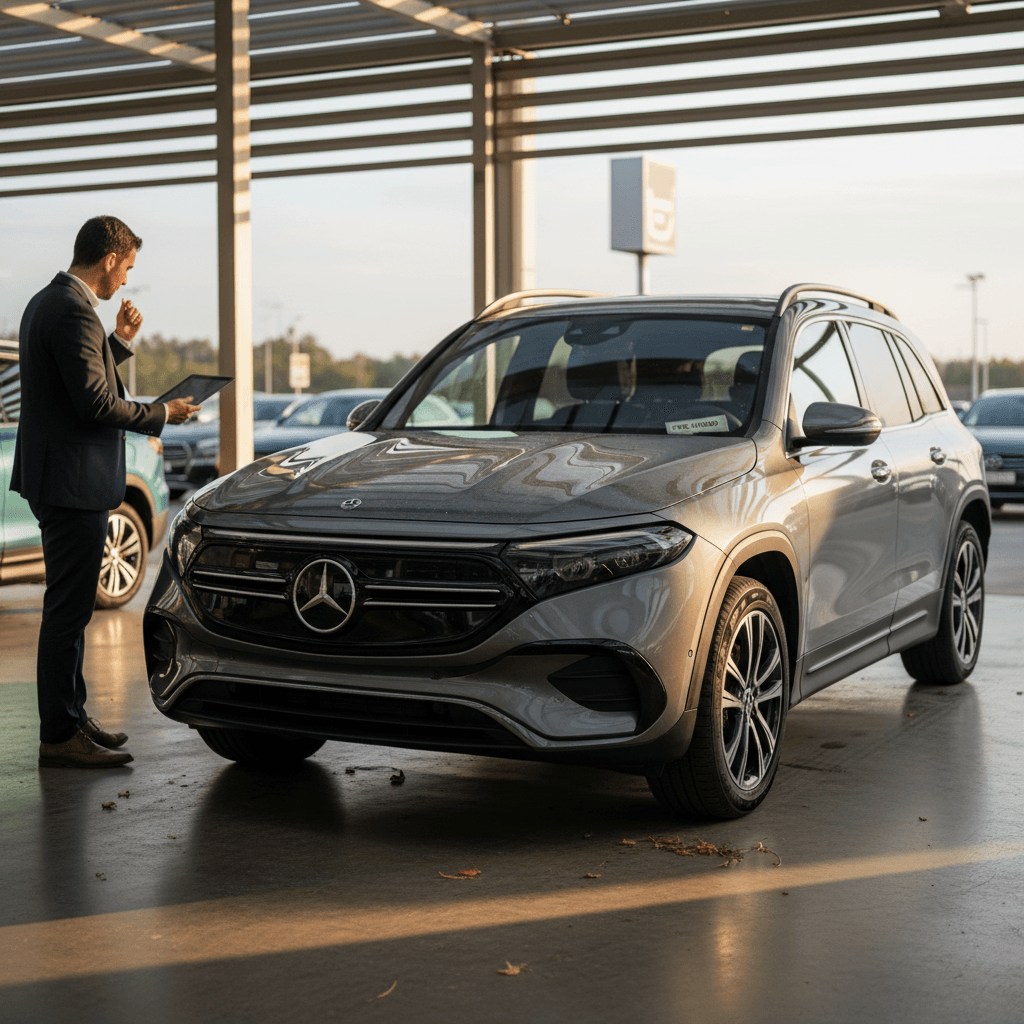
If you’re shopping for a compact luxury electric SUV, a used Mercedes EQB belongs on your 2026 short list. It packs three rows, a familiar Mercedes cabin, and usable range into a city‑friendly footprint. This 2026 used Mercedes EQB buying guide walks you through trims, range, known issues, pricing, battery health and inspection tips so you can decide if it’s the right EV for you, and avoid costly surprises.
Quick EQB snapshot
Why the used Mercedes EQB makes sense in 2026
Core reasons shoppers like used EQBs
Where this compact Mercedes EV fits in the 2026 market
Compact 3‑row layout
The EQB offers an available third row, something few compact EVs can match. The way‑back seats are kid‑sized, but they’re handy for school runs or short carpools.
Comfort over sport
Unlike some EVs that chase performance numbers, the EQB focuses on a quiet, relaxed ride with a familiar Mercedes feel. Great if you’re coming out of a gas GLB, GLC or similar.
Luxury brand at used‑car prices
Early‑build 2022 and 2023 EQBs have already taken a big depreciation hit. In 2026, you’re often paying well under new compact‑luxury‑EV money for a still‑modern Mercedes interior and tech.
Where the EQB isn’t perfect
Model years, trims and key specs to know
For U.S. shoppers in 2026, you’ll mostly see 2022–2025 Mercedes EQB models on the used market, with 2026s beginning to appear as off‑lease units later in the year. Understanding trims and specs will keep you from overpaying for performance you don’t need, or under‑buying and regretting it.
Common U.S. Mercedes EQB trims and specs
High‑level snapshot of trims you’ll see most often on the used market. Exact specs can vary slightly by model year and wheel/tire packages.
| Trim | Drive | Approx. usable battery | EPA range (recent MY) | Power | Typical wheels |
|---|---|---|---|---|---|
| EQB 250+ | FWD | ≈70.5 kWh | ≈245–251 miles | Single motor, modest power | 18" |
| EQB 300 4Matic | AWD | ≈70.5 kWh | ≈205–232 miles | Dual motor, stronger mid‑range | 18" or 19" |
| EQB 350 4Matic | AWD | ≈70.5 kWh | ≈202–207 miles | Quickest EQB, most torque | Mostly 19" |
Always verify exact equipment on the specific VIN, packages and wheel sizes affect range and features.
Model‑year shortcut
EQB size and practicality at a glance
Real-world range and charging: what to expect
On paper, the Mercedes EQB offers roughly 200–250 miles of EPA range, depending on trim and wheels. In the real world, that number changes quickly with highway speed, temperature, and how much weight you’re carrying, especially in a boxy SUV like the EQB.
Typical real‑world range scenarios
What many U.S. owners see in day‑to‑day driving
City / suburban mix
At moderate speeds, many EQB drivers see ~3.0–3.5 mi/kWh. With ~70 kWh usable, that’s often 210–240 miles on a full charge, sometimes more in mild weather.
70–75 mph highway
Expect range to fall closer to 160–200 miles, especially in the dual‑motor 300 and 350. The tall, square shape pushes a lot of air at speed.
Cold‑weather trips
In winter, pre‑conditioning and cabin heat can cut usable range another 15–30% on highway runs. Plan extra charging stops in cold climates.
Charging speeds in context
Home charging
If you can install a Level 2 charger (240 V) at home, the EQB works well as a daily driver. Plug in overnight and you’ll typically wake up near your set charge limit (often 80–90%).
- Plan for a 40‑ or 48‑amp circuit if possible.
- Aim to keep the pack between 20–80% for daily use.
- Time charging for off‑peak utility rates where available.
Public fast charging
On road trips, expect to stop every 120–170 miles in real‑world conditions. Shorter, more frequent DC fast‑charging sessions (e.g., 20–70%) are better for both time and battery longevity than sitting at 100% on a fast charger.
- Use PlugShare or the station’s app to confirm uptime.
- Arrive with 10–20% state of charge for quicker power ramp‑up.
Be realistic about road‑trip range

Known issues, recalls and reliability signals
Because the EQB is still relatively new, long‑term reliability data is thin. But by 2026 we’ve seen clear patterns: generally solid battery chemistry and low degradation for many owners, mixed experiences with software and electronics, and several important high‑voltage battery recalls on early model years you must verify before you buy.
Patterns we see on used EQBs
Not every car will have these problems, but they’re worth checking for
High‑voltage battery recalls
Some 2022–2024 EQBs have recalls related to the high‑voltage battery or its management software, including rare but serious internal cell faults that can trigger warnings or, in extreme cases, fire risk. You want proof that any open campaigns, especially safety recalls, have been completed.
MBUX and software glitches
Owners occasionally report infotainment freezes, random error messages or false alerts that clear with a restart or software update. On a test drive, watch for repeated warnings, especially about the drive system, 12‑V battery, or high‑voltage system.
Rattles and build‑quality complaints
Because the EQB shares bones with the GLB, you’ll see some traditional SUV issues: interior rattles, door or hatch noises, wind noise. These are usually annoying more than dangerous, but they tell you how carefully the previous owner (and dealership) addressed concerns.
Good news: no widespread rapid degradation
So far, we’re not seeing systemic early battery wear in EQBs that are driven and charged normally. Most real‑world complaints are about software, not about packs suddenly losing huge chunks of capacity.
Don’t gloss over recall letters
Before you buy, run the VIN through the NHTSA recall lookup and Mercedes’ own site, and confirm that all safety and service campaigns are closed. At Recharged, we bake this step into our process and include the results in the vehicle’s documentation, so you’re not left deciphering recall codes on your own.
Pricing, depreciation and which EQB is the best value
Exact numbers move with the market, but by 2026 the used EQB has done what most luxury EVs do: it depreciates faster than a comparable gas SUV. That stings for first owners, and creates opportunity for you.
- Early‑build 2022 EQBs now price like well‑equipped compact gas crossovers, not new‑EV money.
- 2023–2024 examples typically command a premium for fresher styling, more range‑focused 250+ trims, and updated software.
- Conservatively optioned EQB 250+ models often deliver the best balance of price and range for commuting families.
- High‑spec 350 4Matic AMG‑line builds cost more used but may not hold extra value if you don’t care about 0–60 times.
How to think about value
When a cheaper EQB can be a trap
- Open high‑voltage battery recall with no scheduled fix.
- Patchy service records or frequent visits for electrical issues.
- Obvious curb rash, mismatched tires, or signs of accident repair.
Each of these can erase any savings and make it harder to resell later.
Signals of a strong value buy
- One‑owner or off‑lease history with consistent dealer or specialist service.
- Clean battery‑health report and no high‑voltage fault history.
- Recent tires, brake service, and up‑to‑date software.
That’s exactly the kind of EQB Recharged looks for when sourcing inventory.
Inspection checklist for a used Mercedes EQB
Whether you’re shopping a private sale, a franchise dealer or an online marketplace, you need a structured way to evaluate a used EQB. Use this checklist as your baseline, and know that a Recharged vehicle has already had a much deeper version of this inspection, documented in the Recharged Score Report.
Used Mercedes EQB inspection checklist (2026)
1. Run recall and service history
Use the VIN to pull recall status and service records. Confirm <strong>all high‑voltage and software recalls are closed</strong>, and look for patterns, repeated electrical visits or long stays at the dealer are yellow flags.
2. Inspect tires, wheels and brakes
Uneven tire wear can hint at suspension or alignment issues. Check that EV‑rated tires are installed in matching sets and that <strong>brake rotors aren’t deeply grooved or rusty</strong> from lack of use.
3. Test AC and DC charging
If possible, plug the EQB into a Level 2 charger and a known‑good DC fast charger. Watch for <strong>charging faults, unusual noises from the charge port</strong>, or inconsistent power levels that could signal hardware or software issues.
4. Scan for warning lights and stored faults
Turn the car on and watch the cluster. Any persistent <strong>drive system, 12‑V, or high‑voltage warnings</strong> are reasons to pause. A professional scan can reveal stored faults even if the dash is currently clear.
5. Evaluate interior tech and comfort
Cycle through the MBUX infotainment system, navigation, Bluetooth, cameras and driver‑assist features. Look for <strong>screen flicker, lag, or random reboots</strong>. Creaks and rattles on a test drive are common but negotiable.
6. Check for water intrusion and underbody damage
Inspect door seals, the cargo area and the underbody for signs of impact or water damage near the battery pack. Any evidence of submersion or major underbody scraping deserves a professional evaluation before you proceed.
What Recharged adds on top
Ready to find your next EV?
Browse VehiclesBattery health: how to tell if an EQB pack is strong
Battery health is the single biggest variable in the long‑term value of any used EV. The EQB’s ~70 kWh pack has been holding up well for many owners, but you still want objective data, especially as 2022 models cross 50,000+ miles in 2026.
Key battery‑health signals on a used EQB
What you can check yourself, plus what needs pro tools
Displayed range vs. EPA
With the battery at or near 100% and recent mixed driving, compare the indicated full‑charge range to the trim’s original EPA figure. Being down a bit is normal; a huge gap can justify deeper diagnostics.
Charging behavior over time
Ask how the car was charged: mostly home Level 2 to ~80–90% is ideal. Lots of daily DC fast‑charging to 100% or long storage at full charge is tougher on the pack.
Professional battery report
The gold‑standard is a dedicated battery‑health scan that reads pack capacity, cell balance and fault history. This is built into the Recharged Score, but you can also request it from a dealer or EV specialist.
Don’t obsess over 2–3%
Should you choose EQB 250+, 300 or 350?
For 2026 used‑market shoppers, the real question isn’t just which trim is fastest. It’s which EQB fits your range needs, climate and driving style without wasting money on capability you’ll never use.
Which used EQB trim fits your life?
Choose based on climate, driving mix and performance expectations
EQB 250+: efficiency first
Best for: suburban commuters and families who value range over speed.
- Front‑wheel drive, calmer acceleration.
- Longest EPA range, especially on 18" wheels.
- Often lower purchase price and insurance.
EQB 300 4Matic: traction and balance
Best for: snow‑belt drivers or those who want AWD confidence without max power.
- Dual motors and 4Matic all‑wheel drive.
- Noticeably quicker than 250+, slight range penalty.
- Good compromise if you see real winters.
EQB 350 4Matic: quick and premium
Best for: drivers who care about acceleration and typically carry light loads.
- Strongest punch off the line.
- Shortest range of the three, especially on 19" wheels.
- Often equipped with AMG‑line appearance and more options.
Range vs. performance trade‑off
How buying a used EQB works with Recharged
You can absolutely hunt down a used EQB on your own, but EVs reward buyers who do their homework. Recharged is built to handle the hard parts for you, especially around battery health, pricing and logistics.
1. Transparent battery and pricing data
Every Recharged vehicle comes with a Recharged Score Report that covers battery health, real‑world range expectations, and how the price compares to current fair‑market data. You see the same data we do before you commit.
2. EV‑specialist support
Our team focuses on EVs all day, so you can ask detailed questions about EQB trims, charging, or known issues and get straight answers. If an EQB isn’t right for your use case, we’ll tell you.
3. Financing, trade‑in and delivery
Recharged offers financing options tailored to used EVs, instant offers or consignment for your trade‑in, and nationwide delivery. You can do the entire purchase digitally or visit our Experience Center in Richmond, VA if you prefer in‑person.
Why this matters for EQB shoppers
Used Mercedes EQB FAQ
Frequently asked questions about buying a used Mercedes EQB
Bottom line: is a used Mercedes EQB right for you?
If you want a compact luxury EV that feels familiar to drive, offers an available third row, and doesn’t scream “sci‑fi,” a used Mercedes EQB is worth serious consideration in 2026. It’s not the quickest‑charging or longest‑range option, but it can cover daily commuting and family duty with calm, comfortable manners, especially if you have home charging.
The smart move is to shop with eyes open: understand trims, confirm recall work, demand real battery‑health data, and take your time on the test drive. Whether you ultimately buy through Recharged or elsewhere, using the guidelines in this EQB buying guide will help you avoid problem cars and focus on the examples that are likely to deliver years of quiet, electric miles.