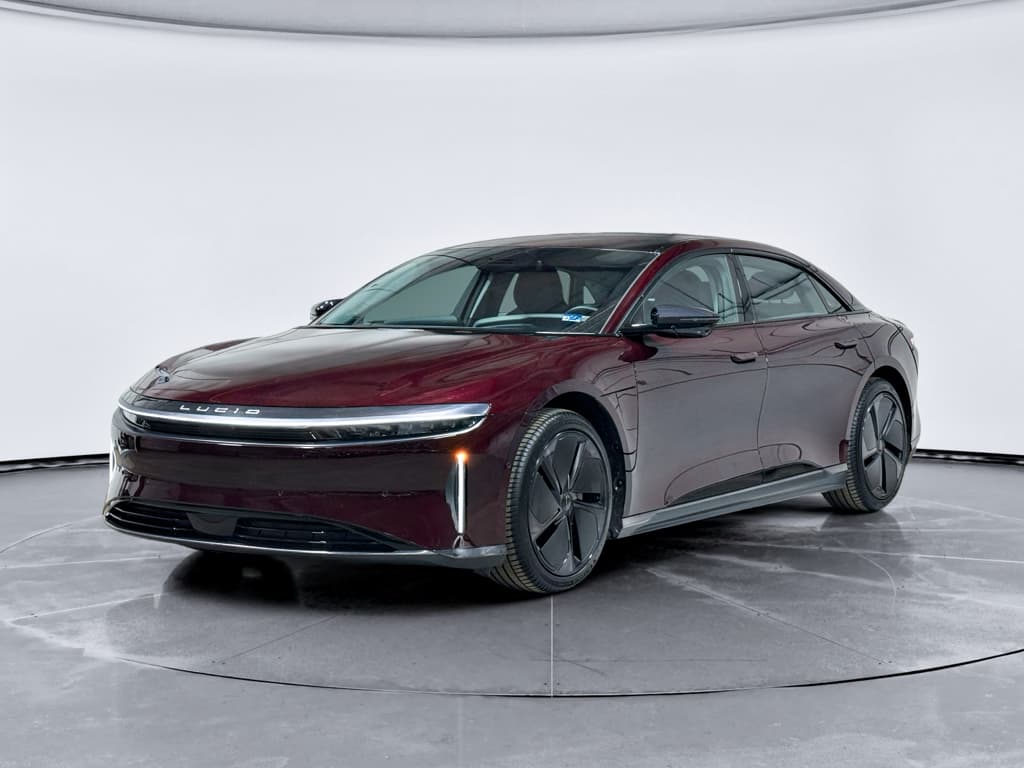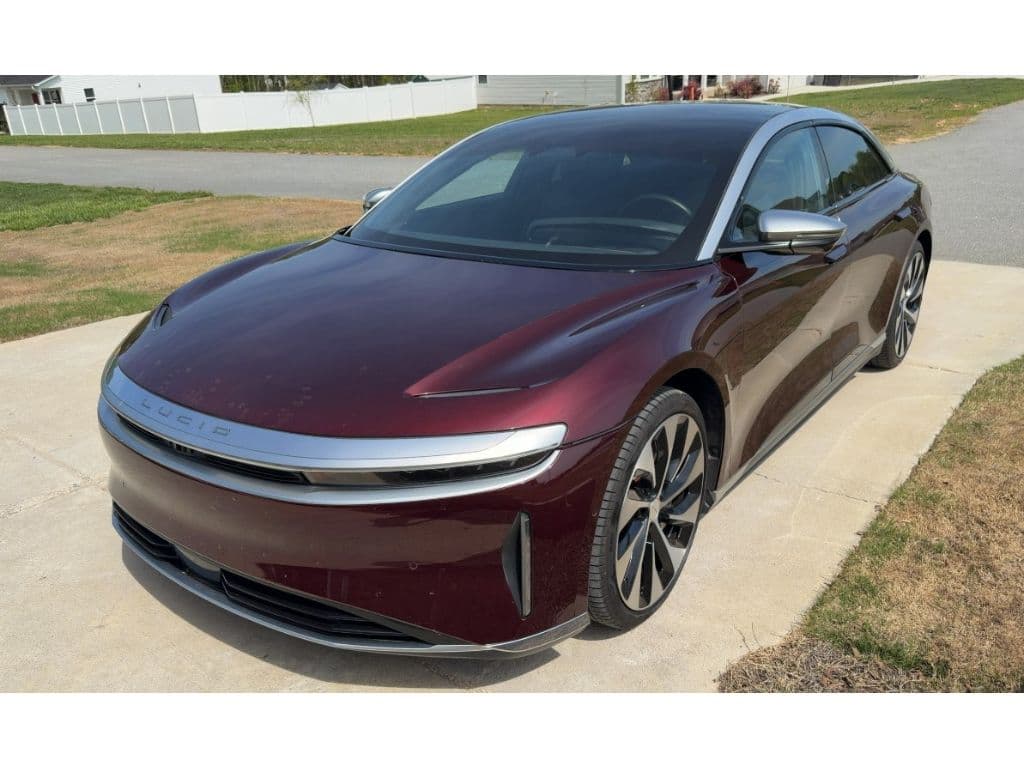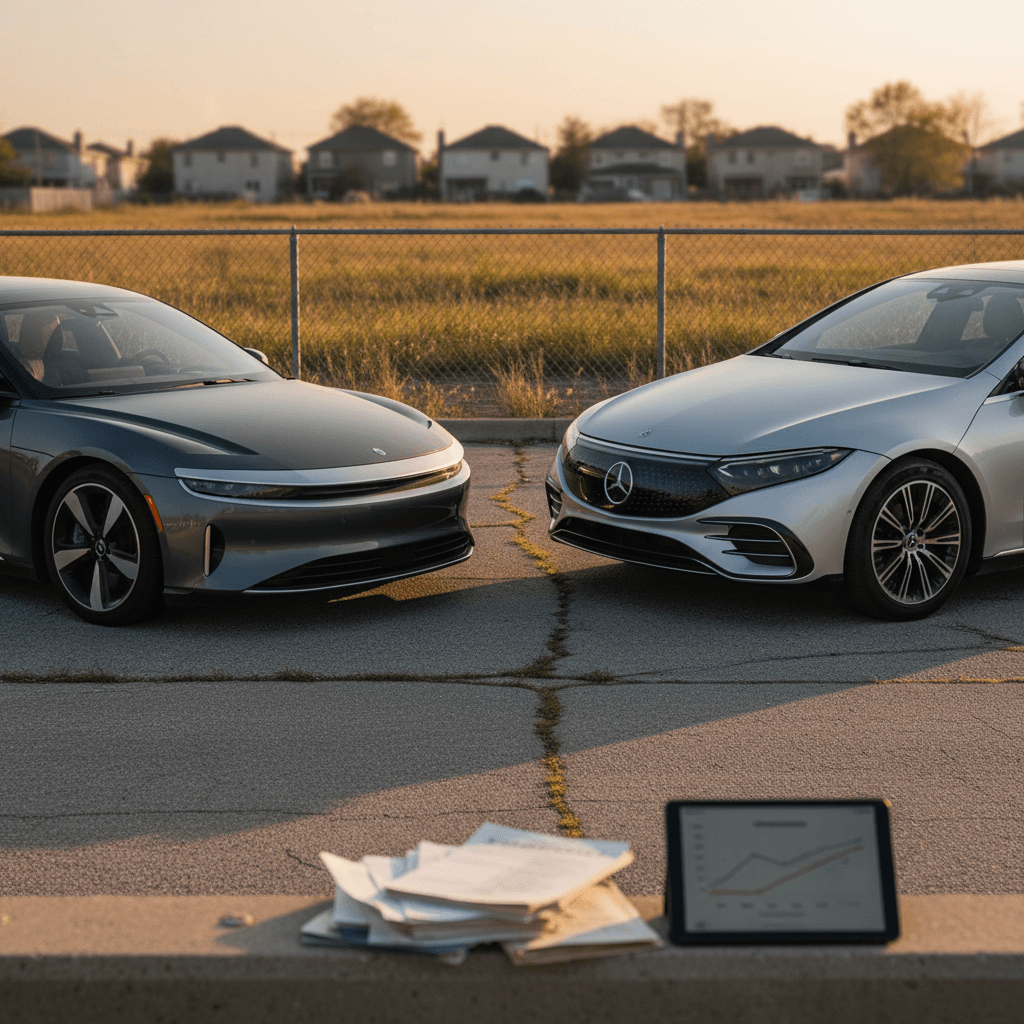
If you’re cross-shopping a used Lucid Air vs Mercedes EQS, you’re looking at two of the most luxurious electric sedans ever built. Both deliver big range, whisper-quiet cabins, and cutting‑edge tech, but they do it with very different personalities, ownership costs, and long‑term prospects.
Two very different paths to luxury EVs
Overview: Used Lucid Air vs Mercedes EQS
Lucid Air (used)
- Strengths: Class‑leading range (up to 516 miles EPA on some Grand Touring trims), super‑quick charging, sharp driving dynamics, airy cabin.
- Weak spots: Newer brand with a shorter reliability track record and much smaller service network.
- Best for: Range‑focused drivers, early adopters, and enthusiasts who prioritize performance and innovation over brand tradition.
Mercedes EQS (used)
- Strengths: Classic Mercedes comfort, ultra‑quiet cabin, Hyperscreen tech, established dealer and service network.
- Weak spots: Heavy depreciation, lower range than comparable Lucid trims, polarizing styling, more floaty drive feel.
- Best for: Drivers who value comfort and brand prestige, and want a Mercedes ownership experience in an EV.
Headline numbers: Lucid Air vs Mercedes EQS
Quick take: Which used EV fits you?
Used Lucid Air vs Mercedes EQS: Who should buy which?
Match the car to how you actually drive, not just the spec sheet.
Choose a used Lucid Air if…
- You want maximum range per dollar, especially on Grand Touring or Touring trims.
- You prioritize performance and handling over a soft, cushy ride.
- You’re comfortable with a newer brand and a smaller dealer/service footprint.
- You road‑trip often and care about fast DC charging speeds and efficiency.
Choose a used Mercedes EQS if…
- You want the quietest, cushiest ride you can get in an EV.
- You value Mercedes dealership support and a large service network.
- You can take advantage of steep depreciation to get a lot of car for the money.
- You care more about cabin comfort and tech theatre than ultimate range or efficiency.
How Recharged can help
Range, power and performance compared
On paper, both cars are quick, refined, and more than adequate for everyday passing and merging. The differences show up at the extremes, range, repeatable fast charging, and how the cars feel when you push them.
Core specs: Common used trims of Lucid Air vs Mercedes EQS
Approximate EPA ranges and performance for popular trims you’ll commonly see on the used market.
| Model / trim | Drive layout | EPA range (approx.) | 0–60 mph (approx.) | Horsepower |
|---|---|---|---|---|
| Lucid Air Pure (RWD) | RWD | ~410–420 mi | ~4.5 sec | ~430 hp |
| Lucid Air Touring | AWD | ~410 mi | ~3.8 sec | ~620 hp |
| Lucid Air Grand Touring | AWD | Up to ~516 mi | ~3.0–3.4 sec | ~819 hp |
| Mercedes EQS 450+ | RWD | ~350–352 mi | ~5.5–5.9 sec | ~355 hp |
| Mercedes EQS 450 4Matic | AWD | ~340–345 mi | ~4.8–5.0 sec | ~355 hp (dual‑motor) |
| Mercedes EQS 580 4Matic | AWD | ~340–345 mi | ~4.1–4.3 sec | ~516–536 hp |
| Mercedes‑AMG EQS 53 | AWD | ~300–305 mi | ~3.4 sec | ~649+ hp |
Always verify exact specs by VIN; wheel size, options, and model year updates affect range and performance.
Lucid’s range advantage is real
- Lucid Air: Prioritizes efficiency and range, with very strong acceleration across the line. The chassis feels lighter and more agile, and performance trims (including Sapphire) move into supercar territory.
- Mercedes EQS: Delivers effortless torque and smooth acceleration, especially in EQS 580 and AMG EQS 53 trims, but emphasizes comfort over sharp handling. Even base 450+ models feel adequately quick for daily use.
Comfort, tech and driving experience
Luxury buyers often care more about how a car feels than how it spec‑sheets, and here Lucid and Mercedes take very different tacks.
Lucid Air: Modern, airy, driver‑focused
- Interior: Minimalist but warm, with a low cowl and huge glass areas that make the cabin feel open. Rear space is good, but not as limo‑like as EQS.
- Seats & ride: Firm‑but‑comfortable seats and a more controlled ride. It feels like a big sports sedan rather than an electric lounge.
- Infotainment: Lucid’s own software with frequent over‑the‑air updates. Early cars had some glitches; many have been improved with software, but you’ll want to confirm update history.
Mercedes EQS: Cocooned, ultra‑quiet luxury
- Interior: Rich materials, lots of ambient lighting, and available Hyperscreen, a wall‑to‑wall glass panel with multiple displays.
- Seats & ride: Exceptionally quiet and soft. The air suspension filters out most of the world; some drivers love it, enthusiasts may find it a bit floaty.
- Infotainment: MBUX is feature‑packed and integrates smoothly with the broader Mercedes ecosystem and dealer service tools.
Where each car shines day‑to‑day
Charging and road-trip usability
Both sedans use CCS fast‑charging hardware on earlier model years, and both pair well with today’s high‑power public networks. The big differences are efficiency and how quickly they add miles at peak charge rates.
Charging and road‑trip comparison
Think in miles added per minute, not just kW numbers.
Lucid Air
- High‑voltage architecture enables very fast DC charging on capable stations.
- In ideal conditions, can add roughly 200–300 miles in ~20–25 minutes, depending on trim and charger.
- Outstanding highway efficiency means you stop less often.
Mercedes EQS
- DC fast‑charging peaks around the low‑100‑kW range on many trims.
- Expect roughly 10–80% in about 30–35 minutes on a strong DC fast‑charger.
- Good, but not class‑leading, efficiency means a bit more energy per mile.
Network access
- Both primarily use CCS public networks like Electrify America, EVgo, and ChargePoint.
- Newer models are gaining access to Tesla’s Supercharger network via adapters and NACS ports, check year and hardware when shopping used.
Check charging hardware and adapters
Depreciation and used pricing
Both cars took big price hits new, but the EQS has, so far, fallen harder. That’s good news if you want Mercedes luxury on a used‑car budget, and a reason to pay close attention if you’re considering resale value.
Mercedes EQS: Huge discounts on the used market
- Early EQS sedans often sold with sizable incentives when new, then depreciated steeply.
- Some 3‑year‑old EQS models retain only around a third of their original MSRP, depending on trim and mileage.
- For you as a used buyer, that means you can often get a flagship Mercedes EV for the price of a new mainstream crossover.
Lucid Air: Newer market, still finding its level
- Lucid is a newer brand with less pricing history, so resale values are more volatile.
- Air models have also seen meaningful price cuts new, which puts pressure on used prices over time.
- Because of its standout range and performance, well‑specced Airs may hold value better among enthusiasts than volume EQS trims.
How to use depreciation to your advantage
Ownership costs and reliability
Neither of these cars is inexpensive to own if something major goes wrong, but they approach long‑term ownership differently.
Service, support, and reliability considerations
What it really feels like to live with each car after the warranty expires.
Lucid Air
- Service network: Still limited to a relatively small number of service centers, backed by mobile service in some regions.
- Early software issues: Many first‑wave vehicles had infotainment and minor electrical gremlins that have improved with updates, but history matters on a used car.
- Parts & repair: Some components are unique to Lucid, which can mean longer waits and less independent‑shop support.
Mercedes EQS
- Dealer network: Widespread Mercedes dealers with established service processes, parts pipelines, and loaner programs.
- Complex tech: Hyperscreen, air suspension, and elaborate comfort features are wonderful when new, but costlier if they fail out of warranty.
- Extended coverage: More third‑party and OEM extended‑warranty options exist thanks to Mercedes’ scale.
Don’t ignore warranty status
Battery health: What matters on a used luxury EV
The battery pack is the single most valuable component in either car. Fortunately, modern EV batteries tend to age slowly when cared for, but you still want data, not guesses, before you buy.
Key battery questions for Lucid Air and EQS shoppers
1. What’s the current usable range?
Don’t rely solely on the original EPA number. Ask the seller for recent full‑charge range readings and compare them to the car’s original rating to estimate degradation.
2. How was the car charged?
Frequent DC fast‑charging, especially to 100%, can accelerate degradation. A car mostly charged on Level 2 at home will typically age more gracefully.
3. Any battery‑related warranty work?
Review service records for high‑voltage battery repairs, module replacements, or software updates addressing range or thermal‑management issues.
4. What’s left on the battery warranty?
Most luxury EVs carry around 8 years / 100,000–150,000 miles of battery coverage from new. Know the <strong>in‑service date</strong> and mileage to see how much is left.
5. Is there independent test data?
Whenever possible, rely on a third‑party battery‑health report rather than a seller’s estimate. At Recharged, our <strong>Recharged Score</strong> includes detailed battery diagnostics so you can compare cars side‑by‑side.
How to choose: Lucid Air vs Mercedes EQS used
By this point, the choice is less about which car is “better” and more about which fits your life, your risk tolerance, and your budget.
Buyer profiles: Which used luxury EV fits you?
The long‑distance commuter or road‑tripper
You drive <strong>200+ miles in a day</strong> with some regularity.
Range anxiety annoys you, and you’d rather charge less often.
You value DC fast‑charging performance and efficiency.
<strong>Better fit:</strong> Lucid Air (Touring or Grand Touring) for its range and charging speed.
The comfort‑first luxury driver
Most of your driving is city or suburban, under 100 miles a day.
You care more about <strong>ride comfort and quiet</strong> than lap times.
You want full‑service dealer support and traditional luxury perks.
<strong>Better fit:</strong> Mercedes EQS 450+ or 580 4Matic.
The value hunter
You want a flagship luxury EV but at a mid‑tier price.
You’re comfortable buying a 2–4‑year‑old car with higher initial depreciation.
You plan to keep the car long enough that further resale isn’t your top concern.
<strong>Better fit:</strong> A used EQS, which often offers the steepest discounts from original MSRP.
The tech‑forward early adopter
You like owning something rare and conversation‑starting.
You’re comfortable with over‑the‑air updates and a newer service ecosystem.
You care deeply about energy efficiency and design innovation.
<strong>Better fit:</strong> Lucid Air in a well‑documented trim with strong battery health.
Use data to decide, not just emotion
Inspection checklist for buying used Lucid Air or EQS
Before you fall in love with a particular color or interior package, slow down and walk through a structured inspection. This is where a little discipline can save you thousands of dollars, and years of headaches.
On‑the‑ground checklist for a used Lucid Air or EQS
1. Scan the Recharged Score (or equivalent report)
Start with a <strong>battery and high‑voltage system health report</strong>. At Recharged, we summarize this in an easy‑to‑compare Recharged Score, along with pricing, accident history, and ownership costs.
2. Verify software update history
Both cars depend heavily on software. Check that key OTA updates and recalls have been applied, especially for infotainment, charging, and driver‑assist systems.
3. Inspect wheels, tires, and brakes
Heavy EVs eat tires and can stress brakes if driven aggressively. Look for uneven wear, mismatched tires, or warped rotors, all of which add immediate cost.
4. Test all comfort and tech features
Spend time with seat adjustments, massage functions, ambient lighting, audio, driver‑assist, and, on EQS, every Hyperscreen panel. Fixing dead pixels, seat motors, or radar sensors out of warranty isn’t cheap.
5. Check for water leaks and odors
Both cars use a lot of seals, gaskets, and panoramic glass. Look for damp carpets, fogged lights, or musty smells that may suggest leaks or prior water intrusion.
6. Confirm charging behavior
If possible, plug into both Level 2 and a DC fast‑charger. Watch for abnormal noises, error messages, or unusually slow charge rates that could signal battery or charging‑hardware issues.
7. Review remaining warranty and extended options
Have the seller provide documentation for all warranties and consider whether an extended plan makes sense for complex components like air suspension, infotainment, and high‑voltage systems.
FAQ: Used Lucid Air vs Mercedes EQS
Frequently asked questions about used Lucid Air and Mercedes EQS
Both the Lucid Air and Mercedes EQS represent the very top of the luxury EV market, just with different philosophies. The Air leans into range, efficiency, and cutting‑edge performance; the EQS doubles down on comfort, quiet, and the familiarity of a three‑pointed star. On the used market, those differences show up in depreciation, daily driving feel, charging behavior, and the support network standing behind each car.
If you pair the right car with the right usage pattern, and back it up with hard data on battery health, service history, and pricing, either can be a fantastic choice. When you’re ready to take the next step, Recharged can help you compare used Lucid Air and Mercedes EQS listings side‑by‑side, review Recharged Score Reports, line up financing, and even arrange trade‑ins and delivery, so your decision is driven by facts, not guesswork.