If you’re hunting for a used EV with the best battery warranty, you’re really asking one question: “How much of the biggest, most expensive part of this car is someone else still on the hook for?” Get that answer right and a used electric car can be a screaming deal. Get it wrong and you’ve adopted a very quiet $15,000 liability.
Quick takeaway
Why battery warranty matters most on a used EV
In a gasoline car, an engine failure is a disaster. In an EV, that role is played by the battery pack. It’s the most expensive component in the vehicle, and replacement costs can run into the five-figure range on many models. A strong remaining battery warranty can turn a used EV from a gamble into a very rational purchase.
Why you care about EV battery warranties
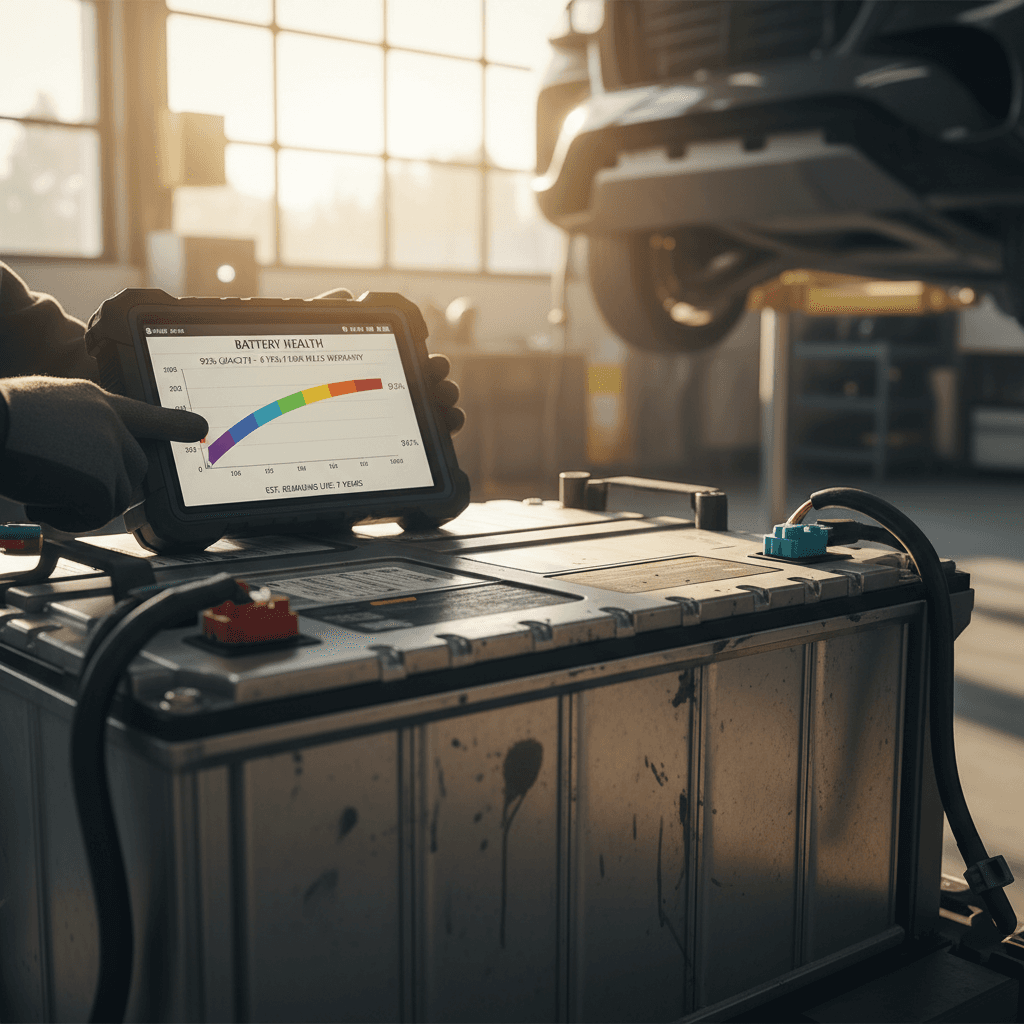
On the used market, warranty is leverage. A 5‑year‑old EV with three years of battery coverage left is a very different proposition than a 9‑year‑old car whose coverage ended last winter. When you shop through Recharged, every vehicle comes with a Recharged Score Report that shows verified battery health alongside remaining warranty, so you can see both protection and real‑world condition before you sign anything.
How EV battery warranties work: years, miles, and capacity
- Time limit: Almost all modern EVs carry 8–10 years of battery coverage from the original in‑service date.
- Mileage limit: Common caps are 100,000, 120,000, 150,000 or even 175,000 miles. Hit the miles or the years, whichever comes first, and coverage ends.
- Capacity guarantee: Many manufacturers now promise the pack will retain at least about 70% usable capacity during the warranty period. If it falls below that threshold under normal use, they repair or replace it.
- Defects vs. wear: Warranties cover defects and abnormal degradation, not normal slow aging, abuse, or crash damage.
- Transferability: Most EV battery warranties follow the car to subsequent owners, but some high‑end “10‑year” pitches quietly step down coverage for second owners. Always read the fine print.
Mind the start date
Top used EVs with the strongest battery warranties
Let’s rank this the way a used buyer actually experiences it: not on paper spec alone, but on how much useful battery coverage is likely to be left when you’re cross‑shopping 3–7‑year‑old cars in 2026.
Battery warranty “tiers” you’ll see on the used market
From generous to merely decent
Tier 1: 10‑year coverage
Who: Hyundai, Kia, Mercedes EQS/EQE (select trims), some niche brands.
Why it matters: These are the only cars likely to still have meaningful battery coverage at years 8–9 of life.
Tier 2: Long‑range 8‑year coverage
Who: Tesla, Rivian, Lucid, Mercedes EQB and many others.
Why it matters: Solid protection into the second owner’s tenure if you’re buying at 3–5 years old.
Tier 3: Basic 8‑year coverage
Who: Mainstream brands like Ford, VW, Nissan, BMW, Audi, etc.
Why it matters: Still adequate, but you need to watch mileage and degradation closely on older, high‑mile examples.
Tesla battery warranty on used models
Tesla doesn’t play the 10‑year headline game, but its Battery and Drive Unit Limited Warranty is still one of the benchmarks in the industry. Coverage on most models is 8 years with mileage caps between 100,000 and 150,000 miles, plus a guarantee that the pack will retain at least 70% of its original capacity during that period.
Tesla battery & drive unit warranty by model
Approximate coverage for recent U.S. models (check the exact year/trim you’re shopping).
| Model | Battery & drive unit warranty | Notes |
|---|---|---|
| Model S / Model X | 8 years / 150,000 miles / 70% capacity | Longest Tesla mileage cap; great for high‑milers. |
| Model 3 RWD & Model Y RWD | 8 years / 100,000 miles / 70% capacity | Shorter mileage cap, especially for commuters. |
| Model 3 Long Range / Performance; Model Y Long Range / Performance | 8 years / 120,000 miles / 70% capacity | Sweet spot for used buyers balancing price and coverage. |
For used buyers, the key question is how many of those years and miles are left.
Used Teslas direct from Tesla vs. marketplace
Hyundai and Kia: 10‑year/100,000‑mile champions
If you want a used EV that behaves like it still has a new‑car battery warranty, Hyundai and Kia are your friends. Their modern EVs, think Hyundai Ioniq 5 and 6, Kia EV6, and related models, carry roughly 10‑year/100,000‑mile high‑voltage battery warranties on U.S.‑market cars, sitting on top of their famously long powertrain coverage.
Why Hyundai and Kia are killer used buys
The asterisk: some earlier plug‑in hybrids and compliance‑era electrics had more complicated state‑by‑state rules and shorter terms. Late‑model dedicated EVs are where the 10‑year story really shines. Always verify the warranty booklet for the exact model year you’re chasing.
Mercedes-Benz EQS and EQE: luxury leaders in warranty length
Mercedes quietly offers one of the most impressive EV battery warranties in the business on its flagship electric sedans. Recent EQS and EQE models are covered for up to 10 years or 155,000 miles on the high‑voltage battery, stretching beyond the 8‑year/100,000‑mile benchmark that dominates the segment.
On the used market, that means a 3‑ or 4‑year‑old EQS can still have six or seven years of battery coverage left, something you simply won’t see from most German rivals. The EQB and other Mercedes EVs, by contrast, sit closer to the industry standard at 8 years/100,000 miles.
Rivian: adventure EVs with huge mileage caps
Rivian goes after a different bragging right: mileage. Its battery warranty is generally 8 years, but the mileage caps vary wildly by configuration. Some R1T and R1S trims with large packs stretch all the way to about 175,000 miles of coverage, well beyond anything you’ll see from mainstream brands.
High‑milers, this one’s for you
Other brands worth knowing about
- Lucid Air: Typically 8 years/100,000 miles on the high‑voltage battery, aligned with premium rivals but not as long as Mercedes’ 10‑year play.
- VW, Audi, BMW, Porsche, Polestar: Most sit in the 8‑year/100,000‑mile neighborhood, sometimes with specific capacity guarantees.
- Nissan Leaf: 8‑year/100,000‑mile warranty on the battery with a bar‑based capacity gauge, older LEAFs can qualify for pack replacement if they drop below a certain number of bars before the clock runs out.
- Domestic brands (Ford, GM, etc.): Generally 8‑year/100,000‑mile coverage, with more nuances on early models. Solid but rarely category‑leading.
Comparison table: used EV battery warranties you’ll actually see in the wild
Headline battery warranties for popular EVs (new)
These are new‑vehicle warranty terms; your job as a used buyer is to subtract age and mileage.
| Brand / Model family | Battery warranty (years / miles) | Capacity guarantee? | Why it’s attractive used |
|---|---|---|---|
| Hyundai Ioniq / Kia EV families | 10 yrs / 100,000 mi | Yes, typically ~70% | Long calendar window; great for 5‑year‑old cars. |
| Mercedes EQS / EQE | Up to 10 yrs / 155,000 mi | Varies by market | Among the longest luxury warranties; still strong at year 7–8. |
| Rivian R1T / R1S (select packs) | 8 yrs / up to 175,000 mi | Yes, by spec | Best for high‑mileage drivers who burn through miles quickly. |
| Tesla Model S/X | 8 yrs / 150,000 mi | 70% | High mileage cap and strong degradation track record. |
| Tesla Model 3/Y Long Range & Performance | 8 yrs / 120,000 mi | 70% | Sweet‑spot coverage for mainstream used buyers. |
| Most other mainstream EVs (Ford, VW, Nissan, etc.) | 8 yrs / 100,000 mi | Often ~70% | Adequate, but you must watch odometer and age carefully. |
Always confirm coverage for the exact model year and trim, this table is a starting point, not a contract.
What battery warranty does, and does not, cover
Usually covered
- Manufacturing defects in cells, modules, or pack assembly.
- Abnormal degradation beyond the capacity threshold (often ~70%) under normal use.
- Internal battery failures that trigger diagnostic trouble codes or safety shutdowns.
- Some related high‑voltage components, depending on brand (contactors, DC bus, etc.).
Usually not covered
- Crash or flood damage, including salt‑water exposure.
- Improper modifications to high‑voltage wiring or pack.
- Abuse like chronic fast‑charging from 0–100% or ignoring cooling system faults.
- Normal, gradual capacity fade that stays above the warranty threshold.
Every manufacturer has its own exclusions. Assume they’ve thought of your most creative bad idea and written it out of coverage.
Salvage title = no warranty
How battery warranty transfers on a used EV
The good news: on most modern EVs, the battery warranty follows the car, not the first owner. If there are three years and 40,000 miles of coverage left when you buy the car, they belong to you. But there are wrinkles.
Key transfer rules to confirm before you buy
1. Is the warranty fully transferable?
Most EV battery warranties are, but some brands cap the long 10‑year headline for the first owner and shorten it for subsequent owners. Read the warranty booklet or have the seller show written confirmation from the manufacturer.
2. Has the car ever had a branded title?
Any insurance total loss, even if repaired beautifully, can void the battery warranty. Run a full history report and avoid gray‑area paperwork.
3. Was all required service done?
If the warranty requires periodic inspections or software updates, confirm they’re in the service history. Skipping required maintenance is a classic warranty‑denial excuse.
4. Is the odometer accurate?
Mileage tampering is rare but not mythical. Compare digital mileage with historical records; big gaps are a red flag.
5. Is there any open recall or campaign?
Open campaigns usually don’t void warranty, but a neglected recall can snowball into problems later. Have them performed before or soon after purchase.
Have the dealer pull the build sheet
Battery health vs. battery warranty: which matters more?
Here’s the uncomfortable truth: a fat warranty on a sick battery is still a bad deal. You don’t want to win a warranty claim; you want a pack that doesn’t need one.
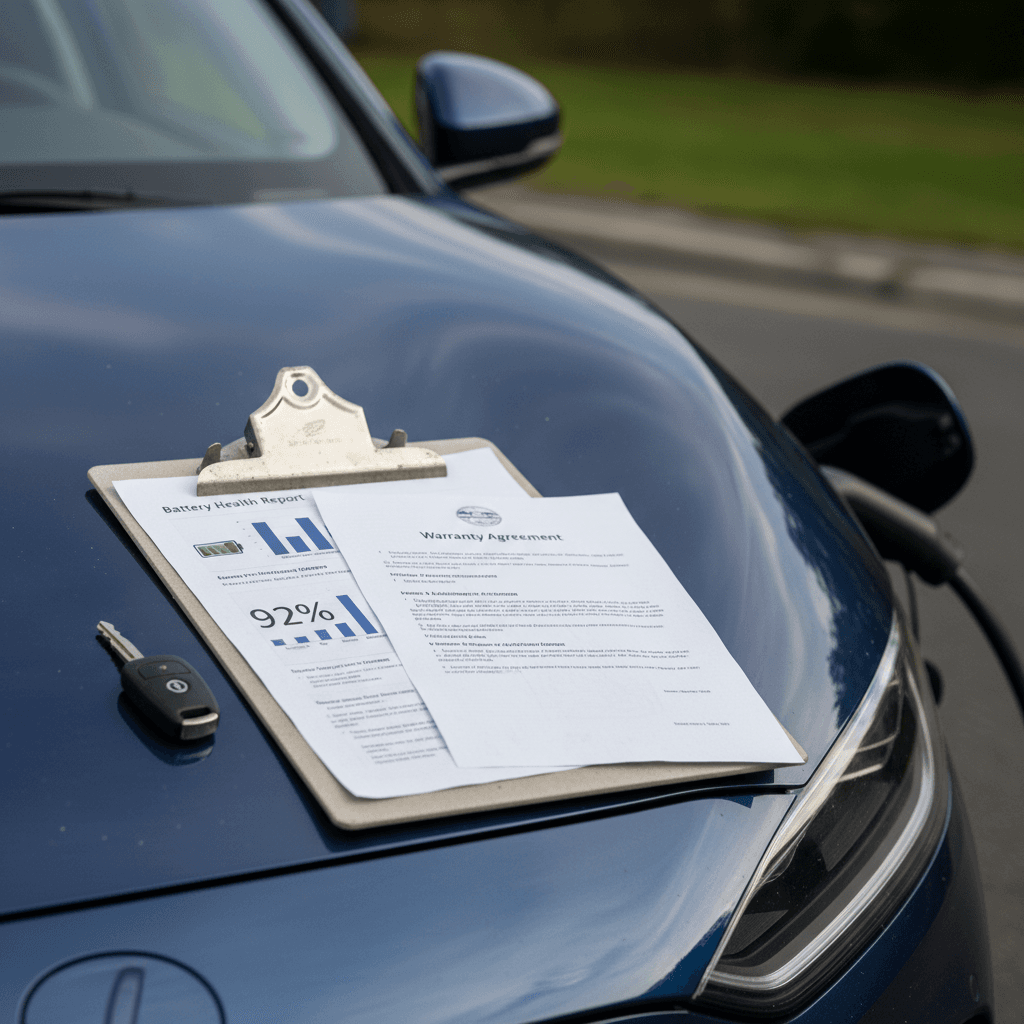
Why battery health matters
- Real‑world range is dictated by remaining capacity, not warranty paperwork.
- A pack hovering right above the warranty threshold may feel tired but not qualify for replacement.
- Degradation patterns reveal how the car was used: lots of DC fast‑charging vs mostly gentle home charging.
Why warranty still matters
- Protects you from unexpected, early‑life failures of expensive components.
- Can make borderline degradation someone else’s financial problem, not yours.
- Improves resale value when you’re the one selling the car later.
How Recharged bridges the gap
Step-by-step: how to shop a used EV for battery protection
7 steps to finding a used EV with real battery peace of mind
1. Start with the right brands
If battery warranty is your north star, put Hyundai, Kia, Mercedes EQS/EQE, Rivian, and Tesla at the top of your list. Their coverage gives you more safety margin as the car ages.
2. Filter by model year and mileage
In late 2026, a 2019 EV is already 7–8 years into its warranty, while a 2023 still has most of its coverage left. As a rule of thumb, aim for <strong>cars under 6 years old and under 80,000 miles</strong> if you want meaningful coverage left.
3. Verify the original in‑service date
Model year is not warranty year. Ask for documentation showing when the car was first sold or registered; that’s when the warranty clock started.
4. Get a true battery health report
Insist on more than a range screenshot. At Recharged, the Recharged Score shows measured battery health, charging history, and degradation so you can compare two cars objectively.
5. Read the actual warranty booklet
Before you fall in love with a particular car, download the factory warranty guide for that model year and trim. Confirm <strong>years, miles, capacity guarantee, and transfer policy</strong>.
6. Avoid sketchy histories
Walk away from salvage titles, flood‑region cars with spotty documentation, or vehicles with repeated high‑voltage faults in their history. No “deal” is good enough to justify an orphaned battery pack.
7. Align finance term with warranty term
Try not to finance longer than the remaining battery warranty. If the battery coverage ends in three years, a seven‑year loan is a mismatch. Recharged can help you <strong>pre‑qualify for financing</strong> that fits the car’s real risk profile.
FAQ: finding a used EV with the best battery warranty
Frequently asked questions
Bottom line: the best used EVs for battery peace of mind
If you want the used EV with the best battery warranty, you’re really shopping for three things at once: a long, transferable factory warranty; a pack that’s aging gracefully; and a seller who will actually show you what’s going on under the floorpan. That usually leads you first to Hyundai and Kia, then to Mercedes EQS/EQE and Rivian for their standout terms, and finally to Tesla for its proven longevity and strong coverage balance.
But the paperwork is only half the story. A car that looks good on a spec sheet can have a tired battery; an EV with modest warranty left can be an outstanding buy if its pack is healthy and priced accordingly. That’s why Recharged pairs verified battery diagnostics, remaining factory warranty details, fair market pricing, financing, and trade‑in support in one fully digital experience. If you want to fall in love with a used EV without losing sleep over the battery, start your search where the data, and the warranty math, are on your side.