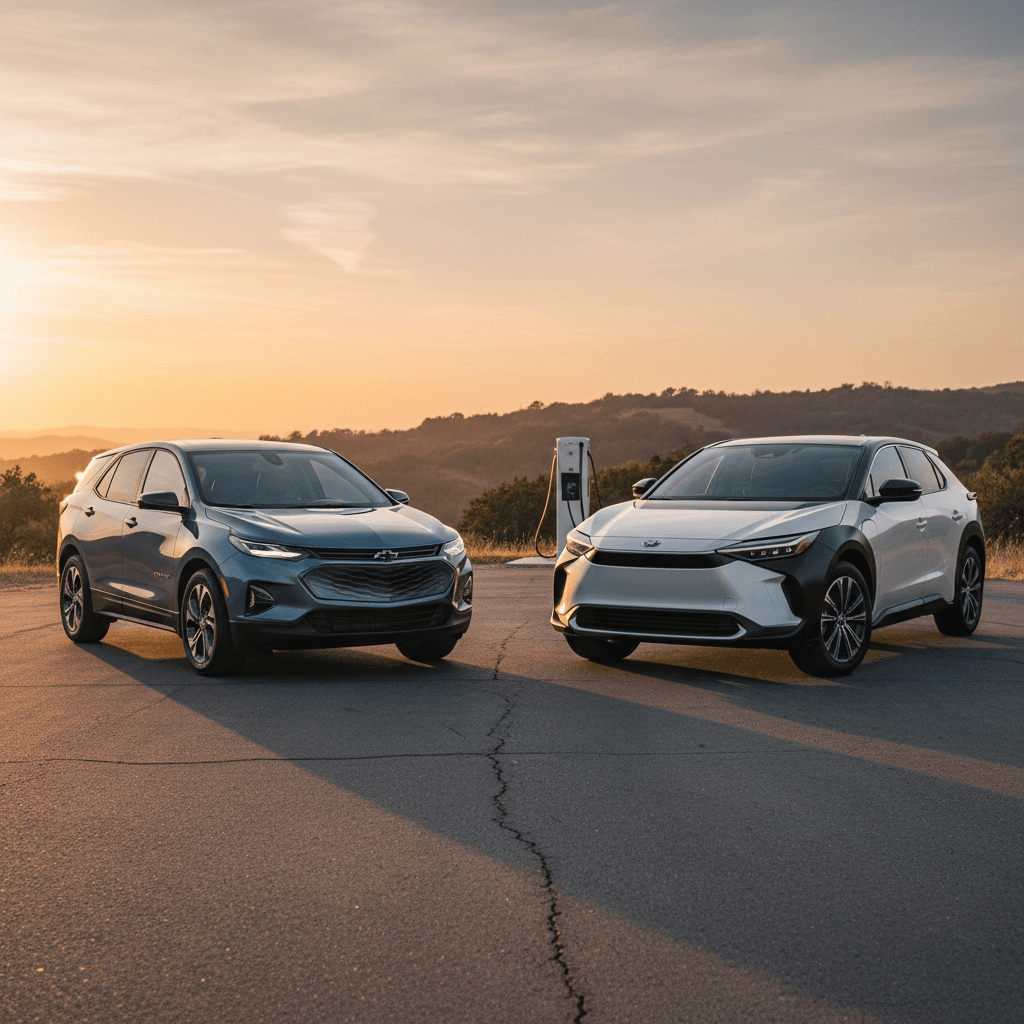
If you’re hunting for a compact electric SUV, the **used Chevy Equinox EV vs Toyota bZ4X** matchup is one of the most interesting, and confusing, choices on the market. Both promise family-friendly practicality and all-electric driving, but they take very different routes to get there, especially once you factor in real-world range, charging, and reliability history.
Who this guide is for
Overview: Used Equinox EV vs Toyota bZ4X
On paper, the **Chevy Equinox EV** looks like the easier car to live with. It offers **up to ~319 miles of EPA-rated range in FWD form** and around **285 miles with all-wheel drive**, using GM’s Ultium battery platform and 150 kW DC fast charging. Toyota’s **bZ4X** counters with a more conservative package: EPA range typically in the **220–252 mile** neighborhood for U.S. models, depending on front- or all-wheel drive, and DC fast charging peaking between **100–150 kW** depending on configuration and update status.
In reality, the choice comes down to personality and priorities. The Equinox EV is the **modern, tech-forward, range-heavy commuter** that just happens to be shaped like an SUV. The bZ4X feels more like an **electric RAV4 with training wheels**, familiar, conservative, and backed by Toyota’s reputation, but not nearly as ambitious on range or performance.
Quick take: who each SUV fits best
Which used EV fits your life?
Two compact SUVs, two very different personalities.
Chevy Equinox EV: Best for range and tech lovers
- EPA range up to ~319 miles (FWD) and ~285 miles (eAWD).
- 150 kW DC fast charging with solid real-world curves when conditions are right.
- Big 17.7-inch screen, Google built-in, and available Super Cruise.
- Great if you road-trip, have a longer commute, or want future-proof tech.
Toyota bZ4X: Best for risk‑averse, brand-loyal buyers
- Lower range, but simple and friendly driving experience.
- Toyota dealer network and familiar service experience.
- Conservative tuning and quieter styling, less "look at me" EV energy.
- Better fit if you prioritize long-term durability and modest daily miles over cutting-edge tech.
Used-market reality check
Key specs at a glance
Chevy Equinox EV vs Toyota bZ4X: core specs (U.S. models)
Approximate specs for common U.S. configurations you’ll see in the used market. Always verify exact trim and equipment on the specific vehicle you’re buying.
| Spec | Chevy Equinox EV (FWD) | Chevy Equinox EV (eAWD) | Toyota bZ4X FWD | Toyota bZ4X AWD |
|---|---|---|---|---|
| EPA range (mi) | up to ~319 | ~285 | ~252 (best-case U.S.) | ~228–228 (varies by wheel/tire) |
| Battery capacity (usable, approx.) | ~85 kWh | ~85 kWh | ~71–73 kWh | ~71–73 kWh |
| Peak DC fast charge | 150 kW | 150 kW | up to 150 kW (FWD) | typically 100 kW |
| Onboard AC charger | 11.5 kW | 11.5 kW | 6.6 kW | 6.6 kW |
| 0–60 mph (mag. tested) | ~6–7 sec | as quick as ~5.8 sec | ~7.0–7.5 sec | ~6.4–6.5 sec |
| Drivetrain | Single-motor FWD | Dual-motor eAWD | Single-motor FWD | Dual-motor AWD |
| Cargo volume (rear seats up) | ~26 cu ft | ~26 cu ft | ~27–28 cu ft | ~27–28 cu ft |
Specs here emphasize the versions you’re most likely to encounter as used vehicles, not every possible configuration.
Specs vary by year and trim
Range and efficiency in the real world
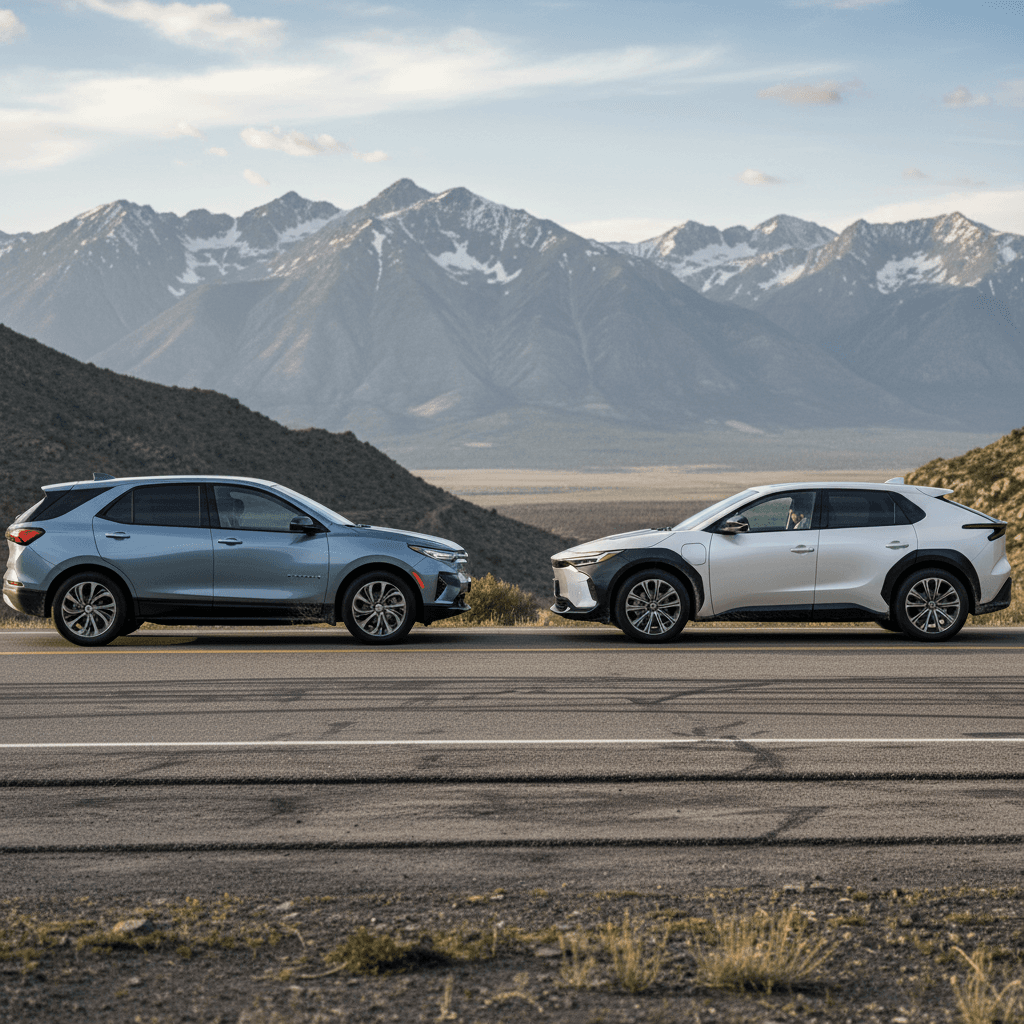
Range is where the Equinox EV stops playing nice and simply outguns the bZ4X. EPA ratings hover around **319 miles for FWD** and **~285 miles for eAWD**, and highway testing has shown roughly **260 miles at 75 mph** for both FWD and AWD in the real world. The Toyota, by contrast, lands closer to **220–250 miles EPA** depending on configuration, and owners routinely report heavy winter penalties and highway range that feels closer to ~180–200 miles when it’s cold and you’re running heat, lights, and wipers.
Equinox EV: Range you can lean on
- Up to ~319 miles EPA in FWD form means many commuters can get through the workweek on one charge.
- Highway tests around 260 miles suggest honest, if not miraculous, efficiency.
- Ultium pack gives you a generous buffer before you’re hunting for a charger.
bZ4X: Fine for short hops, tighter for road trips
- EPA ratings mostly in the low-to-mid 200‑mile range for U.S. models.
- Owners report steep winter losses, 30% or more isn’t unusual when it’s cold and you’re using climate heavily.
- More acceptable if your daily drive is under 60–80 miles and you can charge at home.
Cold-weather behavior matters
Charging speed and road-trip ability
Charging is the part of EV ownership everyone underestimates, until they spend 45 minutes at a lonely charger behind a truck stop. Here, both vehicles can be perfectly livable, but one clearly treats your time as more valuable.
Charging: what your clock will notice
Equinox EV: Better fast charging and home charging
- 150 kW DC fast charging with a healthy plateau up to ~60% when the battery is warm and you’re on a 250–350 kW station.
- Owners commonly report 10–80% in the low‑30‑minute range when conditions are right.
- Standard 11.5 kW onboard charger makes overnight Level 2 charging genuinely quick, roughly 8–9.5 hours from empty.
- GM’s agreement with Tesla means Supercharger access via an adapter, opening the most reliable network in the U.S. to Equinox EV drivers.
bZ4X: Adequate, but not exciting
- Front‑drive versions can hit up to about 150 kW, but many AWD models are capped around 100 kW, which stretches stops, especially on winter road trips.
- Real-world charging curves have improved with updates, but early cars were notoriously slow in the cold.
- 6.6 kW AC charging means a full charge at home simply takes longer; not a problem if you plug in every night, annoying if you frequently charge from low state of charge.
- Toyota is rolling toward Tesla NACS support on newer models, but in the **used** market you’ll largely rely on CCS public networks and whatever adapters are available at the time of purchase.
Think about your real travel pattern
Interior space, comfort, and tech
Both SUVs are roughly the size of a gasoline RAV4 or CR-V. You’re not getting three-row luxury; you’re getting a family-friendly compact with enough room for kids, pets, and the suburban Home Depot run.
Inside the cabin: Equinox EV vs bZ4X
Same mission, different vibes.
Equinox EV: Futuristic but familiar
- Large 17.7-inch center display running Google built-in on most trims.
- Simple physical gear selector and reasonably straightforward controls.
- Available features like heated/ventilated seats, panoramic roof, and GM Super Cruise on certain trims.
- Cargo space around 26 cu ft behind the rear seats, expanding to about 57 cu ft folded, plenty for daily use.
bZ4X: Quieter, more conservative
- More traditional Toyota-style dash, with a slightly quirky high‑mounted instrument cluster.
- Infotainment ranges from basic to improved later systems; wireless smartphone integration on newer years is a plus.
- Cargo space similar to the Equinox EV, with usable rear legroom and an easy step‑in height.
- Less "wow" factor, more "I know how this car works", which some buyers will prefer.
Family usability is strong for both
Reliability and known issues in the used market
This is where Toyota usually mops the floor with everyone else, but the story is more nuanced with the bZ4X. The model launched with a **wheel hub recall** so serious Toyota told early owners to stop driving their cars, then had to buy back or heavily compensate some of them. Later, owners surfaced complaints around **slow DC fast charging and harsh winter range loss**. More recently, an additional recall has targeted the HVAC/defroster system, again requiring software updates and in some cases hardware replacement. None of this is catastrophic in isolation, but it does mean a used bZ4X’s history matters more than the badge on the nose.
The Equinox EV is newer, which cuts both ways. There isn’t a huge database of ten-year durability stories yet, but early owner reports and instrumented tests suggest a solid, well-executed package. The Ultium platform has seen more headline issues in siblings like the Blazer EV’s early software glitches, but most of those are being addressed via updates. In practice, the biggest mark against the Equinox EV isn’t catastrophic failure; it’s that you’re betting on a newer tech stack that will evolve quickly, for better and occasionally for worse.
- **bZ4X used-buying caution:** verify all recalls and software updates have been completed, including early wheel hub fixes and HVAC/defroster campaigns.
- **Equinox EV caution:** focus on software update history, charging behavior, and any indications of Ultium system quirks such as intermittent DC fast-charging failures or infotainment glitches.
- For both: check for uneven tire wear (heavy EVs are hard on tires), brake corrosion if the car has mostly done short urban trips, and any evidence of collision repairs near high-voltage components.
Don’t confuse battery warranty with total reliability
Total cost of ownership and used pricing
On the used market, pricing is a moving target, and it’s shifting faster for EVs than for traditional SUVs. In broad strokes, you can expect **bZ4X pricing to start lower** than comparable Equinox EVs simply because the Toyota has been on sale longer and doesn’t have the same headline range or fast-charging appeal. The Equinox EV, being newer and more desirable on paper, tends to command higher prices and hold them better, at least for now.
What helps Equinox EV ownership costs
- More range means fewer public charging sessions, which are typically more expensive than home charging.
- Faster DC charging saves time, and time is money on road trips.
- Shared Ultium components with other GM EVs means parts commonality over time.
What helps bZ4X ownership costs
- Used prices can be aggressively discounted compared with original MSRP, especially for early‑build cars.
- Toyota’s dealer network is everywhere; if you live far from big cities, that matters.
- Conservative power output and smaller battery may pay small dividends in long-term durability.
Factor in incentives for used EVs
What to check before you buy used
Used Equinox EV vs bZ4X: pre-purchase checklist
1. Battery health and DC fast-charging behavior
Ask for a **verified battery health report** and, if possible, observe a DC fast-charging session from ~10–60%. You’re looking for obviously abnormal tapering or very low maximum power versus spec.
2. Software and recall history
For a bZ4X, confirm all wheel hub, charging, and HVAC/defroster recalls have been performed. For an Equinox EV, check for completed software updates related to the Ultium platform and infotainment.
3. Charging hardware compatibility
Confirm whether the car includes necessary **home charging equipment** and, in the Equinox’s case, any Tesla Supercharger adapter from GM. Make sure the charge port and door operate smoothly.
4. Interior wear and high-voltage caution signs
EV drivetrains hide their age well; interiors don’t. Check seat bolsters, steering wheel, and touchpoints. Under the car, look for signs of poorly repaired accident damage near the battery pack.
5. Tires, brakes, and suspension
Both SUVs are heavy. Inspect tires for inner-edge wear, confirm the brakes are clean and functional (no heavy rust from disuse), and listen for clunks over bumps during a test drive.
6. Realistic daily range needs
Map your daily and weekly driving. If your regular use is under 80 miles/day with home charging, the bZ4X may be plenty. If you routinely drive farther or travel often, the Equinox EV’s extra range is worth paying for.
How Recharged’s battery diagnostics help
How Recharged can help you compare and buy
If you’re cross-shopping a used Equinox EV and a used bZ4X, you’re already doing more homework than most buyers. The next step is seeing real vehicles side-by-side, with numbers, not vibes. That’s exactly what Recharged is built for.
Buying used EVs, without the guesswork
What Recharged adds to your Equinox EV vs bZ4X decision.
Recharged Score battery report
Flexible ways to sell or trade
Expert EV support & delivery
FAQ: Used Chevy Equinox EV vs Toyota bZ4X
Common questions about used Equinox EV vs bZ4X
Bottom line: which EV should you pick?
If your driving life involves **longer distances, regular highway use, or frequent road trips**, the **Chevy Equinox EV is the smarter, calmer choice**. Its longer range, quicker charging, and access to Tesla’s network radically reduce the mental load of owning an EV, especially as a primary family vehicle.
If you’re a **short-hop suburban commuter who values Toyota’s dealer network and sees a great deal on a properly updated bZ4X**, you can absolutely justify choosing the Toyota, just buy with your eyes open about range and charging limitations. In many metro areas, a discounted bZ4X is a quietly rational buy.
Either way, the used EV market is finally giving you real choices in the compact SUV space. Take advantage of it: compare real vehicles, not just spec sheets, insist on a transparent battery health report, and let the way you actually live, not brand loyalty, decide whether the Equinox EV or the bZ4X deserves a spot in your driveway.