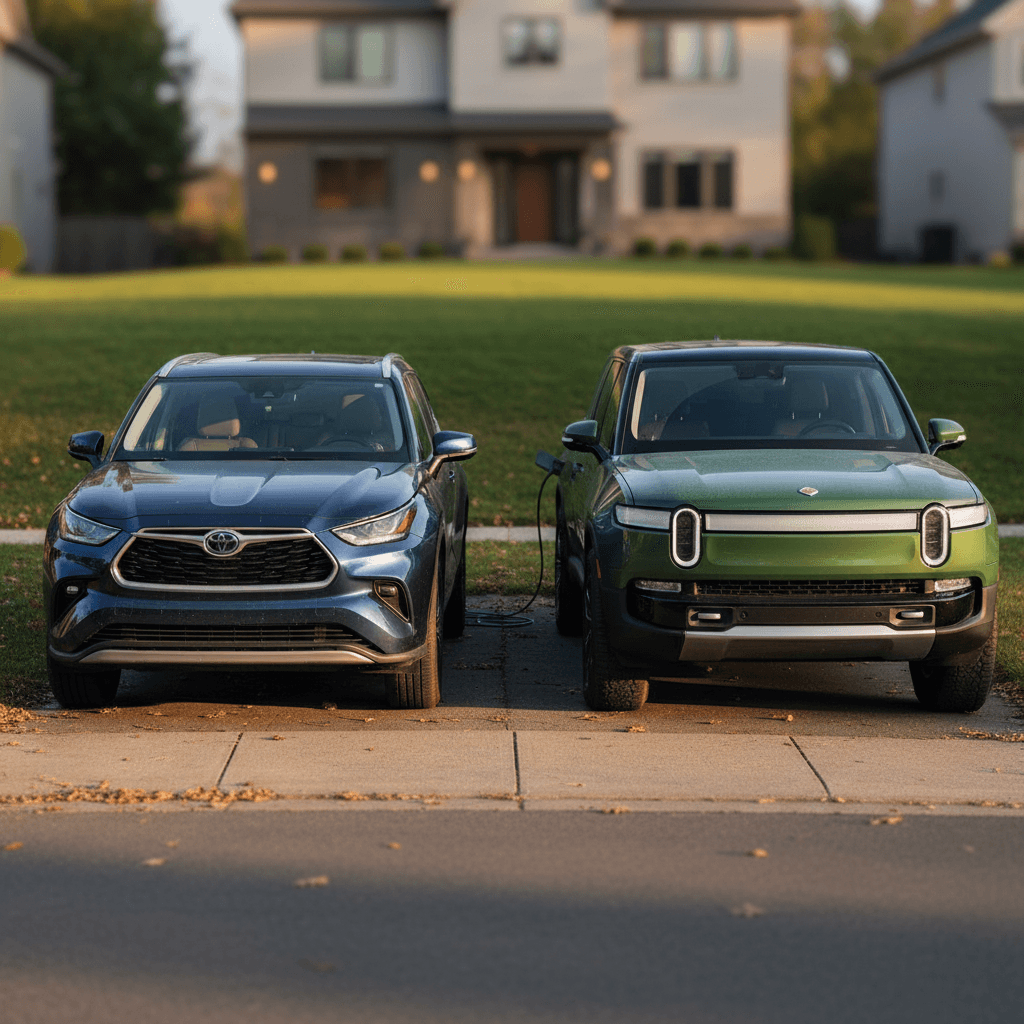
If you’ve been living with a **Toyota Highlander**, reliable, efficient, and quietly competent, and you’re eyeing a **Rivian R1S**, you’re not just changing vehicles. You’re changing fuel, driving feel, and even how you plan road trips. This review walks through what that switch *actually* feels like from a family‑SUV owner’s perspective, with a special focus on used Rivian R1S models you’ll commonly find on Recharged.
The quick take
Who this Highlander-to-R1S review is really for
This guide is written for **current or recent Toyota Highlander owners**, gas or hybrid, who are considering a **Rivian R1S** as their next family hauler. You probably care about three rows, all‑weather confidence, safety and resale value. You might tow a small camper or boat, run kids to sports, and take a couple of big road trips a year. In other words, you’re asking: *Can a Rivian R1S replace my Highlander without making family life harder?*
- You daily‑drive a Highlander (or similar 3‑row crossover) and want less gas and more tech.
- You’re EV‑curious but worried about road trips, winter driving and towing.
- You’re shopping the **used Rivian R1S** market and want to know what will actually feel different from your Toyota.
Toyota Highlander vs Rivian R1S at a glance
Rivian R1S vs Toyota Highlander: key specs snapshot
These are representative numbers for recent model years; exact figures vary by trim and configuration, especially for range and mpg.
| Spec | Rivian R1S (EV) | Toyota Highlander (gas/hybrid) |
|---|---|---|
| Drivetrain | Dual- or quad‑motor AWD, all‑electric | FWD or AWD, gas or hybrid |
| Power | 400–800+ hp (depending on motors) | Approx. 243–295 hp |
| Range / mpg | ~270–410 miles EPA range (battery pack dependent) | Low‑20s mpg city, high‑20s to low‑30s mpg highway; hybrids higher |
| Max towing | Up to about 7,700 lbs when properly equipped | Up to 5,000 lbs when properly equipped |
| Cargo volume (max) | About 104 cu ft with rows folded | About 84–95 cu ft depending on generation |
| Fueling | DC fast charging + Level 2 home charging | Gasoline (regular) or hybrid gas |
| Curb weight | ~6,900–7,100+ lbs | ~4,100–4,450 lbs |
Think of the R1S as a shorter, wider, much heavier Highlander with far more power and a different fuel source.
How it *feels* vs what the numbers say
Space, seating and cargo: does the R1S feel bigger than a Highlander?
Highlander owners care a lot about space, it’s why you didn’t buy a compact crossover. The **Rivian R1S** plays in the same three‑row arena but with different priorities.
Cabin and cargo: what changes when you switch
Both are family SUVs, but they package their space differently.
Front and second row
R1S: Wide, airy, with a big greenhouse and upright seating. Legroom is competitive with a Highlander, though the Toyota may feel slightly roomier in the second row, especially for taller teens.
Highlander: Feels more like a traditional crossover, lower floor, slightly easier step‑in height, and a bit more conventional ergonomics.
Third row and cargo
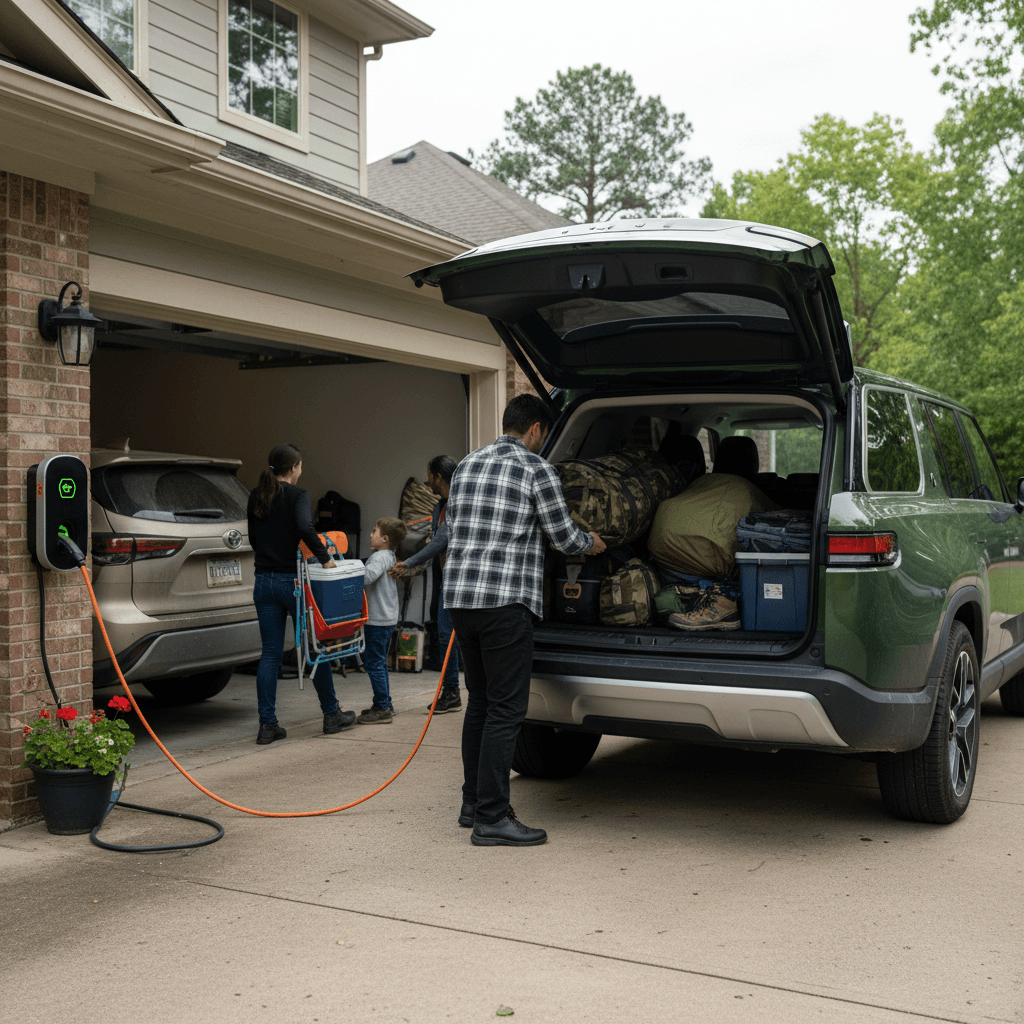
R1S: Third row is adult‑capable for shorter trips, kid‑perfect for longer ones. Behind the third row you get a usefully boxy space plus an under‑floor bin; drop the seats and you’re looking at roughly 104 cu ft of total cargo volume, similar to a full‑size SUV.
Highlander: Third row is tighter, better for kids than adults, with less cargo behind it. Total cargo volume is generous but generally less than the R1S’s max.
Ride height and access
Driving experience: from quiet crossover to instant-torque EV
If you’re coming from a V6 or hybrid Highlander, you’re used to adequate power and a calm, predictable drive. The **Rivian R1S** moves the goalposts.
How the Rivian R1S changes your expectations
What you’ll notice on day one
- Instant torque: The R1S leaps away from lights with no gear changes. Your first on‑ramp merge will make your Highlander feel ancient.
- One‑pedal driving: Lift off the accelerator and the R1S slows aggressively, recovering energy. Around town, you’ll rarely touch the brake pedal.
- Weight and solidity: At nearly two tons heavier than a Highlander, the R1S feels substantial, especially over broken pavement, but the suspension does an admirable job of hiding the mass.
Where the Highlander still feels easier
- Simplicity: Drop it in Drive and go. No charging curves, no range estimates, no learning curve for regen.
- Lightness: On tight suburban streets and parking garages, the Highlander’s smaller footprint and lighter feel can be less intimidating.
- Noise familiarity: Some drivers actually prefer a little engine sound as feedback; the Rivian’s quiet can be disorienting at first.
Mind the weight and brakes
Towing, road trips and adventure duty
A big reason many Highlander owners consider the R1S is its promise of **real off‑road capability** and stronger towing numbers without losing three rows of seats.
R1S vs Highlander when you leave suburbia
Think about how you use (or want to use) your SUV away from home base.
Towing
R1S: Properly equipped models are rated to tow around 7,700 lbs, significantly more than a typical Highlander. The catch? Range drops sharply when towing, sometimes by half or more, so you’ll be planning charges carefully.
Highlander: Up to about 5,000 lbs when properly equipped, with no range penalty beyond worse mpg.
Off‑road and snow
R1S: With height‑adjustable air suspension, sophisticated traction control and multiple drive modes, the R1S can go places a Highlander simply can’t. Think deep snow, rutted fire roads and rocky access tracks to trailheads.
Highlander: All‑wheel drive and respectable ground clearance handle bad weather and light dirt roads just fine, but this is not a rock‑crawler.
Long road trips
R1S: Cross‑country trips are absolutely doable, but you’ll route around DC fast chargers, build in charging time and pay attention to speed, weather and load.
Highlander: Any gas station, any time. Your stops are shorter and planning is nearly zero.
Real‑world towing reality check
Charging a Rivian R1S vs filling a Highlander
Going from a Highlander to a Rivian R1S means trading five‑minute fuel stops for **home charging convenience** and **planned fast‑charge sessions** on the road.
What charging looks like when you come from gas
1. Home becomes your main “gas station”
Most R1S owners install a Level 2 home charger (usually on a 240‑volt circuit). Think of it as waking up to a full tank every morning instead of stopping at Costco every week.
2. You’ll learn your real‑world range
EPA ratings are one thing; your commute, climate, speed and load are another. In practice, many R1S owners see range comfortably below EPA on the highway, especially in winter or with cargo on the roof.
3. Fast charging vs gas stops
A Highlander can be back on the road in under 10 minutes. A Rivian R1S fast charge session is more like 20–40 minutes to add useful range, depending on the charger and battery state.
4. Public charging network quality varies
Some stations are excellent, others less reliable. You’ll start checking charger ratings in apps the way you once checked gas prices.
5. Routine errands get easier
No more dedicated gas runs. Around town, you simply drive, park and plug in at home. For many former Highlander owners, this is the single biggest quality‑of‑life upgrade.
Home charging readiness check
Ownership costs: fuel, maintenance and depreciation
One reason Highlander owners stick with Toyota is predictable **long‑term costs**. Moving to a Rivian R1S changes the math: your fuel bill can plummet, maintenance can be lower, but depreciation and insurance may be higher, especially on new trucks.
Where the R1S can save you money
- Fuel: If you’re paying typical U.S. electricity rates and charging mostly at home, each “gallon equivalent” of energy usually costs less than gasoline. Heavy commuters coming from a 20–25 mpg Highlander often see meaningful monthly savings.
- Routine maintenance: No oil changes, fewer fluids, no timing belts. Tires and brakes still wear, but regenerative braking often extends pad and rotor life compared to a gas SUV.
- Tax incentives (for used): Depending on your state and current federal rules, used EVs can sometimes qualify for incentives or sales‑tax relief. Always check current regulations where you live.
Where the Highlander may still win
- Depreciation: Toyota SUVs have a reputation for holding value. Rivian is newer, and EV values can be more volatile, which is exactly why many shoppers are gravitating to used R1S models where the first owner already absorbed the steepest drop.
- Insurance: Replacement‑cost, repair complexity and higher vehicle price can mean more expensive insurance vs a Highlander. Get quotes for both before you switch.
- Unexpected repairs: Toyota’s dealer network is huge; Rivian’s service footprint is smaller and more centralized. Mobile service covers a lot, but if you’re far from a service center, downtime logistics can be trickier.
Why used R1S models are a sweet spot
Ready to find your next EV?
Browse VehiclesDaily life: what you’ll love and what might annoy you
Specs aside, most Highlander owners want to know how the R1S changes **daily life**, school runs, Costco hauls, late‑night drives home from practice.
From a Highlander driver’s seat: pros and cons of the R1S
Here’s how the switch feels after the honeymoon phase.
What you’ll probably love
- Effortless power: The R1S feels like a luxury rocket ship compared with a Highlander, especially when merging or passing.
- Design and tech: The minimalist interior, large screens and over‑the‑air updates make your old Toyota feel like a flip phone.
- Quiet, clean commute: No engine starting in the garage, no idling in the drop‑off lane, no monthly gas station chore.
- Adventure readiness: Snowstorm? Dirt road to a cabin? The R1S feels born for this in a way the Highlander doesn’t.
What might frustrate you
- Charging‑related anxiety: Early on, you’ll obsess over range and charger locations until you build trust in the system.
- Software quirks: Powerful, connected vehicles sometimes mean occasional bugs or changes after an update. Toyota’s software may be dull, but it’s steady.
- Parking and tight garages: The Rivian’s width and square shoulders can feel more cumbersome than your Highlander in older parking structures.
- Service access: If you’re used to a Toyota dealer every few miles, Rivian’s more limited network will feel like an adjustment.
Buying a used Rivian R1S after a Highlander
Coming from a Toyota, you’re used to long‑term reliability and relatively straightforward used‑car shopping. With a **used Rivian R1S**, the stakes feel higher because the battery pack and software are so central to the experience. This is where a structured process, and good data, matters.
Smart steps for Highlander owners shopping a used R1S
1. Start with your use case, not the spec sheet
Be honest about how you actually use your Highlander. Is it mostly suburban driving with a couple of 500‑mile road trips a year? Or do you tow frequently and drive long distances? Your real‑world habits should dictate which R1S battery and motor configuration you target.
2. Prioritize battery health data
Unlike a used Highlander, a used R1S lives and dies by its battery pack. On Recharged, every vehicle includes a <strong>Recharged Score Report</strong> that shows verified battery health, recent charging behavior and range expectations so you’re not guessing.
3. Compare Large vs Max pack realistically
Bigger isn’t always better. A Max‑pack R1S offers impressive rated range but also costs more and can take longer to charge from low states. If most of your driving is local, a Large‑pack truck may offer the best value.
4. Examine charging history
Frequent DC fast charging at high states of charge can accelerate battery wear. Ask for data or use a marketplace that surfaces this in the listing, another advantage of a Recharged Score.
5. Inspect tires, suspension and alignment
The R1S is heavy and quick. Aggressive driving, heavy towing or off‑roading can show up as uneven tire wear or suspension clunks. A professional inspection or detailed condition report is worth it.
6. Plan your finance and trade‑in
If you’re moving directly out of a Highlander, consider using its strong resale value as a down payment. Platforms like Recharged can help you get an instant offer or consign your Toyota while arranging EV‑friendly financing.
How Recharged helps de‑risk the switch
FAQ for Highlander owners thinking about a Rivian R1S
Common questions from Toyota Highlander owners
Bottom line: should a Highlander owner switch to a Rivian R1S?
If your Highlander has been the dependable family workhorse and you’re ready for something that feels **more special every time you drive it**, the Rivian R1S delivers in ways a traditional crossover simply can’t. It’s far quicker, more capable off‑road, quieter in daily use and, when paired with home charging, dramatically more convenient than weekly gas stops.
You’ll give up some simplicity, road trips require forethought, charging infrastructure isn’t as foolproof as gas stations, and service isn’t on every corner like Toyota. But for many families, especially those with home charging and predictable routines, the tradeoff tilts decisively in the Rivian’s favor, particularly when you shop the **used R1S market** where depreciation and price have already come back to earth.
If you’re ready to see what the switch looks like in real numbers, explore used Rivian R1S listings on Recharged, review the **Recharged Score Reports** for battery health and pricing, and consider getting an instant offer on your Highlander. With the right information up front, moving from Toyota’s most popular three‑row to Rivian’s flagship SUV can feel less like a gamble, and more like the upgrade you’ve been waiting for.