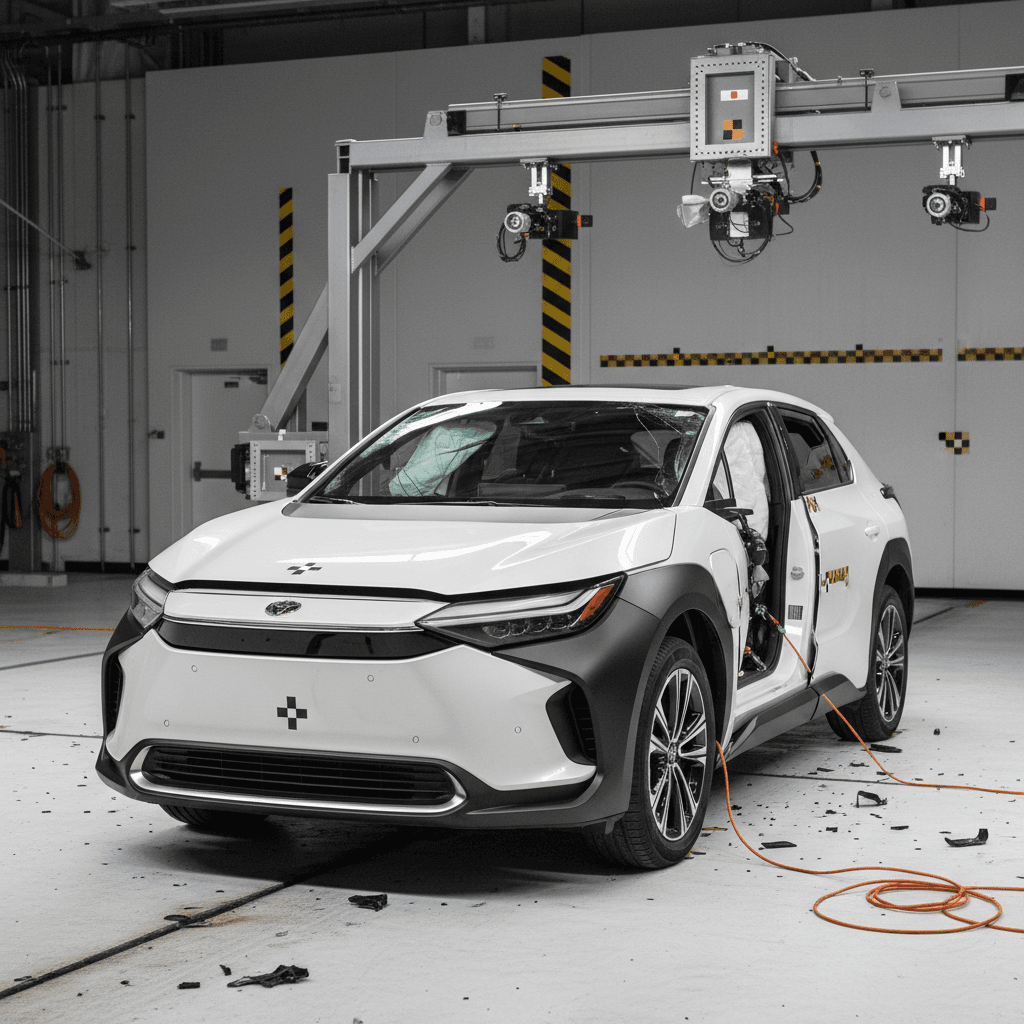
If you’re looking at a Toyota bZ4X, especially on the used market, it’s natural to ask how it performs in real-world crashes. The good news: the Toyota bZ4X scores very well in both NHTSA 5-Star Safety Ratings and IIHS crash tests, even earning a Top Safety Pick+ award on newer builds. In this guide, we’ll decode those ratings, walk through the crash-test results, and point out what matters most if you’re considering a new or used bZ4X.
Quick safety takeaway
Toyota bZ4X safety overview
The Toyota bZ4X is Toyota’s first dedicated electric SUV, sharing its platform with the Subaru Solterra. From launch, Toyota leaned heavily on safety: the bZ4X comes standard with the latest Toyota Safety Sense suite (TSS 3.0 in the U.S.) and a full set of airbags, including side curtain airbags that cover both rows. More importantly, independent crash testing from NHTSA and the Insurance Institute for Highway Safety (IIHS) shows that the structure and restraint systems perform very well in severe impacts.
Toyota bZ4X headline safety stats (U.S.)
Model year & build date matter
Toyota bZ4X NHTSA crash test ratings
The National Highway Traffic Safety Administration (NHTSA) runs the U.S. government’s 5-Star Safety Ratings program. Recent Toyota bZ4X models tested by NHTSA earn an overall 5-star rating, which is the highest score available.
NHTSA crash-test breakdown: Toyota bZ4X
Summary of recent NHTSA 5-Star Safety Ratings for the Toyota bZ4X. Specific values can vary slightly by drivetrain and model year, but this reflects the typical pattern.
| Test category | Subscore | Toyota bZ4X rating (recent MYs) |
|---|---|---|
| Overall | , | 5 / 5 stars |
| Frontal crash | Driver | 4 / 5 stars |
| Frontal crash | Passenger | 5 / 5 stars |
| Side crash | Overall | 5 / 5 stars |
| Side impact | Front & rear seats | 5 / 5 stars |
| Side pole | Driver | 5 / 5 stars |
| Rollover | Overall | 4 / 5 stars |
Always verify the exact score for the model year and configuration you’re considering.
In plain English, this means the bZ4X does an excellent job protecting occupants in both frontal and side impacts. The 4-star rollover rating is typical for tall crossovers; EVs like the bZ4X benefit from a low-mounted battery pack that helps reduce the chance of a rollover even further.
How to check NHTSA scores for a specific bZ4X
Toyota bZ4X IIHS crash test results
The Insurance Institute for Highway Safety (IIHS) goes deeper than NHTSA, with a wider set of crash tests and evaluations of crash-avoidance tech. Because the bZ4X shares its structure with the Subaru Solterra, many IIHS structural ratings apply to both vehicles when they’re built after specific reinforcement updates.
- Small overlap front (driver and passenger sides): typically rated Good on updated vehicles.
- Moderate overlap front: rated Good.
- Updated side-impact test: overall rating of Good for the structure and driver, with Acceptable rear passenger head protection on the shared Solterra/bZ4X design.
- Roof strength, head restraints and seats: generally rated Good in this platform.
More recently, IIHS has added stricter criteria for headlights, pedestrian crash prevention, and rear occupant protection. That’s where the Top Safety Pick+ designation for late-build 2025 bZ4X models comes in: Toyota improved the combination of active safety systems and occupant protection to meet IIHS’s latest, tougher standard.
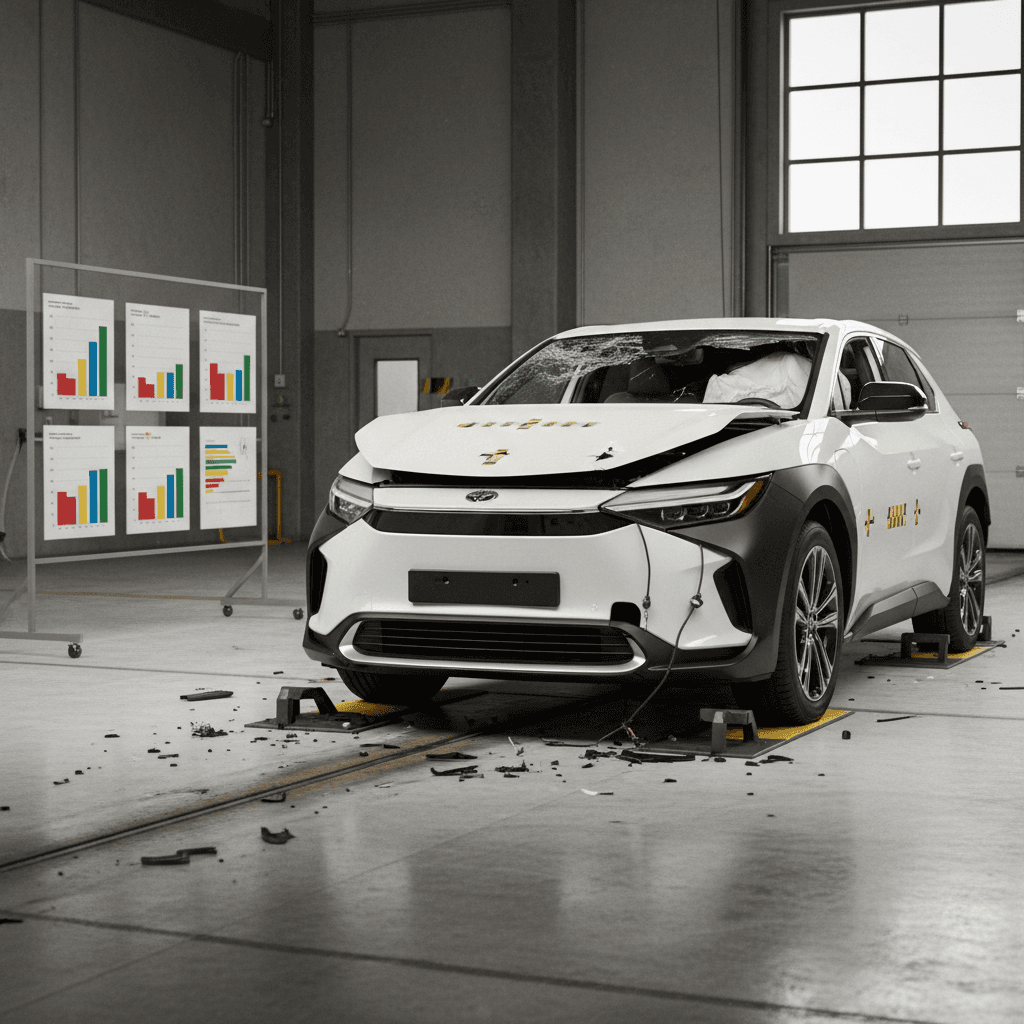
Top Safety Pick+: what it actually means
If you’re scanning listings and you see “Top Safety Pick+” in a bZ4X description, it’s worth knowing what that actually means. IIHS reserves Top Safety Pick+ for vehicles that ace a broad battery of tests and also offer strong crash-avoidance tech on every trim, not just top models.
Key ingredients of an IIHS Top Safety Pick+
How the bZ4X qualifies on newer builds
Strong crashworthiness
Pedestrian protection
Rear occupant focus
Why TSP+ matters for used shoppers
Key safety features on the Toyota bZ4X
Crash-test numbers only tell part of the story. The safety tech that helps you avoid a crash in the first place is just as important. Toyota loaded the bZ4X with its latest driver-assistance and active-safety systems, bundled into Toyota Safety Sense plus a set of additional aids on higher trims.
Core Toyota bZ4X safety & driver-assistance features
Pre-Collision System with pedestrian & cyclist detection
Toyota’s front crash-prevention system can detect vehicles, pedestrians, cyclists, and even motorcyclists in many conditions, warning you and automatically braking if a collision is imminent.
Lane Departure Alert & Lane Tracing Assist
These systems help keep the bZ4X centered in its lane on the highway, providing steering assistance and alerts if you drift without signaling.
Dynamic Radar Cruise Control
Adaptive cruise control maintains distance to the vehicle ahead and can manage stop-and-go traffic, reducing fatigue on longer drives.
Blind Spot Monitor with Safe Exit Assist
Standard blind-spot monitoring is paired with a door-exit assist feature that warns if you’re about to open a door into passing traffic or cyclists.
Automatic High Beams & available advanced headlights
Automatic high beams are standard, and higher trims offer more advanced LED headlight designs that help satisfy stricter IIHS criteria.
Surround-view cameras & parking aids
Limited and certain packages add a Bird’s Eye View camera and parking sensors, making low-speed maneuvers safer in tight spaces.
Don’t assume every trim has every feature
Toyota bZ4X vs. Subaru Solterra safety
Because the Toyota bZ4X and Subaru Solterra share the same e-TNGA platform and much of their body structure, their crash-test outcomes are closely related. IIHS, for example, has published updated side-impact results based on a 2023 Subaru Solterra test that apply to both vehicles when built after late 2022, once structural reinforcements were introduced.
Toyota bZ4X
- Shares core crash structure with Solterra.
- Standard Toyota Safety Sense suite, tuned to Toyota’s lane-keeping and adaptive cruise logic.
- Availability of Top Safety Pick+ award on select 2025 builds reflects Toyota’s combination of structure, headlights, and crash-avoidance performance.
Subaru Solterra
- Same basic body and airbag layout as the bZ4X.
- Subaru’s driver-assistance tuning and interface; similar capabilities with different feel.
- Recent updates improve range and charging, but the underlying safety story closely mirrors the bZ4X.
Safety is basically a draw
How safe is the bZ4X vs other electric SUVs?
The compact electric SUV segment is crowded with strong performers, Hyundai Ioniq 5, Kia EV6, Tesla Model Y, Nissan Ariya, and others. The Toyota bZ4X sits comfortably in the upper tier of that group on safety alone, especially once you factor in its Top Safety Pick+ award and 5-star overall NHTSA rating.
Where the Toyota bZ4X stands among electric SUVs
High-level safety comparison (recent model years)
Structural crash performance
Driver-assistance tech
Overall safety reputation
Don’t ignore tires and maintenance
Used Toyota bZ4X: what safety shoppers should check
If you’re considering a used Toyota bZ4X, you’re getting the benefit of strong underlying safety engineering, but condition and history matter just as much as crash-test scores. Here are the safety-related checks we recommend.
Safety checklist for a used Toyota bZ4X
1. Confirm build date & model year
Look at the certification label on the driver’s door jamb. For the latest structural and IIHS updates, target bZ4X models built after late 2022; for the newest Top Safety Pick+ criteria, focus on 2025 models built after late 2024.
2. Run a full vehicle history report
Accident history matters. A bZ4X that’s had structural repairs or airbag deployments should be inspected carefully for repair quality, or skipped entirely if documentation is thin.
3. Inspect tires, brakes, and suspension
Uneven tire wear, cheap replacement tires, or worn bushings can compromise stability and stopping distances. A pre-purchase inspection from an EV-savvy shop is money well spent.
4. Verify driver-assistance operation
On a test drive, confirm that adaptive cruise, lane keeping, blind-spot monitoring, and parking aids function as expected, no warning lights, odd behavior, or disabled systems.
5. Check recalls & software updates
Ask a Toyota dealer to check the VIN for open recalls or outstanding software updates. EVs rely heavily on software for stability control, braking, and driver assistance.
6. Look for trustworthy battery-health data
Range and performance matter for safety too, especially in winter. At <strong>Recharged</strong>, every EV gets a Recharged Score battery-health report so you’re not guessing about pack condition.
How Recharged helps
Ready to find your next EV?
Browse VehiclesFAQ: Toyota bZ4X safety ratings & crash tests
Common questions about Toyota bZ4X safety
Bottom line: is the Toyota bZ4X a safe EV?
Taken together, the NHTSA 5-star overall rating, IIHS Top Safety Pick+ award for late-build 2025 models, and a mature suite of standard driver-assistance features make the Toyota bZ4X one of the safer compact electric SUVs on the road today. It doesn’t chase headlines with flashy semi-autonomous branding; instead, it leans on a solid structure, predictable handling, and Toyota’s conservative engineering approach.
If you’re shopping for a used Toyota bZ4X, focus on build date, accident history, and real battery health in addition to those excellent crash-test scores. Platforms like Recharged can simplify that search with verified battery diagnostics, transparent pricing, and EV-specialist guidance so you can choose a bZ4X that’s not just safe in the lab, but confidence-inspiring in your daily life.