If you’re looking at a Toyota bZ4X today, whether new or used, you’ve probably heard that it depreciates faster than a typical Toyota. Understanding the Toyota bZ4X depreciation curve over 5 years can help you decide when to buy, how much to pay, and what to expect if you sell later.
Quick take
Why Toyota bZ4X depreciation matters right now
The bZ4X launched into a tough moment for EV pricing. Incentives shifted, interest rates rose, and several brands cut MSRPs on new EVs. At the same time, Toyota’s first modern long‑range EV stumbled out of the gate with an early safety recall and mixed charging performance. All of that shows up in its depreciation curve: used prices fell quickly, and shoppers are now seeing 1‑ to 3‑year‑old bZ4X models advertised well below their original sticker.
- Excellent value if you’re buying used and understand where fair pricing should land on a 5‑year curve.
- More risk if you bought new at full price and plan to sell in only a few years.
Toyota bZ4X depreciation in numbers (early data)
How much value a Toyota bZ4X typically loses in 5 years
- Forecast tools that place 5‑year loss for the bZ4X in the mid‑40% to high‑50% range relative to MSRP.
- Cost‑to‑own and residual models that show around $24k–$30k of depreciation over a 5‑year window for a mid‑$40k build.
- Real‑world used listings and auction data, where some early 2023 models are already trading for roughly half their original transaction price.
Depreciation estimates are not promises
- 5‑year depreciation: about $20,000–$24,000 lost from MSRP.
- 5‑year resale value: roughly $18,000–$22,000 in private‑party or retail transaction value, assuming average miles and clean condition.
Toyota bZ4X 5‑year depreciation curve: illustrative example
Let’s build a simple, realistic example using round numbers. Imagine a 2025 Toyota bZ4X XLE FWD with a $42,000 out‑the‑door price (including common options and destination), driven 12,000–15,000 miles per year and kept in good condition.
Illustrative Toyota bZ4X 5‑year depreciation curve
Approximate retained value for a $42,000 bZ4X, assuming average mileage, typical wear, and a stable EV market. This is not a valuation of any specific vehicle.
| Year of ownership | Vehicle age | Estimated value | Total loss vs. MSRP | Approx. % of original price |
|---|---|---|---|---|
| Purchase | New | $42,000 | , | 100% |
| Year 1 | 1 year | $30,000–$32,000 | $10,000–$12,000 | ~75% |
| Year 2 | 2 years | $26,000–$28,000 | $14,000–$16,000 | ~65% |
| Year 3 | 3 years | $22,000–$24,000 | $18,000–$20,000 | ~55% |
| Year 4 | 4 years | $20,000–$22,000 | $20,000–$22,000 | ~50% |
| Year 5 | 5 years | $18,000–$21,000 | $21,000–$24,000 | ~45–50% |
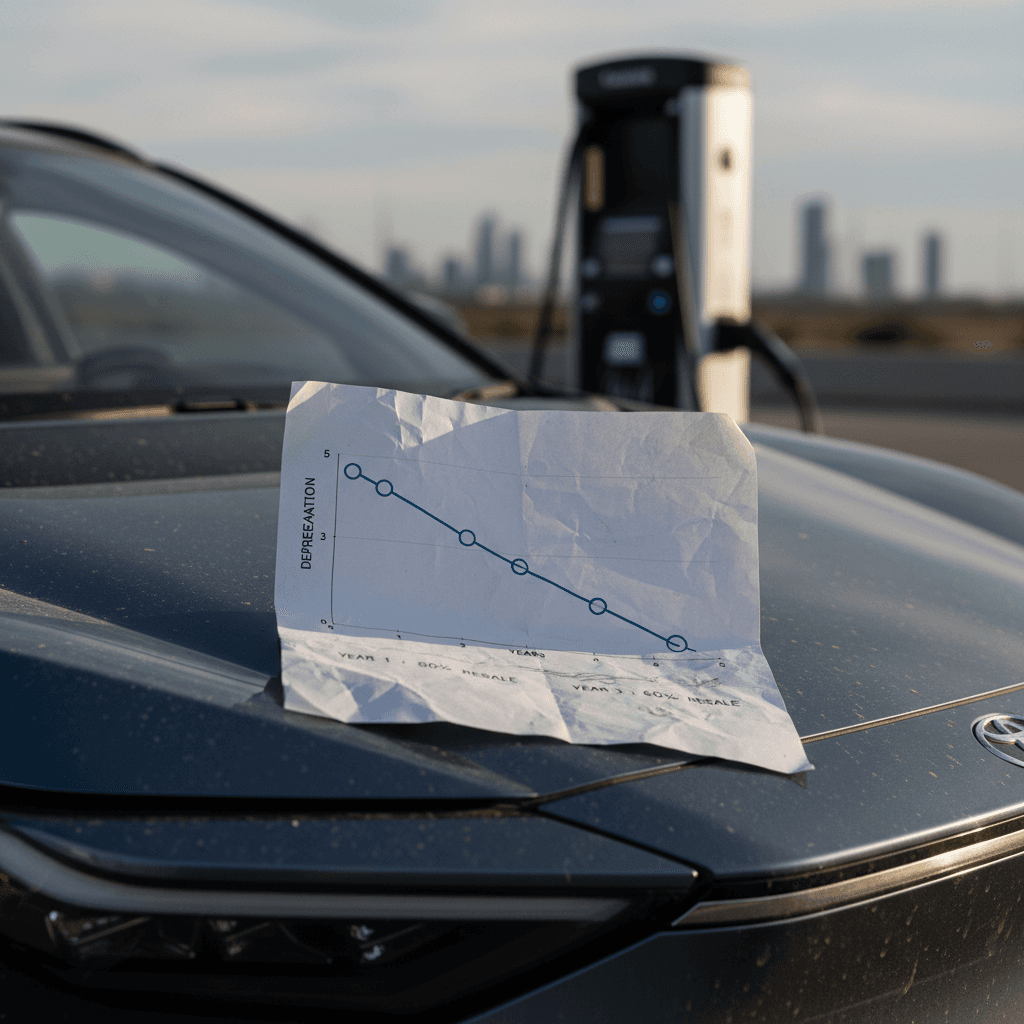
These rounded figures show how value might fall more quickly in the first 3 years, then level off as the bZ4X finds its used‑market price floor.
Why show a range, not a single value?
How the bZ4X depreciation curve compares to rival EV SUVs
Versus other compact EV crossovers
When you line the bZ4X up against EV peers like the Hyundai Ioniq 5, Kia EV6, or VW ID.4, its 5‑year depreciation curve looks broadly similar in shape, fast early losses, then a plateau. The big difference is that some rivals had stronger demand out of the gate, which has helped support their resale values a bit better in the first few model years.
In other words, the bZ4X isn’t an outlier among EVs; it’s closer to the middle of the pack. But it is an outlier compared with Toyota’s historically strong resale record.
Versus gasoline Toyota SUVs
Compared to a RAV4 Hybrid or Highlander, the bZ4X’s 5‑year curve is clearly steeper. Many popular Toyota crossovers are known for retaining 55–65% of their value at year 5. The bZ4X is more likely to be in the mid‑40s to around 50% range, at least based on today’s data and pricing forecasts.
That gap is what creates real used‑EV opportunity: you’re still getting Toyota build quality and a long battery warranty, but at a much lower entry price if you buy after the initial drop.
Shop the curve, not the hype
Key factors that shape the bZ4X depreciation curve
Main drivers of Toyota bZ4X depreciation
These are the levers that can nudge your 5‑year curve up or down.
Charging experience
Early owners criticized DC fast‑charging speeds, especially in cold weather. Toyota has rolled in updates, but reputation lags reality. If future updates and owner experiences improve the narrative, resale values can benefit.
Range & efficiency
The bZ4X’s EPA range is competitive on paper, but real‑world winter range can feel tight compared with some rivals. Vehicles that deliver consistent, predictable range tend to hold value better in EV segments.
Incentives & pricing
New‑car rebates, dealer discounts, and tax credits all ripple into used pricing. Deep discounts on new inventory can temporarily push used prices down; when incentives normalize, depreciation curves can flatten.
Warranty & reliability
Toyota backs the bZ4X battery with a long warranty, and the brand’s reliability halo still matters. If long‑term reliability remains solid and early recall issues fade into history, that supports year‑5 and year‑8 values.
Supply & demand
Lease returns, fleet sales, and production volumes all affect the number of used bZ4X units in the pipeline. More volume with soft demand means more pressure on prices, especially in years 3–5.
Broader EV market
Charging infrastructure growth, gas prices, and policy shifts change how attractive EVs look overall. A friendlier charging network and lower ownership costs can buoy residuals across the segment, including the bZ4X.
How to read bZ4X market signals in 2026
We’re still early in the bZ4X’s life cycle, and the market is adjusting in real time. In early 2026, you can already find 2023 and 2024 models at aggressive prices, sometimes in the low‑$20,000s for clean XLEs with modest mileage, especially in regions where EV incentives were strong and leases were popular.
- If you see many similar bZ4X listings clustered within a narrow price band in your area, that’s a good indication of where the local market has settled for that age and trim.
- If asking prices are all over the place, focus on units with documented history and strong battery‑health evidence, and be willing to walk away from anything priced as if it were a RAV4 Hybrid.
- Watch new‑car offers. When dealers slash prices or stack incentives on new bZ4X inventory, that usually drags used values down for a while, especially on 1‑ to 3‑year‑old units.
Where Recharged fits in
Ready to find your next EV?
Browse VehiclesBuying a used Toyota bZ4X using the 5‑year curve
When you’re in the market for a used bZ4X, the 5‑year depreciation curve becomes a pricing compass. You’re not trying to hit an exact number; you’re deciding whether a specific vehicle is reasonably priced given its place on that curve.
Checklist: sanity‑check a used bZ4X against the 5‑year curve
1. Start from original MSRP, not just today’s asking price
Look up the original window‑sticker price (or close equivalent) for the trim and options you’re considering. A lightly optioned XLE that cost ~$40k new has a different 5‑year curve than a Limited with every package.
2. Place the car on the curve by age and miles
A 2‑year‑old bZ4X with 30,000 miles should normally sit closer to the ~60–65% of original price band. If the asking price is far above that without a compelling reason, negotiate or move on.
3. Adjust for condition and battery health
A clean history report, no accident damage, strong service records, and verified battery health can justify values toward the high end of the range. Evidence of hard DC fast‑charging use, range complaints, or body damage should push you toward the lower end, or off the deal entirely.
4. Compare against other EVs you’re cross‑shopping
If an Ioniq 5 or EV6 with similar age and mileage is priced only slightly higher than a comparable bZ4X, consider which will hold value better from this point forward. Sometimes paying a bit more now can mean a softer hit later.
5. Factor in financing and incentives
Subvented interest rates, dealer cash, and state EV incentives can make a slightly higher asking price still a better total‑cost‑of‑ownership deal. If you’re shopping on Recharged, you can see estimated monthly payments and compare scenarios side by side.
6. Use a trusted valuation tool, then ground‑truth it
Online depreciation calculators and guides are a starting point. Cross‑check their estimates with live listings, Recharged’s fair‑market pricing data, and what similar bZ4X models have recently sold for in your region.
How current owners can protect bZ4X resale value
If you already own a bZ4X and plan to keep it 5 years or more, there’s a lot you can’t control about market‑wide depreciation, but there are a few levers you can pull to keep your personal curve from being steeper than it has to be.
Practical ways to keep your bZ4X on the better side of the curve
Most of these are basic EV best practices that buyers will value later.
Prioritize gentle charging habits
Use Level 2 home charging as your default. Relying heavily on high‑power DC fast charging can accelerate battery wear and may show up as reduced range over time, something future buyers will test‑drive for.
Document service and software updates
Keep records of all maintenance, recall work, and software updates. A well‑documented car is easier to sell and often commands a stronger price, especially in a relatively new EV model like the bZ4X.
Protect cosmetics
Small things like paint chips, curb‑rashed wheels, and a worn interior add up to real dollars at trade‑in time. Parking in a garage and addressing minor damage quickly can keep your bZ4X looking younger than its odometer.
Manage expectations around winter range
If you live in a cold climate, learn how climate settings and preconditioning affect range. A buyer who test‑drives your bZ4X on a cold day and sees reasonable range will feel much better about paying a strong price.
Know your warranty story
Understand the details of your battery and powertrain warranties, and be ready to explain them to prospective buyers. Remaining coverage through year 8 or beyond can be a major selling point.
Choose the right selling channel
Some owners will get more by selling to an informed EV marketplace like Recharged rather than a generic auction‑driven outlet. EV‑savvy buyers will value a clean Recharged Score and detailed condition report.
Don’t assume “it’s a Toyota, it’ll hold value”
Frequently asked questions about Toyota bZ4X depreciation
Toyota bZ4X depreciation: common questions
Bottom line: Is the Toyota bZ4X’s 5‑year outlook improving?
Taken together, the early data points to a steep but stabilizing depreciation curve for the Toyota bZ4X over its first 5 years. If you’re buying new, you should go in with clear eyes about that reality and plan to keep the vehicle long enough for Toyota’s strengths, reliability, warranty coverage, and build quality, to shine through.
If you’re buying used, though, the current curve is your friend. It lets you access a capable all‑electric Toyota SUV at prices that would have been hard to imagine when the bZ4X was announced. The key is to buy the right car at the right point on the curve, with documented history and verified battery health.