If you’re planning a long drive in a Tesla, the big question is simple: what does a Tesla Supercharger road trip really cost in 2025? You’ll see per‑kWh prices on the charger, but translating those numbers into dollars per 100 miles, or into a budget for a 1,000‑mile vacation, is less obvious. This guide walks through real‑world Supercharger pricing, example trips, and simple rules of thumb so you know what to expect before you hit the highway.
Quick answer
How much does a Tesla Supercharger road trip cost?
Tesla Supercharger road trip cost at a glance
That 8–15 cents per mile range assumes Supercharger‑only energy. If you leave home with a full battery and top up again at your destination using cheaper home charging, your effective road trip cost usually lands closer to the low end of those ranges.
How Tesla Supercharger pricing works in 2025
To understand your Tesla Supercharger road trip cost, you first need to know how pricing is set. Tesla no longer has one national rate. Instead, each station posts its own price in the app and on your car’s screen, and can use time‑of‑use pricing that’s higher during peak hours and lower off‑peak.
The building blocks of Supercharger pricing
Three kinds of charges can show up on your bill
Energy price (per kWh)
Most U.S. Superchargers now bill by kWh where regulations allow. In 2025–2026, many sites fall roughly in the $0.35–$0.55/kWh band, with some cheaper off‑peak and some higher in expensive utility markets.
Time‑based pricing
In a few states that still require time‑based billing, you might see a price per minute instead of per kWh. Stations can also use tiered by‑the‑minute rates depending on your charging speed.
Idle / congestion fees
If you stay plugged in after charging is complete and the site is busy, Tesla can add idle fees per minute. As of 2026, the grace period has been extended in some markets, but it’s still worth moving promptly once you’re done.
Watch the local rate
For road trips, what matters most is the combination of price per kWh and your car’s energy use in Wh per mile. Multiply those together, and you’ve got cost per mile.
Step-by-step: how to estimate your trip cost
You don’t need a spreadsheet to estimate your Tesla Supercharger road trip cost. Here’s a simple way to get an answer that’s “close enough” for budgeting before you ever get in the car.
5 steps to estimate your Tesla Supercharger road trip cost
1. Pick a realistic efficiency number
On highway trips, many Teslas land between <strong>240 and 310 Wh/mi</strong> depending on model and conditions. For a Model 3 or Model Y in mild weather, using <strong>260–280 Wh/mi</strong> is a good starting point unless you routinely drive very fast.
2. Note the average Supercharger price
Open the Tesla app, tap the Supercharger icons along your planned route, and look at the posted rates. If you see multiple sites at $0.40/kWh and a few at $0.50/kWh, assume an average around <strong>$0.45/kWh</strong>.
3. Convert to cost per mile
Use the formula: <strong>$/mi = (Wh/mi ÷ 1,000) × $/kWh</strong>. Example: 270 Wh/mi at $0.45/kWh → 0.27 × 0.45 ≈ <strong>$0.12 per mile</strong>.
4. Multiply by your trip distance
If your cost per mile is $0.12 and your loop is 800 miles, your Supercharger energy cost is roughly <strong>800 × $0.12 = $96</strong>, before any home charging offsets.
5. Adjust for home or destination charging
If you can leave home at 90–100% and top off cheaply at your destination, only part of the trip energy comes from Superchargers. Taking 10–30% off your Supercharger‑only estimate usually gets you close to what you’ll actually pay.
Rule-of-thumb shortcuts
Real-world example trips and what they cost
Let’s turn those formulas into road trips you can picture. These are rounded, example numbers based on typical highway efficiency for popular Tesla models, average Supercharger prices, and using Superchargers for most but not all of the energy.
Example Tesla Supercharger road trip costs
Approximate costs for common scenarios in 2025–2026. Actual numbers will vary with weather, speed, traffic, and local pricing.
| Trip | Tesla model | Distance | Assumed efficiency | Avg Supercharger price | Approx Supercharger energy used | Estimated Supercharger cost |
|---|---|---|---|---|---|---|
| Weekend getaway | Model 3 RWD | 300 mi | 260 Wh/mi | $0.40/kWh | ~80 kWh | ~$32 |
| Family visit | Model Y Long Range | 600 mi | 280 Wh/mi | $0.45/kWh | ~170 kWh | ~$75 |
| Cross‑country leg | Model 3 Long Range | 1,000 mi | 270 Wh/mi | $0.40/kWh | ~270 kWh | ~$108 |
| SUV road trip | Model X Dual Motor | 1,000 mi | 360 Wh/mi | $0.45/kWh | ~360 kWh | ~$162 |
Assumes moderate driving (65–70 mph), normal weather, and a mix of home and Supercharger charging where noted.
Those figures assume you start with a high state of charge from home and may top off on slower Level 2 charging at your destination. If you ran the entire 1,000 miles purely on Superchargers, or drive at 80+ mph in winter, expect the bill to land on the higher side of the range.
Tesla road trip cost vs gasoline car
One reason people care about Tesla Supercharger road trip cost is to see whether they’re actually saving money versus a gas car. Even with fast‑charging premiums, a Tesla road trip is usually 40–70% cheaper than driving a typical gasoline vehicle the same distance.
Tesla Supercharger vs gas: 1,000‑mile trip comparison
Illustrative cost comparison using common assumptions for 2025–2026.
| Vehicle | Energy use | Energy price | Total energy for 1,000 mi | Trip fuel cost |
|---|---|---|---|---|
| Tesla Model 3 Long Range (Supercharger only) | 270 Wh/mi | $0.40/kWh | 270 kWh | ~$108 |
| Tesla Model 3 Long Range (mix of home and Supercharger) | 270 Wh/mi | Blended ~$0.26/kWh | 270 kWh | ~$70 |
| Gas sedan (30 mpg) | 33.3 gal | $3.50/gal | 33.3 gal | ~$117 |
| Gas SUV (22 mpg) | 45.5 gal | $3.50/gal | 45.5 gal | ~$159 |
Assumes Supercharger energy at $0.40/kWh, home electricity at $0.14/kWh, and gasoline at $3.50/gal.
Where the savings show up
Factors that make your Supercharger bill go up or down
Not every Tesla road trip costs the same per mile. Two drivers with the same car and route can see very different Supercharger receipts. Here are the levers that move the needle the most.
6 big drivers of Tesla Supercharger road trip cost
Understand these, and your bill won’t surprise you
Weather & climate
Cold weather can increase energy use by 20–40% thanks to battery heating and cabin climate control. Heat also adds HVAC load, though typically less dramatically than deep cold.
Speed
Air resistance rises fast above 65 mph. The difference between cruising at 65 and 80 can easily swing your efficiency by 20–30%, which directly changes cost per mile.
Terrain & elevation
Big elevation gains, long climbs, and mountain passes all push energy use higher. Regenerative braking helps on the way down, but not enough to fully cancel long uphills.
Weight & cargo
Roof boxes, bike racks, full loads of passengers and luggage can trim efficiency by 5–10% and sometimes more, nudging your cost per mile upward.
Vehicle model & tires
Smaller, more aerodynamic cars like a Model 3 generally cost less per mile than taller, heavier vehicles like a Model X or Cybertruck. Tire choice can also shift efficiency by tens of Wh/mi.
When and where you charge
Busy metro‑area Superchargers often cost more than rural ones, and some sites use peak vs off‑peak pricing. Route choice and time of day can change your effective trip rate.
Don’t forget potential idle fees
How to spend less on a Supercharger road trip
You can’t control utility markets or Tesla’s exact per‑kWh rate, but you can control a lot about how much Supercharger energy you actually buy. These strategies help keep your road trip bill in check without turning the drive into a science project.
Practical ways to trim your Tesla road trip charging bill
Charge to 90–100% at home before you leave
Home electricity is usually far cheaper than a Supercharger. Starting full means you push your first paid stop farther down the road and may need fewer stops overall.
Lean on destination charging overnight
Hotels, Airbnbs, and relatives’ garages often offer Level 2 charging at low or zero cost. Waking up with a full pack can save one or more Supercharger sessions the next day.
Drive a little slower, especially in bad weather
Knocking your cruise from 78 mph down to 68 mph can reclaim a surprising chunk of range. On a long day, slightly slower speeds may cut both energy cost and charging time by reducing how often you need to stop.
Plan smart using Tesla’s Trip Planner
Use in‑car navigation or the Tesla app to plan stops where prices are lower and spacing is ideal. Sometimes skipping one expensive station in favor of two cheaper, well‑spaced ones lowers both cost and stress.
Avoid charging to 100% on the road
Charging from 80% to 100% is slow and expensive in terms of time. Most road‑trippers save both time and money by hopping between chargers and staying mostly in the 10–80% window.
Monitor costs live in the app
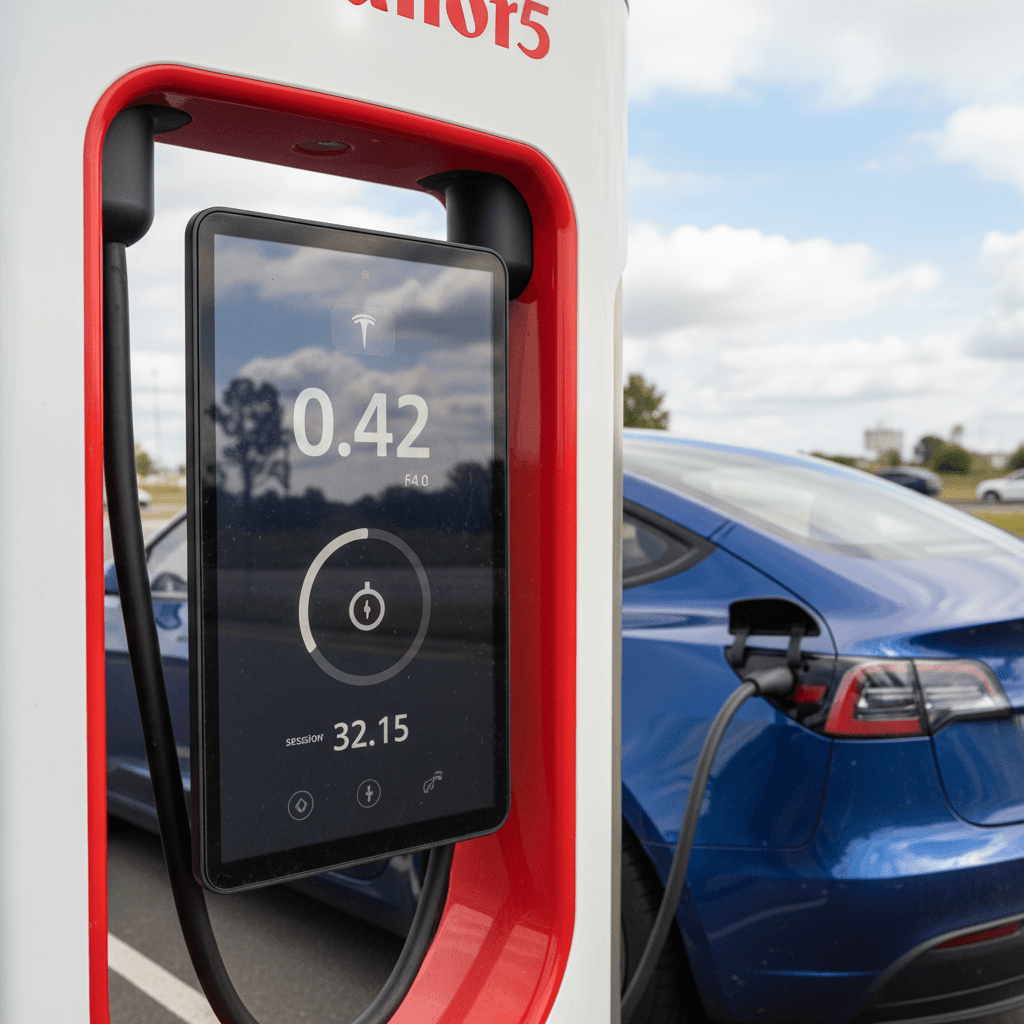
Recent Tesla app updates show <strong>estimated session cost</strong> in real time. Glancing at this while you stretch your legs helps you decide when you’ve gotten enough energy for the next leg.
Home vs Supercharger: the big picture
Used Tesla buyers: what road trip costs mean for you
If you’re shopping the used market, Supercharger road trip cost isn’t just about today’s vacation, it’s part of your total cost of ownership. Older Teslas can still road‑trip extremely well, but real‑world efficiency and battery health matter when you’re trying to keep trip costs predictable.
Why battery health matters for trip cost
A healthy pack doesn’t just hold more energy, it also lets you charge faster for more of the session. That can mean fewer stops and less time hanging out at high per‑kWh prices.
- Less degradation preserves your original range.
- Stable efficiency keeps your $/mile consistent.
- Better peak charge rates shorten expensive fast‑charge sessions.
How Recharged helps used EV buyers
Every EV listed on Recharged comes with a Recharged Score battery health report, so you can see how a vehicle’s pack has aged before you buy.
When you know the real battery capacity and range, it’s much easier to estimate future Supercharger road trip costs and decide whether that specific used Tesla fits your travel plans.
You can browse vehicles entirely online, get expert EV guidance, and even arrange nationwide delivery, all through Recharged.
Think beyond the sticker price
FAQ: Tesla Supercharger road trip costs
Common questions about Tesla Supercharger trip costs
Bottom line: what to budget for your Tesla road trip
If you boil all the numbers down, a realistic budget for a Tesla Supercharger road trip in 2025–2026 is about $15–$25 per 300 miles for a Model 3 or Model Y, or $45–$80 for 1,000 miles, with larger SUVs landing somewhat higher. That’s usually well below what you’d spend on gas, and you can push your cost lower by starting full from home, leaning on destination charging, and driving at sane speeds.
If you’re exploring a used Tesla or other EV, it’s worth thinking about these road trip costs alongside price, range, and charging access. A car with a strong battery and solid efficiency will keep your long‑distance charging bills predictable for years. With Recharged, every vehicle includes a battery health report, fair market pricing, and EV‑savvy support, so you can choose something that fits both your daily driving and your next big adventure.