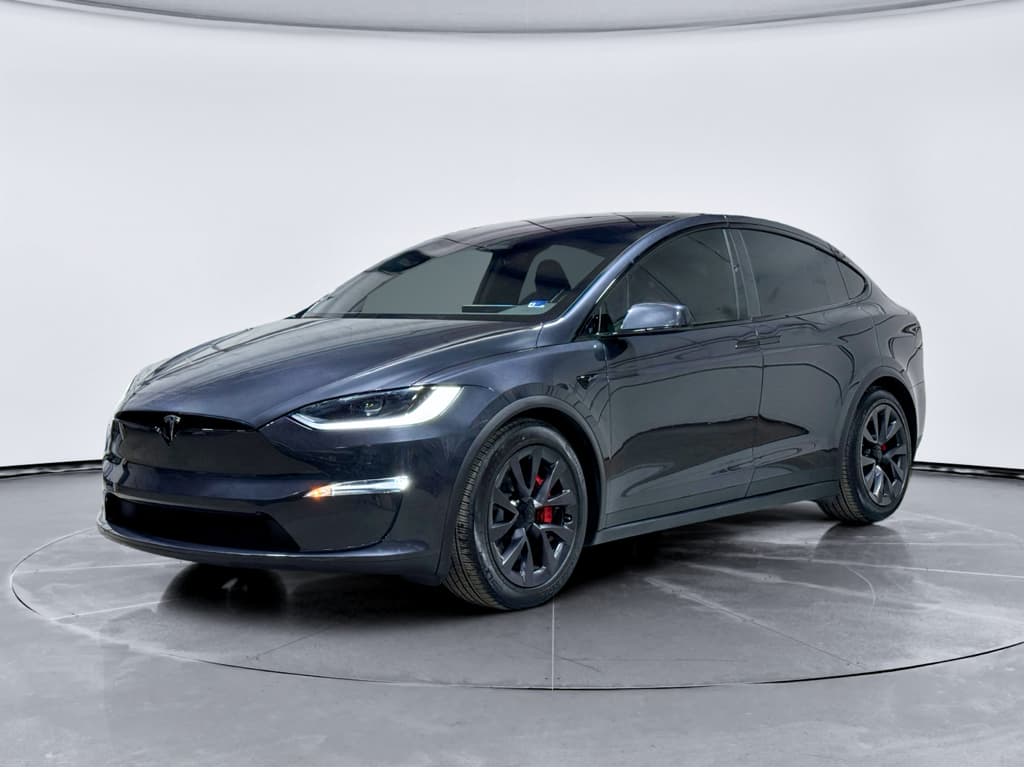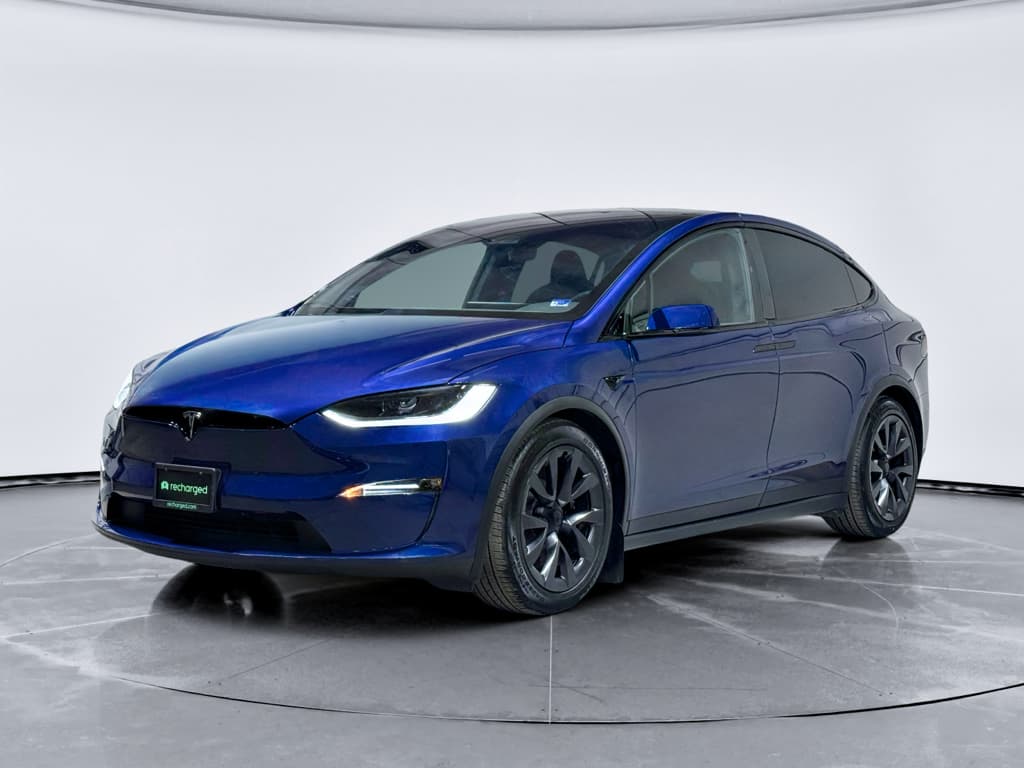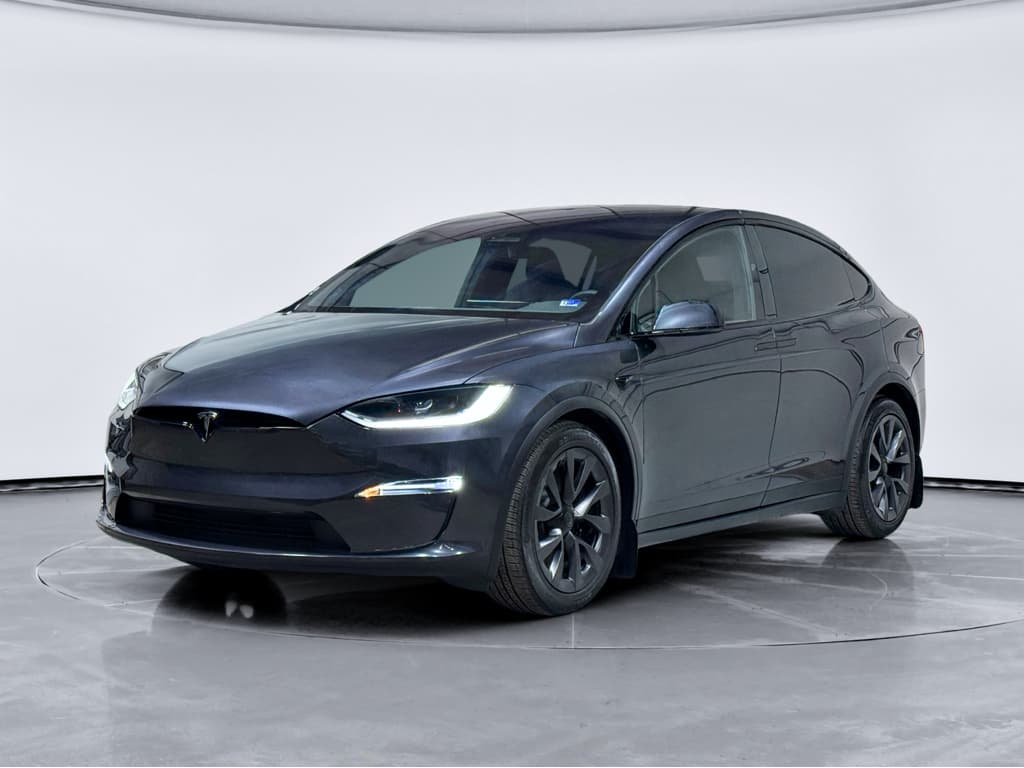
You don’t buy a 5,300‑pound electric falcon‑wing spaceship like the Tesla Model X without wondering how it behaves when physics finally calls the question. The good news: in formal crash tests the Tesla Model X safety rating and crash test results are outstanding. The more complicated news: driver‑assistance tech, software updates, and real‑world crashes paint a nuanced picture you should understand before you buy, especially used.
Key Takeaway
Overview: How Safe Is the Tesla Model X?
Tesla Model X Headline Safety Numbers
From a pure crashworthiness standpoint, how the shell, seatbelts, and airbags protect you when everything goes wrong, the Model X is near the top of the SUV hierarchy. Its low‑slung battery pack drops the center of gravity, reducing rollover risk, and the empty front engine bay becomes a generous crumple zone. Where the debate begins is on the software side: automated driving, driver monitoring, and how human beings behave when a car says it can almost drive itself.
Official Crash Test Ratings: NHTSA & Euro NCAP
Two organizations define the Model X’s safety reputation: NHTSA in the U.S. and Euro NCAP in Europe. They test different things, but the story is broadly consistent, this is a very safe SUV in a crash.
Tesla Model X Crash Test Ratings Snapshot
How the Model X performed in major crash test programs when it was tested as a new vehicle.
| Program | Region | Overall Rating | Highlights |
|---|---|---|---|
| NHTSA NCAP | United States | 5 stars | 5 stars in every frontal, side and rollover category; exceptionally low rollover risk for an SUV. |
| Euro NCAP | Europe | 5 stars | Near‑perfect adult occupant protection; maximum Safety Assist score when tested, matching Model 3. |
| IIHS | United States | Not rated | As of early 2026, Model X has not gone through IIHS’s full modern test battery. |
Note: Ratings refer to the originally tested configurations; equipment and scoring protocols can change over time.
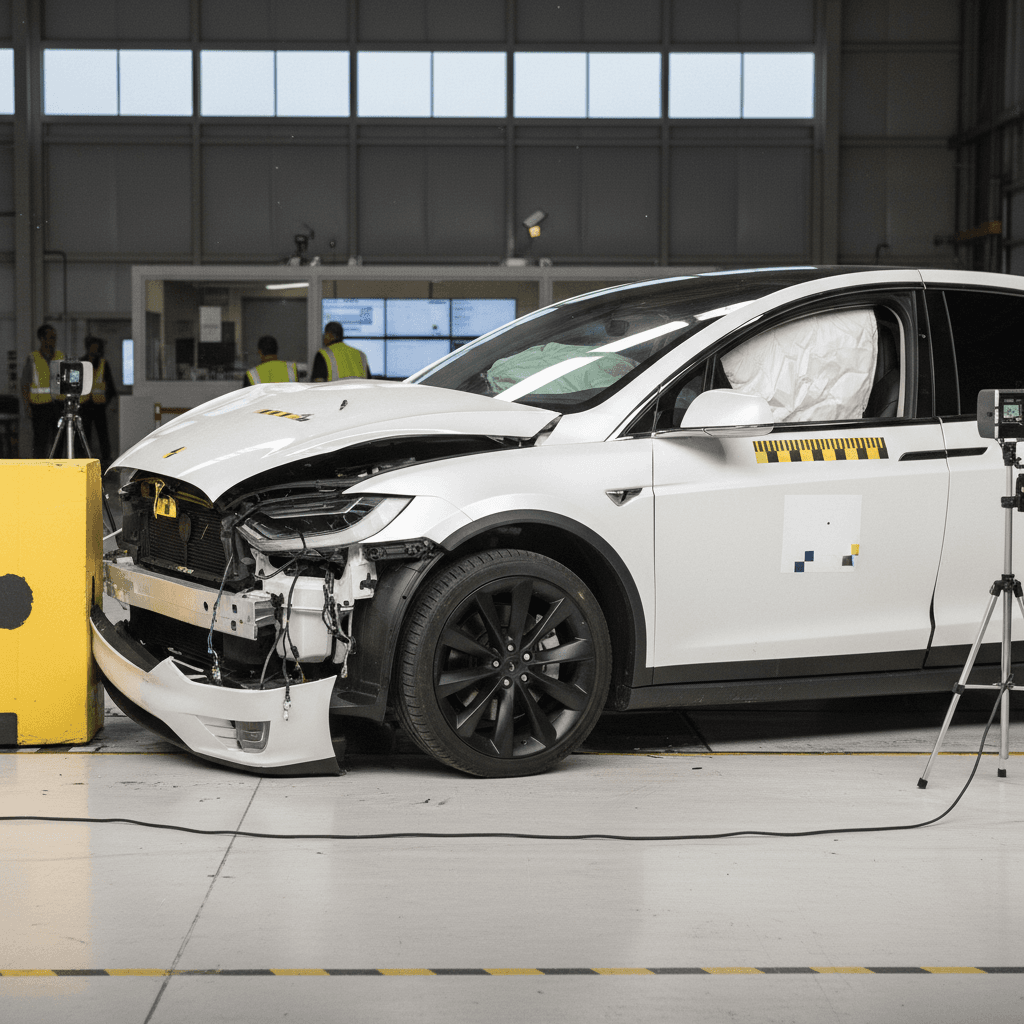
NHTSA’s 5‑Star Safety Ratings program smashes cars into fixed barriers, sleds them sideways into poles, and then publishes a simple star rating so shoppers don’t need an engineering degree. When the Model X was tested, it became the first SUV to earn 5 stars in every single category and sub‑category NHTSA measures for frontal, side, and rollover performance. Euro NCAP later repeated the theme, awarding another 5‑star score plus a class‑leading Safety Assist rating, reflecting strong crash‑avoidance tech for its time.
How to Read NHTSA’s 5 Stars
What About IIHS? Understanding the Missing Data
If you’re accustomed to shopping SUVs using the Insurance Institute for Highway Safety’s Top Safety Pick awards, you’ll notice an odd gap: as of early 2026, the Tesla Model X has not been fully rated under IIHS’s latest protocols. You may see older partial data or references to earlier tests, but there is no current full small‑overlap, roof‑strength, headlight, and crash‑avoidance scorecard like you’ll find for a Highlander or Telluride.
Lack of IIHS Ratings ≠ Lack of Safety
Why IIHS Might Skip the Model X
- Volume: The X sells in far smaller numbers than mass‑market SUVs.
- Cost: Crashing multiple six‑figure EVs is expensive even by lab standards.
- Prior Data: Regulators already have substantial information from NHTSA and Euro NCAP.
How to Compensate as a Shopper
- Lean harder on NHTSA and Euro NCAP results.
- Look at IIHS scores for similar‑size SUVs to benchmark expectations.
- Pay attention to real‑world crash stories and recall history, not just lab scores.
Real‑World Crashes, Autopilot & Where Risk Creeps In
Safety ratings measure how a vehicle protects you when a crash happens. They do not measure how likely you are to get into that crash in the first place. With Tesla, those are increasingly different conversations, because the brand’s driver‑assistance systems, Traffic‑Aware Cruise Control, Autosteer, and Full Self‑Driving (Supervised), have been involved in hundreds of scrutinized collisions.
- A long NHTSA investigation linked Tesla’s Autopilot design to a large number of crashes where drivers appeared over‑reliant on the system.
- U.S. regulators and courts have pushed Tesla to clarify that its systems are hands‑on, supervised driver aids, not self‑driving robots.
- California regulators went so far as to threaten Tesla’s sales license over misleading Autopilot and Full Self‑Driving branding, driving Tesla to tone down its language and add “(Supervised)” labels.
Critical Distinction
If you’re considering a used Model X, treat the driver‑assistance tech as you would a very sophisticated cruise control, not a robot chauffeur. In practice, that means hands on the wheel, eyes up, and skepticism whenever the car proposes something that doesn’t look right. At Recharged, our specialists walk buyers through how these systems actually behave so you’re not learning the hard way at 70 mph.
Active Safety & Crash Avoidance Tech on Model X
Every modern Model X is bristling with cameras and sensors whose day job is to keep you out of trouble. Even if you never pay for Full Self‑Driving (Supervised), you still get an impressive suite of active safety features.
Core Active Safety Features on the Tesla Model X
The exact mix varies by model year and software package, but these are the staples.
Automatic Emergency Braking
Uses forward cameras to detect an imminent collision and automatically apply the brakes to reduce impact speed. When paired with Forward Collision Warning, it buys you precious fractions of a second when you’re distracted or the car ahead panic‑stops.
Forward Collision Warning
Watches the lane ahead and flashes visual and audible alerts if a crash seems likely. On the Model X, the dash will highlight the threat in red and chime. If you don’t react, Automatic Emergency Braking can step in.
Obstacle‑Aware Acceleration
If you pin the accelerator while facing a wall, closed garage door, or another obstacle at low speed, the system can cut torque and in some cases lightly brake, turning what might have been a full‑tilt blunder into a fender‑bender instead of a living‑room remodel.
Pedestrian & Cyclist Detection
Cameras help identify vulnerable road users in front of the vehicle and support both warnings and automatic braking in many scenarios. As with any vision system, performance can degrade in poor visibility.
Lane Keeping & Departure Alerts
Depending on software version, the X can provide lane‑departure warnings and gentle steering assistance to nudge you back toward the center of the lane when you drift.
Rear Cross‑Traffic Alert
While reversing, the wide rear camera view can show red bars and chime if vehicles or pedestrians are crossing behind you, particularly helpful in crowded parking lots where sight lines are terrible.
Vision Has Limits
Passive Safety: Structure, Airbags & EV Architecture
Where the Model X really flexes is in the unglamorous science of not intruding on your personal space at the worst possible moment. The layout of an electric SUV gives Tesla some structural advantages over a traditional gasoline competitor.
EV Architecture Advantages
- Giant front crumple zone: With no engine block to shove backwards, the front of the Model X is mostly sacrificial space designed to absorb energy before it reaches the cabin.
- Rigid battery pack: The floor‑mounted battery contributes to torsional stiffness, helping the cabin hold its shape in a severe crash.
- Low center of gravity: All that weight in the floor makes the X far more resistant to rollover than a tall, top‑heavy gas SUV.
Protection Inside the Cabin
- Multiple airbags, including side‑curtain bags extending back to the third row on most configurations.
- Seat‑belt pre‑tensioners and load limiters tuned to work with the electric SUV’s crash pulse.
- Child‑seat anchors in second‑row seating, with clear manual guidance on proper positioning and weight limits.
Falcon‑Wing Doors & Rescue Access
Model‑Year Differences: 2016 vs 2024+ Model X Safety
Shopping the used market means you’re not just choosing a model, you’re choosing a moment in Tesla’s fast‑moving software and hardware timeline. A 2016 Model X and a 2024 Model X are cousins, not twins, when it comes to sensors and driver‑assist behavior, but their fundamental crash structures are very similar.
How Model X Safety Has Evolved Over Time
High‑level safety and driver‑assistance differences you’re likely to see across used Model X inventory.
| Model Years | Crash Structure | Airbags & Belts | Driver‑Assist Hardware | Software & Features |
|---|---|---|---|---|
| 2016–2018 | Original structure tested by NHTSA/Euro NCAP; already very strong. | Comprehensive airbag coverage; early tuning for belt pre‑tensioners and load limiters. | Mix of camera and ultrasonic sensors; older Autopilot hardware generations. | Earlier Autopilot and optional FSD features; some later functions limited by hardware. |
| 2019–2020 | Incremental tweaks; no fundamental structural downgrade. | Refinements to restraint tuning, added features like multi‑collision braking. | Newer compute hardware, expanded camera capabilities. | More advanced lane‑keeping and Navigate on Autopilot on some builds. |
| 2021–2024+ refresh | Updated front and interior design, but same basic battery‑in‑floor architecture. | Updated interior layouts, revised front seats and restraint strategies. | Shift toward Tesla Vision (camera‑only) and newer FSD computers. | Full Self‑Driving (Supervised) available; vision‑only approach for many safety and convenience features. |
Exact feature sets vary by build date, options, and over‑the‑air software. Always confirm equipment on the specific VIN.
Don’t Assume All Model X SUVs Behave the Same
Used Model X Safety Checklist for Shoppers
You can’t reenact a government crash test in your driveway, but you can absolutely sanity‑check whether a specific used Model X still has its safety act together. Use this checklist as your road map.
10‑Point Safety Checklist Before You Buy a Used Model X
1. Verify Open Recalls Are Addressed
Ask for documentation that all safety recalls, especially software updates related to Autopilot or FSD, have been performed. A reputable seller will provide a recall report by VIN; at Recharged, this is part of our standard intake.
2. Scan the Car for Structural Repairs
Look for uneven panel gaps, overspray, mismatched paint, and non‑OEM welds underneath. A high‑quality repair can be fine, but poorly repaired frame damage can compromise crash performance.
3. Check Airbag & Warning Lights
On startup, make sure the airbag and ABS lights cycle on and off normally. Any persistent warning related to restraints, brakes, or stability control is a red flag until diagnosed and repaired.
4. Inspect Tires & Brakes
Bald, mismatched, or budget tires and worn brakes are a silent safety downgrade. The Model X is heavy and powerful; it needs quality rubber and healthy pads/rotors to stop as intended.
5. Confirm Driver‑Assist Options & Versions
Don’t rely on the listing headline. In the car’s menus, confirm whether it has only basic safety features, Enhanced Autopilot, or Full Self‑Driving (Supervised), and which hardware generation it’s running.
6. Test Collision Warnings & AEB in a Safe Space
Without doing anything reckless, let the car approach a harmless obstacle at low speed to confirm forward alerts and gentle braking work as expected. Combine this with checking the rear camera and parking sensors.
7. Ensure Cameras Are Clear & Intact
Walk around the vehicle and visually inspect all camera lenses for cracks, fogging, or aftermarket tints/wraps covering them. Damaged or obstructed cameras can cripple both safety and convenience features.
8. Evaluate Headlights at Night
Find a dark road and check low and high beams, auto‑high‑beam behavior, and fog lights if equipped. Good crash protection doesn’t help if you can’t see the deer until too late.
9. Review Service & Accident History
Ask for Carfax/AutoCheck plus service invoices. Multiple front or side impacts, especially with airbag deployments, warrant a careful pre‑purchase inspection to ensure repairs met factory standards.
10. Consider a Professional EV Inspection
Tesla‑specific suspensions, high‑voltage components, and driver‑assist systems benefit from an expert eye. Recharged performs a comprehensive EV‑focused inspection and shares the results in a Recharged Score Report, including verified battery health and safety‑relevant findings.
Leverage the Recharged Score
FAQ: Tesla Model X Safety & Crash Tests
Common Questions About Tesla Model X Safety Ratings
Bottom Line: Should You Feel Safe in a Used Model X?
Judged strictly by how it protects you when metal meets immovable object, the Tesla Model X is a star pupil. Its 5‑star NHTSA rating across every category, 5‑star Euro NCAP performance, and inherently favorable EV architecture make it one of the safest big SUVs ever to roll into a crash lab. Where the story gets messy is around the steering wheel, drivers lulled into over‑trusting driver‑assistance, out‑of‑date software, sloppy repairs after a hard hit.
If you respect the technology’s limits, keep the software current, and buy a well‑vetted example, you can feel very good about putting your family in a Model X. And if you’d rather not decode hardware generations, sift through service records, and guess at prior damage on your own, Recharged was built for exactly this problem. Our Recharged Score Report, battery‑health diagnostics, and EV‑specialist inspection give you the kind of safety transparency the window sticker never will, so you can enjoy the spaceship and sleep at night.