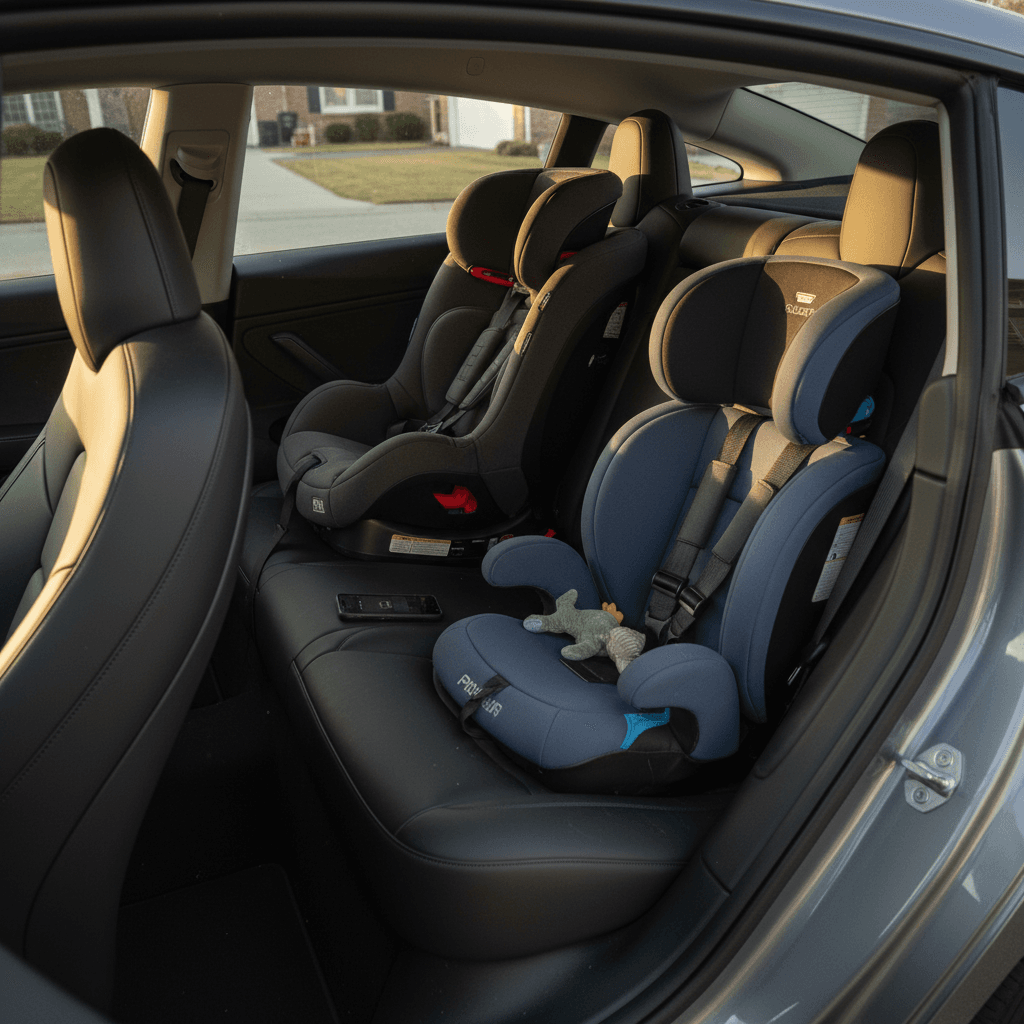
If you’re eyeing a Tesla Model 3 but also hauling diapers, snack cups, and a rear-facing throne for your tiny monarch, you’re asking the right question: **will my child seat actually fit?** This Tesla Model 3 child seat fit guide walks you through LATCH locations, real-world space for rear- and forward-facing seats, 3‑across possibilities, and a few sharp edges you won’t find in the brochure.
Big Picture
Why the Model 3 Needs Its Own Child Seat Guide
On paper, the Tesla Model 3 looks like any other small sedan. In the real world, its **minimalist interior and sporty packaging** create a few quirks for parents:
- Rear bench is firm and heavily contoured, which can fight against flat‑bottomed child seats.
- Lower LATCH anchors in the outboard seats sit **deeper than average** in the seat bight, so clipping in can take more effort and smaller hands.
- There are **only two full LATCH positions** (left and right rear). The center spot has a tether anchor but no lower LATCH anchors.
- The low roofline and short rear doors mean more ducking and twisting as you lift kids in, especially rear-facing.
Safety First, Comfort Second
Model 3 LATCH Locations and Seat Layout
All U.S.‑spec Tesla Model 3s (including refreshed 2024–2026 cars) follow the same basic rear-seat layout:
Where You Can Safely Install Child Seats in a Model 3
Two full LATCH positions plus a flexible center belt install
Left Rear (Outboard)
Full LATCH + tether.
Ideal for rear- or forward-facing harnessed seats.
Lower anchors are deep in the seat; expect some fumbling to connect.
Center Rear
Seat belt + tether only.
No lower LATCH anchors here.
Excellent crash position when you can get a rock-solid belt installation.
Right Rear (Outboard)
Full LATCH + tether.
Often the best spot for a rear-facing infant seat.
Front passenger seat can usually slide back more on this side than behind the driver.
IIHS rates the Model 3’s LATCH usability as **Acceptable**, not because it’s unsafe, but because the lower anchors are tucked deeply into the cushions and can be trickier to access than in some family crossovers. Once connected and tightened, however, they perform as intended.
Pro Move: Find the Buttons First
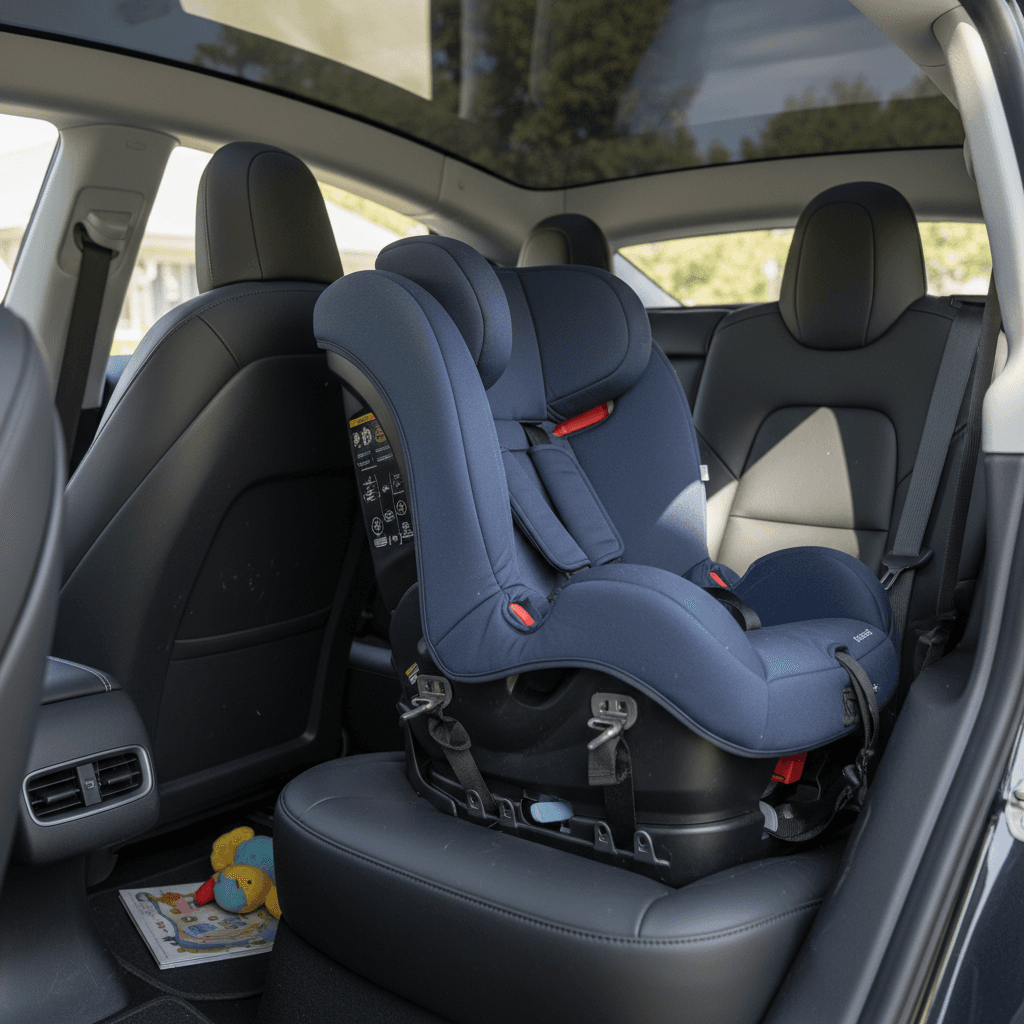
Rear-Facing Infant and Convertible Seats in a Model 3
Rear-facing is where the Model 3 either works beautifully, or drives you to reconsider a Model Y. The key variables are **seat size, your height, and how often adults ride in front of the child.**
Best Spots for Rear-Facing
- Right outboard with LATCH is the sweet spot for most families. It keeps the driver’s seat free and usually lets a front passenger of average height sit comfortably.
- Center with seat belt can work well with a compact infant or slim convertible seat. It often buys you a little extra front seat travel since the shell sits between the front seatbacks.
- Left outboard with LATCH is doable, but tall drivers may have to slide forward noticeably in early infant stages.
What to Expect With Space
- Compact infant seats and slim convertibles generally fit rear-facing without smashing the front seats.
- Larger all‑in‑one seats may require the front seat in front of them to move forward several clicks, fine for a shorter adult, rough on a long‑legged driver.
- As your child grows and you can make the rear-facing angle more upright (within the seat’s limits), front legroom improves significantly.
Angle Matters
Rear-Facing Install Checklist for the Model 3
1. Choose your position wisely
Start with the passenger-side outboard spot. Have your usual front passenger sit where they’d like, then test whether your rear-facing seat can fit at the proper recline behind them.
2. Decide LATCH vs seat belt
Use LATCH in the outboard seats if the child + seat are under the combined LATCH weight limit (typically 65 lb). In the center, you must use the seat belt; never ‘borrow’ outboard anchors for a center LATCH install.
3. Set recline before tightening
Adjust the child seat’s recline angle on the garage floor first, then move it into the car. It’s much harder to fight the Model 3’s firm cushions while also wrestling recline settings.
4. Use your body weight
Lean your weight into the seat, press down where the child’s hips will be, while tightening the LATCH strap or seat belt. In a Model 3 this is often the difference between “pretty tight” and rock-solid.
5. Check for movement
At the belt path, the seat shouldn’t move more than 1 inch side-to-side or front-to-back. If it does, try again or test a different seating position.
6. Fine-tune front seats
Once installed, slide the front seatback gently toward the child seat until it’s close but not pushing on it. In an EV like the Model 3, you’ll feel every bump; a pushed‑in seat can slowly loosen over time.
Forward-Facing Harnessed Seats: Best Practices
Once your child is old enough and heavy enough to face forward (ideally after age 3–4, depending on your pediatrician and local laws), the Model 3 becomes much easier to live with, but still rewards careful setup.
Forward-Facing Options by Seating Position
Where forward-facing harnessed seats generally work best in a Tesla Model 3.
| Position | Attachment | Pros | Tradeoffs |
|---|---|---|---|
| Left outboard | LATCH + tether or seat belt + tether | Easy tether routing, solid install, predictable belt path. | Tall drivers may need to slide slightly forward with some bulkier seats. |
| Center | Seat belt + tether | Excellent crash position, often good legroom for both front seats. | Slightly trickier install; buckles on flexible stalks can shift as you tighten. |
| Right outboard | LATCH + tether or seat belt + tether | Great visibility of the child from the sidewalk side, easy loading. | Front passenger legroom can shrink with large combination seats. |
Always follow both the vehicle and child-seat manufacturer’s instructions for allowable positions and attachment methods.
Never Skip the Top Tether
In everyday use, most families end up with a forward-facing seat in the **center with a seat-belt install** or behind the **passenger with LATCH**, preserving maximum legroom for the driver. The good news: forward-facing shells are more upright, so they generally coexist well with the Model 3’s sculpted bench.
Boosters and Bigger Kids in the Model 3
Boosters add a new wrinkle: you’re no longer locking the child seat down; the seat belt and your child’s behavior do the real work. The Model 3’s **fixed, forward-leaning head restraints and low-set buckles** can make some boosters awkward.
Booster Fit Realities in a Tesla Model 3
Where things go smoothly, and where they don’t
High-Back Boosters
- Work best on the two outboard seats.
- Look for slimmer shells; wide wings can fight the head restraints.
- Teach kids to pull slack from the shoulder belt at the buckle side so it doesn’t get trapped under the booster base.
Backless Boosters
- Only for kids with good belt fit and maturity.
- The low belt buckles can hide under some booster bases, check that kids can buckle and unbuckle without contorting.
- Be choosy: some backless models slide around on the Model 3’s leatherette more than on cloth seats.
Watch the Belt Path
Can You Fit Three Across in a Tesla Model 3?
Short answer: **yes, but only with the right seats and a lot of patience.** The Model 3 is narrower than a midsize SUV, and its deeply contoured rear bench steals usable width.
- Three-across is most realistic with **narrow convertible or multimode seats** marketed specifically as slim (often 17 inches wide or less).
- Plan on at least one seat using a **seat-belt install instead of LATCH** on each outboard position. This lets you slide seats slightly closer together than rigid LATCH spacing allows.
- The center seat will always be a **seat-belt install**, since the Model 3 has no lower LATCH anchors there, only a top tether.
- You’ll be doing test‑fits. What technically “fits” may still be impossible to buckle daily without bruised knuckles.
Three-Across Game Plan
Model 3 Child Seat Installation Checklist
10-Step Safety Checklist Before You Drive Off
1. Read both manuals
Open your Tesla Model 3 Owner’s Manual to the child restraint section, and your child seat manual to the vehicle-install pages. Cross‑check allowed positions and attachment methods.
2. Pick the best seating position
Balance safety, daily access, and front legroom. Rear center is gold-standard for safety when you can get a rock‑solid install; otherwise use an outboard LATCH position.
3. Choose LATCH vs seat belt intentionally
Use the method your seat and vehicle both allow for that position. Remember: the Model 3’s center rear has no lower anchors, and you shouldn’t borrow anchors from the sides.
4. Pre‑set recline and headrest
Adjust recline on the child seat, and lower or raise rear head restraints as required by your seat (some need them up, others removed or all the way down).
5. Attach and tighten
Clip to LATCH anchors or thread the seat belt, then use your body weight to tighten. In the Model 3’s firm bench, that extra force matters to remove hidden slack.
6. Lock the belt if using seat belt install
Engage the retractor lock or built‑in lockoff, per your seat’s instructions, so the belt can’t loosen as the car moves and the seat settles.
7. Connect the top tether for forward-facing
Route the tether strap around the head restraint as directed (outside for outboard seats, over the top for center) and snug it tight.
8. Do the 1‑inch wiggle test
At the belt path, try moving the seat side-to-side and front-to-back. If it moves more than 1 inch in any direction, adjust and retighten.
9. Check front seat clearance
Make sure neither front seat is pressing hard into a child seat, especially rear-facing. Light contact may be allowed by some manufacturers, but never a load‑bearing shove.
10. Recheck after a week
After a few drives, recheck tightness. Child seats tend to settle into Tesla’s cushions; a quick re‑torque can bring everything back to spec.
Choosing the Right Seat for Your Child (and Your Tesla)
Not every “top-rated” child seat plays nicely with the Model 3’s deep anchors and sculpted cushions. Before you click Buy Now, think about **fit in this specific car**, not just lab scores and influencer lists.
What to Look for in a Model 3-Friendly Child Seat
Features that make installation easier in Tesla’s compact sedan
Slim Overall Width
If you might ever need 3‑across or a combo of seats + booster, target seats around 17 inches wide or marketed as slim-fit. Wider thrones eat into door clearance quickly.
Friendly Belt Lockoffs
Built‑in lockoff clamps or easy‑to‑reach belt paths are a blessing in the Model 3, where buckle stalks are short and can dive under the cushions while you tighten.
Flexible Recline Range
Seats that allow more upright rear-facing angles (for older toddlers) and multiple forward-facing reclines help you tune both comfort and front-seat legroom.
Use NHTSA’s Car Seat Finder
If you’re shopping used, a good Model 3‑oriented test is simple: can you get the seat **properly tight in two different positions** (for example, right outboard and center) without exotic tricks? If the answer is no, keep looking.
EV-Specific Safety Tips for Families
Electric power doesn’t change the physics of a crash, but it does change how you use the car with kids day to day. A few Model 3 and EV‑specific habits go a long way.
- Use **Child Lock** on the rear doors and windows; the Model 3 makes this a quick toggle on the touchscreen.
- If you enable **Easy Entry** for the driver’s seat, disable it when a child seat is directly behind you so the seat doesn’t motor back into little legs.
- Precondition the cabin while plugged in so you’re not tempted to loosen harnesses or take off coats mid‑drive because somebody’s too hot or cold.
- During fast charging stops, keep kids buckled unless you’re genuinely getting out. Superchargers are usually near traffic and other distracted drivers.
Don’t Rely on Tech to Babysit
How Recharged Helps Family Buyers
If you’re considering a **used Tesla Model 3** as the family shuttle, the bigger question isn’t just “will the car seat fit?”, it’s “will this particular car still be safe and comfortable five years from now?” That’s where Recharged comes in.
Battery & Safety Confidence
- Every Model 3 on Recharged comes with a Recharged Score Report that includes verified battery health and a detailed inspection.
- We flag crash history and structural repairs that could affect how seats and belts perform.
- Transparent pricing means you’re not haggling in a showroom while a toddler melts down.
Family-Friendly Shopping
- Browse and buy 100% online, or visit our Experience Center in Richmond, VA where you can install your own child seats in any car on the lot.
- Need to trade in the gas SUV you’ve outgrown? We offer instant offers, consignment, financing, and nationwide delivery.
- Our EV specialists can walk you through Model 3 vs. Model Y vs. other family EVs so you’re not guessing about space and usability.
Tesla Model 3 Child Seat Fit FAQ
Frequently Asked Questions
The Tesla Model 3 can absolutely be a family car, but it’s not a lazy one. Its compact footprint, deep LATCH anchors, and sculpted rear bench reward parents who pick the right seats, install them carefully, and verify the fit over time. Get that right and you have a quiet, efficient, crash‑tested cocoon that happens to sync with your phone and cost pennies per mile. And if you’re shopping used, let Recharged help you find a Model 3 where the battery, body, and safety systems are as solid as your child-seat install.