Wondering between the Tesla Cybertruck vs Chevrolet Silverado and which you should buy? You’re not alone. On one side you’ve got an all‑electric stainless‑steel wedge with 0–60 mph times that would shame sports cars. On the other, a proven full‑size pickup that can be ordered dozens of ways and serviced almost anywhere. This guide breaks down specs, real‑world usability, and ownership costs so you can choose the truck that actually fits your life, not just your social feed.
Key takeaway up front
Cybertruck vs. Silverado: who is this comparison for?
This comparison focuses on the Tesla Cybertruck (current U.S. models in 2025–2026: rear‑drive Long Range and dual‑motor all‑wheel‑drive) versus the Chevrolet Silverado 1500 (2025 model year, the mainstream half‑ton truck most buyers cross‑shop). We’ll touch on the Silverado EV briefly, but the core matchup here is: - Cybertruck: all‑electric, high‑performance, crew‑cab pickup with fixed configuration. - Silverado 1500: traditional body‑on‑frame truck available with gas or diesel engines, multiple cabs, beds, and trims. If you’re deciding between an electric lifestyle statement and a conventional workhorse, you’re in the right place.
Headline numbers at a glance
Quick specs: Tesla Cybertruck vs. Chevy Silverado 1500
Core specs: Cybertruck vs. Silverado 1500 (gas/diesel)
Representative configurations for shoppers comparing a dual‑motor Cybertruck to a well‑equipped Silverado 1500. Exact numbers vary by trim, options, and testing cycle.
| Tesla Cybertruck AWD | Tesla Cybertruck Long Range RWD | Chevy Silverado 1500 (5.3L V8 4x4 Crew) | Chevy Silverado 1500 (3.0L Duramax diesel) | |
|---|---|---|---|---|
| Powertrain | Dual‑motor electric AWD | Single‑motor RWD | 5.3L V8 gas, 10‑spd auto, 4x4 | 3.0L I‑6 turbodiesel, 10‑spd auto, 4x4 |
| Peak power | ~600+ hp (est.) | Lower than AWD (focus on range) | 355 hp | 305 hp, high torque |
| Max towing | Up to ~11,000 lb | About 7,500 lb | ~11,000–13,200 lb (properly equipped) | Up to 13,300 lb (properly equipped) |
| Payload | Roughly 2,200–2,500 lb | ~2,000 lb+ | ~1,600–2,200 lb (by configuration) | Up to ~2,200+ lb |
| Bed length | ~6 ft composite vault | Same | 5 ft 8 in or 6 ft 6 in | 5 ft 8 in or 6 ft 6 in |
| Range / MPG | ~320–340 mi est. (unladen) | Up to ~360 mi est. | ~17 mpg combined (typical V8 4x4) | Up to mid‑20s mpg combined (diesel) |
| Base price new | Around low‑$80Ks (often higher with options/founder editions) | Low‑$70Ks | From high‑$40Ks for well‑equipped 4x4 crew | Similar to high‑content gas models; diesel option adds cost |
Use these numbers as directional benchmarks, not absolute values for every configuration.
About these numbers
Performance, towing, and payload
Acceleration and driving feel
Cybertruck: instant torque rocket
The Cybertruck delivers instant electric torque with no gear changes. Dual‑motor AWD models launch especially hard, with 0–60 mph times that rival performance cars. Steering is steer‑by‑wire with rear‑wheel steering, so it feels very different from a traditional truck: quick, almost video‑game‑like, and extremely maneuverable in tight parking lots.
If you care about quick passing, silent cruising, and futuristic driving dynamics, the Cybertruck is the standout.
Silverado: familiar, flexible power
The Silverado 1500 offers multiple engines, from a turbo four‑cylinder to a 5.3L or 6.2L V8 and the 3.0L Duramax diesel. They don’t deliver the instant shove of an EV, but they offer predictable, linear power that most truck owners find familiar. GM’s 10‑speed automatic is smooth and proven in towing duty.
If you value predictable throttle feel and the option to choose between efficiency and V8 sound, the Silverado wins on configurability.
Towing: ratings vs. real‑world
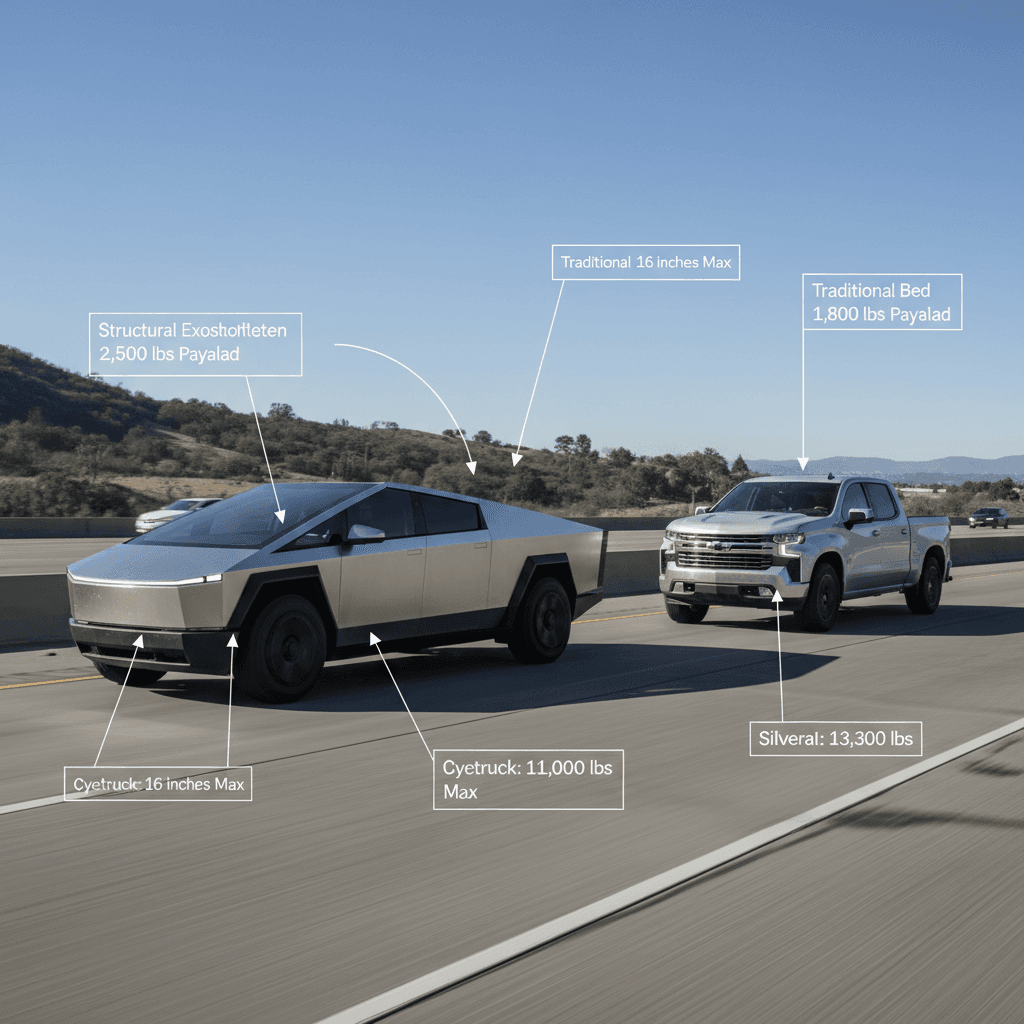
On paper, both trucks can tow five‑figure weights when properly configured. Tesla quotes up to 11,000 pounds of towing capacity for most Cybertruck models, while Chevrolet rates the 2025 Silverado 1500 at up to 13,300 pounds with the right Duramax diesel setup and equipment. But the experience of towing with gas/diesel versus electric is very different.
- Cybertruck: Electric torque makes getting a heavy trailer moving feel effortless, and built‑in trailer brake control plus advanced driver‑assist can ease highway work. The catch is range. Pulling a sizable camper or car hauler can easily cut usable range in half, forcing more frequent DC fast‑charge stops and careful route planning.
- Silverado 1500: Properly equipped trucks can tow heavier loads, and while fuel economy drops under load, you can refuel in minutes almost anywhere. For frequent long‑distance towing, horses, enclosed car trailers, big campers, the Silverado platform is still the more practical choice.
Practical towing advice
Payload and bed use
Payload matters if you’re hauling tools, materials, or tongue weight from a trailer. Cybertruck payload ratings climb into the low‑to‑mid‑2,000‑pound range in many trims, competitive with half‑ton pickups. Silverado 1500 payload also runs roughly 1,500–2,300 pounds depending on cab, bed, engine, and options. Where they differ is bed character:
Bed and cargo differences
How each truck handles real working cargo
Cybertruck composite vault
The Cybertruck’s bed is a composite "vault" with a power tonneau cover. It’s around 6 feet long, has an integrated tailgate ramp, and offers built‑in power outlets. It’s great for locking gear out of sight and keeping everything dry. However, the sloping sail panels and high sides can make side access and ladder racks tricky.
Silverado open box options
Silverado offers multiple bed lengths and box styles, from basic work‑truck spec to high‑line trims with spray‑in bedliners, tie‑downs, and Multi‑Flex tailgates. It’s still the more up‑fit‑friendly platform if you need racks, toolboxes, campers, or customized commercial bodies.
Range, fuel economy, and charging
Cybertruck range in the real world
Tesla’s published numbers for the Cybertruck reach into the mid‑300‑mile range for some trims and wheel choices. In practice, owners and independent testers typically see lower real‑world range, especially at highway speeds, in cold weather, or when towing. That’s true of all EVs, but large, heavy trucks exaggerate the effect.
Range extender notes
Silverado fuel economy
The 2025 Silverado 1500’s 5.3L V8 4x4 configuration typically returns around the mid‑teens in combined driving, while the 3.0L Duramax diesel can hit the mid‑20s mpg combined in lighter‑duty highway use. Under heavy towing, both will burn more fuel, but you can refill in five minutes at almost any exit in the country.
Charging and fueling experience
Living with Cybertruck charging
Day to day, charging a Cybertruck at home on a 240‑volt Level 2 charger is painless: you plug in at night and wake up full. Long road trips and heavy towing are where you’ll feel the difference. Even with access to high‑power DC fast chargers, you’re planning around charging stops of 20–40 minutes instead of a 5‑minute fuel stop.
Access to Tesla’s Supercharger network is a major advantage, but if you live far from interstate corridors or in an apartment without dedicated parking, you’ll need a clear charging strategy before you commit.
Living with Silverado fueling
Silverado ownership stays within the familiar gas‑station rhythm: stop when the tank gets low, fill in a few minutes, and keep going. There’s no planning around charge curves, connector availability, or cold‑weather range loss. The downside is higher total energy cost over time compared with home EV charging, especially if you drive a lot of miles per year.
Where Recharged fits in
Ready to find your next EV?
Browse VehiclesDaily driving, comfort, and utility
Ride quality and noise
The Cybertruck rides quietly at low speeds because there’s no engine noise, and air‑suspension‑equipped trims can smooth out broken pavement. However, big all‑terrain tires, upright bodywork, and sheer mass mean you’ll still hear wind and tire roar, especially on concrete freeways. Silverado ride quality varies more by trim: basic work trucks can feel stiff unloaded, while higher trims with better damping and insulation deliver a relaxed, traditional half‑ton experience.
Cabin tech and ergonomics
Inside the cab: minimalism vs. familiarity
Two very different approaches to the same job
Cybertruck interior
The Cybertruck leans into radical minimalism: a massive center touchscreen, very few physical buttons, yoke‑style or unconventional steering, and software‑driven features. Over‑the‑air updates can add features or tweak behavior over time, and integration with Tesla’s app ecosystem is excellent.
This will thrill tech‑forward buyers and frustrate drivers who want dedicated knobs and switches, especially when towing or off‑roading.
Silverado interior
Recent Silverado cabins offer modern digital clusters and touchscreens, but still retain traditional truck ergonomics: column or console shifters, hard keys for key functions, and clear analog‑style readouts. It’s designed for gloved hands, work boots, and multi‑hour stints behind the wheel.
If you share the truck with several drivers or operate in harsh environments, familiarity can be a serious advantage.
Parking, maneuvering, and visibility
Both trucks are big. The Cybertruck’s sharp angles and thick sail panels can complicate rear‑quarter visibility, though cameras and sensors help. Rear‑wheel steering gives it a surprisingly tight turning circle, which makes parking lots easier than you might expect. Silverado dimensions vary more by cab and bed, but its conventional shape, big mirrors, and clear glass areas make it intuitive to place in traffic and tight work sites.
Off-road ability and work-truck credibility
Tesla designed the Cybertruck with substantial ground clearance, stout skid protection, and favorable approach and departure angles. With the right tires and suspension settings, it’s capable off‑road, especially on loose surfaces where instant torque shines. That said, weight is the enemy in deep mud or sand, and the truck’s width can be a limitation on tight trails.
Trail‑use reality check
- Cybertruck strengths off‑road: instant torque, flat underbody, good clearance, onboard power for tools and camp gear.
- Silverado strengths off‑road: wide range of off‑road packages (Trail Boss, ZR2), locking differentials, proven aftermarket for armor, suspension, and recovery gear.
Ownership costs, maintenance, and resale value
Energy costs over time
Energy is where EV trucks can shine. Charging a Cybertruck at home on off‑peak electricity is typically cheaper per mile than buying gasoline or diesel for a Silverado, sometimes dramatically so if you drive many miles and live in a region with high fuel prices and reasonable electric rates. Public DC fast charging narrows that gap and can even be more expensive than fuel on a per‑mile basis, so your mix of home vs. public charging matters a lot.
Maintenance and repairs
Cybertruck maintenance profile
EVs eliminate oil changes, spark plugs, exhaust systems, and many traditional service items. Expect lower routine maintenance but plan for tires, brakes, and suspension components, all stressed by the Cybertruck’s weight and performance. Collision repairs on stainless‑steel body panels may be more complex and costly than conventional sheet metal, and Tesla’s service footprint is still more limited than Chevy’s dealer network in rural America.
Silverado maintenance profile
Silverado maintenance is familiar: regular oil changes, transmission service, coolant, and more moving parts under the hood. Parts availability and technician familiarity are excellent almost everywhere in the U.S. Long‑term, a high‑mileage gas or diesel truck can rack up more maintenance dollars than an EV, but if something breaks far from home, a Chevy dealer is usually much easier to find.
Depreciation and resale
Cybertruck resale is still forming. Early units behaved like most headline‑grabbing new vehicles: demand outpaced supply at first, then prices corrected as more trucks hit the market. Its long‑term depreciation curve will depend on future Tesla updates, range improvements, and how quickly competing electric trucks mature. Silverado, by contrast, is a known quantity: half‑ton pickups tend to hold value well if they’re not abused, and buyers understand their capabilities and costs.
How Recharged evaluates used EVs
Which truck should you buy for your use case?
Match the truck to your life, not the hype
Daily commuter + weekend projects
You drive under 60–80 miles most days and only tow occasionally.
Home Level 2 charging is realistic (garage or dedicated parking).
You want cutting‑edge tech, quiet commuting, and strong acceleration.
<strong>Leaning Cybertruck:</strong> If the price works and you have charging, Cybertruck fits this profile well. A lightly used electric truck can dramatically cut fuel spend.
Serious towing and long road trips
You regularly tow 7,000+ pounds for several hours at a time.
Your routes include rural areas with sparse fast‑charging coverage.
Downtime at chargers is lost time or billable hours.
<strong>Leaning Silverado 1500 (or 2500‑series):</strong> For now, a diesel or properly equipped gas Silverado is the more predictable, efficient tool.
Rural work, ranch, or jobsite use
You’re often far from interstates and major cities.
On‑site power is a plus, but you can’t rely on public chargers.
You may need up‑fits: flatbeds, toolboxes, ladder racks, or plows.
<strong>Leaning Silverado 1500:</strong> The ecosystem of parts, up‑fitters, and local service still heavily favors conventional pickups. An EV truck can work here, but it takes more planning.
Image, innovation, and early‑adopter appeal
You want your truck to make a statement as much as haul.
You’re comfortable being an early adopter, and patient with software updates and occasional quirks.
You live within strong EV‑infrastructure regions (major metros, interstate corridors).
<strong>Leaning Cybertruck:</strong> It is unlike anything else on the road. Just go in clear‑eyed about range and charging realities, especially when towing.
Pre‑purchase checklist: Cybertruck vs. Silverado
1. Map your real driving and towing
Look at a typical month: daily miles, how often you tow, and how heavy. A truck you buy for a rare ‘someday’ scenario will cost you every other day you own it.
2. Audit your charging or fueling options
For a Cybertruck, confirm you can install Level 2 home charging and check nearby fast‑chargers along your regular long routes. For a Silverado, consider fuel prices and range between fill‑ups.
3. Consider who services the truck
If you live near a Tesla service center, Cybertruck support is manageable. If the nearest one is hours away but you pass three Chevy dealers on the way to work, that should factor in.
4. Plan your budget beyond the payment
Compare not just monthly payments, but also <strong>energy costs, insurance, maintenance, and depreciation</strong>. EVs often win on operating cost, but purchase price and insurance can be higher.
5. Test‑drive both back‑to‑back
Drive a Cybertruck and a comparable Silverado on the same roads, ideally with some highway time. Pay attention to visibility, seat comfort, steering feel, and how intuitive the controls are when you’re stressed.
6. Think about resale timing
If you swap trucks every 2–3 years, you’re riding early‑cycle depreciation. If you keep vehicles 8–10 years, long‑term durability, battery health (for EVs), and service access matter more.
Buying used: Cybertruck vs. Silverado
On the used market, Silverado 1500 inventory is massive: work trucks, lifted customs, high‑trim daily drivers, and everything in between. That choice lets you target exactly what you need, maybe a lightly used diesel tow rig or a basic gas crew cab for a growing family. The downside is a wide spread in maintenance history and prior use; some trucks have had hard lives.
Used Cybertrucks are newer and rarer. Most will still be under factory coverage but may have seen aggressive driving, frequent fast charging, or heavy towing from day one. That makes independent battery and high‑voltage system checks especially important. A truck that looks great on the outside could already have meaningful range loss if it’s been pushed hard without much care.
How Recharged helps used‑EV buyers
Frequently asked questions: Cybertruck vs. Silverado
Cybertruck vs. Silverado: your top questions answered
Bottom line: Tesla Cybertruck vs. Chevrolet Silverado
If your life is mostly commuting, weekend errands, and occasional light towing, and you have solid access to home and public charging, the Tesla Cybertruck can deliver stunning performance, lower energy costs, and a driving experience that feels like the future. Just walk in with clear eyes about range, charging stops, and the realities of early‑adopter ownership.
If you haul heavy, travel far into rural areas, or depend on your truck as a primary work tool, the Chevrolet Silverado 1500 remains the conservative, proven choice. It offers deeper configuration options, a massive support ecosystem, and towing and up‑fit flexibility that an EV truck can’t fully match yet.
The best truck is the one that fits your life with the fewest compromises. If you’re leaning toward an electric option, whether Cybertruck or another EV pickup, and want hard data on battery health, range, and long‑term costs, start your search with Recharged. Our Recharged Score Report, EV‑specialist support, financing, and trade‑in options are built to make that decision simpler, whether you end up in a stainless‑steel wedge or a steel‑bodied classic.