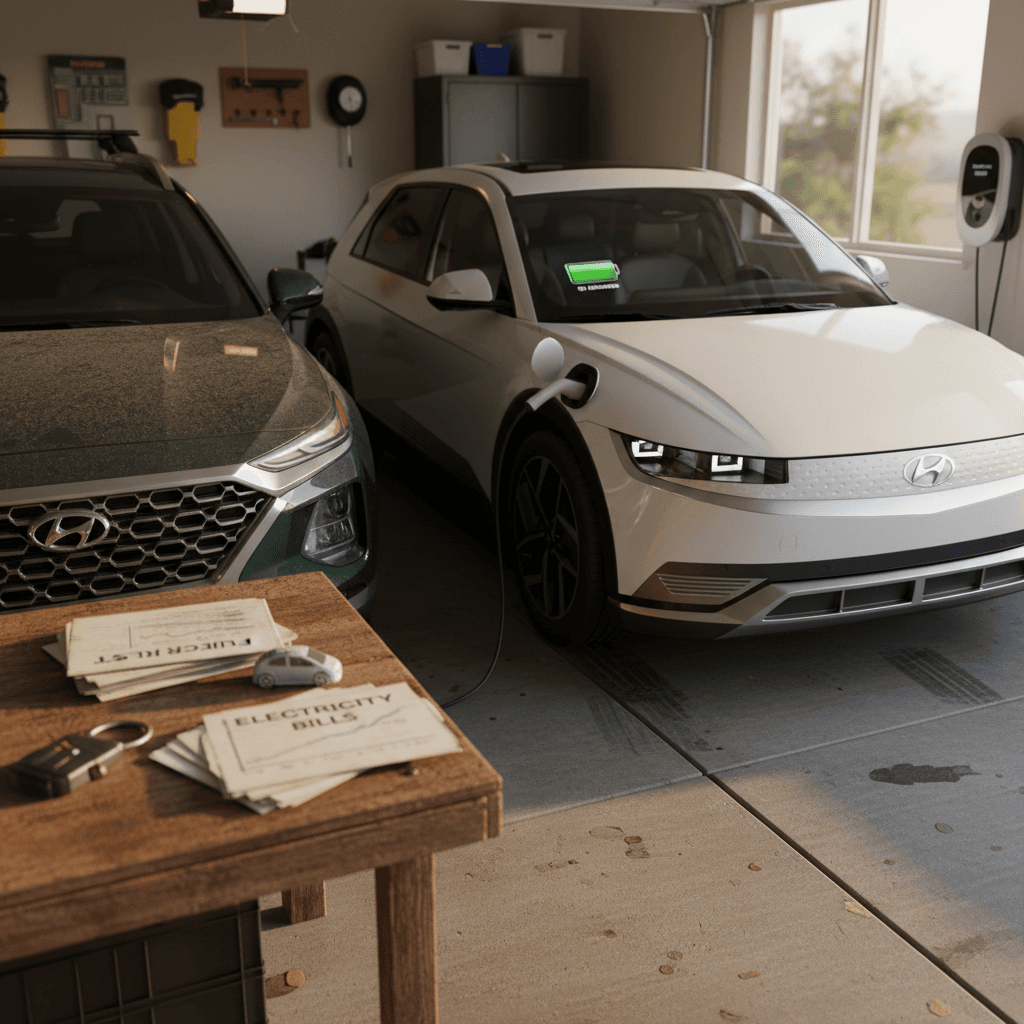
If you’re driving a **Hyundai Santa Fe** and eyeing a **Hyundai Ioniq 5**, you’re probably wondering one thing: *how much money would I actually save* by switching from gas to electric? This guide walks through the real‑world cost savings of switching from a Hyundai Santa Fe to a Hyundai Ioniq 5, fuel, electricity, maintenance, and resale, using simple math you can adapt to your own commute.
At-a-glance answer
Why switch from a Hyundai Santa Fe to an Ioniq 5?
Santa Fe: Comfortable, familiar, but thirsty
The modern Hyundai Santa Fe is a handsome, practical crossover that runs on gasoline. In non‑hybrid form, recent model years are rated around 24 mpg combined (20 city / 29 highway for a typical AWD trim). It’s refined, but every commute is an IV drip of unleaded.
As gas has bounced around $3–$4 per gallon nationally in recent years, a 24‑mpg midsize SUV locks you into a permanently rising subscription fee to geopolitics.
Ioniq 5: Same family mission, different powertrain
The Hyundai Ioniq 5 is basically Hyundai’s idea of the future family car: a roomy, two‑row crossover on a dedicated EV platform. Depending on battery and wheels, U.S. EPA efficiency lands around 114–125 MPGe, or roughly 3.3–3.7 miles per kWh.
Instead of buying gallons of fuel, you’re buying kWh, often at a residential rate around $0.17–$0.19 per kWh on average in the U.S. That single swap is where the big cost difference lives.
Typical Santa Fe → Ioniq 5 savings snapshot
Key assumptions behind the cost savings math
Cost comparisons can get silly if you don’t pin down a few assumptions. To keep this grounded, we’ll use conservative, nationally averaged numbers, and you can tweak them later for your own situation.
Working assumptions: Hyundai Santa Fe vs Hyundai Ioniq 5
You can plug your own numbers into these same formulas later.
| Variable | Santa Fe (Gas) | Ioniq 5 (EV) | Notes |
|---|---|---|---|
| Annual miles | 12,000 mi | 12,000 mi | Roughly the U.S. average |
| Efficiency | 24 mpg (combined) | 3.5 mi/kWh | Realistic mixed‑driving average |
| Energy price | $3.50/gal gasoline | $0.18/kWh electricity | Approx. recent U.S. national averages |
| Driving style | Normal mix | Normal mix | No hypermiling, no lead foot |
| Charging | N/A | 80–90% at home, 10–20% public DC fast | Home charging is where most savings happen |
Assumptions based on recent U.S. fuel and electricity price data and EPA efficiency figures.
Your local prices can move the goalposts
Fuel vs electricity: how much can you actually save?
Let’s do the part everyone cares about first: **what you spend each year just to make the car move.** We’ll keep the algebra forgiving.
Annual energy cost: Santa Fe vs Ioniq 5
Same miles, very different fuel bills.
Hyundai Santa Fe (gas)
Step 1: Gallons per year
12,000 miles ÷ 24 mpg = 500 gallons/year
Step 2: Annual fuel cost
500 gallons × $3.50/gal = $1,750 per year
If gas spikes to $4.00/gal (not exactly unheard of), that jumps to $2,000/yr.
Hyundai Ioniq 5 (electric)
Step 1: kWh per year
12,000 miles ÷ 3.5 mi/kWh ≈ 3,430 kWh/year
Step 2: Annual electricity cost (home charging)
3,430 kWh × $0.18/kWh ≈ $617 per year
If your power is $0.22/kWh, that’s ≈ $755/yr. With cheap $0.12/kWh electricity or solar, you might be closer to $410/yr.
Fuel vs electricity: the gap in plain numbers
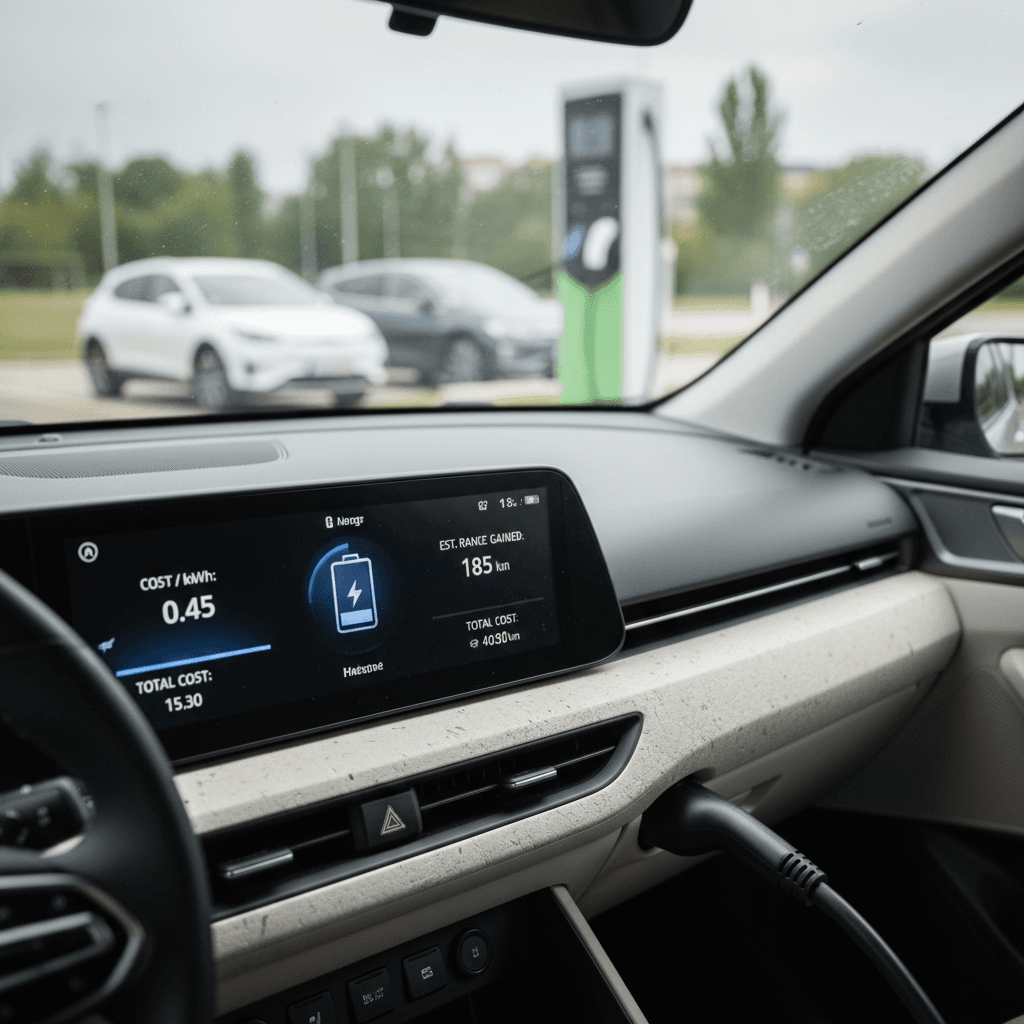
Don’t forget public fast charging in your mix
Maintenance and repair savings when you go electric
Fuel is the loud headline; **maintenance is the quiet money drip.** The Santa Fe is a conventional gasoline crossover with all the usual supporting cast: oil, transmission fluid, exhaust, spark plugs, and so on. The Ioniq 5 deletes half the powertrain and most of the complexity.
What you stop paying for with an Ioniq 5
Fewer moving parts, fewer things to service.
Oil & filters
Santa Fe: Oil + filter changes every 5k–7.5k miles, cabin and engine air filters on schedule.
Ioniq 5: No engine oil. Cabin filter still, but far fewer fluid services.
Transmission & exhaust
Santa Fe: Multi‑speed automatic transmission plus exhaust system, catalytic converters, O2 sensors.
Ioniq 5: Single‑speed reduction gear, no exhaust at all.
Brakes & wear items
Santa Fe: Conventional brakes doing most of the work.
Ioniq 5: Strong regenerative braking means pads and rotors usually last much longer.
Real‑world data from fleet operators and long‑term EV owners generally show **20–40% lower maintenance and repair costs** for EVs versus comparable gas vehicles over the first 5–8 years. On a Santa Fe vs Ioniq 5 comparison, a conservative estimate is that you might save **$300–$500 per year** on average, especially once you’re out of the basic warranty window.
The big scary: EV battery replacement
Other cost factors: insurance, tires, and depreciation
- Insurance: EVs sometimes cost a bit more to insure than comparable gas vehicles, especially when new, because of higher repair costs and parts pricing. The difference between a Santa Fe and an Ioniq 5 will depend heavily on your ZIP code, driving history, and insurer. Budget for a modest increase, then shop around.
- Tires: The Ioniq 5 is heavy and torquey, and like most EVs, it can eat through soft, efficiency‑tuned tires faster than a Santa Fe if you drive it like you’re late to everything. On the other hand, many Santa Fe owners upgrade to more aggressive all‑terrain or SUV tires, which aren’t cheap either. Call it roughly a wash unless you’re extremely spirited with the EV’s throttle.
- Depreciation: This is the wild card. New EVs have seen steeper depreciation in some years as prices have fallen and incentives have shifted. The smart play right now is often a used Ioniq 5, where someone else has paid the steepest part of the curve and you’re just enjoying low running costs. Santa Fe depreciation is historically quite reasonable, but its fuel cost doesn’t get any cheaper with age.
Where Recharged fits into the depreciation story
Ready to find your next EV?
Browse VehiclesWhen the Ioniq 5 wins big, and when it doesn’t
Scenarios where the Ioniq 5 is a slam dunk
- Long commute, high miles: If you’re doing 15,000–20,000 miles a year, the fuel delta alone can exceed $1,500–$2,000 annually.
- Reasonable electricity, pricey gas: Coastal or urban markets where gas is north of $4/gal but you can still get home power at $0.20/kWh or less.
- Home charging: You have a driveway or garage and can install (or already have) Level 2 charging, so 80–90% of your charging happens at home rates.
- Keeping the car for years: The longer you own it, the more the running‑cost savings overwhelm the higher purchase price.
Scenarios where savings shrink or vanish
- Very low annual mileage: If you drive 5,000 miles a year, the annual fuel savings might only be a few hundred dollars.
- High electricity / cheap gas region: A few markets still have relatively cheap gasoline and high kWh prices; in those zip codes, the math can be marginal.
- No home charging: If you rely almost entirely on public DC fast charging, your electricity cost can approach or even exceed what you’d spend on gas.
- Huge price gap between vehicles: If you have a paid‑off older Santa Fe and are looking at a very expensive, brand‑new Ioniq 5, the fuel savings may not offset the new car payment.
How incentives and used pricing change the equation
So far, we’ve talked about **operating costs**, what it takes to keep the thing moving. But your switch from Santa Fe to Ioniq 5 also involves **what you pay to get into the EV in the first place**, and that’s where incentives and used pricing come in.
Key levers that can tilt the math toward an Ioniq 5
1. Federal EV tax credits
Depending on configuration and how you buy (new vs used, lease vs purchase), you may qualify for federal EV incentives that effectively reduce the Ioniq 5’s price by several thousand dollars. That’s like pre‑paying years of fuel savings on day one.
2. State and local rebates
Some states, utilities, and cities still offer rebates or bill credits for buying an EV or installing home charging. These don’t show up in the window sticker price, but they absolutely belong in your personal cost calculation.
3. Used Ioniq 5 pricing vs your Santa Fe’s value
If your Santa Fe still has strong resale value, it can fund a large chunk of a used Ioniq 5. On Recharged, you can get an <strong>instant offer or consignment</strong> for your current vehicle and roll those funds straight into a low‑running‑cost EV.
4. Financing structure
The monthly payment on an Ioniq 5 might be higher than on a Santa Fe, but lower fuel and maintenance costs can more than offset the difference. Run the numbers including <strong>all-in monthly cost</strong>, not just the car note.
Use total monthly cost, not just the payment
Step-by-step: calculate your own Santa Fe vs Ioniq 5 savings
Here’s a simple framework you can run on the back of an envelope, or in a spreadsheet, using your actual prices and commute. Swap in your local gas and electricity rates for best results.
DIY savings calculation: Santa Fe vs Ioniq 5
1. Energy cost per mile
Find your <strong>real mpg</strong> for the Santa Fe (dashboard average, Fuelly, etc.). If you don’t know, use 24 mpg as a placeholder.
Check your <strong>gas price</strong> today (per gallon).
Calculate Santa Fe cost per mile: gas price ÷ mpg. Example: $3.50 ÷ 24 ≈ <strong>$0.146/mi</strong>.
For the Ioniq 5, use your real efficiency if you have it, or 3.5 mi/kWh as a baseline.
Find your all‑in <strong>electricity rate</strong>: total bill ÷ total kWh from your last bill. Use that instead of the headline “energy rate.”
Calculate Ioniq 5 cost per mile: electricity rate ÷ mi per kWh. Example: $0.18 ÷ 3.5 ≈ <strong>$0.051/mi</strong>.
2. Annual energy bill
Multiply each cost per mile by your annual miles.
Example Santa Fe: $0.146/mi × 12,000 mi ≈ <strong>$1,752/yr</strong>.
Example Ioniq 5: $0.051/mi × 12,000 mi ≈ <strong>$612/yr</strong>.
Subtract: $1,752 – $612 ≈ <strong>$1,140/yr fuel savings</strong> in this scenario.
If you expect heavy DC fast charging, add 10–30% to your EV energy cost as padding.
3. Maintenance and everything else
Pull your last 1–2 years of Santa Fe maintenance bills, oil changes, brakes, tires, etc. Divide by years to get an annual average.
For the Ioniq 5, assume at least a <strong>20–30% reduction</strong> in annual maintenance vs your Santa Fe. If you’re meticulous, you can model specific services, but a percentage is a reasonable shortcut.
Adjust for insurance: get real quotes for both vehicles; don’t guess.
Now you have an annual savings estimate: <strong>fuel + maintenance – (any higher insurance)</strong>. Multiply by how long you plan to own the EV.
Want help running the numbers?
FAQ: Switching from Hyundai Santa Fe to Hyundai Ioniq 5
Frequently asked questions
Is switching from Santa Fe to Ioniq 5 worth it?
If you drive a typical American mileage, pay anything close to current national averages for gas and electricity, and can charge at home, switching from a Hyundai Santa Fe to a Hyundai Ioniq 5 is one of the simplest ways to lower your automotive burn rate. You’re trading a 24‑mpg crossover for an electric one that quietly does the same daily job on far cheaper energy, with less maintenance drama along the way.
Run your own numbers using your local prices, your commute, and your insurance quotes. If the math pencils out, and for many households it does, the rest comes down to feel: the instant torque, the quiet cabin, the sense that you’re driving something a half‑step into the future. And if you’re ready to explore that future, Recharged can connect you with a carefully vetted used Ioniq 5, transparent pricing, a verified battery health report, and EV‑savvy support from first question to final delivery.