If you own a Cadillac XT5 and you’re eyeing the all‑electric Cadillac Lyriq, you’re probably wondering one thing: will switching from Cadillac XT5 to Cadillac Lyriq deliver real cost savings, or is it just about the tech and quiet ride? This guide walks through the math in plain English so you can see how fuel, electricity, maintenance, insurance, and incentives stack up over the next 5–10 years.
Key context: prices as of early 2026
XT5 to Lyriq: Who This Guide Is For
- You currently drive or are familiar with a Cadillac XT5 and want to understand the cost side of going electric.
- You’re cross‑shopping a used XT5 and a used Lyriq and want a clear operating‑cost comparison.
- You’re trying to decide if the premium you’ll pay for a Lyriq is justified by lower running costs.
- You’re evaluating a trade‑in and want to time your move from gas to electric smartly.
We’ll focus on realistic daily use, not lab numbers. Think commute, errands, and the occasional road trip, exactly how many XT5 owners actually use their SUVs.
Quick answer: how much can you save?
Typical XT5 to Lyriq Cost Differences (U.S. Averages)
Rule of thumb
Baseline specs: Cadillac XT5 vs Cadillac Lyriq
To understand the cost difference, you first need a sense of how thirsty each vehicle is. The XT5 is a conventional gas crossover; the Lyriq is a large luxury EV riding on GM’s Ultium platform with a big battery and high efficiency for its size.
Cadillac XT5 vs Cadillac Lyriq: High‑Level Efficiency Specs
Representative values for late‑model XT5 and Lyriq trims. Exact numbers vary slightly by year, drivetrain, and wheels.
| Metric | Cadillac XT5 (V6 AWD example) | Cadillac Lyriq (RWD example) |
|---|---|---|
| Fuel / Energy type | Gasoline | Electricity |
| Typical combined efficiency | ≈22–24 mpg | ≈3.0–3.3 miles per kWh (≈90–100 MPGe) |
| Energy per 100 miles | ≈4.3–4.5 gallons of gas | ≈30–33 kWh of electricity |
| Tank / battery size | ≈19–21 gallons | ≈100+ kWh usable battery |
| Official range (varies by trim) | ≈400+ miles with full tank | ≈300+ miles on full charge |
EPA and owner‑reported figures rounded for clarity.
What matters for your wallet
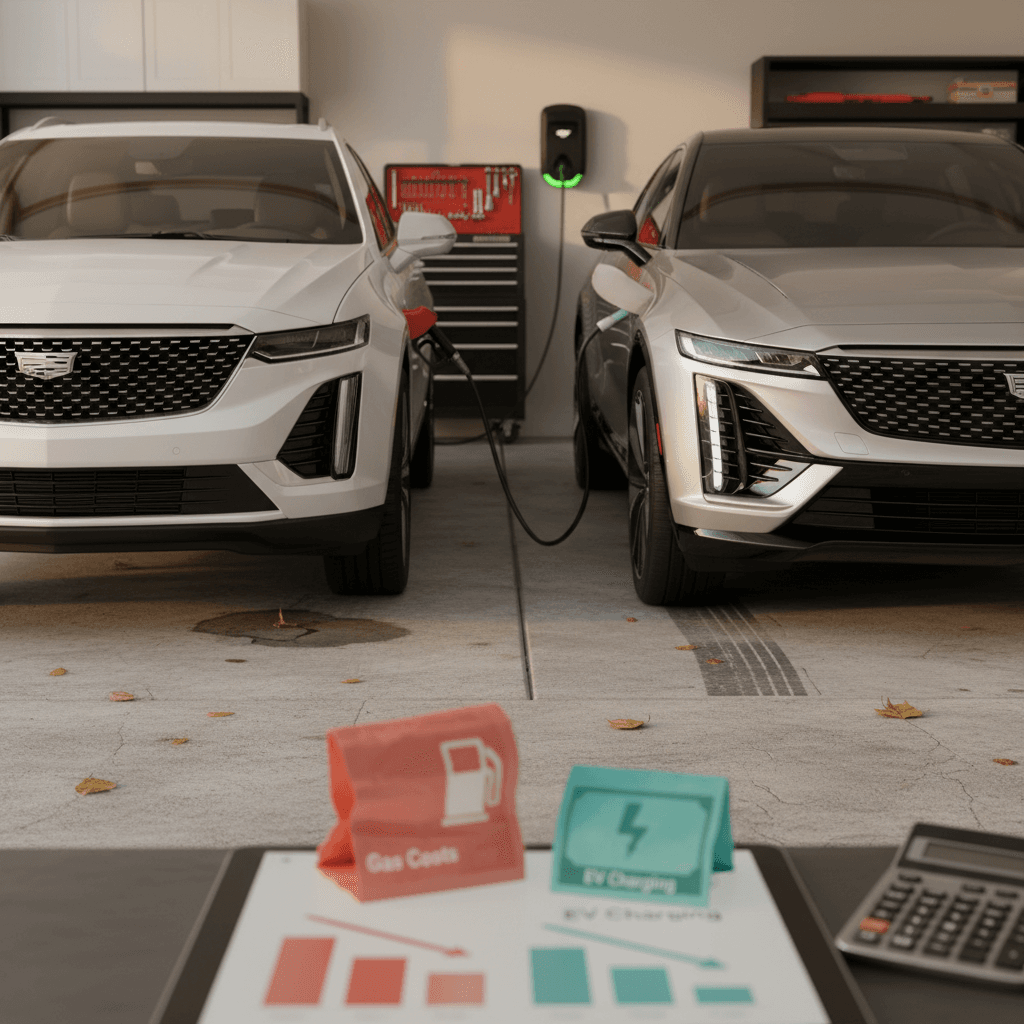
Fuel vs electricity costs: where most XT5-to-Lyriq savings come from
Let’s use simple, realistic assumptions so you can plug in your own numbers. We’ll assume:
- You drive 12,000 miles per year (roughly the U.S. average).
- Your XT5 averages 23 mpg combined.
- Your Lyriq averages 3.1 miles per kWh over mixed driving.
- Gas costs $4.00 per gallon in your area.
- Home electricity is around $0.17 per kWh.
XT5 annual fuel cost (example)
- 12,000 miles ÷ 23 mpg ≈ 522 gallons of gas per year.
- At $4.00/gallon, that’s roughly $2,088 per year in fuel.
- Miles cost: about 17–18¢ per mile in fuel alone.
If gas in your area runs closer to $3.25, the fuel cost drops, but the Lyriq still usually wins on a per‑mile basis.
Lyriq annual electricity cost (example)
- 12,000 miles ÷ 3.1 mi/kWh ≈ 3,870 kWh per year.
- At $0.17/kWh, that’s about $658 per year in home charging.
- Miles cost: roughly 5½–6¢ per mile when you mostly charge at home.
Even if your electricity is a bit higher, say 20¢/kWh, you’re still closer to 7–8¢ per mile, well under typical XT5 fuel costs.
Annual energy savings snapshot
What if you rely on DC fast charging?
Maintenance and repairs: how much cheaper is Lyriq to keep?
The Lyriq has no engine oil, spark plugs, transmission fluid, or exhaust system. That doesn’t make it maintenance‑free, but over time it stacks the deck in your favor versus a gas XT5.
Typical Maintenance Differences: XT5 vs Lyriq
Exact costs vary by dealer and region, but the pattern is consistent.
Cadillac XT5 (gas)
- Regular oil and filter changes (2–3 per year for many drivers).
- Transmission fluid service as the miles add up.
- More complex engine‑related repairs over 100k miles.
- Standard wear items: brakes, tires, coolant, etc.
For a typical XT5, it’s easy to spend $800–$1,200 per year once you average routine services and the occasional repair out of warranty.
Cadillac Lyriq (EV)
- No routine oil changes or spark plugs.
- Simpler drivetrain with far fewer moving parts.
- Brake wear is often slower thanks to regen, especially in city driving.
- Still needs tire rotations, cabin filters, brake fluid, and inspections.
Most Lyriq owners see routine maintenance costs closer to $400–$700 per year outside of warranty, often less in the early years.
What about battery replacement?
Insurance, taxes, and fees when you switch to a Lyriq
On the non‑mechanical side of ownership costs, three line items can shift when you go from XT5 to Lyriq: insurance, registration/EV fees, and taxes.
Insurance
- Many insurers price Lyriq policies a bit higher than XT5 because of its higher MSRP and newer tech.
- That can add $100–$300 per year versus an older XT5, depending on your profile.
- Shop quotes before you switch, your insurer’s EV appetite matters.
Taxes and EV fees
- Several states now charge modest annual EV registration fees to make up for lost gas tax revenue.
- Often this ranges from a few dozen to a few hundred dollars per year.
- Some localities, on the other hand, offer reduced registration fees or perks for EVs. Check your DMV or state energy office website before you buy.
Don’t forget tax credits and rebates
Upfront price, depreciation, and resale value
Historically, XT5 and Lyriq have lived at slightly different price points, especially when you look at new vehicles. But the used market, where Recharged operates, is where the financial picture often becomes more attractive for Lyriq shoppers who value lower operating costs.
Typical Market Positioning (Used, High‑Level)
Approximate relative pricing for late‑model used examples in similar condition, as of early 2026. Actual prices vary by mileage, options, and region.
| Vehicle | Typical used price band* | Notes |
|---|---|---|
| Cadillac XT5 (3–5 years old) | Often mid‑$20,000s to mid‑$30,000s | Gas SUVs depreciate steadily but demand for luxury crossovers remains strong. |
| Cadillac Lyriq (1–3 years old) | Frequently high‑$40,000s and up | Newer model, higher original MSRP, still maturing resale market. Older examples are just starting to enter the used space. |
Think of this as a price band comparison, not a quote.
In other words, you may pay more upfront to get into a Lyriq than an XT5 of similar age and mileage. The question is whether energy and maintenance savings, plus potential tax incentives, offset that gap over your ownership window.
Think in total cost of ownership, not monthly payment
Run the numbers for your driving profile
Everyone’s situation is different. City vs highway, home vs public charging, and local fuel prices all matter. Use this simple framework to estimate your own XT5‑to‑Lyriq cost savings.
XT5 to Lyriq Cost Calculator: 6 Steps
1. Start with your actual mileage
Look at your last 12 months of XT5 fuel receipts, odometer, or telematics data. Write down your actual annual miles, not just a guess.
2. Calculate your real‑world XT5 mpg
Divide miles driven by gallons purchased over that same year. If you don’t have the data, use your trip computer’s long‑term average as a starting point.
3. Multiply by today’s gas price
Take your annual gallons and multiply by your local price per gallon to get your personal XT5 fuel cost per year. This will be more accurate than national averages.
4. Estimate Lyriq efficiency
For most Lyriq owners, <strong>2.7–3.3 miles per kWh</strong> is a realistic year‑round range. If you have a heavy highway foot or harsh winters, lean toward the lower end.
5. Use your home electricity rate
Grab your latest utility bill and find the cents‑per‑kWh line. Multiply your estimated Lyriq kWh per year by that rate to find your electricity cost, assuming mostly home charging.
6. Add maintenance differences
Look at what you’re spending on oil changes, engine services, and repairs. It’s reasonable to assume a Lyriq trims a few hundred dollars a year off that number, especially if your XT5 is aging out of warranty.
If you don’t want to build a spreadsheet…
Ready to find your next EV?
Browse Vehicles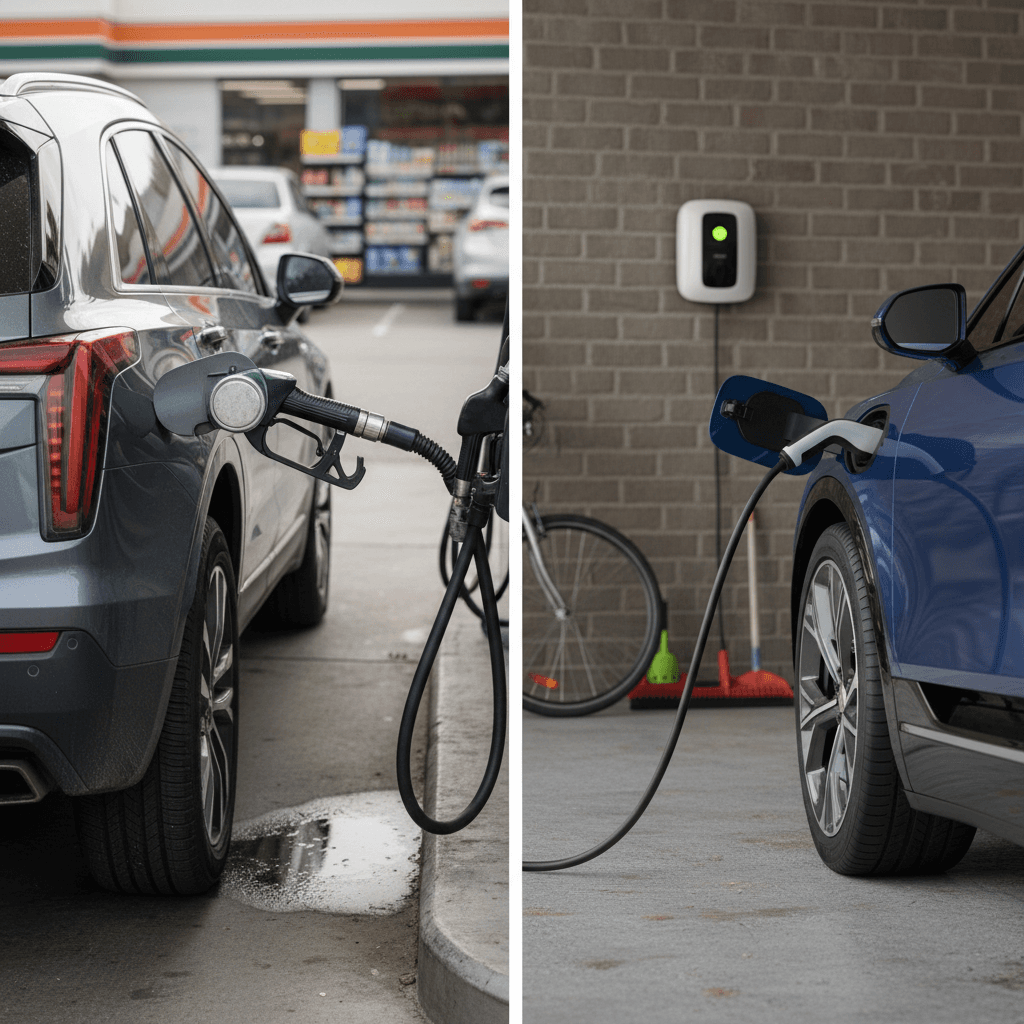
How to maximize savings when moving from XT5 to Lyriq
Four Ways XT5 Owners Can Squeeze More Value From a Lyriq
These habits make the biggest difference in real‑world cost savings.
Charge at home
Use off‑peak rates
Drive smoothly
Plan road trips
Climate matters
Buying a used Lyriq: where Recharged fits in
If you’re thinking about moving from an XT5 into a used Lyriq, the biggest questions are usually: “What shape is the battery in?” and “Am I paying a fair price for the savings I’ll get?” That’s exactly the problem Recharged was built to solve.
Battery health, verified
Every Lyriq on Recharged includes a Recharged Score Report with detailed battery diagnostics, estimated remaining capacity, and real‑world range expectations. Instead of taking a seller’s word for it, you see data.
That’s especially important for an EV like the Lyriq whose value is tightly linked to pack health.
Fair pricing, trade‑ins, and delivery
Recharged combines market data, vehicle condition, and battery health to price used EVs transparently. You can:
- Trade in your XT5 or get an instant offer.
- Use built‑in financing tools to understand your payment.
- Have your Lyriq delivered nationwide or visit the Richmond, VA Experience Center.
That makes it much easier to line up your XT5 sale with your Lyriq purchase and see the net cost after your equity and incentives.
Why a used Lyriq can be a sweet spot
Frequently asked questions about switching from XT5 to Lyriq
XT5 to Lyriq Cost Savings: FAQ
Bottom line: when does a Lyriq beat an XT5 on cost?
If you drive a modest‑to‑high number of miles each year, can charge at home most of the time, and plan to keep your next vehicle for several years, switching from a Cadillac XT5 to a Cadillac Lyriq usually lowers your total cost to drive. The Lyriq’s energy and maintenance savings, plus potential tax incentives, often outweigh its higher purchase price, especially in the used market where depreciation has already done its work.
On the other hand, if you drive very little, pay exceptionally high electricity rates, or rely almost entirely on expensive public fast charging, the financial advantage narrows. In that case, your decision may rest more on Lyriq’s refinement, tech, and driving experience than on pure dollars and cents.
Either way, the smartest move is to treat this as a total‑cost‑of‑ownership decision, not a hunch. Run your numbers, or let a Recharged Score Report do a lot of that homework for you, then decide whether it’s time to trade pump stops in your XT5 for plug‑ins in a Lyriq.