If you’re asking yourself, “Should I buy a used VW ID.4?” you’re not alone. Volkswagen’s electric SUV has become a popular alternative to Tesla and Hyundai/Kia, and heavy new-car discounts mean there are a lot of ID.4s flowing into the used market in 2026. The result: tempting prices, but also real questions about reliability, battery life, and recent recalls.
In a hurry?
Is a used VW ID.4 right for you?
The ID.4 is a compact electric SUV that competes with models like the Tesla Model Y, Hyundai Ioniq 5, and Ford Mustang Mach‑E. It’s built on VW’s MEB platform and offers rear‑wheel drive or all‑wheel drive, up to roughly 275–290 miles of EPA range on newer big‑battery versions, and a calm, comfortable driving experience rather than a sporty one.
On the used market, the ID.4’s big appeal is value. Early model years have already dropped well over a third from their original MSRP, and even 2023–2024 Pro models often sell at meaningful discounts versus rival EVs of the same age. That depreciation can work in your favor if you’re a second owner who buys carefully and plans to keep the car for several years.
But there are tradeoffs. The ID.4 has had software glitches, charging quirks, and several high‑voltage battery recalls. Later model years improve performance and charging speed, yet those are exactly the cars affected by the newest recalls. So the real question isn’t just “should I buy a used VW ID.4?” It’s “which ID.4, under what conditions, and at what price?”
Quick pros and cons of a used ID.4
Used VW ID.4 at a glance
Where this electric SUV shines, and where it doesn’t
Pros
- Excellent space and comfort: Roomy cabin, flat floor, big cargo area for families.
- Soft, quiet ride: Tuned more like a traditional VW SUV than a sporty EV.
- Strong safety scores: 2024 ID.4 earned IIHS Top Safety Pick with good crash results and solid driver‑assist tech.
- Big depreciation = value: Earlier model years and ex‑leases are often thousands less than comparable EVs.
- Solid real‑world range: Big‑battery Pro/Pro S models can realistically cover most daily U.S. driving with margin.
Cons
- Software gremlins: Owners commonly report buggy infotainment, freezes, and occasional error messages.
- Charging issues: Some cars struggle with certain DC fast chargers or show charging‑related alerts.
- Recent high‑voltage battery recalls: 2023–2025 models are under active NHTSA recalls for fire risk; recall completion is critical.
- Heavy depreciation: Good for buyers now, but future resale value is uncertain.
- Not a performance EV: Even with 2024+ power bump, it’s more brisk than thrilling.
Pay attention to recalls
Key used VW ID.4 differences by model year
Not all used ID.4s are created equal. Volkswagen has steadily improved the vehicle since its 2021 U.S. debut, especially in infotainment, performance, and charging. When you’re shopping, you’re really choosing among several distinct “generations” of the same SUV.
VW ID.4 model year highlights for used buyers
Major changes that matter when you’re choosing a used ID.4 in 2026.
| Model year | Battery options (usable) | EPA range (approx.) | Key changes for shoppers | What it means used |
|---|---|---|---|---|
| 2021 | 77 kWh | ~240–260 miles | Launch year, imported from Europe; earlier software, slower DC charging (~125 kW peak). | Often the cheapest; fine if you value price over the latest tech and fastest charging. |
| 2022 | 77 kWh | ~245–260 miles | Refined from 2021; still imported; incremental software tweaks. | Good value sweet spot if well‑maintained; similar hardware to 2021 with minor improvements. |
| 2023 | About 58 kWh & 77 kWh | ~209 miles (small pack), up to mid‑260s (big pack) | U.S. production in Chattanooga; new smaller‑battery Standard trim; updated interior and infotainment. | Check which battery you’re getting, range differs a lot. Some builds tied to early battery‑recall VIN ranges. |
| 2024 | 77–79 kWh (big pack) | Up to ~290 miles on some trims | More power, improved charging (big‑pack peak up to ~175 kW), updated software and driver‑assist tuning. | Best blend of performance and refinement; still affected by 2023–24 battery recalls on some units. |
| 2025 | Similar to 2024 big pack; 62 kWh model pushed into “Limited” niche | Comparable to 2024 | Lineup simplified; smaller‑battery Limited variant de‑emphasized; incremental refinements. | Great if you find an off‑lease bargain, but verify whether it’s a small‑ or big‑battery car. |
Always confirm exact equipment on the specific VIN, options and regional specs can vary.
Model‑year sweet spots
Battery, range, and charging on a used ID.4
Every ID.4 uses a lithium‑ion battery pack mounted in the floor. In the U.S., you’ll typically see two usable battery sizes on the used market: a smaller pack in entry trims (roughly 58 kWh usable) and a larger pack (around 77–79 kWh usable) in Pro/Pro S and AWD versions.
- Smaller‑battery cars (Standard/Limited) are better suited to city and short‑commute drivers who rarely road‑trip.
- Big‑battery Pro, Pro S, and AWD models work better if you routinely cover 150–200 miles in a day, or road‑trip a few times a year.
- Later‑year big‑battery ID.4s (2024+) can DC fast‑charge faster than early cars, trimming 10–80% charge stops to around half an hour when everything is working properly.
Like all EVs, the ID.4 will lose some range over time. Moderate annual mileage with regular Level 2 home charging typically leads to gradual, not dramatic, degradation in the first 5–7 years. The larger pack also gives you more buffer before degradation becomes noticeable in your daily use.
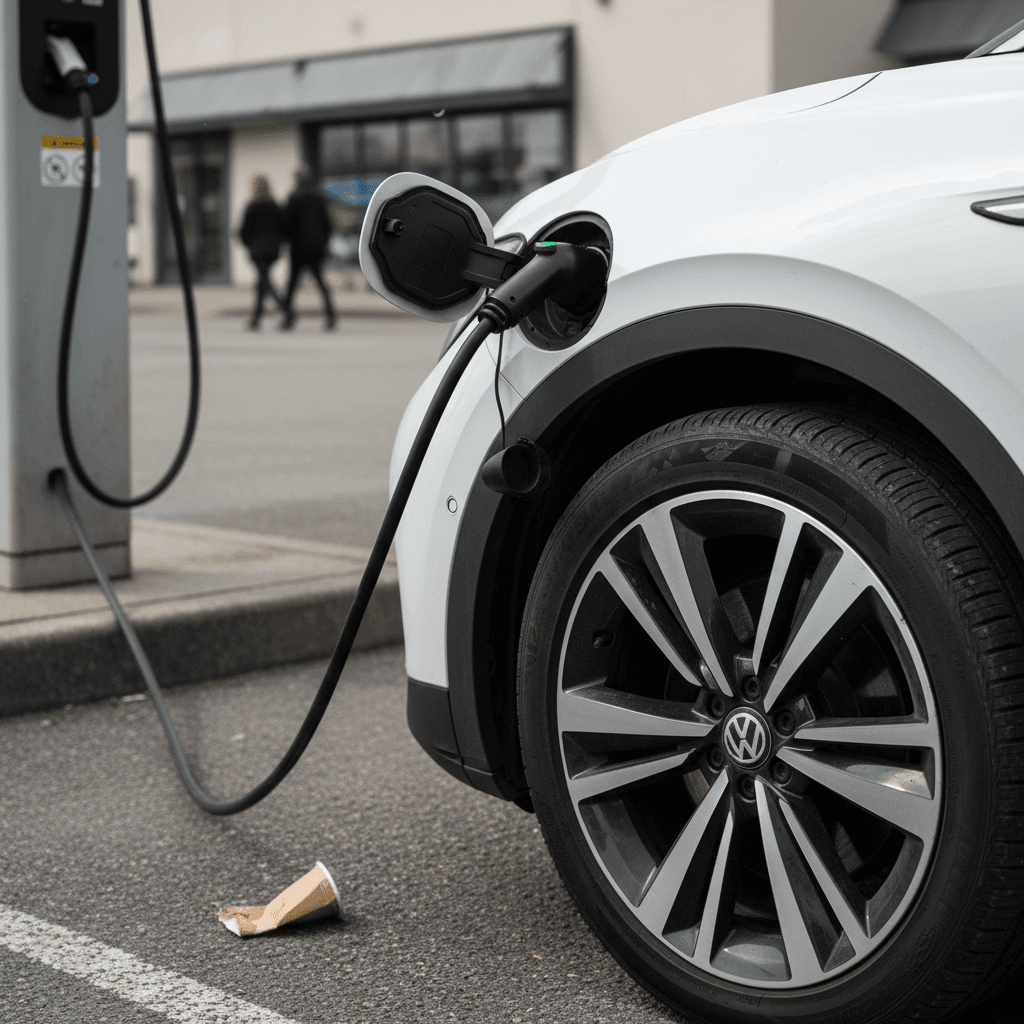
Charging connector and networks
Reliability, common issues, and recalls
Mechanically, the ID.4 has relatively few moving parts compared with a gas VW SUV. Where it’s struggled is on the software and electrical side, plus some high‑profile battery cases. When you shop used, how the previous owner treated the car, and how quickly recall work was handled, matters as much as the badge on the nose.
What owners and lawyers say about ID.4 trouble spots
Not every car has these problems, but you should know where to look.
Infotainment glitches
Charging errors
12V and HV battery issues
Recent high‑voltage battery recalls
The flip side is that these recalls also mean defects are being corrected under warranty, often including new or reworked high‑voltage components at no cost to the owner. A used ID.4 with freshly completed recall work and documented software updates can actually be a safer bet than a similar vehicle with “nothing ever touched.”
How to sanity‑check reliability on one specific ID.4
Depreciation and used pricing realities
One reason shoppers ask “should I buy a used VW ID.4?” is that the prices can look almost too good. The ID.4 has depreciated faster than many gas SUVs, and even faster than some rival EVs, thanks to aggressive new‑car incentives, evolving EV tax‑credit rules, and consumer preference shifts.
How hard has the ID.4 fallen in value?
For you as a used buyer in 2026, this steep depreciation can be a real opportunity. If you buy after the big drop, and plan to keep the car five or more years, the remaining value curve may be more gentle, especially as EV adoption and charging infrastructure continue to improve.
But think about your exit
What to check before you buy a used ID.4
Because the ID.4’s main risks are software, charging, and battery‑related, not traditional engine wear, you’ll want to tailor your pre‑purchase inspection accordingly. Here’s a practical checklist you can work through with a seller, dealer, or an EV‑savvy inspection service.
Essential pre‑purchase checklist for a used VW ID.4
1. Run the VIN for recalls and campaigns
Use the NHTSA website or a VW dealer to check the VIN for open recalls, especially 2023–2025 high‑voltage battery campaigns. Make recall completion a condition of the sale or get proof in writing that the work is already done.
2. Review software update history
Ask for service records showing major software updates. On your test drive, verify that the infotainment system boots quickly, the screen doesn’t freeze, and driver‑assist features behave as expected.
3. Get an objective battery health report
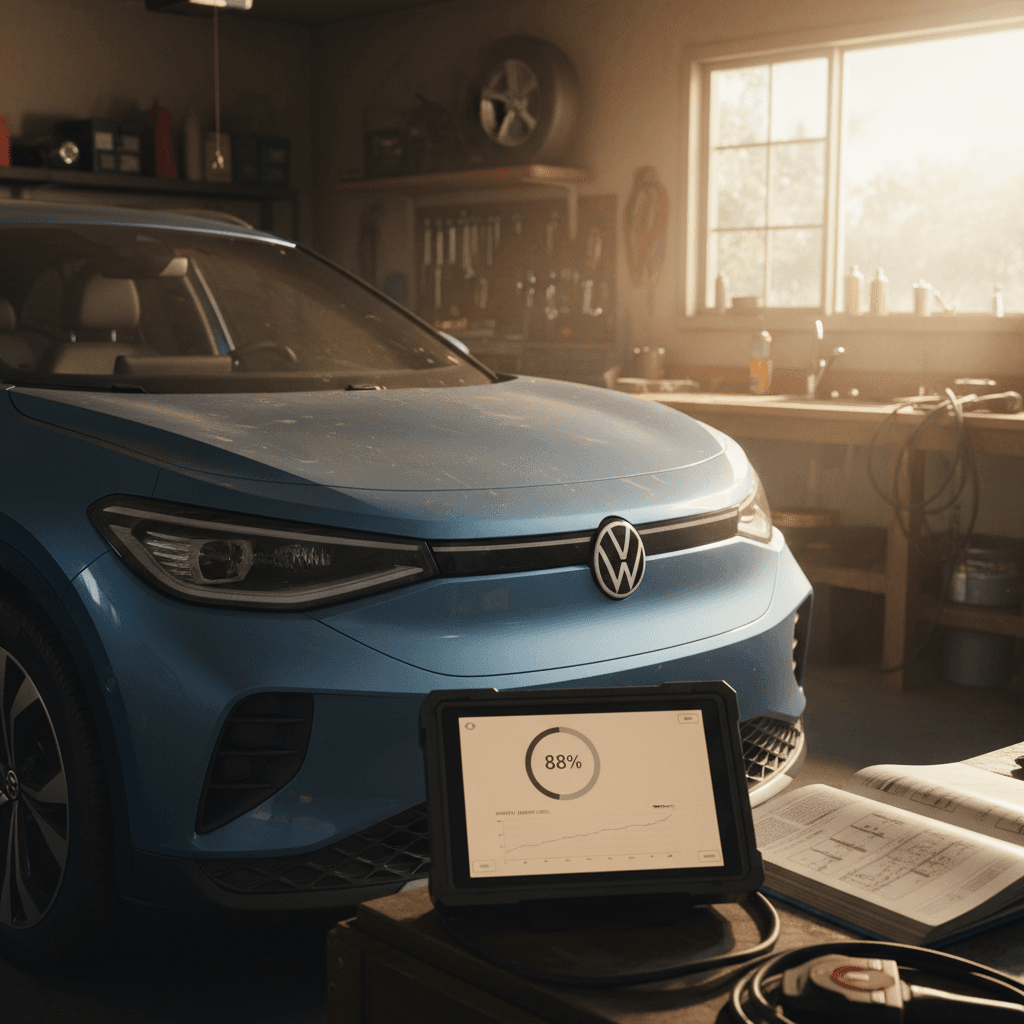
Unlike a gas car, a used EV’s value lives in its battery. A platform like <strong>Recharged</strong> uses diagnostic tools to measure usable capacity and charging behavior, summarizing results in a Recharged Score so you’re not guessing about degradation.
4. Inspect charging behavior in real life
If possible, plug into both a Level 2 charger and a DC fast charger. Look for error messages, aborted sessions, or unusually slow charging. A clean, drama‑free charging session is a good sign.
5. Check tire wear and alignment
EVs are heavy, and uneven tire wear can hint at suspension or alignment issues. Uneven front or rear wear may mean it’s been curbed, driven hard, or just needs an alignment, factor that into your offer.
6. Evaluate interior condition and features
Confirm that heated seats, heated steering wheel, driver aids, and navigation all work if they’re advertised. Wear on controls, seats, and steering wheel should line up with the odometer reading.
7. Confirm home‑charging fit
Before you buy, make sure you have (or can install) a proper 240‑volt outlet or wallbox where you live. The ID.4 is easiest to live with if it can charge overnight at Level 2 at least a few times per week.
Bring a structured checklist
How a platform like Recharged can help
Buying a used EV is different from buying a used gas SUV. You’re not just worried about paint and mileage, you’re trying to judge battery health, charging behavior, and software history. That’s where a specialist marketplace like Recharged can tilt the odds in your favor.
What Recharged adds to a used ID.4 purchase
Beyond the typical used‑car checklist
Recharged Score battery diagnostics
Fair, transparent pricing
Financing & trade‑in support
Nationwide, digital‑first buying
Recharged offers a fully digital retail experience, so you can compare multiple used EVs, including VW ID.4s, from your couch. Transparent condition reports, photos, and pricing help you decide whether the ID.4 is truly the right fit, or if another model suits your needs better.
Hands‑on help when you want it
If you prefer to see and feel before you buy, Recharged operates an Experience Center in Richmond, VA. You can test‑drive EVs, talk through charging plans, and get real‑world advice on living with a used electric SUV.
Who should, and shouldn’t, buy a used ID.4
Match the ID.4 to your real‑world needs
Great fit for you if…
You want a <strong>comfortable, family‑friendly electric SUV</strong> with good safety ratings and lots of space.
You plan to keep the vehicle long enough to ride out the worst of its early depreciation.
You have (or will install) <strong>reliable Level 2 home charging</strong> and only use fast charging occasionally.
You’re price‑sensitive and would rather get more car for your money than chase the absolute newest tech.
You’re willing to prioritize cars with clean histories, proven reliability, and documented recall completion.
You may want to look elsewhere if…
You’re extremely sensitive to <strong>software glitches</strong> and want the most polished infotainment on the market.
You <strong>road‑trip constantly</strong> and need the absolute fastest charging speeds and best fast‑charger reliability today.
You plan to keep the car only 1–3 years and are very concerned about resale value.
You live in an area with <strong>weak CCS fast‑charging coverage</strong> and no home‑charging option.
You simply prefer the driving feel or design of competing EVs like the Hyundai Ioniq 5, Kia EV6, or Tesla Model Y.
FAQ: Buying a used VW ID.4
Frequently asked questions about used VW ID.4s
Bottom line: should you buy a used VW ID.4?
If you’re a value‑minded shopper with predictable driving needs, access to home charging, and a willingness to vet battery health and recall status carefully, then yes, a used VW ID.4 can be a very smart buy in 2026. You’ll likely get more space and comfort for your money than most rival EVs, with safety scores that give real peace of mind.
On the other hand, if you’re allergic to software hiccups, obsess over maximum charging speed, or plan to flip the vehicle in a couple of years, the ID.4’s mixed reliability reputation and heavy depreciation may push you toward a different electric SUV or even a short‑term lease instead of a purchase.
Either way, don’t answer “should I buy a used VW ID.4?” in the abstract. Answer it for a specific VIN, with a specific history, at a specific price. Make that decision with clear data on battery health, recall completion, and fair market value, and with a specialist partner like Recharged in your corner, that process gets a lot more straightforward.