If you’re thinking, “It’s time to sell my Volkswagen ID.4,” you’re not alone. Early ID.4 leases are maturing, incentives have shifted, and used EV prices have moved a lot over the last few years. The good news: with the right prep and pricing strategy, you can still get a strong number for your electric VW and move into your next EV with confidence.
Why the ID.4 selling experience is unique
Should I Sell My Volkswagen ID.4 Now?
Before you rush to list your ID.4, step back and ask what you’re solving for. Are you trying to lower your payment, move into something with more range, or just get out before warranty runs out? Your answer should shape whether you sell now, wait, or simply refinance.
Common reasons to sell now
- Range no longer fits your commute or family road trips.
- You’re coming to the end of a lease and don’t love the buyout price.
- Insurance or payment is higher than you’d like.
- You want the latest tech, driver assists, or charging speed.
Good reasons to keep it longer
- You’re comfortably within the 8‑year/100,000‑mile battery warranty and like the car.
- Your mileage is low and depreciation has already hit hard in the first few years.
- Your payment is modest compared with what a new EV would cost today.
- Charging at home is cheap and convenient.
Quick gut check
How Much Is My Volkswagen ID.4 Worth
Values move quickly in the EV world, but a few rules of thumb will help you ballpark what your ID.4 might bring. Online pricing tools are a starting point, not the final word. They often lag real‑world auction data and local supply, especially for EVs that saw big new‑car incentives.
Volkswagen ID.4 Value Snapshot (Typical Patterns)
Broadly speaking, a clean, average‑mileage ID.4 that sold new in the mid‑$40,000s can land in the mid‑ to high‑$20,000s after a few years, with trade‑in numbers several thousand lower. Exact figures vary with model year (2021–2024), trim (Standard vs Pro vs AWD), mileage, and whether your car was built in Chattanooga (often seen as a positive by U.S. buyers).
Don’t anchor only on MSRP
ID.4 Depreciation: What Owners Need to Know
The ID.4 has faced heavier depreciation than some rival EVs and many gas SUVs. Deep discounts on new models, generous lease programs, and rapid improvements in EV tech all play a role. Understanding this doesn’t magically boost your number, but it does help you judge which offers are fair in today’s market.
Typical Volkswagen ID.4 Depreciation Curve
High‑level illustration of how value can fall over time for many ID.4s in normal use. Your vehicle may be higher or lower depending on trim, incentives, and condition.
| Vehicle age | Odometer (approx.) | Typical status | What many owners see |
|---|---|---|---|
| New | 0–5,000 miles | Incentives & discounts heavy | Effective price already 10–20% under MSRP |
| Year 1–2 | 10k–25k miles | Fastest drop | Biggest single hit to value; many owners see 25–35% off what they paid |
| Year 3–4 | 25k–50k miles | Stabilizing | Depreciation slows, often another 10–15 percentage points total |
| Year 5+ | 50k–80k+ miles | Battery & warranty in focus | Buyers scrutinize battery health and remaining warranty more than model year. |
Use this as a directional guide, then verify with current offers from multiple buyers.
How incentives warp the numbers
Best Ways to Sell My Volkswagen ID.4
When you say, “I want to sell my Volkswagen ID.4,” you’re really choosing between four main paths: trading it in, getting an instant online offer, consigning it with a specialist, or selling it yourself. Each comes with different levels of effort, risk, and potential payoff.
Four Main Ways to Sell Your Volkswagen ID.4
Balance convenience, speed, and price to match your priorities.
1. Trade-in at a dealer
Easiest way to move on, especially if you’re buying or leasing another vehicle.
- Pros: Fast, simple, good for negative equity roll‑ins.
- Cons: Usually the lowest number you’ll see.
2. Instant online cash offer
Car‑buying sites and some EV‑focused platforms will bid on your ID.4 online.
- Pros: Quick quote, transparent, often better than a walk‑in offer.
- Cons: Final price may adjust after inspection.
3. EV specialist marketplace (like Recharged)
You list or sell through an EV‑only platform that understands battery health and EV shoppers.
- Pros: Buyers see verified battery diagnostics and EV‑specific info, which can support stronger pricing.
- Cons: May take longer than an instant cash offer.
4. Private‑party sale
You advertise and sell directly to another driver via classifieds or marketplaces.
- Pros: Often the highest price if you market it well.
- Cons: Time‑consuming, requires screening buyers, handling test drives, and paperwork.
Where Recharged fits in
Ready to find your next EV?
Browse VehiclesHow to Get Your ID.4 Ready to Sell
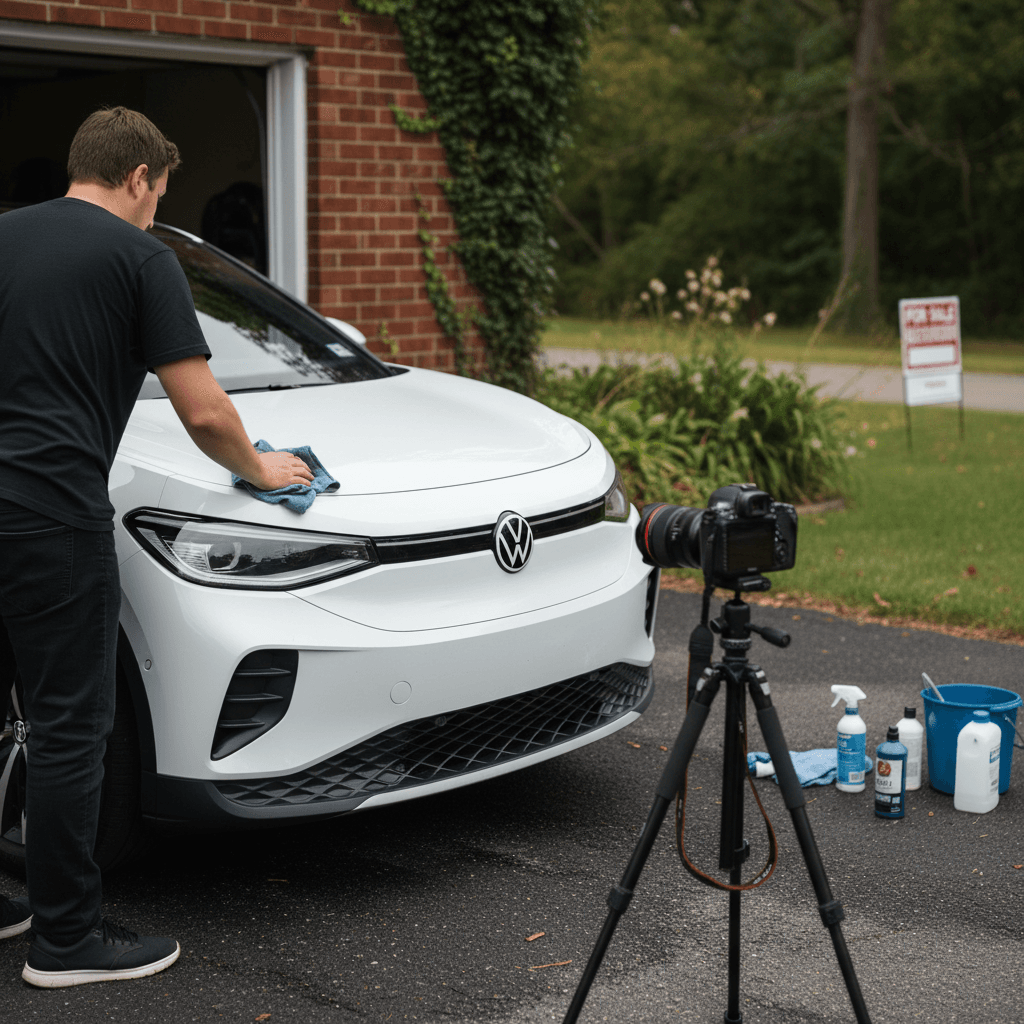
Clean, well‑documented EVs simply bring more money. Buyers can scroll past dozens of sloppy listings; they’ll stop for the one that looks loved and clearly cared for. Think like a buyer for half a day, and you can often justify hundreds or even thousands more in asking price.
Pre‑Sale Prep Checklist for Your Volkswagen ID.4
1. Deep clean inside and out
Wash, clay, and wax the exterior; vacuum and wipe down the interior; clean the glass. EV interiors show dirt and fingerprints quickly, removing them makes the car feel newer.
2. Fix obvious, inexpensive issues
Replace wiper blades, burned‑out bulbs, missing key caps, and inexpensive trim pieces. Small flaws give buyers leverage to negotiate down more than the repair actually costs.
3. Gather all charging equipment
Include the factory charge cable, any adapters, and a home wallbox if you’re selling it with the house. Missing cables are a red flag; full kits reassure buyers and justify a stronger price.
4. Update software and document it
Make sure your ID.4 is on the latest available software version. Take a quick photo of the system info screen so buyers see that infotainment and charging updates are current.
5. Pull service and warranty records
Collect receipts for tire rotations, brake service, and warranty repairs. Documented history tells buyers they’re not inheriting someone else’s neglect.
6. Get an independent battery health report
Where possible, get third‑party diagnostics or a platform like Recharged to provide a battery‑health assessment. Having real data instead of just a dashboard guess builds trust and supports pricing.
Photos buyers actually care about
Battery Health and Range: Why Buyers Care So Much
With a gas car, most shoppers worry about miles and maintenance. With a used EV, especially a family SUV like the ID.4, buyers are laser‑focused on whether the battery will still comfortably cover their daily routine and weekend trips. The more clearly you can answer that, the easier it is to get your price.
What buyers want to know
- Realistic range today at typical highway speeds.
- How the range changes in cold or very hot weather.
- Whether the car has seen lots of DC fast charging, which some shoppers worry about.
- If there are any warning lights or error messages related to the high‑voltage system.
How Recharged helps you prove it
Every vehicle sold through Recharged includes a Recharged Score Report with:
- Verified battery diagnostics based on real‑world data, not just a generic dashboard bar.
- Estimated real‑world range so buyers know what to expect on their commute.
- Notes on charging behavior and performance over time.
That level of transparency reduces haggling and makes your ID.4 more competitive against listings that just say “battery is fine.”
Be honest about range and issues
Paperwork, Taxes, and Credits When You Sell
Selling a used EV is paperwork‑wise similar to selling a gas car, but tax credits and EV‑specific incentives add a few wrinkles. Plan ahead so you’re not scrambling on the day you hand over the keys.
- Vehicle title (or payoff letter if you still owe money)
- Current registration and a valid ID
- Odometer disclosure, if your state requires it
- Bill of sale with VIN, sale price, and date
- Any lien release documents from your lender
About federal EV tax credits
Watch your state rules
Step-by-Step Checklist to Sell Your Volkswagen ID.4
If you like a simple roadmap, use this sequence. It works whether you’re planning to trade in, get an instant offer, or sell privately.
Two Smart Paths to Selling Your ID.4
Path A: Convenience‑first (trade‑in / instant offer)
Get payoff amount from your lender, if applicable.
Use a few online valuation tools to set expectations.
Get 2–3 instant offers, including any EV‑focused platforms.
Schedule inspections and compare out‑the‑door numbers (after fees).
If you’re buying another EV, negotiate <strong>sale price and trade‑in separately</strong> so the dealer can’t hide one in the other.
Time the hand‑off so you’re never without transportation.
Path B: Price‑first (private sale / consignment)
Follow the full prep checklist: detail, minor fixes, records, and battery report.
Research similar ID.4 listings within 250 miles to benchmark pricing.
Pick an asking price <strong>slightly above</strong> what you’d be happy to accept.
Create a complete listing with 20+ clear photos and honest notes about range and charging.
Screen buyers by phone or message before meeting; choose safe, public locations.
Have your paperwork ready so when the right buyer appears, you can close quickly.
FAQs: Selling a Volkswagen ID.4
Frequently Asked Questions About Selling a Volkswagen ID.4
Is Now the Right Time to Sell Your ID.4?
Selling a used EV, especially a Volkswagen ID.4, is different from selling the average crossover. Depreciation has already done some damage, but buyers are also more informed and more comfortable with electric SUVs than they were a few years ago. If you prep the car well, document its battery health, and compare multiple offers, you give yourself the best shot at a fair outcome.
If your goal is simplicity, start with a couple of instant offers and a trade‑in quote so you know the floor. If you want to maximize your return, consider listing with an EV‑focused marketplace like Recharged, where your ID.4 is presented with a Recharged Score Report, verified battery diagnostics, and expert guidance from first estimate to final paperwork. Either way, going in with clear numbers and a plan turns “I need to sell my Volkswagen ID.4” from a headache into a manageable next step in your EV journey.