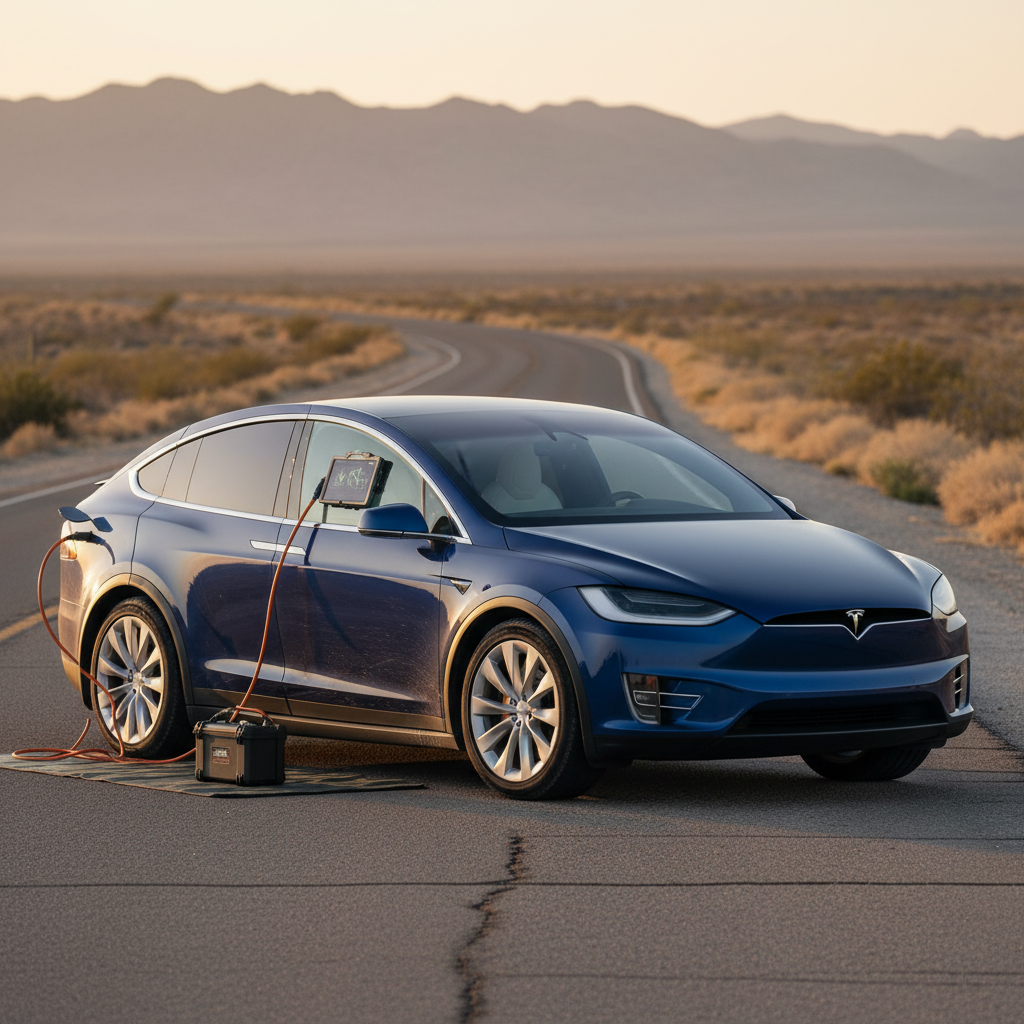
If you’re eyeing a Rivian R1T, or already own one, the question that matters on real road trips is simple: **what’s the Rivian R1T real-world range on the highway**, not just the number on the window sticker? EPA ratings north of 350 or even 400 miles sound great, but steady 70–75 mph driving, big tires and a bed full of gear tell a different story.
Why highway range matters more than EPA numbers
Rivian R1T highway range: the big picture
Across multiple independent tests, a Rivian R1T typically delivers **about 70–80% of its EPA rating at constant highway speeds**. In practical terms, that means many owners see **230–310 miles** on a full charge at 70–75 mph, depending on battery pack, wheels/tires and conditions. That’s still plenty for most days, but it’s not the 352–410 miles you’ll see on Rivian’s site.
Typical real-world highway range for Rivian R1T*
Important note
EPA ratings vs real-world highway range
To understand why your Rivian R1T’s **real-world highway range** may not match the number on the sticker, you first need to know what EPA range actually represents. The EPA test combines city and highway cycles at relatively modest speeds, then applies a correction factor. Trucks like the R1T are tall, heavy and very powerful, so they’re inherently less efficient once you hold a steady 70–75 mph into the wind.
Rivian R1T: EPA vs typical highway range (Dual Motor)
Approximate comparison for popular configurations, assuming steady 70–75 mph in mild weather and no towing.
| Configuration | EPA rating (mi) | Typical 70–75 mph range (mi) | Highway % of EPA |
|---|---|---|---|
| Large pack, 21" wheels | 352 | ~270–290 | ~75–80% |
| Large pack, 22" wheels | 341 | ~250–280 | ~73–82% |
| Large pack, 20" AT wheels | 307 | ~220–250 | ~72–81% |
| Max pack, 21" wheels | 410 | ~310–340 | ~75–83% |
| Max pack, 22" wheels | 380 | ~290–320 | ~76–84% |
| Max pack, 20" AT wheels | 355 | ~270–300 | ~76–85% |
Highway estimates are based on aggregated independent testing and owner reports, not an official rating.
Independent tests of Dual‑Motor R1Ts with the Large and Max packs have repeatedly shown that the **Max pack does deliver more highway range**, but not the full EPA spread. In one well‑known comparison, a Large‑pack truck went roughly **308 miles at ~68 mph**, while a Max‑pack truck managed about **338 miles at ~66 mph**, a real‑world gain closer to 30 miles than the 58‑mile EPA gap suggests.
How to use EPA range realistically
Battery packs, wheels and how they change range
Rivian offers three battery packs on the R1T, Standard, Large and Max, and three wheel/tire setups: 21‑inch aero‑style wheels, 22‑inch street wheels and 20‑inch all‑terrain (AT) tires. The combination you choose has a huge impact on both **EPA range and real‑world highway results**.
Rivian R1T battery options in plain English
How each pack affects range and use case on the highway
Standard pack
Who it fits: Mostly local use, shorter trips.
- EPA rating: roughly high‑200‑mile range depending on wheels.
- Highway expectation: ~190–220 miles at 70–75 mph.
- Best if you rarely road‑trip or live near dense fast‑charging.
Large pack
Sweet spot for most drivers.
- EPA rating: up to 352 miles with 21" wheels.
- Highway expectation: ~250–290 miles depending on tires.
- Good balance of cost, weight and range for mixed use.
Max pack
Longest‑range option.
- EPA rating: up to 410 miles with 21" wheels.
- Highway expectation: ~310–340 miles in ideal conditions.
- Best if you road‑trip often or tow at highway speeds.
Wheel and tire choice matters more than you think
21" wheels (street‑biased)
- Best range and efficiency.
- EPA figures: up to 352 mi (Large), 410 mi (Max).
- Ideal for highway commuters and road‑trippers.
- Soft‑roading and light gravel are fine with the right tires.
22" wheels or 20" all‑terrain
- 22" street wheels: sharper look, modest range hit.
- 20" all‑terrain: biggest penalty for EPA and highway range.
- Better off‑road traction but more noise and energy use.
- Choose only if you genuinely use the off‑road capability.
What independent highway tests show
A number of respected outlets have now put the Rivian R1T through 65–75 mph highway loops, giving us a clearer picture of **real-world range on the open road** than any brochure can.
- A Quad‑Motor R1T with Large pack and 20" all‑terrain tires delivered about **220 miles** at a steady 75 mph before needing a charge.
- The same Quad‑Motor truck with 22" street tires managed roughly **280 miles** on the same 75‑mph loop, showing just how much rubber and tread pattern matter.
- A Dual‑Motor R1T with the Large pack has also returned about **280 miles** in 75‑mph testing, underscoring that motor configuration isn’t the main driver of highway range.
- In back‑to‑back tests, Dual‑Motor R1Ts with Large vs Max packs on similar wheels showed roughly **30–35 miles of extra real‑world highway range** for the Max pack, useful, but less than the EPA spread suggests.
On our 75‑mph real‑world highway route, our Quad‑Motor R1T with the Large battery and 20‑inch all‑terrain tires delivered just 220 miles of range, while the same truck on 22‑inch street tires pushed that to 280 miles.
The good news for shoppers
How towing, load and weather slash R1T highway range
If you plan to use your Rivian R1T as a truck, towing, hauling or heading for the mountains, your **real-world highway range** can fall quickly. That’s not a flaw unique to Rivian; it’s true of every EV pickup (and every gas truck, for that matter). But because we watch the battery percentage so closely, the impact feels more dramatic.
Biggest highway range killers for the Rivian R1T
Plan around these, especially on longer trips
Towing and heavy loads
- Towing a ~6,100‑lb camping trailer at 70 mph has cut R1T range to around 110 miles in instrumented tests.
- Even modest trailers or a bed full of gear can easily knock 30–50% off your highway range.
Cold or very hot weather
- Cold batteries are less efficient and heaters draw serious power.
- Sub‑freezing temps can trim highway range by 20–40%, especially on short hops.
- High heat plus strong A/C also adds a smaller but noticeable hit.
Hills, wind and speed
- Long climbs at highway speeds can burn through battery quickly, even if some energy is recaptured on descents.
- Strong headwinds dramatically increase drag.
- Jumping from 65 mph to 80 mph can feel like losing an entire battery size.
Don’t plan to “run it to zero”
How to plan highway road trips in a Rivian R1T
The R1T is fully capable of long‑distance travel; you just have to plan around its **real-world highway range** instead of the brochure number. Here’s a straightforward way to do that, whether you’re in a Max‑pack adventurer or a Large‑pack daily driver.
Simple highway planning formula for your R1T
1. Start with 70–80% of EPA range
Take the EPA rating for your configuration and multiply by 0.75. That’s your realistic planning range at 70–75 mph in mild weather with no trailer.
2. Subtract a safety buffer
Subtract another 10–15% to avoid arriving at chargers nearly empty. For example, if your calculated highway range is 280 miles, plan legs of <strong>220–240 miles</strong> instead.
3. Add penalties for towing and weather
If you’re towing, in winter, or driving into strong headwinds, cut your planning range by another 25–50% depending on severity. It’s better to stop more often than to arrive on “0%” with a trailer.
4. Use in‑car and app‑based route planners
Rivian’s built‑in navigation and third‑party tools factor in elevation and speed limits. Start with those estimates, then cross‑check with your own conservative numbers, especially on new routes.
5. Charge a bit more than you think you need
On fast‑charge stops, it’s often worth staying a few extra minutes to leave with a larger buffer, particularly in cold weather or unfamiliar charging regions.
6. Watch real‑time efficiency
Use the R1T’s trip computer to monitor Wh/mi. If your consumption is significantly higher than expected, shorten the next leg or add an extra charging stop.
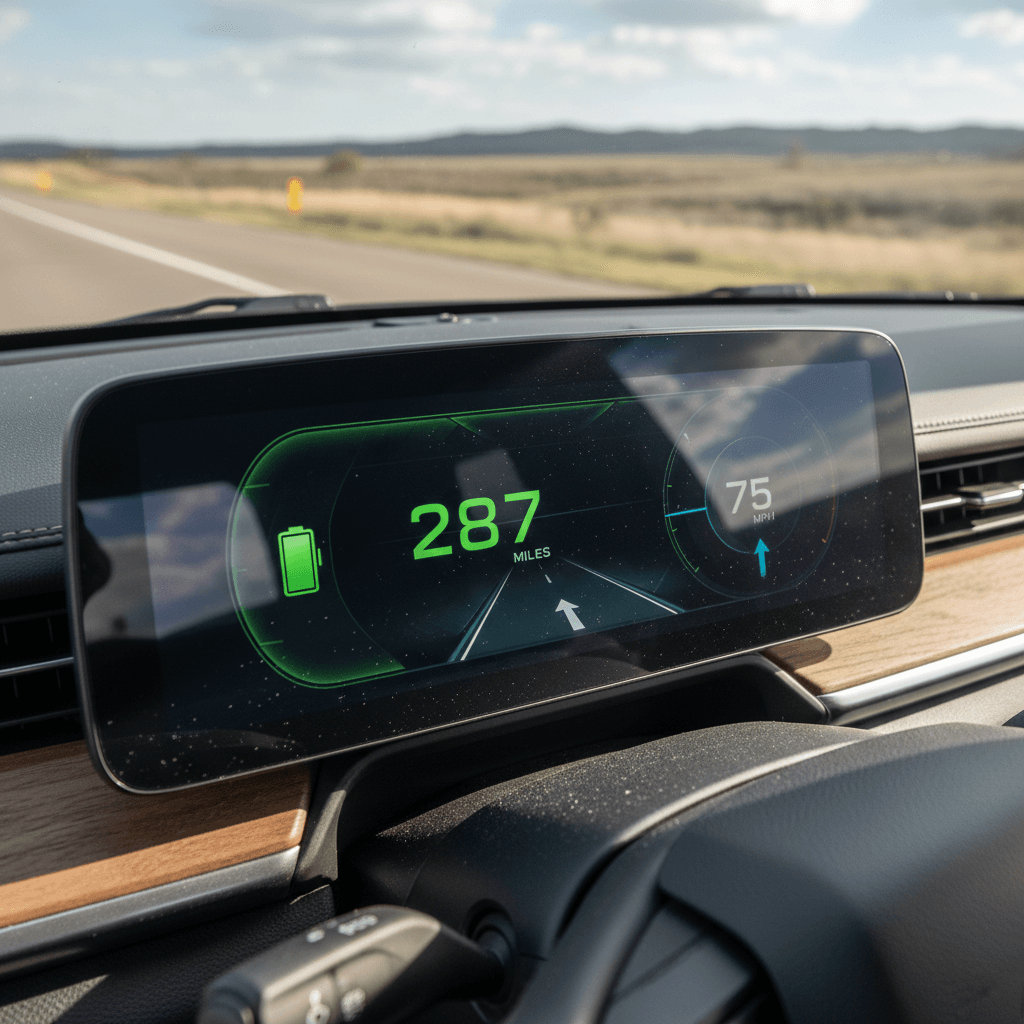
Think in legs, not in total range
Range checklist for used Rivian R1T shoppers
If you’re shopping for a **used Rivian R1T**, understanding its real‑world highway range is even more important. You’re dealing with not only the original configuration but also how the truck has been driven, charged and maintained. This is where a transparent battery‑health report and test‑drive strategy really pay off.
Used R1T range checklist before you buy
1. Confirm battery pack and wheel setup
Ask the seller, or check the build sheet, for battery pack (Standard, Large, Max) and wheel/tire option. A Large‑pack R1T on 21" wheels is a very different highway animal than a Standard‑pack truck on 20" all‑terrains.
2. Review battery health data
Request a recent battery‑health report. At <strong>Recharged</strong>, every vehicle includes a <strong>Recharged Score</strong> with verified battery state of health, so you know how much usable capacity remains compared with new.
3. Look at lifetime efficiency
In the R1T’s settings, check lifetime Wh/mi if available. High numbers (for example, over ~450 Wh/mi) suggest lots of high‑speed, towing or cold‑weather use, which can hint at how the truck has been treated.
4. Do a controlled highway test drive
On a test drive, reset the trip computer, drive a 10–20‑mile highway loop at your typical cruising speed and note Wh/mi and % battery used. That gives you an instant snapshot of **your** likely highway range.
5. Check for off‑road hardware and accessories
Roof racks, off‑road tires, bed racks and rooftop tents all hurt highway efficiency. Great for adventure, but factor in the range hit, or budget to swap them if you don’t need them.
6. Understand software and warranty coverage
Confirm the Rivian’s software is up to date and check remaining battery and drivetrain warranty. Over‑the‑air updates can improve efficiency and charging curves over time.
How Recharged helps de‑risk a used R1T purchase
Ready to find your next EV?
Browse VehiclesR1T highway range vs other electric trucks
On paper, a Max‑pack Rivian R1T with 410 miles of EPA range sits at the top of the electric‑truck heap. But in the real world, especially at 70–75 mph, things are a bit closer. Many full‑size EV pickups cluster in the **200–300‑mile real‑world highway range** band when similarly equipped and driven.
How the R1T’s highway range stacks up
Approximate real‑world 70–75 mph ranges based on testing and owner reports, with no trailers and mild weather.
| Model / configuration | EPA rating (mi) | Typical 70–75 mph range (mi) | Notes |
|---|---|---|---|
| Rivian R1T Dual Motor, Large pack, 21" | 352 | ~270–290 | Strong balance of range and performance. |
| Rivian R1T Dual Motor, Max pack, 21" | 410 | ~310–340 | Class‑leading EPA number; real‑world advantage shrinks at high speed. |
| Ford F‑150 Lightning ER | 300–320+ | ~210–250 | Large, blunt truck; aero works against it at speed. |
| GMC Hummer EV Pickup | ~300 | ~190–220 | Massive weight and off‑road focus hurt efficiency. |
| Chevrolet Silverado EV WT (estimate) | ~450 | ~320–360 | High EPA estimate; real‑world data still emerging. |
Exact results vary by configuration, but the R1T is competitive or better than most electric pickups on sale today.
What this means for buyers
Frequently asked questions about R1T highway range
Rivian R1T highway range: FAQs
Bottom line: what highway range you can really expect
Viewed through a realistic lens, the **Rivian R1T’s real-world highway range** is very solid for such a quick, capable electric pickup, but it’s not magic. A Dual‑Motor R1T with the Large pack and sensible wheels will usually return **around 270–290 miles at 70–75 mph**, and a Max‑pack truck might add another **30–50 miles** in gentle conditions. Aggressive tires, trailers, high speeds and harsh weather can eat into those numbers quickly.
If you’re shopping new or used, focus on the configuration, battery health and how you actually drive. Use EPA numbers as a starting point, then apply the 70–80% rule for highway trips and build in a healthy safety buffer. And if you’d like expert help translating spec‑sheet promises into **honest, real‑world Rivian range expectations**, Recharged is built for exactly that, pairing detailed battery diagnostics with straightforward guidance so you can buy, trade or sell your EV with confidence.