The Rivian R1T long term review 2026 looks very different from the glowing launch coverage back in 2021–2022. Three to five years in, early trucks now show real patterns in range, reliability, depreciation, and day-to-day livability. If you’re considering a used R1T today, or wondering whether to hold or sell the one in your driveway, this guide pulls together what long-time owners, pricing data, and real-world tests are telling us.
Why 2026 is a turning point
Rivian R1T long-term overview in 2026
Rivian R1T at a glance for long-term owners
When you strip away launch hype, the long-term picture is nuanced but encouraging. The R1T remains one of the quickest, most capable electric pickups you can buy, with legit off-road ability and towing muscle. Real-world range is solid if you spec the right battery and tires, and accept that highway and winter driving take a toll. Where things get more complicated is reliability, service access, and resale. Early adopters have seen more warranty visits than typical mainstream trucks, and Rivian’s young service network can mean longer downtimes. At the same time, steep early depreciation has turned the used R1T into one of the most interesting values in the electric-truck market.
Who the R1T suits best long term
Powertrain, battery, and real-world range
Across 2022–2025 model years, you’ll see three main powertrain flavors: Dual-Motor, Performance Dual-Motor, and Quad-Motor, paired with Standard, Large, or Max battery packs. EPA-rated range spans roughly 270 miles to just over 400 miles depending on configuration, but long-term owners report a consistent pattern: highway and winter use trim 10–20% off those numbers even before you factor in degradation.
- Typical highway range (Large pack, all-terrain tires): often 220–280 miles at 70–75 mph when new
- Standard pack dual-motor trucks: better suited to mixed city/suburban use than heavy highway towing or long winter road trips
- Max pack dual-motor: the go-to choice if you regularly run long distances between fast chargers
Expect range, not EPA posters
Gen 1 vs. Gen 2 powertrains
Early “Gen 1” R1Ts (2022–early 2024) built Rivian’s reputation for wild acceleration, think supercar-like 0–60 times in Quad-Motor trucks. More recent “Gen 2” hardware focuses on efficiency and cost, with revised motors and electronics that trim real-world consumption. Owners making the jump report slightly better highway range at the same speeds, and software has steadily refined drive modes, traction logic, and one-pedal driving. From a long-term perspective, that means a later-build R1T may give you a bit more usable range per kWh, especially at highway speeds.
Towing, hauling, and off-road use
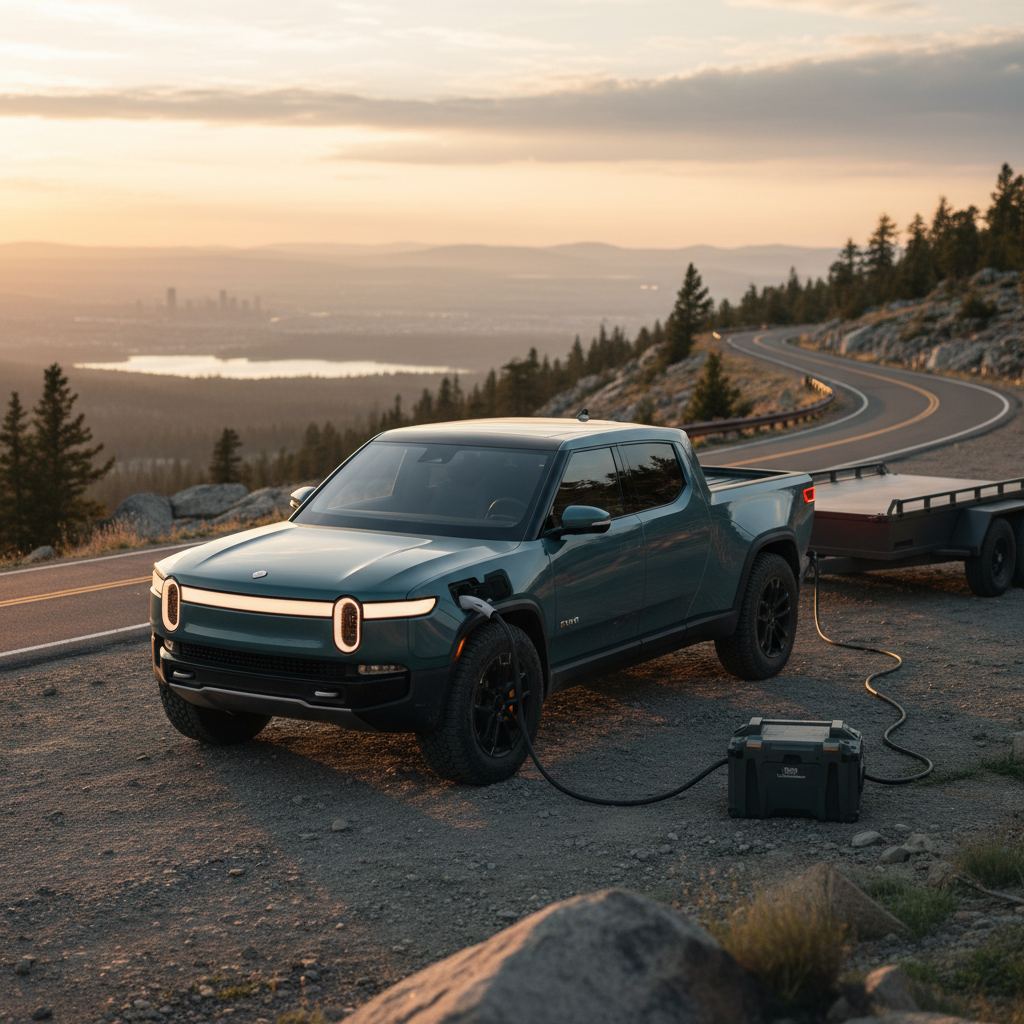
On paper, every R1T can tow 11,000 pounds and haul roughly 1,700–1,760 pounds in the bed. Long-term owners confirm the capability is real, the truck feels planted with a 5,000–7,000 pound trailer and shrugs off dirt, snow, and rutted forest roads thanks to its adjustable air suspension and fast-reacting traction control. The catch isn’t whether it can tow; it’s how far it can tow on a charge.
What long-term owners see when towing
Plan your charging stops with these rough patterns in mind
Light loads (under 3,500 lbs)
Think small utility trailer or light pop-up camper. Owners often report losing ~30–40% of solo range at highway speeds, less on slower scenic routes.
Mid-size campers & boats
Travel trailers and boats in the 4,000–7,000 lb range can cut range roughly in half. That turns a 260-mile solo highway truck into a 120–150 mile tow rig between fast charges in good weather.
Heavy or tall trailers
Near max tow rating, tall boxy campers, steep grades, or winter conditions can drop you to 30–40% of solo EPA range. Plan routes carefully and expect frequent DC fast-charging stops.
Don’t buy an R1T as your only heavy tow vehicle
Comfort, tech, and software over time
If there’s one thing long-term R1T owners consistently praise, it’s the daily driving experience. The cabin still feels distinctive years in, more boutique outdoor brand than mainstream truck, with high-quality materials, clever storage, and that signature gear tunnel. Seats hold up well, ride comfort is excellent in standard or soft suspension modes, and the quiet powertrain makes even short errands feel upscale.
Infotainment and driver aids
Rivian’s big center touchscreen remains your control hub for almost everything. Over-the-air updates have improved responsiveness, added apps, and refined navigation and off-road interfaces. The flip side is that if you dislike screen-heavy controls, it hasn’t changed course, climate controls, drive modes, and many settings still live in menus.
Driver-assistance features like adaptive cruise and lane-keeping feel more polished now than they did in 2022–2023, but they’re still not as hands-off as some mainstream systems. Think helpful on long drives, not autonomous.
Over-the-air updates: blessing and curse
On the plus side, Rivian has shipped noticeable improvements in range estimation, charging behavior, and even ride quality via software. On the minus side, big updates occasionally introduce new bugs, camera glitches, random warnings, or odd behavior that then require another update or a service visit to fully sort out.
Long-term owners learn to schedule big firmware updates when they don’t need the truck for a mission-critical trip the next morning.
Reliability, service, and recalls
Three to four years in, the R1T’s reliability story is mixed. You can find owners with 50,000+ trouble-free miles outside of scheduled maintenance, and you can find others who’ve had trucks in the service center multiple times for suspension quirks, panel alignment, or assorted warning messages. Most issues have been fixable under warranty, but the variance between experiences is wider than with mature full-size truck lines from Ford or Toyota.
- Common nuisance issues: occasional 12-volt battery warnings, squeaks/creaks in the suspension or body, sensor and camera glitches, trim or panel alignment fixes.
- More serious but less common: air suspension leaks or ride-height errors, HV system alerts that require a tow-in visit, or infotainment failures that knock out key functions until rebooted or repaired.
- Recall activity: like most young EVs, the R1T has seen several recalls, some software-only, others for physical components. A good used example should show these as completed in its service history.
Service-center reality check
The R1T is easily the best vehicle I’ve ever owned to drive. It’s also required more service appointments in three years than my last two trucks combined, all covered, but not all convenient.
Depreciation and used-market pricing in 2026
Early Rivian R1Ts came with luxury-level MSRPs, often $70,000–$90,000+ when nicely equipped. By 2026, a combination of softening EV demand, new-truck discounts, and normal market aging has pushed many three-year-old trucks to 30–40% below their original price. That hurts first owners, but it’s a gift to used buyers looking for maximum truck per dollar.
Typical used Rivian R1T price bands in 2026
These aren’t quotes for a specific truck, but they’re representative ranges you’ll see in many U.S. markets as of early 2026.
| Model year / trim | Typical miles | Typical price range | Notes |
|---|---|---|---|
| 2022 R1T Adventure Quad (Large) | 35k–60k | $48,000–$60,000 | Strong performance, higher mileage, often the best deals |
| 2023 R1T Adventure Dual (Large) | 25k–45k | $55,000–$65,000 | Balanced range and price, many coming off early loans or leases |
| 2024–2025 R1T Dual (Standard) | 10k–30k | $60,000–$72,000 | Newer trucks, shorter range, usually lower wear |
| Max pack or highly optioned builds | 15k–40k | $70,000–$85,000+ | Hold value better due to long range and desirability |
Condition, mileage, and configuration matter more than model year alone.
Why depreciation works in your favor now
Battery health and range loss on used R1Ts
Long-term EV ownership ultimately lives or dies on battery health. The good news: three to four years in, most R1T packs seem to be holding up well. For trucks driven and charged normally, daily Level 2 at home, occasional fast charging on road trips, owners commonly report roughly 5–10% real-world range loss compared with new.
What actually affects R1T battery health
Not all miles are created equal
Charging habits
Trucks that spend most of their life on Level 2 charging and only hit DC fast chargers on trips tend to show healthier packs than vehicles fast-charged several times a week.
Climate and storage
Extreme heat and frequently parking at 100% state of charge can accelerate degradation. Moderate climates and keeping the battery between ~20–80% day-to-day are kinder.
Use case
Heavy towing at high speeds isn’t inherently bad if you charge smartly, but it does mean more energy throughput. That shows up as slightly more range loss by year four or five.
Use third-party battery health data when you can
What ownership costs really look like
An electric truck with this much performance and tech won’t be “cheap,” but long-term R1T ownership costs look different from a gas truck’s. You’ll trade fuel and oil changes for higher insurance and potential out-of-warranty repairs later on.
Major cost buckets for long-term R1T owners
1. Electricity vs. fuel
Home charging on a typical residential rate often costs the equivalent of paying $1–$2 per gallon for a similarly quick, heavy truck. Frequent DC fast charging, especially on pricier networks, narrows the savings but usually doesn’t erase them.
2. Insurance and taxes
The R1T’s high sticker price and repair complexity mean insurance is often higher than for a comparable gas half-ton. Registration and property taxes in some states also track original MSRP, not your used purchase price.
3. Tires, brakes, and wear items
Expect to replace tires more often than on a lighter crossover, this is a heavy, high-torque truck, and many trims ride on aggressive all-terrain rubber. The upside: regenerative braking means brake pads can last a long time under normal use.
4. Warranty coverage window
Factory coverage on battery and drive units is generous by mileage and years, but bumper-to-bumper coverage will expire earlier. If you’re buying a three- or four-year-old R1T, think about where you’ll be on that warranty timeline in another five years.
5. Out-of-warranty risk
As with any tech-heavy first-generation product, expensive components like air suspension, power electronics, or infotainment hardware may eventually need work outside warranty. That’s a risk you should price into any long-term ownership plan.
How to shop for a used Rivian R1T in 2026
If this Rivian R1T long term review 2026 has you leaning toward buying used, how you shop matters as much as which truck you pick. Variations in battery pack, motor configuration, software history, and how the first owner used the truck all move the needle on value.
Start with the right configuration
- Daily driver, light adventure: Dual-Motor with Standard or Large pack can be plenty. Prioritize comfort options and driver-assistance features over max towing.
- Frequent road trips or towing: Look for Large or Max pack, preferably with more efficient wheel/tire combinations. Quad-Motor is fun, but Performance Dual-Motor often hits the sweet spot for price and efficiency.
- Cold-climate owners: Heated accessories and a larger pack are worth the spend. Winter range losses are real, and extra buffer reduces stress.
Inspect, test, and verify history
- Check panel gaps and seals for signs of prior repairs or factory build issues.
- Cycle suspension heights and listen for air leaks or odd creaks over speed bumps.
- Drive at highway speed to check for vibrations, wind noise, or steering pull.
- Review recall and service history to confirm key campaigns are complete and issues were resolved, not just cleared.
Pro-level checklist when buying through a marketplace like Recharged
Confirm battery health and tested range
Look for a documented range or battery-health report such as the <strong>Recharged Score</strong>. It should show pack condition, estimated real-world range, and how that compares to a similar new truck.
Compare price to current market, not original MSRP
Use current used listings and value guides, not what the first owner paid. In 2026 the market is softer than the early adopter years, so you often have room to negotiate.
Factor in distance to service
Map the nearest Rivian Service Center or mobile-service coverage zone before you sign. A great price can be undermined quickly if every minor fix means shipping the truck across state lines.
Ask how the truck was charged
Trucks primarily home-charged on Level 2 with occasional road trips are ideal. High DC fast-charging counts aren’t an automatic red flag, but they should send you back to the battery-health data for confirmation.
Leverage financing and trade-in options
If you’re coming out of a gas truck or SUV, using integrated financing and trade tools, like Recharged’s online trade-in and pre-qualification experience, can help you see the full cost picture in one place.
FAQ: Rivian R1T long-term ownership
Frequently asked questions about long-term R1T ownership
Is the Rivian R1T a good long-term bet?
In 2026, the Rivian R1T has settled into its true identity: a fast, capable, tech-forward electric adventure truck that rewards informed owners. Long-term, it’s not the simplest choice if you live far from service, expect flawless reliability, or tow near max capacity every weekend. But if you want a truck that’s as happy on a dirt trail as in a city parking garage, and you’re willing to think a bit about charging and service access, a well-chosen R1T can be deeply satisfying to live with.
For used shoppers, the combination of steep early depreciation, solid battery performance, and constant software refinement makes the R1T one of the more compelling electric trucks on the market. Focus on the right configuration, verify battery health, and price in the reality of a young brand’s service network, and you can end up with a truck that feels special every time you drive it, without paying launch-day money to get there. If you’d like a starting point, exploring Recharged’s used R1T listings with a Recharged Score battery report and nationwide digital purchase experience can help you move from research to keys-in-hand with a lot less uncertainty.