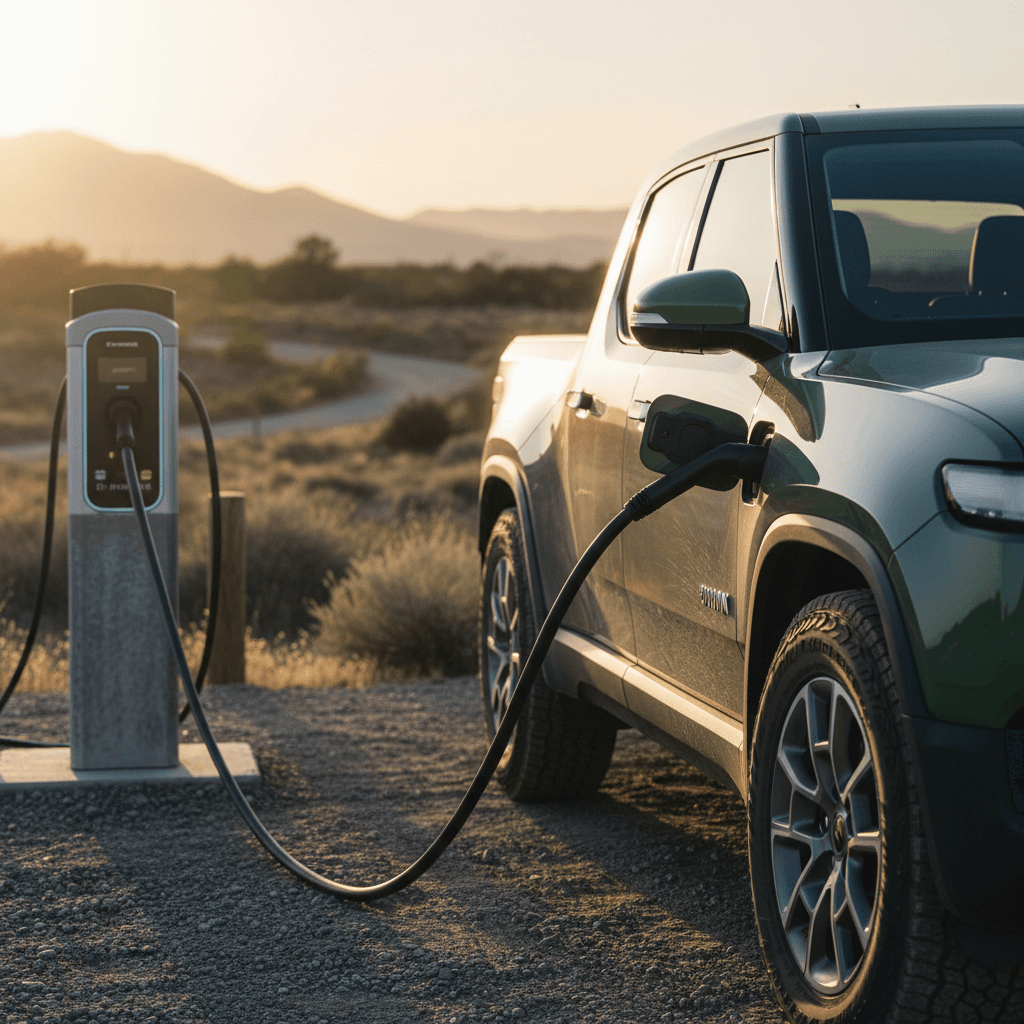
If you’re looking at a Rivian R1T, you already know it’s not a cheap truck. What most shoppers want to know next is: how much does it cost per mile to charge a Rivian R1T in the real world? The answer depends on where you charge, how you drive, and which battery you have, but once you understand a few numbers, it’s surprisingly easy to estimate.
Quick answer: average cost per mile
Why Rivian R1T charging cost per mile matters
With a truck this capable, quad motors, big battery options, genuine off‑road chops, it’s easy to get wrapped up in specs and forget the day‑to‑day. But charging cost per mile is one of the best ways to compare the R1T to a gas truck, or to other EVs. If you drove 1,000 miles in a month, are you spending $80 on electricity or $180? Over several years, that gap adds up to thousands of dollars in ownership costs.
The good news: once you know your electricity rate and the R1T’s efficiency, you can plug in a few numbers to understand your personal cost per mile. We’ll walk through real‑world examples, then show you how to run the math for your own situation, whether you’re charging mostly at home, relying on public fast chargers, or shopping for a used EV and want to sanity‑check your future running costs.
Rivian R1T charging cost at a glance
Rivian R1T battery sizes and real-world efficiency
Before you can estimate Rivian R1T charging cost per mile, you need two basics: battery size and energy use. Rivian has offered several battery packs and motor layouts, and they don’t all consume energy at the same rate.
Rivian R1T battery packs and typical efficiency
Approximate battery sizes and real‑world energy use in mild weather, mixed driving. Actual numbers vary with speed, load, terrain, and temperature.
| R1T configuration | Approx. usable battery (kWh) | Typical consumption (kWh/100 mi) | Cost per mile at $0.16/kWh* |
|---|---|---|---|
| Dual‑motor, Standard pack | ≈105 | 43–48 | $0.07–$0.08 |
| Dual‑motor, Large pack | ≈135 | 45–50 | $0.07–$0.08 |
| Quad‑motor, Large/Max pack | ≈135–149 | 50–60 | $0.08–$0.10 |
| Quad‑motor, aggressive off‑road or heavy towing | Same packs | 70–90+ | $0.11–$0.14+ |
Use these ballpark figures to estimate your own cost per mile. Always check your specific build’s specs and your real‑world consumption on the trip computer.
These are estimates, not promises
How to calculate Rivian R1T charging cost per mile
Whether you’re already driving an R1T or just running the numbers before you buy, the math is the same. You only need two inputs: your electricity price per kWh and your truck’s energy consumption in kWh per 100 miles (or per mile).
- Find your electricity rate. Check your utility bill for your total cost per kWh, including delivery and fees. In many U.S. states this is around $0.14–$0.22/kWh, but off‑peak EV plans can be much lower.
- Find your R1T’s energy use. Look at the truck’s efficiency display, usually shown as kWh/100 mi. If you don’t own one yet, use a reasonable estimate like 50 kWh/100 mi for mixed driving in a dual‑motor truck.
- Divide cost per kWh by miles per kWh. Convert your kWh/100 mi figure to miles per kWh by dividing 100 by that number, then divide your electricity rate by miles per kWh.
- Check your answer against trip data. If you already own the truck, reset a trip meter, drive a full charge cycle, and compare your measured consumption and cost.
Shortcut formula
Home charging: cheapest Rivian R1T cost per mile
Most owners will do the bulk of their charging at home, and that’s where the Rivian R1T really shines. Home electricity is almost always cheaper than public fast charging, and you’re not paying station operator overhead or demand charges.
Example 1: Average‑cost electricity
You live in a state where your all‑in residential rate is $0.18/kWh, and your dual‑motor R1T averages 50 kWh/100 mi in mixed use.
- Energy per mile: 50 ÷ 100 = 0.50 kWh/mi
- Cost per mile: 0.50 × $0.18 = $0.09/mi
- 1,000 miles/month: about $90 in electricity
Example 2: Off‑peak EV rate
You enroll in an EV‑friendly plan with off‑peak charging at $0.10/kWh, still averaging 50 kWh/100 mi.
- Energy per mile: 0.50 kWh/mi
- Cost per mile: 0.50 × $0.10 = $0.05/mi
- 1,000 miles/month: roughly $50 in charging costs
If you’re shopping a used R1T, ask the seller how they charge today and whether their utility offers EV‑specific rates, this can dramatically change your ongoing costs.
Compare to a gas pickup
Public fast charging: what your R1T really costs per mile
Long trips and apartment living often mean relying on DC fast charging. It’s convenient and keeps a heavy truck like the R1T road‑trip ready, but it’s also the most expensive way to feed those motors. Many highway fast‑charging networks price sessions in the $0.35–$0.50/kWh neighborhood, depending on location and membership plans.
Example 3: Typical network pricing
You pay $0.40/kWh at a public fast charger, and your R1T uses 55 kWh/100 mi at freeway speeds.
- Energy per mile: 55 ÷ 100 = 0.55 kWh/mi
- Cost per mile: 0.55 × $0.40 = $0.22/mi
- 1,000 miles/month: about $220 in charging
Example 4: Mixed home + fast charging
You drive 1,000 miles/month, with 70% at home ($0.18/kWh) and 30% on DC fast chargers ($0.40/kWh), averaging 50 kWh/100 mi overall.
- Home portion: 700 mi × $0.09/mi ≈ $63
- Fast‑charge portion: 300 mi × $0.20–$0.22/mi ≈ $60–$66
- Total: around $123–$129 per month, or $0.12–$0.13/mi overall
Don’t judge the R1T by 100% fast‑charging costs
5 big factors that change your Rivian R1T cost per mile
What pushes your R1T cost per mile up or down?
The same truck can swing from bargain to pricey depending on how you use it.
Driving speed
Weather & climate
Weight, towing & gear
Where you charge
Time of day
Driving style
Practical ways to lower your R1T charging costs
Simple habits that cut your R1T cost per mile
1. Get on an EV‑friendly utility plan
Call your power company or check its website for EV or time‑of‑use plans. Shifting most of your charging to off‑peak hours can slice your cost per kWh, and your cost per mile, by a third or more.
2. Install (or confirm) efficient home Level 2 charging
A properly sized Level 2 charger in your garage or driveway lets you avoid high‑priced, last‑minute fast‑charging sessions. If you’re shopping used, confirm that the home already has a 240V circuit or budget for an electrician.
3. Use trip planning and preconditioning
Use built‑in navigation or your favorite EV apps to plan charging stops so you’re not arriving with a cold pack or needing unnecessary top‑ups. Preconditioning the battery en route to a DC fast charger improves charging speed and efficiency.
4. Lighten the load between adventures
Roof boxes, racks, and knobby off‑road tires are fantastic for weekends but can hurt efficiency during your weekday commute. If you’re chasing lower cost per mile, strip the truck back to its sleeker configuration when you’re not exploring.
5. Watch your efficiency readout
Make a game of lowering your kWh/100 mi number. Reset a trip meter, try a week of gentler acceleration and slightly lower highway speeds, and see how far you can bring your average down.
6. Combine home charging with smart public use
Public fast chargers are great tools, just don’t depend on them for every kWh. Use them for road trips and occasional top‑ups, and lean on cheaper home charging for daily use.
Use your real data, not just estimates
Used Rivian R1T: what cost per mile means for buyers
If you’re eyeing a used Rivian R1T, understanding charging cost per mile helps you see the full ownership picture. The sticker price is only half the story; a truck that’s thousands cheaper up front but saddles you with expensive public charging or poor efficiency might not be the bargain it looks like.
Questions to ask the seller
- How and where do you usually charge? Mostly home Level 2 or public DC fast charging?
- What’s your typical kWh/100 mi? Ask for screenshots of the trip computer from highway and mixed driving.
- Has the truck towed or hauled heavy regularly? Occasional use is fine; constant heavy towing skews historical efficiency upward.
How Recharged helps
Every EV sold through Recharged comes with a Recharged Score Report that includes verified battery health and fair‑market pricing. That gives you confidence that the battery, the heart of your cost per mile, is in good shape. Our EV specialists can also help you compare an R1T’s energy use and charging patterns to other trucks you’re considering, so you understand long‑term costs before you buy.
Thinking about trading in or selling your truck?
Rivian R1T charging cost per mile: FAQ
Frequently asked questions about R1T charging costs
Bottom line: what you’ll really pay per mile in an R1T
When you boil it down, a Rivian R1T’s charging cost per mile is usually well below what you’d spend feeding a comparable gas truck, especially if you can charge at home. For many owners, the sweet spot is somewhere around $0.08–$0.12 per mile on a typical utility rate, and even with regular road‑trip fast charging, it often undercuts gasoline.
The key is understanding your own driving and charging patterns, then doing the simple math with your local electricity prices. If you’re considering a used R1T or another electric truck, that cost‑per‑mile number belongs right alongside price, range, and features on your shopping checklist. And if you’d like help comparing candidates, Recharged offers expert‑guided used EV shopping, trade‑ins, transparent pricing, and detailed battery health reports, so you know exactly what to expect, mile after mile.