If you’re eyeing a Rivian R1S in 2026, especially on the used market, you’re not wondering how fast it is. You want to know what it’s like to live with after a few winters, road trips, software updates and service visits. This long-term‑style Rivian R1S review pulls together owner data, instrumented tests and market trends so you can decide if this big electric adventure SUV fits your real life, not just your Instagram feed.
Long-term, not just launch glamour
Who this 2026 Rivian R1S long-term review is for
- Shoppers considering a used Rivian R1S and trying to decide if the deal is worth the risk.
- Current EV owners thinking about switching from a Tesla, Hyundai, Kia or Mercedes EQ to something more adventure‑oriented.
- Families who need three rows and want honest talk about road‑trip range, cargo space and car‑seat reality.
- Enthusiasts weighing an R1S against a Model X, Escalade IQ, EQS SUV or a plug‑in hybrid three‑row SUV.
We’ll lean heavily on real‑world data from owners and long‑form tests, along with what we see every day at Recharged when we appraise and sell used Rivian R1S SUVs, especially around battery health, pricing and trade‑ins.
Rivian R1S at a glance in 2026
2026 Rivian R1S long-term snapshot
Rivian keeps tweaking the R1S, but the core recipe hasn’t changed: a big battery, serious off‑road hardware, strong acceleration and a cabin that feels more Patagonia than Prada. For 2025–2026, Rivian added the NACS charge port on new builds and kept improving its software and driver‑assist systems.
Trim and battery basics
Real-world range and efficiency after years of use
Owners don’t drive spec sheets, they drive kids to school at 18 °F, tow boats into headwinds and sit in summer traffic with the A/C pegged. After a few years and tens of thousands of miles, most R1S drivers are seeing lifetime efficiency in the 1.8–2.5 mi/kWh range, depending heavily on climate, tires, driving style and how much time they spend above 70 mph.
Typical real-world Rivian R1S range (long-term owners)
Approximate ranges from long‑term owner data and independent tests, assuming healthy batteries and moderate loads.
| Configuration | Scenario | Typical Efficiency | Usable Range from Full |
|---|---|---|---|
| Dual‑Motor Standard pack, 20" all‑terrain | Mixed driving, mild weather | ~2.1 mi/kWh | ~220–230 miles |
| Dual‑Motor Large pack, 21" road tires | Highway 70–75 mph, mild weather | ~2.0–2.2 mi/kWh | ~260–280 miles |
| Tri/Quad‑Motor Large or Max pack, 22" wheels | Highway 75–80 mph | ~1.8–2.0 mi/kWh | ~260–320 miles depending on pack |
| Any pack, winter highway, 20–30 °F | 75 mph, heater on | ~1.5–1.8 mi/kWh | Often 30–40% below EPA range |
Think of these as "plan on" numbers, not best-case bragging rights.
Highway speed is your real range killer
Compared with rivals, the R1S is on the thirsty side. Independent testing of 2025–2026 Tri‑ and Quad‑Motor trucks shows average highway efficiency often under 2.0 mi/kWh, noticeably behind some big luxury EV SUVs, though still workable if you plan your stops.

Battery health and long-term degradation
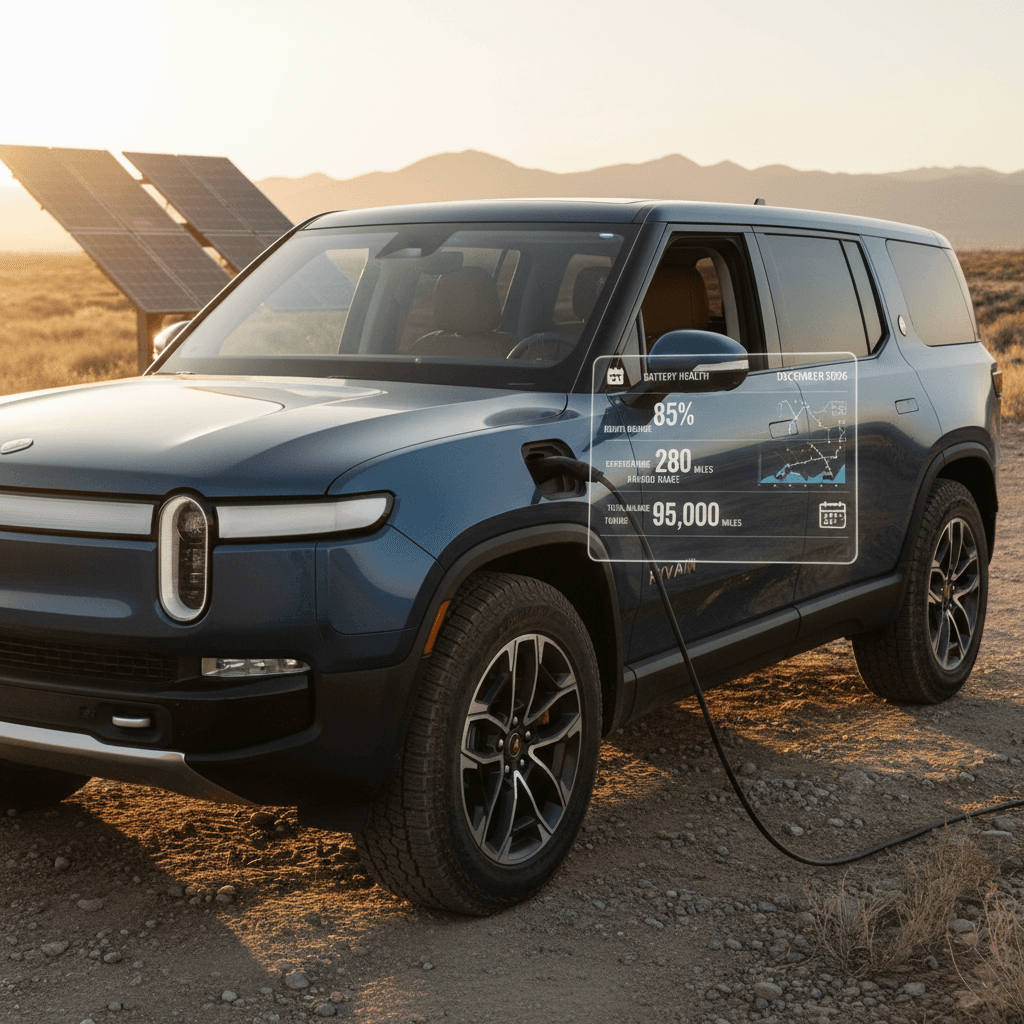
Battery health is the heart of any long‑term EV review. The encouraging news for the R1S: so far, real‑world reports don’t show catastrophic degradation. Between Rivian’s own data and owner logs, many early trucks with 30,000–50,000 miles are still displaying high‑90s percent of original capacity, especially on the Large and Max packs when they’ve been charged reasonably.
What we’re seeing on R1S battery life
Patterns emerging from 2022–2024 trucks now several years old
Early dip, then flat
Gentle daily charging helps
Warranty safety net
Don’t trust the range estimate blindly
This is exactly why every R1S sold through Recharged includes a Recharged Score Report with an instrumented battery‑health test. Instead of guessing from a range number, you see a measured state‑of‑health percentage, so you know whether you’re buying a pack that’s effectively like‑new or one that’s had a harder life.
Charging experience: home, public, and NACS
Living with a Rivian R1S day‑to‑day in 2026 is much easier than it was in 2022, mainly because the charging world has caught up. Newer trucks ship with the NACS (Tesla‑style) charge port, and older CCS trucks can access adapters and more robust public networks than when the R1S launched.
At home
- Most long‑term owners install a Level 2, 40–48 amp charger on a 240‑volt circuit.
- Expect roughly 20–30 miles of added range per hour, depending on pack and efficiency.
- Nightly top‑ups mean you rarely arrive at public chargers under 20% except on road trips.
On the road
- Newer NACS‑port R1S models can plug directly into Tesla Superchargers as they open to non‑Teslas, dramatically improving rural coverage.
- CCS‑port trucks still rely on networks like Electrify America, ChargePoint and others, fine in many corridors, but more hit‑or‑miss in remote areas.
- The R1S can be power‑hungry; budgeting stops every 120–180 miles at highway speeds keeps stress down.
How to make road trips easier
Reliability, recalls, and ownership hassles
Let’s talk about the part glossy launch reviews gloss over: living with a young brand. Long‑term R1S owners report a mixed picture. The electric drivetrain and battery so far look stout. Where complaints cluster is software gremlins, trim quality and service logistics.
Common long-term ownership themes
What Rivian R1S drivers praise, and what they grumble about
Powertrain feels bulletproof
Software quirks
Service access varies
Check recall history on used R1S
Comfort, interior and family-duty reality check
From the driver’s seat, the R1S feels like an outdoorsy luxury loft. Materials lean warm and modern, with real wood, woven fabrics and a giant central screen. Long‑term, most cabins are holding up well, but there are a few recurring themes you should know before you commit.
Daily comfort
- Front seats stay comfortable on 4–6 hour stints, and the driving position works for a wide range of body types.
- The suspension walks a line between firm control and comfort. On 20‑inch wheels it’s pleasantly plush; on 22s, you feel more expansion joints.
- Noise isolation is good, but big all‑terrain tires can add a low‑frequency hum at highway speeds.
Family and cargo duty
- The second row is adult‑friendly; the third row is best for kids or shorter trips for grown‑ups.
- Three car seats across the second row can be tight. For two seats plus one booster, it works well.
- With the third row up, cargo space is tight. Long‑term owners with big families lean on roof boxes and hitch carriers for road trips.
Kids tend to love it
Towing, off-road use, and adventure credentials
Rivian didn’t build the R1S to sit under fluorescent lights at the mall. Long‑term owners use them for overlanding, ski trips, beaches and towing everything from small campers to boats. The good news: it feels as capable as the marketing suggests. The catch: energy use goes through the roof when you really lean on that capability.
What to expect when you tow or wheel an R1S long term
Rough guidelines based on owner logs and off‑road/towing reports.
| Use case | What the R1S does well | What to watch for |
|---|---|---|
| Towing ~3,000–5,000 lb camper | Stable, confident pulling power; plenty of torque on grades. | Real‑world range can drop to 100–150 miles between fast charges on highway trips. |
| Light off‑roading, forest roads | Excellent traction, clever drive modes, air suspension gives useful clearance. | Underbody scrapes are possible; inspect skid plates and suspension components on used trucks. |
| Snow and ice family duty | Instant torque and fine traction control make it feel very secure in winter. | Cold weather plus snow tires can pull highway range to roughly half the EPA figure. Plan trips conservatively. |
Adventure is this SUV’s element, but you pay in electrons.
If you’ll tow often, oversize the battery
Depreciation and the used Rivian R1S market in 2026
Here’s where things get interesting for used shoppers. Early Rivian R1S models carried eye‑watering MSRPs. By late 2025 and into 2026, market data shows many R1‑series vehicles have dropped over 30% from their original price within roughly three years, with some examples listed tens of thousands below sticker. That stings for first owners, but it’s exactly why the R1S is suddenly on more used‑EV shopping lists.
R1S value trends that matter in 2026
On Recharged, we see buyers gravitating toward well‑specced Dual‑Motor Large pack and Tri‑Motor trucks with documented service and strong battery‑health scores. They deliver most of the Rivian experience with a big chunk of depreciation already in the rear‑view mirror.
Why depreciation can be your friend
Should you buy a used Rivian R1S in 2026?
Who’s a great fit, and who isn’t
A long-term R1S is brilliant for some, frustrating for others.
The R1S is probably right for you if…
- You want a three‑row EV that actually feels special every time you drive it.
- You value off‑road and all‑weather ability more than ultimate efficiency.
- Your typical day is under 80 miles, with easy access to home Level 2 charging.
- You live reasonably close to Rivian service or are comfortable using mobile service.
- You’re buying used at a healthy discount with verified battery health.
You might be happier in something else if…
- You need maximal highway range and efficiency (frequent 250–300‑mile non‑stop runs).
- You live far from Rivian service and can’t afford long repair lead times.
- Your budget is tight enough that surprises, tires, alignment, out‑of‑warranty repairs, would really hurt.
- You’re allergic to software quirks and prefer a more mature ecosystem like Tesla’s.
If that first column sounds like you, a used Rivian R1S in 2026 can be an outstanding buy. The key is to treat it like the sophisticated, heavy, complex machine it is: get a thorough inspection, insist on transparent battery‑health data, and shop carefully for the right configuration rather than just the cheapest price.
Quick inspection checklist for shopping used
10 things to check before you buy a used R1S
1. Verify battery state of health
Ask for a <strong>quantitative battery‑health report</strong>, not just a screenshot of the range estimate. On Recharged, the Recharged Score includes a verified state‑of‑health percentage so you know what you’re getting.
2. Confirm recall and service history
Request a full service printout, including software campaigns and hardware recalls. Make sure critical safety items, like suspension or seatbelt recalls, have been completed.
3. Inspect tires and alignment wear
The R1S is heavy and powerful. Uneven tire wear on the inner edges can hint at alignment issues or curbed suspension. A new set of 20–22 inch tires isn’t cheap, so factor that into pricing.
4. Check for off-road scars
Crawl under the truck and look at skid plates, control arms and the rear bumper. Light scrapes are normal; bent metal or missing fasteners are not.
5. Test all drive modes
Cycle through ride heights and drive modes on a test drive. Listen for clunks, watch for error messages and make sure the air suspension lifts and lowers smoothly.
6. Live with the software for 20 minutes
Park, then poke around the infotainment: navigation, profiles, Bluetooth, driver‑assist menus. You’re checking for unresponsive screens, lag or random error pop‑ups.
7. Try DC fast charging if possible
If you can, stop at a public fast charger before you sign. Confirm the truck connects quickly and pulls reasonable power for its state of charge and pack temperature.
8. Confirm driver-assist behavior
On a freeway test drive, engage adaptive cruise and lane‑keeping. Make sure it tracks lanes calmly, doesn’t ping‑pong between lines and reacts smoothly to traffic.
9. Examine the interior closely
Look at high‑touch surfaces, steering wheel, armrests, seat bolsters, for unusual wear or discoloration. A rough interior on a low‑mile truck can hint at hard use.
10. Run the numbers on insurance and taxes
Before you fall in love, get an actual insurance quote and understand any local EV incentives or registration fees. A premium EV SUV can carry premium insurance rates.
How Recharged simplifies the used R1S search
Ready to find your next EV?
Browse VehiclesFrequently asked questions about long-term R1S ownership
Rivian R1S long-term ownership FAQ
Bottom line: Who the long-term R1S really suits
After a few years in the wild, the Rivian R1S has settled into its true role: not the perfect EV for everyone, but a deeply satisfying one for the right driver. It’s quick, comfortable, genuinely capable off‑road and in bad weather, and full of the kind of character that makes you look back at it in the parking lot. It’s also heavy, hungry for energy at speed, and still part of an evolving ecosystem where software tweaks and recalls are part of the deal.
If you’re shopping in 2026, that combination of steep early depreciation and mostly healthy batteries can tilt the math in your favor, especially if you buy from a source that can prove pack health and pricing fairness. That’s exactly what Recharged was built to do. When you’re ready to hunt for the right R1S, you can lean on our Recharged Score battery diagnostics, fair‑market pricing tools, trade‑in options and nationwide delivery to make a complex purchase a lot simpler. The Rivian R1S might not be perfect, but with the right homework, it can be a brilliant long‑term companion.