If you’re considering a Rivian R1S, or eyeing a used one, the phrase “Rivian R1S battery degradation per year” is going to stick in your mind. Range is the lifeblood of any EV, and the big question is simple: how fast will the R1S battery lose capacity, and what does that mean for you over 5, 8, or 10 years?
The short answer
What “Rivian R1S battery degradation per year” really means
Before you zero in on a percentage, it helps to understand what battery degradation actually is. In simple terms, degradation is the gradual loss of usable battery capacity over time. Your Rivian R1S might have started with, say, a 135 kWh pack (Large Pack), but after years of driving and charging, the pack can no longer store that full amount of energy.
- It doesn’t happen overnight, it’s a slow, mostly predictable process.
- It’s influenced by time, temperature, charging habits, and mileage.
- You feel it as reduced range or more frequent charging stops, not as sudden “battery failure.”
Rivian, like other EV makers, builds in generous buffers and uses liquid thermal management to keep the pack in a comfortable temperature window. That’s why even when you hear about “degradation,” you rarely hear about modern EV packs suddenly dying. Instead, you see a slow drift downward in displayed range over years.
Rivian R1S battery life: realistic expectations
Important caveat
How much range will a Rivian R1S lose each year?
Let’s translate percentages into something more tangible: miles of range. Exact range depends on wheel/tire choice, driving style, climate, and whether you have the Standard, Large, or Max pack. To keep things simple, we’ll use a rough real‑world highway range baseline of ~300 miles for a well‑equipped R1S with the Large Pack.
Estimated Rivian R1S battery degradation over time
Approximate, real‑world expectations for an R1S used and charged normally, starting from 300 miles of usable range when new.
| Vehicle Age | Estimated Capacity Remaining | Approx. Usable Range | What You’ll Notice |
|---|---|---|---|
| Year 1 | 97–98% | 290–295 mi | No real change; range may fluctuate more with weather than age. |
| Year 3 | 93–95% | 280–285 mi | Slightly more frequent charging on long trips, but still strong. |
| Year 5 | 90–93% | 270–280 mi | Noticeable but manageable; you may add one more quick stop on a long road trip. |
| Year 8 | 86–90% | 255–270 mi | Road trips need a bit more planning, daily use still easy. |
| Year 10 | 82–88% | 245–265 mi | Still usable for most commutes; serious road‑trippers will lean more on fast charging. |
These are not Rivian official numbers, but realistic planning assumptions based on modern EV data.
How to use these numbers
Factors that speed up or slow down R1S battery degradation
Not all R1S batteries age the same. Two identical SUVs can look very different at 100,000 miles depending on where they live and how they’ve been charged. Here are the big levers you control as an owner.
6 key drivers of Rivian R1S battery degradation
Think in terms of heat, time at high charge, and charge speed.
Climate & Heat
High heat is the enemy of lithium‑ion batteries. An R1S living in Phoenix and parked outside all day will age faster than one garaged in Seattle. Rivian’s liquid cooling helps, but not even the best system can fully defeat extreme heat.
DC Fast Charging Frequency
Fast charging is fine in moderation, but using DC fast chargers as your primary fuel source can add extra stress. Occasional road‑trip use is expected; daily 0–100% fast‑charge sessions are not ideal.
State of Charge Habits
Keeping the battery near 100% for long periods accelerates wear. Daily charging to 70–80% is much gentler than routinely topping off to 100% and letting it sit.
Deep Discharges
Frequently running the pack down to very low percentages (near 0%) isn’t ideal. It’s fine occasionally, but making a habit of it can contribute to faster degradation.
Mileage & Driving Style
Higher mileage will naturally mean more cycling of the pack. Hard acceleration and heavy towing don’t directly “damage” the battery, but they do consume more energy and can run the pack warmer.
Storage & Parking
Parking in a garage or shaded area and avoiding long‑term storage at very low or very high states of charge helps the pack age gracefully.
Good news for normal owners
Rivian R1S vs other EVs: how its battery holds up
What we know from the broader EV market
While Rivian’s fleet is still young, we have over a decade of data from Tesla, Nissan, GM, Hyundai, and others. The pattern is consistent: modern liquid‑cooled packs tend to lose a few percent early, then settle into a slow, steady 1–2% per year in everyday use.
Some high‑mileage vehicles, well over 150,000 miles, still show 85%+ capacity when they’ve been treated reasonably well. That’s the neighborhood Rivian is likely to live in.
What’s unique about Rivian’s approach
Rivian uses a large, liquid‑cooled pack with sophisticated thermal management. The cells are similar chemistry to what you’ll find in other modern long‑range EVs, and the software constantly manages temperature and charge windows.
On top of that, the company backs the pack with an 8‑year / 175,000‑mile battery warranty, which would be a strange bet to make if they expected high failure or extreme degradation in normal use.
For most shoppers, the better question isn’t “Will the battery last?” It’s “Will the range still fit my lifestyle when this vehicle is 8 or 10 years old?”
Real‑world scenarios: 5–10 years of R1S ownership
To put all of this into plain English, here’s how Rivian R1S battery degradation per year tends to look in realistic ownership scenarios. None of these are promises, but they’re helpful planning tools.
Three common R1S ownership patterns
1. The suburban daily driver
You drive 12,000 miles per year, mostly commuting and errands, plus a few road trips. You Level 2 charge at home, usually limit to 80%, and fast‑charge only on trips. After 8–10 years, your R1S likely still offers more range than you need for day‑to‑day use, with perhaps one extra quick stop on a long holiday drive.
2. The road‑trip warrior
Your family loves long highway trips, and you fast‑charge frequently, sometimes multiple times per week. You’ll likely see the higher end of normal degradation. The vehicle is still very usable, but you may notice more range loss by year 8–10, especially in winter or with a roof box mounted.
3. The hot‑climate workhorse
You live in a very hot region, park outside often, and don’t always limit charge level. Over many years that combination can accelerate wear. The R1S will still function, but usable range may decline faster than the averages in the earlier table. Parking in shade and using cabin pre‑conditioning can help mitigate this.
Red flags to watch for
How to check battery degradation on a Rivian R1S
If you already own an R1S, you can get a rough sense of degradation with simple tools. If you’re shopping used, though, you’ll want something more objective than a casual glance at the range display.
- Compare displayed range at 100% to the original EPA rating. This gives a very rough estimate, but keep in mind that wheel size, tires, accessories, and software updates can affect the displayed number.
- Note the conditions. Temperature, recent driving style, and terrain all influence what the vehicle thinks its range will be. A cold battery on winter tires can show less range than the same pack on a mild spring day.
- Look at trip‑meter energy use. Over several drives, see how many kWh per 100 miles (or Wh/mi) you’re using. If energy use is unusually high, it may not be degradation, it might be aggressive driving, big tires, or a roof rack.
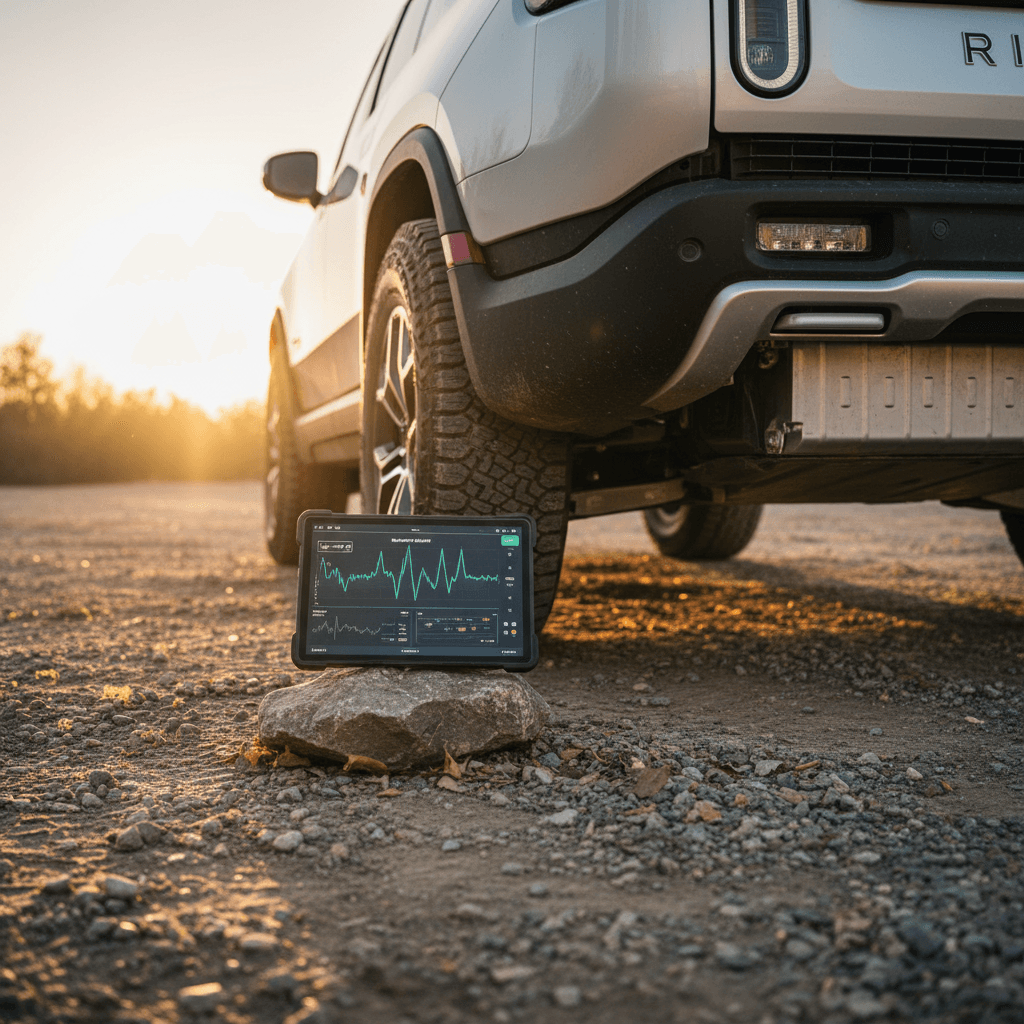
- Use a professional battery health report. The most reliable way to assess Rivian R1S battery degradation per year, especially on a used vehicle, is a dedicated battery health diagnostic that reads pack data directly from the car rather than inferring it from range displays.
Why DIY range tests can mislead you
Buying a used Rivian R1S? Battery health checklist
The R1S is a fantastic long‑range SUV, which makes it an attractive used EV. But as with any high‑value electric SUV, battery health is the single most important mechanical variable. Here’s how to approach it like a pro.
Used Rivian R1S battery health checklist
1. Ask about charging habits
Did the previous owner mostly Level 2 charge at home? Did they routinely charge to 100% and leave it parked, or did they keep it closer to 70–80%? Frequent DC fast‑charging isn’t automatically a deal‑breaker, but it’s important context.
2. Look at age, mileage, and climate
A three‑year‑old R1S with 20,000 miles in a mild climate is a different story from a three‑year‑old, 90,000‑mile highway commuter that lived in extreme heat. Degradation is a blend of calendar age and miles.
3. Check for software and service history
Confirm the vehicle is up to date on Rivian software and that there are no outstanding battery‑related service bulletins or warnings. Ask for service records if they’re available.
4. Compare displayed range to expectations
With the battery at (or near) 100%, note the displayed range and compare it to the factory estimate for that configuration. Small differences (5–10%) are normal; big gaps deserve more digging.
5. Get an objective battery health report
Whenever possible, rely on a <strong>pack‑level diagnostic</strong> rather than eyeballing the range gauge. At Recharged, every Rivian R1S we sell comes with a Recharged Score battery health report, so you can see how that specific pack stacks up against similar vehicles.
6. Weigh degradation against price
A used R1S that has slightly more degradation than average might still be a great buy at the right price. The key is transparency, knowing what you’re getting so you can decide if the discount is worth the range trade‑off. That’s exactly the equation we try to make easy at Recharged.
How Recharged evaluates Rivian battery health
Because modern EV batteries are complex, we don’t rely on guesses. Every EV sold through Recharged includes a Recharged Score Report, and for vehicles like the Rivian R1S, battery health is front‑and‑center.
What goes into a Recharged Score battery health report
Going deeper than a simple range readout.
Pack‑level diagnostics
We use specialized tools to read battery data directly from the vehicle. That includes state of health estimates, charge cycles, and other pack‑level metrics, not just the range number on the dash.
Comparison to similar EVs
Battery health isn’t judged in a vacuum. We compare each Rivian R1S to similar age and mileage EVs so you can see whether you’re looking at better‑than‑average, typical, or below‑average battery health.
Transparent pricing & guidance
If a particular R1S shows more degradation than average, that’s reflected in how we price it, and in the guidance our EV specialists give you. The goal is simple: no surprises down the road.
Ready to find your next EV?
Browse VehiclesFrom research to keys, fully online
Rivian R1S battery degradation: FAQ
Frequently asked questions about Rivian R1S battery degradation per year
Key takeaways on Rivian R1S battery degradation
If you’re worried about Rivian R1S battery degradation per year, it helps to zoom out. Modern EV packs aren’t fragile. When you combine Rivian’s liquid‑cooled battery, smart software, and a bit of owner common sense, you’re looking at a vehicle that should deliver useful, confident range for many years.
Expect a small capacity drop in the first few years, then a slow, predictable decline, on the order of 1–2% per year for most owners. The real test is whether the remaining range still fits your life, and for the majority of drivers, it will. If you’re stepping into the used market, focus on verified battery health and fair pricing rather than chasing a theoretical “perfect” pack.
At Recharged, that’s exactly what we try to simplify, pairing each used EV, including Rivian R1S models, with a transparent Recharged Score Report, expert guidance, financing options, and nationwide delivery. That way, you can spend less time worrying about degradation curves and more time enjoying the EV you actually drive.