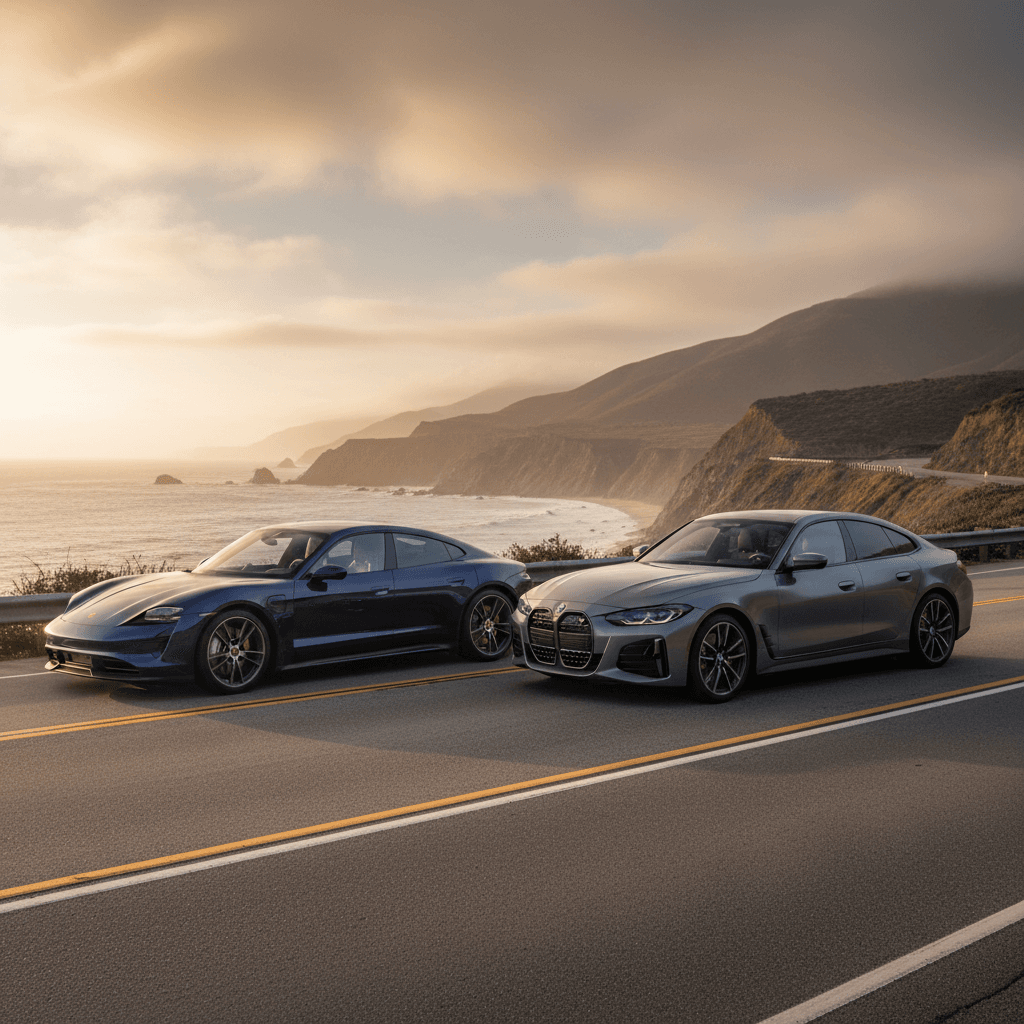
You don’t cross-shop the Porsche Taycan and BMW i4 by accident. You’re looking for a fast, premium electric sedan that doesn’t feel like an appliance. The question is whether you want the full opera at Porsche prices, or the smart, still-very-quick BMW that leaves money in your pocket for, say, electricity.
Same idea, very different executions
Porsche Taycan vs BMW i4: Who Each Car Really Suits
Porsche Taycan: The electric 911 for grown‑ups
If you buy cars with your heart first and spreadsheet later, the Taycan is your car. It’s stunningly fast, absurdly composed, and for 2025 it finally has the range and efficiency to match the drama. It’s also expensive to buy and to insure, and options can turn the price into a telephone number.
Think of the Taycan if you:
- Care more about driver feel than maximum range.
- Are fine paying six figures for a daily driver.
- Want something that feels special every time you walk up to it.
BMW i4: The stealth performer
The i4 is the sensible enthusiast’s EV. It’s still quick, still nicely built, and offers more range per dollar than the Taycan. Underneath, it’s a reworked 4‑Series Gran Coupe, and you feel that: more conventional seating, more usable rear seats, and a friendlier price.
Consider the i4 if you:
- Want a premium EV under (or near) $60,000.
- Need to commute and road trip without thinking about chargers constantly.
- Like BMW’s classic blend of comfort and sport, now powered by electrons.
Headline numbers at a glance (2025 models)
Quick specs: Porsche Taycan vs BMW i4
Core spec comparison: 2025 Porsche Taycan vs 2025 BMW i4
Representative trims; exact figures vary by configuration, wheel size, and options.
| Spec | Porsche Taycan (base RWD) | BMW i4 (eDrive40) |
|---|---|---|
| Power | ~402 hp (up to 429 hp with larger battery) | 396 hp |
| Drivetrain | RWD (AWD on higher trims) | RWD (AWD available) |
| Battery capacity | ~89–97 kWh usable | ≈83.9 kWh |
| EPA range | Up to about 318 mi (battery option dependent) | Up to about 318 mi (wheel/tire dependent) |
| 0–60 mph | Low 4‑second range (quicker with launch control) | Low-to-mid 4‑second range |
| DC fast‑charge peak | Up to ~320 kW | Up to 200 kW |
| Starting MSRP (new, 2025) | Around $100k+ for sedan | Low‑to‑mid $50k range |
| Body style | Dedicated EV sport sedan (also Turismo wagons) | 4‑door Gran Coupe based on 4‑Series |
Both cars offer multiple trims, but this table shows the flavor of each lineup.
Specs are a moving target
Pricing and value: Sticker shock vs smart money
Here’s the core economic truth of Porsche Taycan vs BMW i4: they are not really in the same financial universe. A 2025 Taycan sedan starts around the $100,000 mark before destination and options. By the time you add the bigger battery, adaptive suspension, and the usual parade of Porsche checkboxes, you’re sailing well into the $120k–$150k band. Meanwhile, the 2025 BMW i4 starts in the low‑$50,000s, with well‑equipped eDrive40 and xDrive40 models typically landing in the $55k–$65k neighborhood.
New pricing snapshots (2025)
Approximate US MSRPs before destination, taxes, or incentives.
Porsche Taycan
- Base Taycan sedan: around $100k+ MSRP.
- 4S / GTS: climbs rapidly into the $120k–$150k range with options.
- Turbo / Turbo S / Turbo GT: high‑performance halo cars well into supercar pricing.
You’re paying for a dedicated EV platform, Porsche engineering, and brand theater.
BMW i4
- eDrive35: low‑$50k starting price.
- eDrive40 & xDrive40: roughly mid‑$50k to low‑$60k for most real‑world builds.
- M50: generally around $70k when equipped like a small M car.
A far lower entry price with performance that would have embarrassed an M3 a decade ago.
Where used EVs change the math
Performance and driving feel
The Taycan and i4 are both quick. The difference is how they manage physics when you start driving like you mean it. The updated 2025 Taycan lineup offers everything from a 402‑hp rear‑drive base model to a Turbo GT with more than 1000 hp in overboost and a 0–60 mph time in the 2‑second zip code. The i4 tops out with the M50 trim in the mid‑3‑second range to 60, with the volume eDrive40 and xDrive40 trims in the 4‑second bracket. In other words, all of these cars are comically fast in real traffic.
Porsche Taycan: Feels engineered by sadists (the good kind)
Porsche attacked the EV brief like a motorsport problem. Steering is precise and communicative by EV standards, the brake pedal feels natural, and the car’s Active Ride suspension (on many AWD trims) practically erases body roll. You sit low, with a long hood ahead of you; it feels like an electric Panamera that spent a semester at the Nürburgring.
The tradeoff is weight and stiffness. Even with 2025’s efficiency gains, the Taycan still carries a big battery and big tires. You feel the heft over broken pavement, especially on larger wheels. But on a flowing road, it has that rare Porsche quality of shrinking around you.
BMW i4: Hot hatch energy in a business suit
The i4 inherits its bones from the 4‑Series Gran Coupe, and you can tell. The seating position is higher than the Taycan’s, visibility is better, and the whole car reads as a conventional sport sedan that happens to be electric. In xDrive40 and M50 form, the i4 is plenty playful, with instant torque out of corners and the familiar BMW steering feel, even if it’s filtered through an EV lens.
Pushed hard, the i4 moves into gentle understeer sooner than the Taycan, and you can feel that it’s not a clean‑sheet EV. But for commuting, back‑road fun, and the odd track‑day lark, it’s more than game.
Driving-joy verdict
Range, efficiency, and real-world road trips
Earlier Taycans had a reputation for being brilliant to drive but mediocre on range. For 2025, Porsche fixed that with larger batteries, improved chemistry, and aero tweaks. Depending on trim and battery, Taycan sedans now push into the low‑to‑mid‑300‑mile EPA range band, and independent highway testing has shown huge jumps compared with earlier years. The BMW i4, meanwhile, has always played the efficiency game well, with EPA estimates reaching into the ~267–318‑mile zone depending on motor count and wheel choice.
Representative range comparison (2025)
Exact EPA figures vary by wheel size, drivetrain, and battery choice, but this shows the general picture.
| Model / Trim | Approx. EPA range | Notes |
|---|---|---|
| Taycan base RWD (larger battery) | Up to ~318 mi | Best‑case sedan configuration with bigger pack. |
| Taycan 4S / GTS | 300+ mi | Performance‑leaning trims still offer solid range. |
| Taycan Turbo / Turbo GT | Mid‑200s–270s mi | Enormous power, slightly lower efficiency. |
| BMW i4 eDrive35 | Mid‑200s mi | Smaller‑battery entry point. |
| BMW i4 eDrive40 | Up to ~318 mi | Best‑range configuration on modest wheels. |
| BMW i4 xDrive40 / M50 | Mid‑200s mi | More power and AWD trim a bit of range. |
Both cars are road‑trip capable; the Taycan leans on charging speed, the i4 on efficiency.
How to think about road trips
Charging experience: Speed, networks, and daily living
Charging is where the Taycan pulls out its spec sheet and drops it on the table. The 2025 models can DC fast‑charge at up to around 320 kW under ideal conditions, and real‑world tests have shown 10–80% in roughly 18 minutes, or 10–90% in under half an hour on the right hardware. The BMW i4 tops out at a still‑good 200 kW, with 10–90% charges typically in the high‑30‑minute range. For daily life on Level 2, both cars are perfectly manageable: think overnight full charges from a 240‑V home setup.
Charging: Taycan vs i4 in practice
What the numbers feel like in your actual week.
Fast charging speed
Taycan: Among the quickest‑charging EVs on sale; can gulp electrons at over 300 kW, so short, intense stops.
i4: Peaks around 200 kW; still fast, but you’re standing at the charger a bit longer for the same energy.
Home charging
Both offer ~11 kW AC onboard chargers. With a 40‑ or 48‑amp Level 2 unit, a full overnight charge is easy in either car.
If you don’t have home charging, the Taycan’s higher peak rates and Porsche’s focus on long‑distance capability start to matter more.
Network & access
Both use the CCS standard (with North American Charging Standard adapters and access increasing over time). Real‑world experience will hinge more on your local networks (Electrify America, EVgo, etc.) than on the badge on the nose.
Beware DC fast charging abuse on used cars
Comfort, practicality, and daily usability
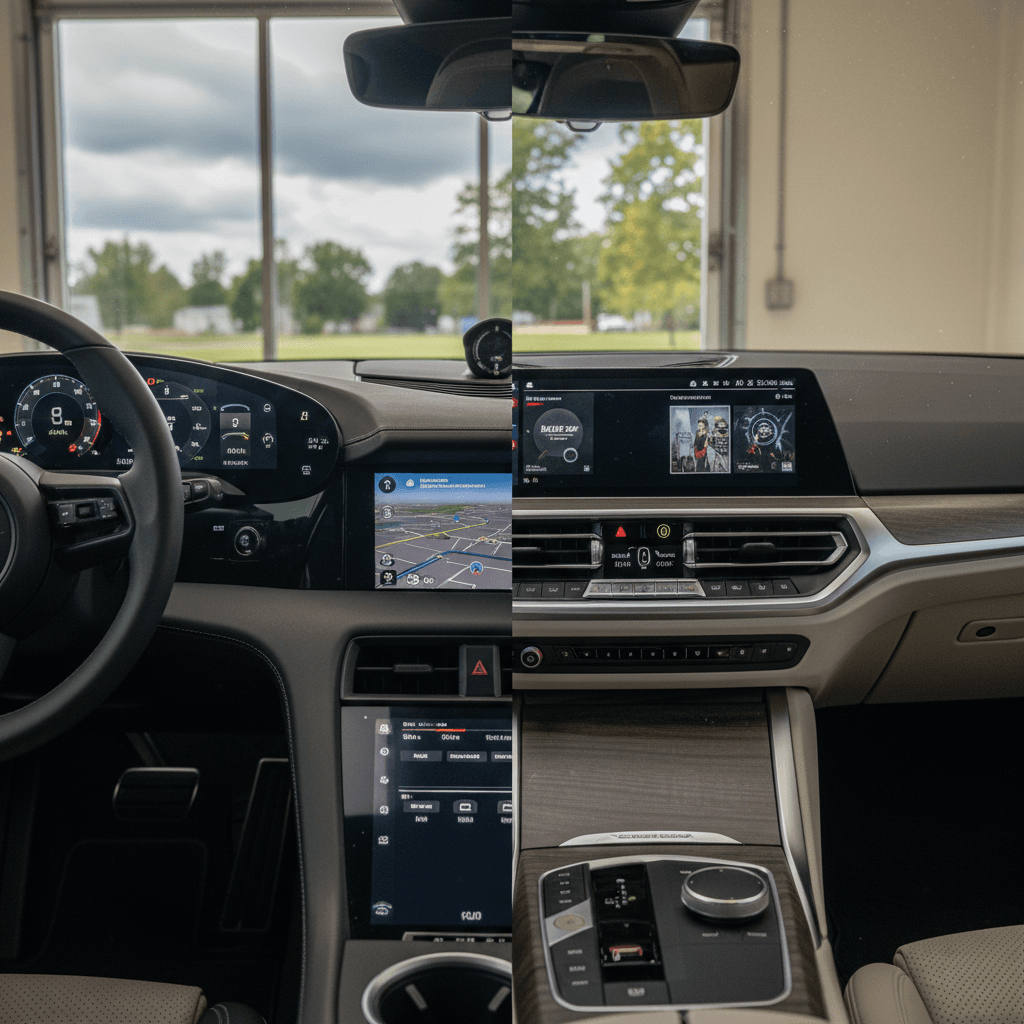
Both the Porsche Taycan and BMW i4 look like sleek four‑door sedans. Live with them for a week and the packaging story diverges. The Taycan is a low, wide, unapologetically sporty machine with a snug cabin, especially in the rear. The i4, shaped by its 4‑Series roots, feels more conventional: higher roofline, easier ingress, and more usable space for adults or child seats.
Taycan: Sport first, practicality second
The Taycan’s interior is gorgeous, digital, minimal, and festooned with available leather, color packages, and luxury options. Front seats are excellent for long drives, but you do drop down into them; older backs will notice. Rear space is tight for tall passengers, and the trunk is adequate rather than generous, though the front trunk adds helpful extra volume.
Best for: Couples, empty‑nesters, and solo commuters who prize the experience over maximum space.
i4: Real-life friendly
The i4’s cabin is recognizably BMW: twin‑screen dash, solid materials, and a seating position that doesn’t demand yoga to exit. The hatchback‑style trunk opening and folding rear seats make it genuinely useful for Costco runs, strollers, and road‑trip luggage.
Best for: Small families, single‑car households, and anyone who needs their EV to substitute for a 3‑ or 4‑Series sedan day in, day out.
Kid and car-seat duty
Ownership costs, depreciation, and used-market realities
Electric or not, Porsches and BMWs live on different economic planets. New or used, the Taycan carries higher purchase prices, higher insurance premiums, and typically higher parts and service costs once it’s out of warranty. The i4 isn’t cheap to run by Honda standards, but it’s much closer to the center of the bell curve.
Ownership snapshot: Taycan vs i4 (5-year lens)
General trends based on 2025 market data; exact numbers depend on trim, miles, and how you buy.
| Factor | Porsche Taycan | BMW i4 |
|---|---|---|
| New purchase price | Very high (six‑figure typical) | Moderate‑high (mid‑$50k–$70k) |
| 5‑year depreciation | Heavy in dollars, but stronger percentage retention than many EVs | Also heavy; typically steeper percentage drop than Taycan |
| Insurance | High | Moderate‑high |
| Maintenance & tires | Expensive; performance tires and Porsche parts pricing | Still premium, but generally cheaper than Taycan |
| Energy costs | Similar per kWh; Taycan often uses more kWh per mile | Often slightly more efficient per mile driven |
| Resale appeal | Strong among enthusiasts and Porsche faithful | Wide shopper pool; more price‑sensitive buyers |
The Porsche badge holds value better; the BMW is gentler on your cash flow.
How to think about value, not price
Which should you buy: Taycan or i4?
Five questions to decide between Porsche Taycan and BMW i4
1. What’s your realistic budget, out the door?
Be honest about the full on‑road price including taxes, fees, and home charging setup. If the Taycan’s budget leaves you financially tight, the BMW i4 will feel like a revelation rather than a compromise.
2. How often do you really drive hard?
If your commute is traffic and speed limits, the Taycan’s race‑car talent may be largely hypothetical. The i4 delivers plenty of daily joy without requiring a racetrack to justify itself.
3. Do you have easy home charging?
With a home Level 2 charger, the Taycan’s slightly lower efficiency matters less. Without home charging, the BMW’s thrift and the Taycan’s fast‑charging advantage both become more critical, choose based on how often you’ll need public DC fast charging.
4. Who and what are you carrying?
Frequent rear passengers, child seats, or big dogs all argue strongly for the i4’s more upright packaging and hatchback practicality. If it’s usually just you and maybe one passenger, the Taycan’s compromises fade.
5. How much do you value the badge and feel?
A Taycan feels like an event every time you drive it. An i4 feels like a very good BMW that happens to be electric. If that "event" feeling matters to you and you can afford it, the Porsche is hard to beat.
Simple rule of thumb
Buying either one used: How Recharged helps
On the used market, both the Porsche Taycan and BMW i4 are incredibly tempting: huge performance, big‑brand badges, and prices that have already eaten the first owner’s depreciation. This is also where you need to be careful. Early‑build Taycans may not have the latest efficiency and software updates; high‑mileage i4s may have seen a lifetime of DC fast charging and winter abuse. Odometers tell only part of the story.
How Recharged de-risks a used Taycan or i4
What you want to know before you fall in love with the paint color.
Verified battery health
Every EV on Recharged gets a Recharged Score battery report, using diagnostics to assess pack health rather than guessing from the dash display. You see how much usable capacity remains, so you’re not buying a mystery battery.
Transparent pricing & history
We benchmark cars against fair‑market data so you know whether that Taycan Turbo or i4 M50 is priced realistically. You also get clarity on accident history, ownership, and usage patterns that can affect long‑term reliability.
EV‑specialist guidance
Porsche Taycan vs BMW i4 isn’t just about numbers, it’s about how you’ll actually live with the car. Recharged’s EV specialists can talk you through home charging, road‑trip planning, and realistic costs of ownership, then help with financing, trade‑in, and even nationwide delivery.
Ready to find your next EV?
Browse VehiclesThink battery first, paint second
Porsche Taycan vs BMW i4: FAQ
Frequently asked questions about Porsche Taycan vs BMW i4
In the end, Porsche Taycan vs BMW i4 is less a fair fight than a question of identity. The Taycan is an electric sports car dressed as a sedan, with a price and personality to match. The i4 is a smart, fast, livable BMW that happens to be electric. One flatters the soul, the other flatters the balance sheet. Whichever camp you fall into, buying used through a platform like Recharged, where battery health, pricing, and expert help are part of the deal, can turn either car from a risky indulgence into a well‑understood, fully charged decision.