If you’re considering a Porsche Taycan, especially on the used market, you’re probably wondering how it actually performs in a crash, not just how fast it is. The phrase “Porsche Taycan safety rating crash test” shows up a lot in searches, but the data behind those ratings is more nuanced than a simple 5‑star score. This guide pulls together the official crash-test results we do have, explains what’s missing for U.S. buyers, and shows you how to judge Taycan safety in the real world.
Key takeaway
Porsche Taycan safety at a glance
Taycan safety snapshot
Those percentages come from Euro NCAP, Europe’s independent crash-test program, which tested the Taycan when it launched. They give us the clearest picture of the car’s crash performance today. In the U.S., safety agencies have generally focused their early EV testing on higher-volume family models, so data on low-volume premium EVs like the Taycan is thinner, and that matters if you’re trying to compare it against a Tesla Model S or Mercedes EQE.
Don’t over-interpret one number
Crash-test ratings: what data we actually have
Global crash-test picture
- Euro NCAP has fully tested the Porsche Taycan as an executive car.
- The published rating covers core body styles like the original Taycan sedan.
- The rating has remained valid through subsequent model years, with updates noted in Euro NCAP’s “Rating Validity” documentation.
U.S. crash-test picture
- As of early 2026, there are no widely published full crash ratings for the Taycan from NHTSA or IIHS.
- That doesn’t mean the Taycan is unsafe; it simply hasn’t been prioritized for testing compared with higher-volume models.
- For U.S. buyers, Euro NCAP plus vehicle design, safety tech, and recall history become especially important.
When you search for a Porsche Taycan safety rating, you’ll mostly see Euro NCAP data cited or references that point you back to NHTSA and IIHS without providing a star or letter grade. That’s your clue that U.S. labs haven’t yet run the full suite of tests (or at least haven’t publicly published them). For a used-Taycan shopper, that means you rely more heavily on the European crash program, Porsche’s engineering, and how the individual car has been maintained and updated.
Euro NCAP Porsche Taycan crash-test results explained
Euro NCAP 2019 Porsche Taycan results (executive car class)
Euro NCAP’s original rating gives the best publicly available view of Taycan crash performance.
| Category | Score | What it means for you |
|---|---|---|
| Adult Occupant | 85% | Very good overall cabin protection in front and side impacts, with stable passenger cell and strong side-impact scores. |
| Child Occupant | 83% | Good protection for 6- and 10-year-old dummies in frontal and side tests, with clear ISOFIX anchorages and airbag labeling. |
| Vulnerable Road Users | 70% | Front-end design and auto emergency braking help reduce injury to pedestrians and cyclists, though not class-leading. |
| Safety Assist | 73% | Standard AEB, lane support, and speed assistance systems perform well but leave room for improvement versus the very newest rivals. |
Percentages are Euro NCAP category scores; detailed point scores vary by test.
Drilling down into the test data, the Taycan performed particularly well in side-impact tests. Euro NCAP’s lateral and pole-impact subtests showed strong torso and head protection, which is exactly what you want in a heavy EV with a large battery pack. Frontal protection was also rated highly, with a stable passenger compartment and low readings for critical body regions in both the offset and full-width crashes.
How to read Euro NCAP scores
What about NHTSA and IIHS crash tests in the U.S.?
In the U.S., shoppers often look for a 5‑star NHTSA rating or an IIHS Top Safety Pick badge. As of February 2026, neither agency is widely publishing a full set of Porsche Taycan crash scores. The Taycan’s relatively low sales volume, and the fact that it’s a high-end performance EV, put it behind mainstream models on the testing priority list.
- NHTSA: No public, model-specific star rating for the Taycan is broadly cited as of early 2026.
- IIHS: The organization has focused its EV testing on higher-volume sedans and SUVs; Taycan results are limited or not yet published in headline form.
- Insurance and safety analysts often reference Euro NCAP data and Porsche’s engineering reputation when evaluating Taycan risk profiles.
How to think about the gap
How the Taycan protects you in a crash
Regardless of the badge on the grille, EV crash safety comes down to three fundamentals: a strong passenger cell, smart energy absorption, and battery protection. The Porsche Taycan checks all three boxes with a structure designed from day one as a dedicated EV platform.
Key Porsche Taycan safety design elements
What matters most if the worst happens
Rigid passenger cell
The Taycan uses a mix of high‑strength and ultra‑high‑strength steel plus aluminum to create a stiff safety cage around the cabin. In Euro NCAP’s frontal and side tests, this structure remained stable, limiting intrusion into the passenger space.
Protected battery pack
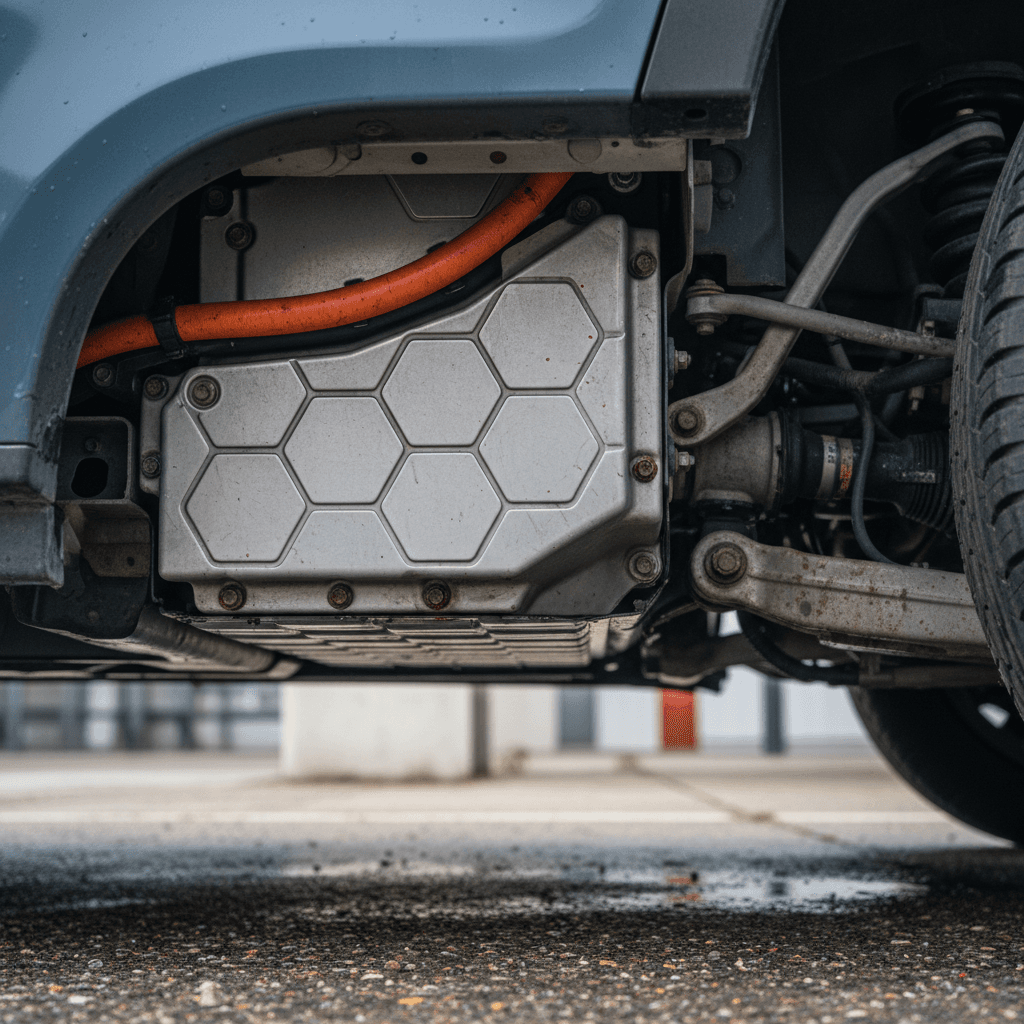
The high‑voltage battery is housed in a reinforced casing integrated into the floor. In a severe impact, sensors can automatically shut down the high‑voltage system to reduce the risk of electrical injury or fire.
Side‑impact defense
Strong side sills, impact beams in the doors, and multiple side and curtain airbags work together to spread crash forces and protect occupants’ heads and chests in T‑bone and pole impacts.
Porsche also builds in details you won’t see in a spec sheet: pre‑tensioning and load‑limiting seatbelts, front structures designed to “crumple” in a controlled way, and a deformable hood that can help protect pedestrians in a frontal collision. These aren’t unique to the Taycan, but they’re critical parts of the overall safety story.
EV fire risk context
Taycan safety tech and driver-assistance features
Crash structure is only half the story. The Porsche Taycan also relies on a wide range of active safety and driver-assistance features designed to help you avoid a crash altogether. Equipment varies by model year and trim, but the core package is competitive with other premium EV sedans.
Common Taycan safety and driver-assistance features
Standard on most U.S. models, with key options worth seeking out
Automatic emergency braking (AEB)
Forward collision warning with automatic emergency braking can spot vehicles, pedestrians, and cyclists and apply the brakes if you don’t react in time.
Lane-keeping and lane-change assist
Lane-departure warning and lane-keeping assist help prevent drifting, while optional Lane Change Assist (blind-spot monitoring) adds another layer of protection on multilane roads.
Adaptive cruise & traffic assist
Available adaptive cruise control can maintain distance to the car ahead and, in some versions, provide limited steering support in traffic jams, reducing fatigue on long drives.
Matrix LED headlights (market-dependent)
Outside the U.S., Taycan models can get advanced matrix LED headlights that shape the beam around oncoming traffic. U.S. regulations have historically limited some of this functionality, though hardware is often present.
Eight or more airbags
Typical Taycan configurations include front, side, curtain, and rear-seat airbags, plus front-knee airbags on some models, offering extensive cushioning in multi-directional crashes.
Parking sensors & cameras
Front and rear parking sensors and a reversing camera are standard on most trims, with optional surround-view systems for easier low-speed maneuvering and improved visibility.
Feature checklist for listings
Recalls, software fixes, and real-world concerns
No modern EV is recall‑free, and the Taycan is no exception. What matters for safety is understanding the issues and confirming that any used car you’re considering has had the right fixes applied.
- Rear-view camera issues: Recent recalls in the U.S. have covered Taycan models from 2020–2025 for intermittent or missing rear-view camera images due to signal noise or software problems. While this doesn’t affect crash structures, it does impact low-speed visibility and backing safety.
- Passenger airbag sensor concerns: Some 2022–2023 Taycans have been recalled for passenger-seat sensor issues that could deactivate the front passenger airbag in certain situations. The remedy involves replacing the seat cushion or updating associated components.
- Battery monitoring and fire risk mitigation: A small number of early Taycans have been subject to recalls or software updates related to potential battery cell issues and enhanced thermal monitoring. Regulators in some markets temporarily paused sales of affected units until updated software could be rolled out.
- Lighting and software features: U.S. regulations have limited some of the Taycan’s advanced headlight functions, but Porsche has indicated that, where possible, future regulatory changes could unlock features via software updates.
Why recall completion matters for used buyers
Used Porsche Taycan safety checklist
If you’re looking at a three- or four-year-old Taycan, you’re not just buying a safety rating, you’re buying that specific car’s history. Here’s a focused checklist to evaluate a used Taycan from a safety standpoint.
9 safety checks before you buy a used Taycan
1. Verify recall completion
Ask for a printed recall history by VIN from a Porsche dealer, or check with a national recall database. Confirm that camera, airbag, and battery-related campaigns show as completed.
2. Inspect crash and repair history
Pull a vehicle history report and look for prior accidents, airbag deployments, or structural repairs. Be extra cautious with cars that show front or side structural work near the battery tunnel.
3. Check airbag and warning lights
When you turn the car on, all warning lights should illuminate briefly and then go out. A persistent airbag, ABS, or stability-control light is a red flag that needs a professional diagnosis.
4. Test driver-assistance systems
On a test drive, safely verify lane-keeping, blind-spot monitoring, adaptive cruise control, and AEB warnings (without forcing an actual crash). Any non-functioning system may indicate sensor damage or calibration issues.
5. Examine tires and brakes
The Taycan is heavy and powerful; it needs high-quality tires and brakes. Uneven tire wear or mismatched sets can compromise emergency handling and traction, especially in wet or cold conditions.
6. Confirm windshield and camera condition
Advanced driver-assistance features often rely on cameras behind the windshield and in the bumpers. Look for cracks, chips, or replaced glass that might require camera recalibration.
7. Ask about software update history
Porsche routinely improves charging, safety, and driver-assistance behavior via software. Request service records that show major updates, especially any tied to recalls or battery management.
8. Evaluate lighting performance
Test headlights (low and high beams), turn signals, brake lights, and reverse lights at night. Verify that adaptive or matrix functions behave as expected, within what your market’s regulations allow.
9. Look for water or corrosion around battery areas
Have a trusted technician inspect underbody covers, battery mounting points, and high-voltage cabling for signs of impact damage, corrosion, or water intrusion, all of which can become safety issues later.
Make safety part of the price conversation
How Recharged evaluates used Taycan safety
Because Recharged focuses exclusively on used electric vehicles, we spend a disproportionate amount of time on two questions: Is this EV structurally sound? and Is its high-voltage system healthy and safe? The Porsche Taycan is no exception.
What Recharged looks at on a used Taycan
Beyond basic crash-test scores
Recharged Score battery & safety health
Every Taycan listed on Recharged includes a Recharged Score Report, which uses diagnostic data and a physical inspection to verify battery health, charging behavior, and look for patterns that might indicate past damage or abuse.
Undercarriage & structural inspection
We check for signs of structural repairs, underbody damage near the battery tray, and improper crash fixes that could compromise performance in a future collision.
System & sensor verification
Technicians verify the operation of airbags, ABS, stability control, cameras, parking sensors, and driver-assistance systems, and they note any DTCs (diagnostic trouble codes) tied to safety components.
Recall and software status
We confirm recall completion and review the Porsche dealer service history when available, paying particular attention to campaigns related to airbags, cameras, and battery monitoring logic.
Ready to find your next EV?
Browse VehiclesIf you find a Taycan you love that’s not already on Recharged, you can still use this same framework with your own mechanic or a Porsche specialist. The goal is simple: build a real-world picture of safety that goes far beyond a single crash-test score.
Porsche Taycan safety rating FAQ
Common questions about Porsche Taycan crash safety
So, is the Porsche Taycan a safe EV to buy used?
Taken together, the evidence points to the Porsche Taycan being a solidly safe premium EV. Euro NCAP’s results show strong crash performance, especially in side impacts. The car’s rigid structure, protected battery pack, and extensive airbag coverage form a robust passive-safety foundation, and its suite of driver-assistance features helps you avoid trouble in the first place.
The two big caveats for U.S. shoppers are the lack of widely published NHTSA/IIHS ratings and the Taycan’s recall history. Neither is a deal-breaker, but both raise the bar for due diligence. On a used Taycan, you’re not just buying a badge and 0–60 time, you’re buying a specific car’s maintenance record, software status, and repair history.
If you combine what we know from crash tests with a thorough safety-focused inspection, and, ideally, a Recharged Score Report that verifies battery health and checks for unresolved safety issues, the Taycan can be a compelling, confidence-inspiring EV to own. Take the time to get the safety picture right, and you can enjoy one of the most engaging electric sedans on the market without second-guessing what might happen if things go wrong.