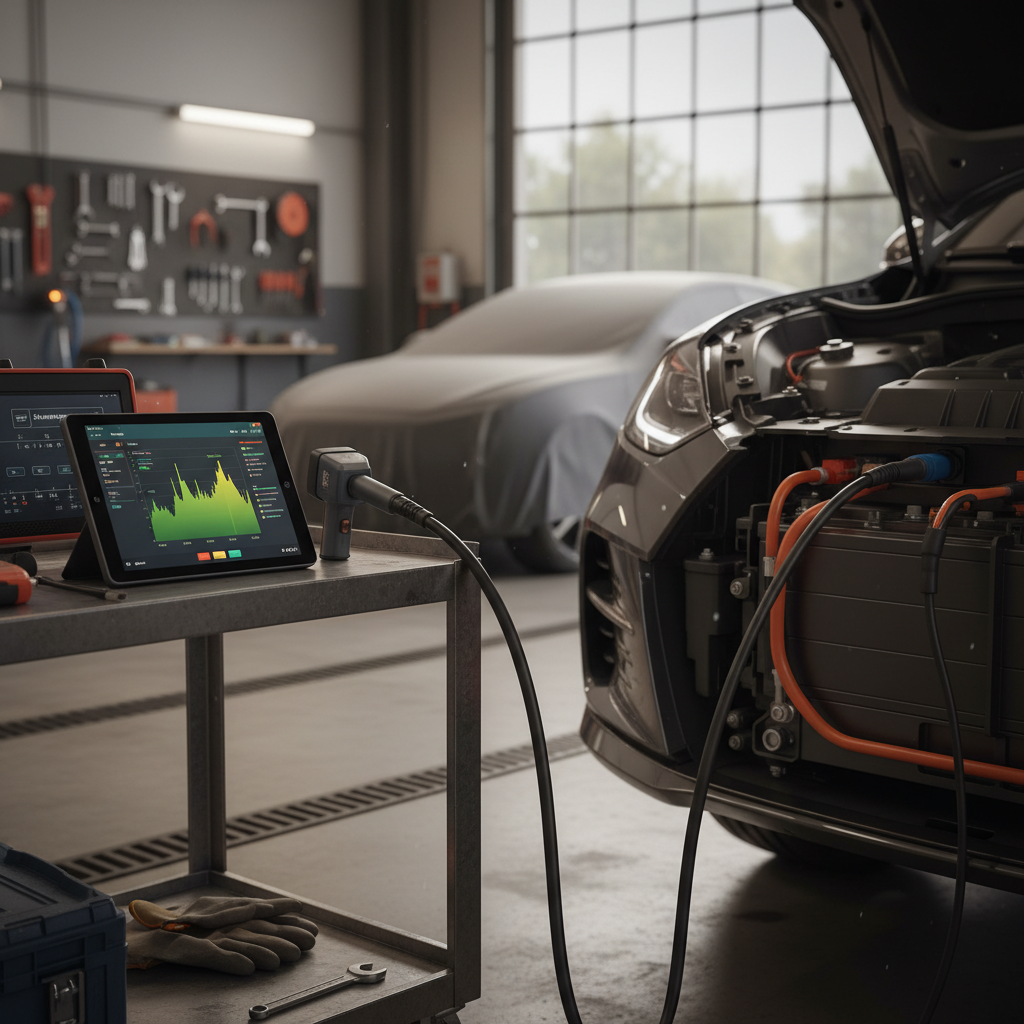
If you only learn one thing about buying a used Nissan Leaf, let it be this: the whole car is the battery. The body panels, the seats, the touchscreen, those are set dressing. What matters is how much usable energy is left in that pack. This guide breaks down exactly how to check Nissan Leaf battery health, from a quick no‑tools dash check to deep‑dive LeafSpy scans and dealer reports, so you don’t discover a 40‑mile commuter car after you’ve signed the paperwork.
The Leaf is uniquely sensitive to battery health
Why Nissan Leaf battery health matters so much
Range lives and dies with SOH. The Leaf doesn’t hide behind a huge battery. A 24 kWh early car started with roughly 70–80 miles of real‑world range when new; a 40 kWh car might deliver 130–150 miles in mixed driving when fresh. Lose 25–30% of that capacity and your daily comfort zone shrinks fast.
Battery condition drives resale value. Two Leafs of the same year and mileage can differ by thousands of dollars in value depending on State of Health (SOH). In the used market, shoppers and dealers quietly sort them into two piles: the cars you want to live with, and the cars you buy only if the price is a fire sale.
Why casual shoppers get burned on Leafs
Fast driver‑seat Nissan Leaf battery health check (no tools)
Let’s start with what you can do in under five minutes in a seller’s driveway or at a dealership, using nothing but the Leaf’s own display. This isn’t as precise as an OBD‑II scan, but it’s the difference between a smart test drive and just kicking the tires.
- Power the car on fully (foot on brake, press the start button until you see READY).
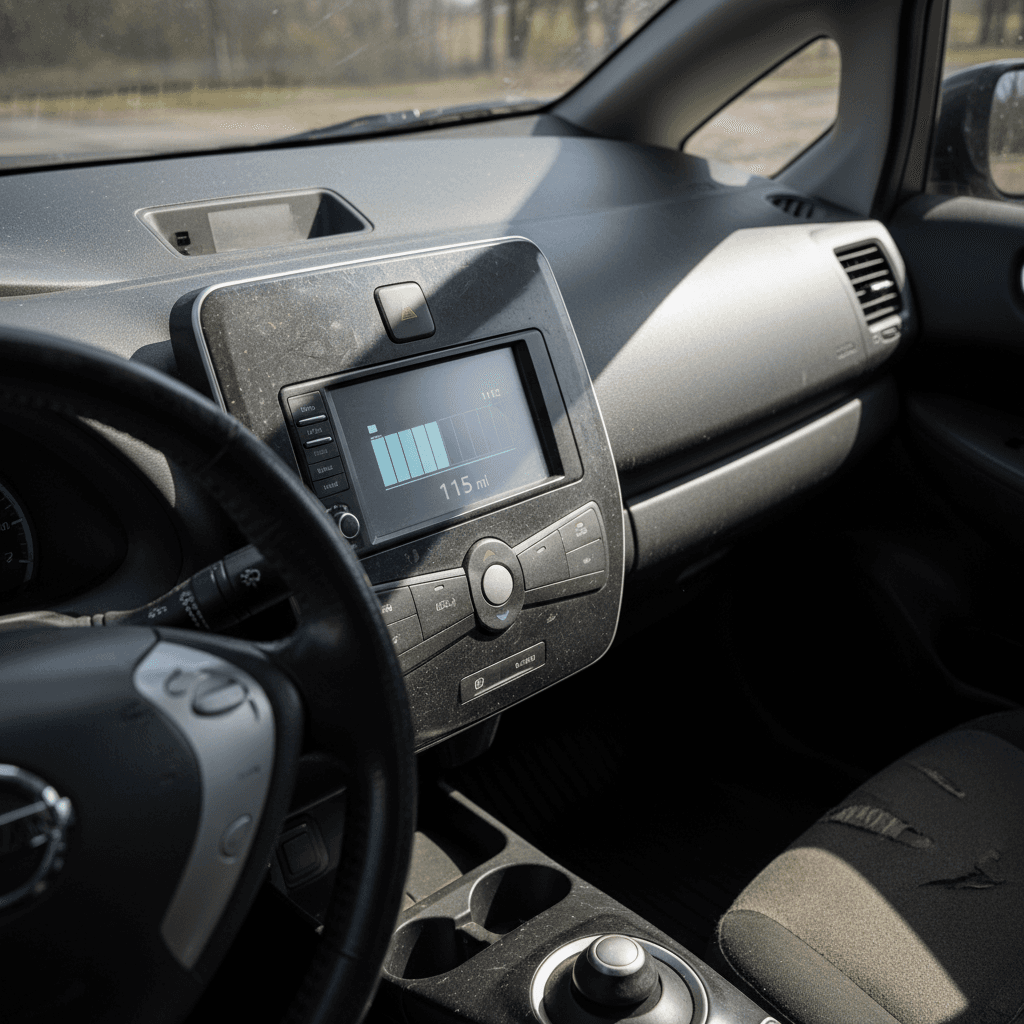
- Look at the right side of the instrument cluster, near the state‑of‑charge bars. Find the thin set of bars that do not move when you drive, these are the capacity bars.
- Count how many of those capacity bars are lit. A new Leaf shows 12; as the battery loses usable capacity, bars disappear one by one.
- Check the odometer and model year. A 2018–2020 car with, say, 11–12 bars is behaving very differently from a 2013 with 10 bars.
- Compare the capacity bars to the “Guess‑O‑Meter” range reading. If the car shows nearly full and the range estimate feels absurdly low, that can be another clue that the pack is tired or the recent driving has been very inefficient.
Quick rule of thumb for bars
How to read Nissan Leaf capacity bars correctly
The Leaf’s battery capacity gauge is famously opaque: it shows 12 little bars, but no percentage numbers. Under the hood, those bars map to a State of Health value, but the mapping isn’t as neat as people assume.
Rough guide: Nissan Leaf capacity bars vs. SOH
These are approximate, community‑observed relationships between the 12‑bar capacity gauge and battery State of Health (SOH). Nissan’s internal thresholds aren’t perfectly linear, but this is a useful buyer’s shorthand.
| Capacity bars lit | Approx. SOH range | What it usually means for a buyer |
|---|---|---|
| 12 bars | ~92–100% | Behaves like a nearly new pack; excellent for daily use and moderate trips. |
| 11 bars | ~85–92% | Very healthy; small range loss vs. new. Ideal for most commuters. |
| 10 bars | ~78–85% | Noticeable but manageable loss. Good if your daily round‑trip is short. |
| 9 bars | ~70–78% | Real compromise. Fine for city duty only; price should reflect it. |
| 7–8 bars | ~55–70% | Serious degradation. Think short‑hop, backup, or project car territory. |
| 6 bars or fewer | <55% | Special cases only, assuming the price is extremely low and you know the limitations. |
Treat this table as guidance, not gospel. Always confirm with LeafSpy or a dealer report when possible.
Bars can be misleading, here’s why
How to check Nissan Leaf battery health with LeafSpy
If you want the real story, you go under the dash. LeafSpy has become the unofficial truth serum for Nissan Leafs: it reads directly from the car’s battery management system and shows the numbers that Nissan hides behind those generic bars.
What LeafSpy tells you about a Leaf battery
Three key metrics separate a strong pack from a tired one.
State of Health (SOH) %
The headline number. SOH compares the pack’s current usable capacity to what it had when new. A 90% SOH pack has lost about 10% of its capacity.
AHr & Hx values
Leaf‑specific indicators of how much charge the cells hold (amp‑hours) and how willing they are to deliver power (Hx). Dropping numbers suggest aging or stressed cells.
Charge & DC fast history
LeafSpy can show Level 1/2 and DC fast charge counts. Lots of fast‑charge sessions in a hot climate can correlate with quicker degradation.
Step‑by‑step: Using LeafSpy to check a Nissan Leaf battery
1. Get the right OBD‑II adapter
Choose a Leaf‑compatible Bluetooth OBD‑II dongle (many owners like OBDLink LX, OBDLink CX, or Veepeak BLE+). Avoid ultra‑cheap adapters that can drop the connection or misreport data.
2. Install LeafSpy on your phone
Download LeafSpy Pro or LeafSpy Lite from your app store and grant it Bluetooth permissions. Open the app once to confirm it runs cleanly on your phone.
3. Plug into the Leaf’s OBD‑II port
Sit in the driver’s seat and look under the steering column, slightly left. You’ll see the trapezoid OBD‑II port. Gently plug in the adapter until it’s fully seated and powered.
4. Turn the car fully on
Press the start button with your foot on the brake until the car shows READY. This wakes up the high‑voltage systems and lets LeafSpy talk to the battery modules.
5. Pair your phone to the adapter
In your phone’s Bluetooth settings, connect to the adapter, then select it within LeafSpy’s connection screen. Give it a minute; the first connection can be slow.
6. Read and record the key values
On LeafSpy’s main battery screen, note SOH %, AHr, Hx, pack voltage, and odometer. Take screenshots so you can compare cars later or share results with a knowledgeable friend, or an EV specialist at Recharged.
Treat LeafSpy as data, not dogma
Getting a Nissan dealer battery health report
If you’d rather not juggle adapters and apps, a Nissan dealer can pull an official battery report. It’s less granular than LeafSpy, but it carries weight if you ever need to pursue warranty service.
- Call the service department and ask for a traction battery capacity test or Leaf battery health check. Expect a modest diagnostic fee unless it’s being done under warranty.
- Ask them to print or email the full report, not just say “it’s fine.” You want to see SOH or a capacity figure, and any stored battery‑related trouble codes.
- Bring that report when negotiating on a used Leaf, especially if you’re buying from an independent dealer or private seller who hasn’t seen it. It’s your leverage.
- If the car is still under Nissan’s 8‑year/100,000‑mile capacity warranty and the report shows the pack below the warranty threshold (typically 8 bars or fewer), discuss options for repair or replacement.
How Recharged handles this step for you
Ready to find your next EV?
Browse VehiclesWhat “good” Nissan Leaf battery health looks like by model year
Once you have SOH from LeafSpy or a dealer, you still need to answer the real question: “Is this good for a car of this age and mileage?” The Leaf has gone through several battery chemistries, and they age differently.
Typical “good” SOH targets by Nissan Leaf generation
These ballpark figures assume a typical U.S. climate and normal use, not a pampered garage queen or a car that lived on quick chargers in Phoenix. Use them as context, not strict pass/fail lines.
| Leaf generation / pack | Age & mileage example | SOH many buyers consider “good” | Notes |
|---|---|---|---|
| 2011–2015 24 kWh (Gen 1) | 10–13 years, 70–100k miles | ~70–80% | Early packs are more heat‑sensitive. A 70%+ SOH survivor is respectable; below that, range gets very tight. |
| 2016–2017 30 kWh | 8–10 years, 60–90k miles | ~75–85% | These added range, but some cars saw faster degradation; check SOH carefully and lean on pricing leverage. |
| 2018–2022 40 kWh (Gen 2) | 4–8 years, 40–90k miles | ~85–95% | Generally more robust chemistry. In moderate climates, many still hold high‑80s to mid‑90s SOH. |
| 2019–2024 62 kWh e+ | 2–7 years, 20–80k miles | ~90–98% | Larger pack spreads the stress out; modest SOH loss is normal, but big drops deserve extra scrutiny. |
If a car is significantly below these ranges, the price, warranty situation, or your expectations should adjust accordingly.
Climate is destiny for Leaf batteries
Battery health red flags on a used Leaf
Numbers are one thing; patterns are another. Certain combinations of data and history should make you slow down, or walk away.
Common battery red flags on a used Nissan Leaf
These don’t automatically kill the deal, but they demand a lower price and clear eyes.
Low SOH with modest miles
Example: a 2019 40 kWh Leaf with 45,000 miles showing 72% SOH. That suggests hard use, lots of DC fast charging, or a brutal climate. The car might still work for a short commute, but the asking price should reflect “early retirement” for the pack.
High bars, suspicious story
Seller swears it “always had 12 bars” but can’t show any history, and LeafSpy readings feel out of line with age and mileage. Reset clusters and swapped modules happen; treat a too‑good‑to‑be‑true pack with caution.
Hot‑climate, street‑parked life
Years spent baking in direct sun at a full charge is Leaf battery hell. A Sunbelt car with lots of missed services and no garage time deserves extra scrutiny, even if the dash still shows 11–12 bars.
Heavy quick‑charge history
Dozens upon dozens of DC fast‑charge sessions aren’t necessarily a death sentence, but combined with low SOH they hint at a hard life. Fine if you’re buying a cheap commuter; not great for long‑term ownership.
Don’t fall for the “it still goes 70 miles” line
Translating SOH into real‑world range
Battery SOH is abstract; range is visceral. What you actually care about is how far the car will carry you on a Tuesday in February with the heater on. You can approximate it without a physics degree.
- Find the original EPA range for that Leaf’s battery size (roughly 84 miles for early 24 kWh cars, ~149 miles for 40 kWh, ~215 miles for 62 kWh, give or take trim and year).
- Multiply that EPA figure by the current SOH as a decimal. Example: 149 miles × 0.85 SOH ≈ 127 miles of idealized range.
- Take another 15–25% off for real‑world driving: highway speeds, temperature, HVAC use, hills, and the fact that you probably don’t want to arrive home at 0%.
- Decide whether that realistic range covers your absolute worst‑case day with comfortable buffer. If your daily round‑trip is 45 miles and your estimate is 110+, you’re in great shape; if it’s 65 miles and your estimate is 80, you’re buying stress.
Use range to negotiate, not just panic
How Recharged handles Nissan Leaf battery health for you
If all of this sounds like homework, that’s because it is. The Leaf rewards informed buyers and punishes the casual. Recharged exists partly to flip that script, to make buying a used EV, including a Leaf, feel less like a science project.
Battery transparency, baked in
What happens when a Leaf goes through Recharged instead of a random lot.
Recharged Score battery diagnostics
Every Leaf on Recharged comes with a Recharged Score Report that includes verified battery health data, not just a photo of the dash. Our EV specialists interpret the scan so you know what the numbers mean for your daily life.
Fair‑market pricing
We price Leafs based on battery condition, not just model year and trim. A car with stronger SOH is valued accordingly; a car with a tired pack has to earn its keep with a lower price.
Digital buying, human backup
You can browse, finance, and arrange nationwide delivery fully online. Along the way, real EV specialists are on tap to talk through SOH, range, and whether a particular Leaf actually fits your commute.
Talk to an EV‑only team
Nissan Leaf battery health check FAQ
Frequently asked questions about Nissan Leaf battery checks
Bottom line: How to walk away with a healthy Leaf
The Nissan Leaf is one of the easiest EVs to live with, and one of the easiest to get wrong if you ignore the battery. To stack the odds in your favor, combine a quick bar‑count from the driver’s seat, a LeafSpy scan or dealer report, and a cold‑eyed look at how that SOH translates into your worst‑case commute. If the numbers, the price, and your daily reality all line up, you’ve found the sweet spot: a Leaf that delivers quiet, low‑cost miles without range anxiety drama. And if you’d rather have someone else do the math, start with Leafs listed on Recharged, where battery health and fair pricing are on the spec sheet, not hidden behind a glossy window sticker.