If you own a Nissan Ariya and you’re thinking about upgrading in 2026, you’ve probably discovered something unsettling: trade‑in offers on used EVs can be all over the map. The Nissan Ariya trade in value in 2026 is shaped by aggressive new‑EV discounts, fast depreciation, and dealers who are still figuring out how to price used electric SUVs. The good news? Once you understand how the numbers are built, you can walk into any store, or onto a site like Recharged, with a clear idea of what your Ariya should really be worth.
Quick snapshot: 2026 Ariya trade‑in values
Why Ariya trade‑in values look “weird” in 2026
On paper, the Nissan Ariya launched as a premium electric SUV with pricing to match. But by 2024–2025, Nissan was slashing new‑vehicle prices and adding heavy lease incentives to stay competitive in a crowded EV market. At the same time, the broader used‑EV market saw values for nearly new electric vehicles fall sharply as cheaper new EVs and a wave of lease returns hit dealer lots. Put simply, today’s used Ariya is competing against far cheaper new Ariyas and a flood of other discounted EVs, and that reality shows up in your trade‑in offer.
How the 2026 EV market pressures Ariya trade‑ins
Don’t compare your Ariya to gas SUVs
What is my Nissan Ariya worth in 2026?
Every car is unique, but we can outline realistic 2026 price bands for U.S.‑market Nissan Ariya models based on recent transaction data and market trends. Think of these as starting ranges for a clean, accident‑free vehicle with average mileage (about 12,000 miles per year) and a healthy battery.
Typical 2026 U.S. Nissan Ariya value ranges
Approximate retail and trade‑in ranges for common Ariya model years and trims in early 2026. Your actual number depends heavily on mileage, battery health, equipment, and region.
| Model year / trim | Typical retail asking price | Typical dealer trade‑in range | Notes |
|---|---|---|---|
| 2024 Ariya (most trims) | $24,000 – $29,000 | $18,000 – $22,000 | Many are low‑mile off‑lease units; heavy new‑car discounts cap used prices. |
| 2023 Ariya Engage / Venture‑style trims | $20,000 – $25,000 | $15,000 – $19,000 | Base or lower‑range trims suffer more from price cuts on new models. |
| 2023 Ariya Evolve+ / higher trims | $22,000 – $28,000 | $17,000 – $21,000 | More options and longer‑range packs help, but depreciation is still steep. |
| Older/early builds with high miles (40k+ by 2026) | $16,000 – $21,000 | $12,000 – $16,000 | High mileage and any battery concern push values toward the low end. |
These figures assume a clean title, no major accidents, and normal wear. High‑mileage or damaged vehicles will fall below these bands; low‑mileage, like‑new examples may exceed them.
Retail vs. trade‑in: why the gap feels so big
How dealers actually calculate Ariya trade‑in value
You’ll hear phrases like “that’s what the book says” or “this is what they’re going for at auction.” Behind the curtain, most dealerships combine three inputs to come up with your Nissan Ariya trade in value in 2026:
- Guidebook values (Kelley Blue Book, Black Book, auction data) for a Nissan Ariya with your year, trim, and mileage in your ZIP code.
- Local market checks, what similar Ariyas are actually listed for and selling for at nearby stores and online marketplaces.
- Risk adjustments for EV‑specific concerns: battery health, charger availability in your region, and how fast comparable EVs are turning on their lot.
Traditional franchised dealer
Most franchised dealers still think in terms of gas vehicles. Many lack in‑house EV battery expertise, so they price conservatively. Your Ariya might be lumped in with “all EVs” instead of being valued as a specific model, which can drag your offer down.
Trade‑ins also get blended into the deal structure. A great discount on the new car can be offset by a weaker number on your Ariya, or vice‑versa.
Digital or EV‑specialist buyer
Online players and EV‑focused retailers look more closely at trim, equipment, and battery health data. Instead of just VIN and miles, they’ll factor in real‑world battery diagnostics and current EV demand in your area.
At Recharged, for example, every Ariya we buy or sell is backed by a Recharged Score battery health report, which lets us be more precise, and often more competitive, on price than a dealer guessing off a screen.
Use multiple offers as leverage
Key factors that move your Ariya trade‑in up or down
6 big levers on your Nissan Ariya trade‑in value
Some you can’t change, others you absolutely can before you sell.
1. Model year & trim
Newer 2023–2024 Ariya models naturally bring more money, but upper trims don’t always retain value dollar‑for‑dollar. A loaded Platinum can depreciate faster than a sensibly equipped Evolve+ because the used market is more price‑sensitive than feature‑sensitive.
2. Mileage and usage
Mileage still matters. A rough rule of thumb: crossing big milestones, 30k, 50k, 75k miles, can knock hundreds off your offer. What’s changed with EVs is that low miles alone are not enough if the battery doesn’t check out.
3. Battery health
This is the wildcard. An Ariya that still delivers close to its original EPA range and shows strong battery test results can out‑punch book value. One showing unusual degradation or repeated fast‑charge abuse may get thousands less than a cosmetically identical twin.
4. Options & packages
Panoramic roof, e‑4ORCE all‑wheel drive, larger battery packs, and popular colors do help. But add‑ons like cosmetic appearance packages rarely move trade‑in values much. Buyers pay for range and major comfort tech, not dealer add‑ons.
5. Accident history & cosmetics
A clean Carfax (or similar) is worth real money. Structural repairs, airbag deployments, or visible paintwork lower confidence and resale value. The same goes for curb‑rashed wheels, smoked interiors, or neglected detailing before appraisal.
6. Region and timing
Used EV demand in 2026 looks very different in California than in, say, the upper Midwest. Local charging infrastructure, electricity prices, and weather all affect willingness to pay. Seasonality matters too; EV interest often peaks when fuel prices spike.
Real‑world 2026 Nissan Ariya trade‑in scenarios
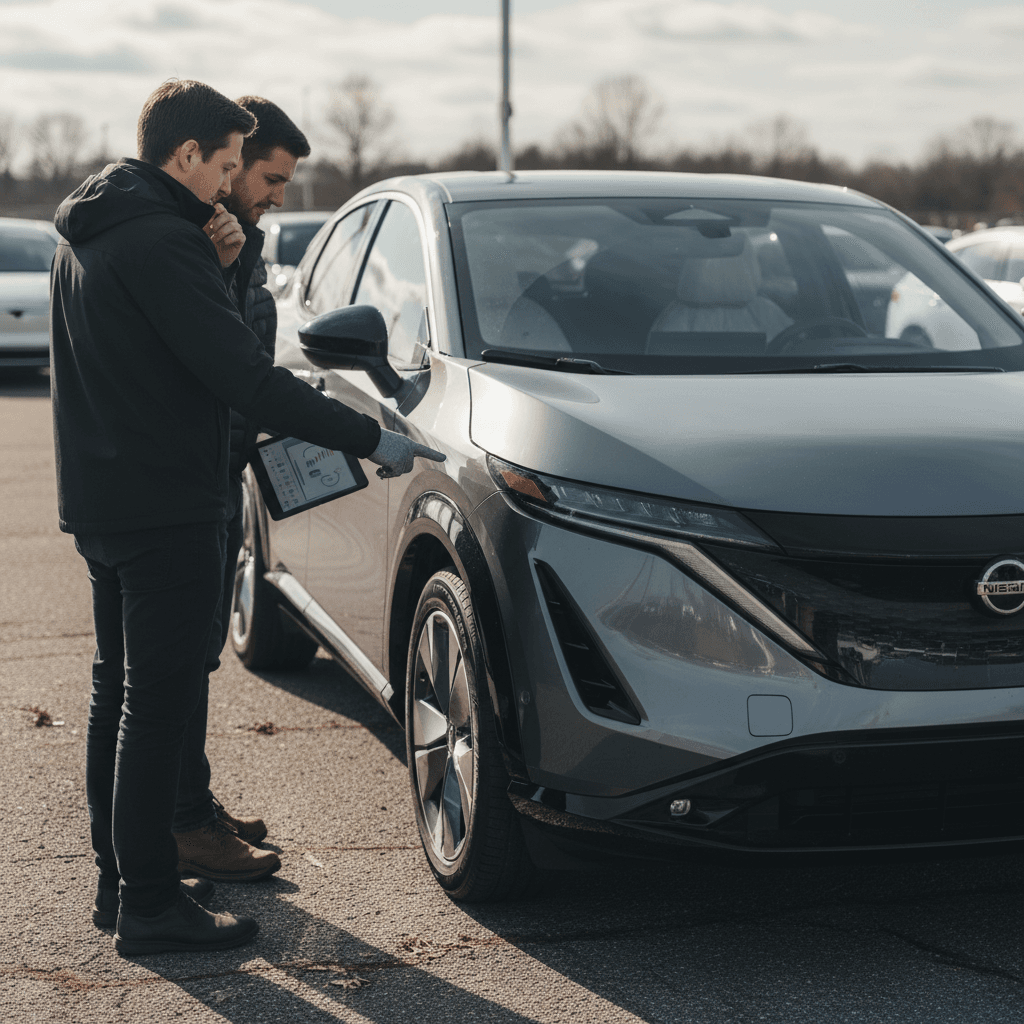
Let’s walk through a few realistic 2026 scenarios to show how Nissan Ariya trade‑in value can change depending on your situation. These are examples, not guaranteed numbers, but they’ll put guardrails around what’s reasonable.
Sample 2026 Ariya trade‑in scenarios
Scenario 1: 2024 Ariya Evolve+, low miles
• Purchased new in late 2023 for around $45,000. • By mid‑2026 it has ~18,000 miles, clean history, and excellent battery health. <strong>2026 reality:</strong> Dealer might retail it around the mid‑$20,000s and offer a trade‑in in the low‑$20,000s. An EV‑focused buyer who values the clean battery report may stretch a bit higher.
Scenario 2: 2023 Ariya Engage, average miles
• Original MSRP in the upper $30,000s. • By 2026 it shows ~36,000 miles and basic equipment. <strong>2026 reality:</strong> Retail listings cluster around $20,000–$23,000, with trade‑in offers in the mid‑ to high‑teens if condition is solid and history is clean.
Scenario 3: 2023 Ariya with accident on record
• Similar to Scenario 2, but with a prior rear‑end repair and visible paint mismatch. <strong>2026 reality:</strong> Some dealers will automatically shave $1,000–$3,000 off otherwise comparable trade‑ins, especially if the accident triggers structural or airbag damage on reports.
Scenario 4: High‑mileage commuter Ariya
• 2023 Evolve+ with 60,000+ miles by 2026, mostly freeway. • Battery health tests okay but not exceptional. <strong>2026 reality:</strong> Expect offers at or below the low‑teens. A strong history of scheduled maintenance and clean battery scans can keep it from falling into wholesale‑only territory.
Beware the “over‑allowance” trick
How to maximize your Ariya trade‑in value (step‑by‑step)
You can’t change what Nissan or the broader EV market has already done, but you can absolutely influence where your Ariya lands inside those 2026 value bands. Here’s a practical, pre‑trade‑in checklist.
Pre‑trade‑in checklist for your Nissan Ariya
1. Get a battery health report
Schedule a proper <strong>battery diagnostic</strong> before you shop your Ariya. A documented, healthy pack is your biggest bargaining chip. Recharged’s <strong>Recharged Score battery health report</strong> is designed exactly for this, a third‑party view that buyers and lenders can trust.
2. Fix inexpensive cosmetic issues
Touch up curb rash on wheels, clean or replace worn floor mats, remove decals, and have professional detailing done. A few hundred dollars spent smartly can add <strong>$500–$1,000</strong> in trade‑in value by making the car “front‑line ready.”
3. Assemble maintenance and charging records
Save receipts for tire rotations, cabin filters, brake fluid, and any warranty work. If you use DC fast charging a lot, bring documentation showing your patterns are normal and not abusive. Organized paperwork builds confidence and can keep a wary appraiser from padding in extra risk.
4. Get two or three real offers
Use at least one EV‑specialist platform, like an instant offer from Recharged, plus a quote from your local Nissan store and perhaps another brand dealer. If one number is way out of line, you’ll know it’s an outlier, not “what the market says.”
5. Separate your trade from your new‑car deal
Negotiate the price of the new vehicle <em>and</em> the value of your Ariya <strong>as two separate conversations</strong>. This makes it much easier to see whether a great trade‑in is being offset by an inflated selling price or vice‑versa.
6. Consider a clean retail sale or consignment
In some cases, you’ll net more by <strong>selling your Ariya outright</strong> instead of trading it. Recharged, for example, can list your Ariya on our marketplace with nationwide exposure, handle financing and paperwork, and return more of the final sale price to you than a same‑day trade‑in would.
Trade in at a dealer vs. sell your Ariya to Recharged
You’ve basically got three paths in 2026: trade your Nissan Ariya in at a franchised dealer, sell it yourself, or work with a specialist marketplace like Recharged. Each has different pros and cons.
Comparing your 2026 Ariya selling options
Convenience, price, and risk rarely line up perfectly. Choose what matters most to you.
Franchised dealer trade‑in
- Pros: Easiest; you’re in and out with one set of paperwork; good if you’re heavily upside‑down and need help rolling negative equity.
- Cons: Often the lowest number, especially from stores that don’t understand EVs or overestimate battery risk.
Private‑party sale
- Pros: Potentially the highest sale price if you’re patient and good with marketing and screening buyers.
- Cons: You handle showings, test drives, payoff logistics, and fraud risk yourself. Many shoppers still hesitate around used EVs without formal battery reports.
Recharged instant offer or consignment
- Pros: EV‑specialist pricing, instant digital offers, and options: trade‑in, instant sale, or consignment. Every Ariya gets a Recharged Score battery health report and nationwide exposure.
- Cons: You may wait a bit longer with consignment versus a same‑day dealer trade if you choose to chase maximum value.
How Recharged fits into your 2026 plan
Ready to find your next EV?
Browse VehiclesWhen is the best time in 2026 to trade your Ariya?
Timing is never perfect, but EV owners have a few extra variables to think about. In 2026, used EV supply is rising as 2023–2024 leases roll off, while new‑EV pricing remains aggressive. That argues for a strategic, not reactive, approach.
Timing your Nissan Ariya trade‑in in 2026
If you’re close to mileage or warranty limits
Watch your odometer relative to warranty milestones (for example, 36,000 miles for many bumper‑to‑bumper policies). Crossing them can dent value.
Try to trade or sell <strong>before</strong> a big mileage rollover like 40,000 or 60,000 miles, it’s psychologically important to buyers and appraisers.
Plan 60–90 days ahead so you can gather battery reports, offers, and your next‑vehicle options instead of trading under pressure.
If your Ariya is leased
Check your payoff vs. market value in early 2026. In many cases, market values have fallen below lease residuals, so buying out then trading may not pencil.
Ask whether there are <strong>lease‑end incentives</strong> or loyalty bonuses that effectively raise your trade‑in value if you stay with the brand.
If your buyout is lower than what Recharged or a dealer will pay you, you may have equity to capture. Don’t leave it behind by just dropping the keys and walking away.
If you own it outright
You have maximum flexibility. You can list the Ariya on consignment, wait for the right buyer, or trade only when the new‑car numbers look good.
Pay attention to fuel prices and local incentives, when gas spikes or new EV rebates change, <strong>used EV interest jumps</strong>, which can briefly improve your position.
If battery health is strong and you like the car, remember that every extra year you keep it after the steep early depreciation curve is largely “bonus value.”
Avoid the last‑minute trade
FAQ: Nissan Ariya trade‑in value in 2026
Frequently asked questions about 2026 Nissan Ariya trade‑ins
Bottom line: Building a smart 2026 Ariya trade‑in strategy
The Nissan Ariya has been caught in the same crosswinds as many modern EVs: fast‑moving technology, big new‑car discounts, and a used‑car market still learning how to price batteries. That’s why 2026 Nissan Ariya trade in value can feel lower than you expected when you first signed the paperwork. But you’re not powerless. With a verified battery health report, honest pricing research, a clean, well‑presented vehicle, and a few competing offers, you can lift your Ariya to the top of its value band instead of the bottom.
If you’re ready to see real numbers rather than guesses, consider starting with an instant offer or consignment evaluation from Recharged. You’ll get EV‑specific guidance, a clear look at how your Ariya’s battery health stacks up, and flexible options, trade‑in, sale, or upgrade, to make 2026 the year your next electric vehicle move actually feels smart, not painful.