If you’re shopping for a used electric SUV, the Nissan Ariya safety rating and crash test results are probably near the top of your checklist. The good news: the Ariya has performed well in independent crash tests and comes loaded with modern driver‑assist tech. The nuance is in the details, model year, build date, and options all matter.
Quick safety snapshot
Nissan Ariya safety overview at a glance
How the Nissan Ariya scores on safety
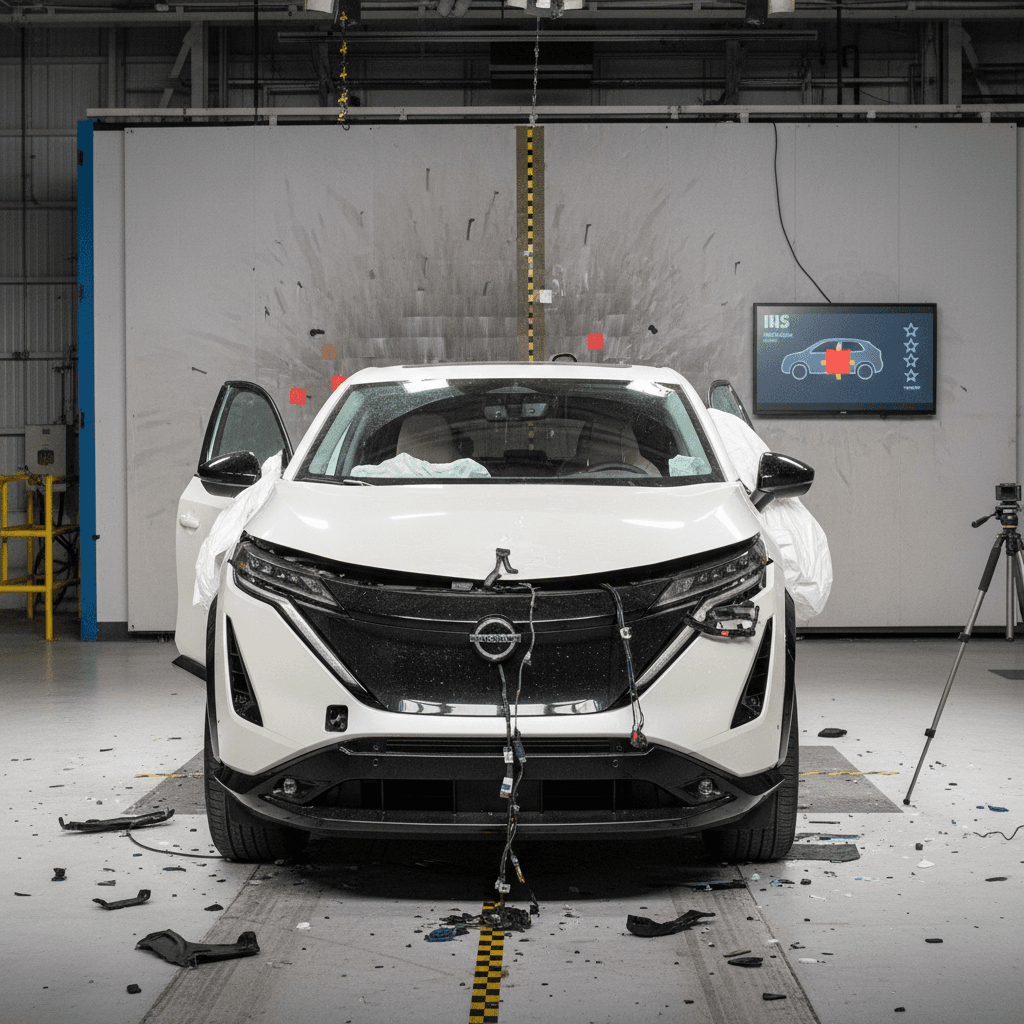
For U.S. shoppers, the headline is simple: the Ariya has been evaluated by the Insurance Institute for Highway Safety (IIHS) and has earned Top Safety Pick or Top Safety Pick+ depending on model year and build date. That puts it in the same conversation as other safety‑focused electric SUVs like Hyundai Ioniq 5 and Tesla Model Y.
However, safety isn’t just a single score. The Ariya’s crash tests reveal where it excels (side impacts, small‑overlap frontal crashes, pedestrian detection) and where there’s room for improvement (the newest, tougher moderate‑overlap frontal test). We’ll walk through each test and then translate those lab numbers into real‑world shopping advice, especially if you’re considering a used Nissan Ariya from a marketplace like Recharged.
IIHS crash test results for the Nissan Ariya
When shoppers talk about "crash test cars," they’re usually thinking of IIHS. The nonprofit crashes vehicles into barriers in a series of brutal tests and then grades them from Good (G) down to Poor (P). Here’s how the Ariya stacks up in the latest round of evaluations.
IIHS crash test scores: 2025 Nissan Ariya
Summary of key IIHS ratings for the 2025 Nissan Ariya midsize SUV.
| Category | Test / Feature | 2025 Ariya Rating | What it means for you |
|---|---|---|---|
| Crashworthiness | Small overlap front (driver & passenger) | G | Strong protection when you hit or are hit by another vehicle or object with only part of the front end. |
| Crashworthiness | Moderate overlap front (updated test) | M | Structure and restraints are adequate but not class‑leading in IIHS’s newest, stricter frontal crash test. |
| Crashworthiness | Side impact (updated test) | G | Performs very well in severe side impacts from a taller SUV or pickup. |
| Crash avoidance | Front crash prevention: pedestrian (day & night) | G | Ariya can avoid or significantly reduce impact speed with pedestrians in most IIHS scenarios. |
| Crash avoidance | Headlights (all trims) | A | Standard LED headlights are Acceptable after a 2023 aiming update; earlier builds were rated lower. |
| Occupant protection | Seat belt reminders | A | Seat belt warning logic is good but could be more assertive. |
| Child safety | LATCH ease-of-use | G+ | One of the easiest vehicles in its class for installing child seats correctly. |
Ratings are on the IIHS scale of Good (G), Acceptable (A), Marginal (M), Poor (P).
Family‑friendly bonus
The big story is that the Ariya does very well in the tests that mimic many common real‑world crashes: small‑overlap front impacts and the updated side test. The main caveat is its Marginal grade in the newest moderate‑overlap frontal test, which is designed to better evaluate rear‑seat occupant protection. That doesn’t mean the Ariya is unsafe, it simply means some rivals manage crash forces slightly more gracefully in that specific, very demanding scenario.
Build date matters
Euro NCAP ratings and how they translate for U.S. shoppers
If you’ve been digging deep on the Ariya, you may have run across Euro NCAP results as well. Europe’s crash‑test program uses different scoring buckets, but the themes are similar: the Ariya offers robust protection and advanced driver assistance when properly equipped.
What Euro NCAP liked about the Ariya
Highlights from independent European testing, translated into plain English
Strong active safety
Pedestrian protection
Balanced assistance
European ratings don’t replace U.S. IIHS and NHTSA scores, but they do add confidence: in multiple regions and test programs, the Ariya’s underlying structure and software‑based safety tech perform well.
Does the Nissan Ariya have an NHTSA safety rating?
As of early 2026, the Nissan Ariya has not yet received a published 5‑Star Safety Rating from NHTSA in the U.S. It simply hasn’t been through that specific government test program, which focuses on frontal and side barrier impacts plus rollover risk.
IIHS vs. NHTSA, what’s the difference?
For the Ariya, that means you’ll be relying primarily on IIHS crash tests, Euro NCAP assessments, and the vehicle’s extensive standard safety equipment rather than NHTSA stars. In practice, most safety‑focused shoppers treat IIHS scores as at least equal, if not more demanding, than NHTSA’s.
Key Nissan Ariya safety features and driver assists
On paper, every Ariya is well equipped. Even base trims include a deep roster of active and passive safety tech. Higher trims layer on more sophisticated driver‑assist features and, in some markets, hands‑free capability.
Standard safety tech on most Nissan Ariya trims
What you can typically expect, even on lower trims
Collision avoidance
- Automatic emergency braking with pedestrian detection
- Forward collision warning
- Rear automatic braking to help avoid backing into obstacles
Lane & blind‑spot support
- Lane departure warning and lane keeping assistance
- Blind‑spot monitoring
- Rear cross‑traffic alert
Occupant protection
- Advanced airbags and strong occupant cell
- Good seat and head‑restraint design
- Excellent LATCH child‑seat anchor usability
Visibility & lighting
- LED headlights on all trims
- Automatic high‑beam assist on many models
- Improved headlight aiming on 2023‑onward builds
Good news for used‑EV shoppers
Is ProPILOT Assist 2.0 a safety feature or convenience tech?
The Ariya’s headline option is ProPILOT Assist 2.0 on select higher trims. It’s often advertised as a semi‑hands‑free system that can steer, brake, and accelerate on certain mapped highways. That sounds like a safety net, but it’s more accurate to think of it as driver convenience technology with safety layers built in, not an autopilot.
What ProPILOT Assist 2.0 can do
- Provide lane‑centering steering on clearly marked roads
- Adjust speed with adaptive cruise control, including stop‑and‑go in traffic
- In some versions, allow hands‑free operation on pre‑mapped highways with driver monitoring
- Help maintain distance from vehicles ahead and, in some scenarios, support automated lane changes
What it can’t do
- Replace your attention, you are still responsible for steering, braking, and accident avoidance
- Perfectly read every speed‑limit sign, lane marking, or curve
- Function reliably in heavy rain, snow, glare, or when cameras/radars are blocked
- Guarantee crash avoidance in every scenario
Hands‑free is not crash‑free
Independent European testing backed this up: Euro NCAP scored the Ariya’s ProPILOT‑based system "Very Good" overall, awarding high marks for both driver assistance and safety backup behavior. In plain terms, it’s one of the better‑behaved systems out there when used as intended.
Real‑world safety: what Ariya owners report
Crash tests happen once, in a lab. You’ll live with your Ariya every day, through storms, surprise traffic, and the occasional inattentive driver next to you at 75 mph. Owner stories help fill in that picture.
- Many owners praise the Ariya’s calm, planted feel and predictable braking, which can help you avoid trouble before the airbags ever matter.
- The elevated driving position and large glass area contribute to good all‑around visibility, especially compared with some coupe‑ish EV crossovers.
- Some drivers report overly cautious or quirky behavior from speed‑limit recognition and adaptive cruise, such as slowing down when it misreads a side‑road or toll‑booth sign.
- Like most camera‑ and radar‑based systems, ProPILOT can be fussy after windshield or bumper repairs if sensors aren’t perfectly calibrated. That’s an important note on used cars with recent bodywork.
Sensor calibration matters
Safety checklist for buying a used Nissan Ariya
On the used market, you’re not just buying safety engineering, you’re buying how that car has been cared for. Here’s a practical checklist to size up a used Nissan Ariya’s safety before you fall in love with the color or the payment.
Used Nissan Ariya safety checklist
1. Confirm build date and trim
Look at the driver‑side door jamb for the build month and year. Builds after March 2023 benefit from improved headlight performance in IIHS testing. Note the trim level so you know which safety and ProPILOT features it should have.
2. Inspect headlights and lenses
Check for hazing, cracks, or mismatched headlight assemblies (a sign of accident repair). Even great crash ratings can’t help if you can’t see well at night. Ask if the car has had any headlight‑or front‑end‑related warranty work.
3. Ask about crash history and repairs
Pull a vehicle history report and review any front or side impacts. If the car has had structural repairs, consider an independent inspection to verify airbag systems and crumple zones were restored correctly.
4. Verify ADAS calibration
On a test drive, confirm that lane‑keeping, adaptive cruise, blind‑spot monitoring, and automatic emergency braking behave normally and don’t show warning lights. Recent windshield or bumper work should come with documentation of camera/radar calibration.
5. Test child‑seat fit
Bring your own car seat(s) and latch them in. The Ariya’s LATCH system is highly rated, but you’ll want to verify ease of use and front‑seat room with your specific gear and family needs.
6. Review tires and brakes
Grippy tires and healthy brakes are your first line of defense. Look for even tire wear, plenty of tread depth, and a firm, predictable brake pedal, especially on heavier EVs like the Ariya.
7. Check for software updates
Ask the seller or a Nissan dealer about recent software updates for safety and driver‑assist systems. Many glitches or false alerts are fixed with updated code, not wrenches.
How Recharged approaches used‑EV safety
Ready to find your next EV?
Browse VehiclesNissan Ariya safety rating & crash test FAQ
Common questions about Nissan Ariya safety
Bottom line: Is the Nissan Ariya a safe EV to buy used?
The short answer: yes. The Nissan Ariya combines strong lab‑tested crash performance with a deep bench of standard safety tech, excellent LATCH usability for families, and one of the more polished driver‑assist suites when equipped with ProPILOT Assist 2.0. Its lone weak spot is the latest, more demanding moderate‑overlap front test, where it trails the very best performers, but it still clears the bar for IIHS Top Safety Pick status.
On the used market, the smartest move is to focus on build date, repair history, and the specific safety features you care about most. That’s where a transparent marketplace like Recharged helps: every EV comes with a Recharged Score Report, verified battery health, and EV‑savvy guidance so you’re not decoding crash tests and trim codes alone. Do your homework, drive a few contenders, and the Ariya can be a safe, comfortable, and confidence‑inspiring electric SUV for years to come.