If you’re eyeing a Nissan Ariya, especially a used one, the big question is simple: how much battery degradation per year should you expect? You’re not wrong to worry; early Nissan Leafs were infamous for cooked batteries. The Ariya is a different animal: liquid‑cooled pack, bigger buffer, and a capacity warranty that quietly tells you what Nissan expects the chemistry to do over time.
Quick take
Nissan Ariya battery degradation per year: the short version
Nissan Ariya battery degradation at a glance
There isn’t yet a decade of hard fleet data on the Ariya, it launched globally in 2022, but we can triangulate from three things: owner reports, Nissan’s pack design, and its 8‑year/100,000‑mile capacity warranty. Put that together and a realistic expectation is:
- Around 1–2% capacity loss per year for a typical driver who mostly AC‑charges, avoids leaving the car parked at 100% in heat, and doesn’t DC fast‑charge every day.
- After 8 years, many Ariyas should still have roughly 85–90% of original capacity.
- By 10 years, a well‑treated Ariya might still be in the low‑80% range; a hard‑used one could dip closer to 75–80%.
Don’t confuse cold‑weather range with degradation
How the Nissan Ariya battery is built (and why that matters for degradation)
Nissan clearly learned from the Leaf. The Ariya’s pack is a much more mature piece of hardware designed to age slowly, not melt in the Arizona sun.
Key Nissan Ariya battery design choices
These are the quiet heroes behind its slower degradation curve
Modern liquid‑cooled pack
The Ariya uses a liquid‑cooled high‑voltage pack, unlike the air‑cooled Leaf. Coolant channels manage cell temperatures under fast charging and in heat, which is crucial for slowing long‑term degradation.
Big usable capacity, bigger buffer
There are two main packs: a 63 kWh usable (≈66 kWh gross) and an 87 kWh usable (≈91 kWh gross). That difference between usable and gross helps hide early‑life capacity loss inside a buffer, so you don’t see 2–3% instantly vanish on the dash.
NMC chemistry tuned for longevity
The Ariya uses modern nickel‑manganese‑cobalt cells (some trims using NMC 811 cathodes). Nissan has tuned these for a balance of energy density and durability rather than headline‑grabbing peak charging speeds.
Conservative power and charge rates
Peak DC rates are competitive but not brutal. The car doesn’t hammer the pack at 250 kW; it charges more gently, which is less spectacular on YouTube and kinder to the battery after 6–8 years.
Why buffers matter
Real‑world Nissan Ariya battery degradation so far
We’re now a few years into Ariya ownership. Cars built in 2022 are approaching their fourth birthdays, and thousands of 2023–2025 models have real mileage on them. The early story is boring in the best possible way: no pattern of rapid battery decay has emerged.
Owner‑reported battery health
- Drivers with 15,000–30,000 miles on 2023 Ariyas are routinely reporting 99–96% state of health from dealer diagnostics or OBD tools, well within normal early‑life settling.
- Several owners past the 2–3 year mark still hit their original realistic highway ranges when the weather’s mild, suggesting little noticeable degradation so far.
- Battery health gauges in the cluster often still show full bars; Nissan clearly designed the display not to twitch at the first few percent of loss.
Data from the broader EV world
- Independent EV‑fleet studies across many brands point to an average of about 1–2% capacity loss per year when cars are managed reasonably well.
- Nothing in Ariya owner data so far suggests it’s an outlier in a bad way; if anything, it sits on the conservative, well‑managed side of the curve.
- Most real‑world complaints around the Ariya today focus on software quirks or 12V issues, not the main traction battery fading prematurely.
Good news for used shoppers
Ready to find your next EV?
Browse VehiclesWhat Nissan’s battery warranty really promises
Automakers rarely tell you exactly how many percent per year to expect. Instead, they hide their expectations inside the warranty fine print. For the Ariya, that fine print is actually quite reassuring.
Nissan Ariya battery warranty basics (U.S. market)
Always check the specific warranty booklet for your model year, but this is the broad outline.
| Coverage | Term | What it covers | Key trigger |
|---|---|---|---|
| EV system warranty | 8 years / 100,000 miles | Defects in materials or workmanship for the high‑voltage battery and EV system components | Component failure, not normal wear |
| Battery capacity warranty | 8 years / 100,000 miles | Excessive loss of battery capacity beyond Nissan’s standard | Capacity bar gauge dropping below a defined threshold (often ≈9 of 12 bars) |
| Capacity floor (practical) | ≈85% by year 8 | Implied by bar‑gauge threshold and Nissan documentation | Below this, you may qualify for pack repair/replacement |
Warranty terms tell you what Nissan thinks is a realistic degradation curve, not a fantasy scenario.
Use the warranty to read the tea leaves
One wrinkle with Nissan: they often use a capacity bar gauge in the dash rather than quoting raw percent. That can make it harder for you to see the first 5–10% disappear. It’s not deception so much as expectation management; the company would rather you not obsess over a percentage bouncing with the weather.
7 things that actually speed up Ariya battery degradation
Degradation isn’t random bad luck. It’s chemistry responding to how you use and store the car. Here are the big levers that push a Nissan Ariya battery to age faster, or keep it happy for a decade.
Real‑world Ariya battery stressors
1. Keeping it at 100% in hot weather
Parking an Ariya at a full charge in summer heat, especially for days at a time, is about the worst thing you can do for long‑term health. High state of charge plus high temperature accelerates cell wear.
2. Constant DC fast charging from low to 100%
Occasional road‑trip fast charging is fine. Living on DC chargers, hammering the pack from 10% to 90–100% several times a week, will age the cells faster than slower AC charging.
3. Deep cycling to nearly empty
Routinely running the battery down into the single digits before charging increases stress. The Ariya has buffers, but you’ll still see more wear than someone who lives between, say, 20–80%.
4. High sustained speeds and aggressive driving
Blasting along at 80–85 mph for hours heats the pack and draws high power. That alone won’t ruin it, but when combined with high SOC and heat, it adds up over years.
5. Chronic fast‑charging in extreme cold
Fast‑charging a cold‑soaked pack forces the car to heat the battery rapidly. The Ariya manages this reasonably well, but doing it habitually in sub‑freezing temps isn’t ideal for longevity.
6. Letting the car sit totally full or totally empty for weeks
Storing an Ariya at 0–5% or 95–100% for long periods is unhealthy. If it’ll sit for weeks, aim for ~40–60% SOC and a cool place.
7. Poor 12V health and software issues
While not direct degradation, a weak 12V or software bugs can cause odd charging behavior and deep discharge events. Keeping firmware updated and fixing 12V issues promptly protects the main pack indirectly.
How to slow Nissan Ariya battery degradation day to day
The good news: you don’t have to drive like a monk or spreadsheet your kilowatt‑hours. A few simple habits will keep your Ariya’s battery aging gracefully, whether you plan to own it for three years or thirteen.
Everyday habits that protect your Ariya battery
Think of these as sunscreen for your traction pack
Live in the middle
Whenever practical, try to keep daily use between about 20% and 80%. The Ariya doesn’t let you set an automatic charge cap, but you can manually unplug or schedule end‑of‑charge times so it isn’t sitting at 100% all night.
Prefer AC home charging
Use Level 2 home or workplace charging as your default and save DC fast charging for trips. Slower charging is gentler on the pack, and you’ll still wake up to plenty of range.
Fight the heat, not the cold
Cold kills range for the day but not the battery; heat is what ages cells. Whenever possible, park in shade or a garage in summer and avoid leaving the car fully charged in extreme heat.
Time your 100% charges
If you need a full battery for a trip, great, just time the charge to finish right before you leave instead of topping off to 100% at 7 p.m. and letting it bake until morning.
Build “soft limits” into routine
Because the Ariya doesn’t offer a built‑in 80% limit, use your own rule of thumb: charge every night to roughly what you’ll need plus a cushion, not to the top of the gauge by default.
Keep software and 12V healthy
Stay current on software updates and fix any 12V battery issues quickly. A happy low‑voltage system means fewer weird wake‑ups and fewer needless deep discharges of the main pack.
Estimating Nissan Ariya range loss over 5–10 years
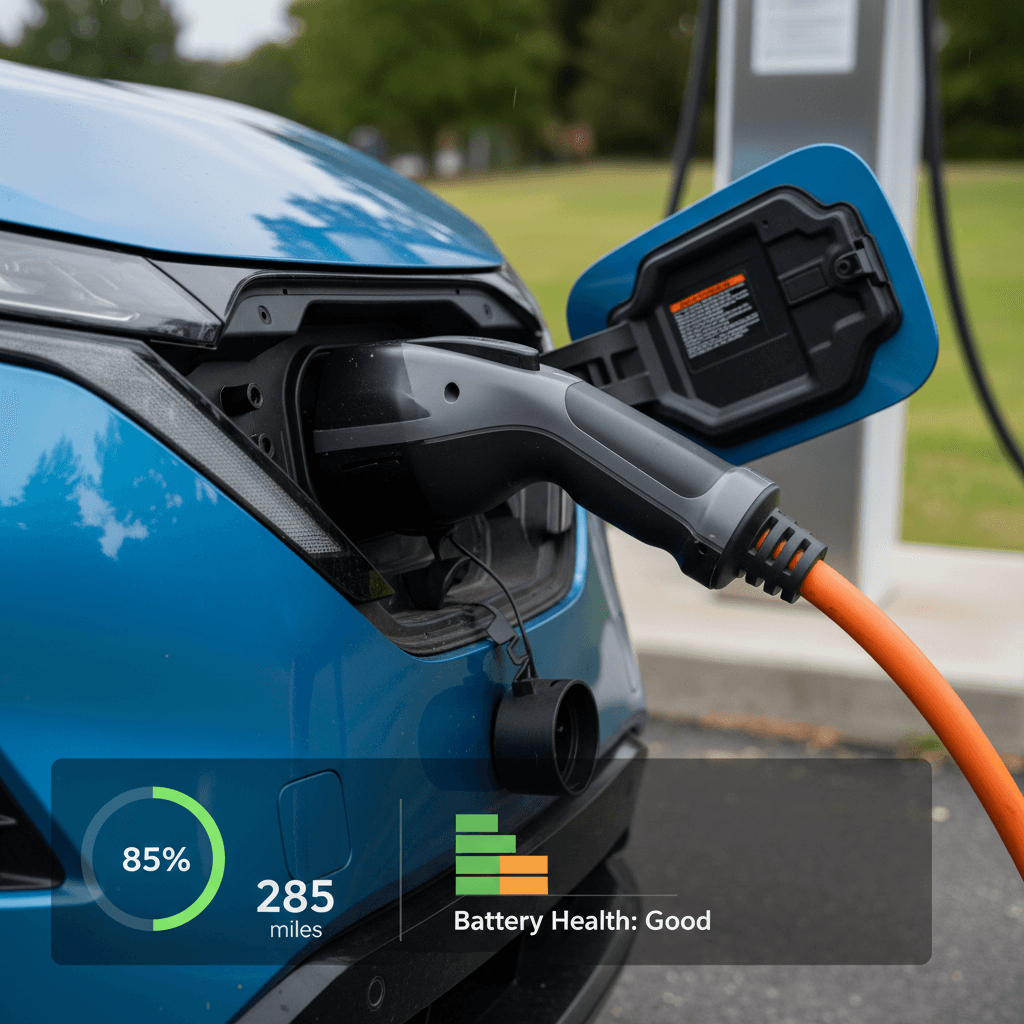
Let’s translate percentages into something you actually feel: miles of range. We’ll use the long‑range Ariya Venture+ (EPA ~289 miles) as an example, but the math scales to other trims.
Approximate Nissan Ariya range loss over time
Assuming 1.5% average annual capacity loss and mostly gentle use.
| Year | Approx. capacity | Highway range on a full charge* | What it feels like day to day |
|---|---|---|---|
| New | 100% | ≈289 mi | You can realistically plan 230–250‑mile highway legs in good weather. |
| Year 5 | ≈92–93% | ≈265–270 mi | You might trim a fuel stop on long trips, but around town it’s barely noticeable. |
| Year 8 | ≈86–88% | ≈250–255 mi | You start noticing that “full” isn’t quite as full, but the car still works fine as a family hauler. |
| Year 10 | ≈80–84% | ≈230–240 mi | You plan highway stops a bit more carefully, but for commuting it’s still more range than many people use in a week. |
These are ballpark estimates, not guarantees, but they’re a useful sanity check.
*Real‑world highway range depends heavily on speed, temperature, terrain, and wheel/tire choice. These numbers assume moderate temperatures, mostly 65–70 mph, and a driver who isn’t drag‑racing from every stoplight.
When you’ll really feel it
Used Nissan Ariya? How to judge battery health before you buy
On the used market, battery health is the whole ballgame. A three‑year‑old Ariya with a lazy pack and no remaining warranty is a different car, in resale value and in real utility, than one that’s been gently driven and still tests strong.
Battery‑health checklist for used Ariya shoppers
1. Don’t trust the range estimate alone
The guess‑o‑meter on the dash is influenced by the last few drives and the weather. It can look pessimistic in winter even with a healthy pack, or optimistic if someone babied it for a week. You need harder data.
2. Ask for a formal battery health report
A <strong>Recharged Score report</strong> uses verified diagnostics and real‑world data to estimate true state‑of‑health, not just bars on the dash. That’s a huge upgrade over eyeballing an EPA sticker and hoping.
3. Confirm remaining battery warranty
Make sure the high‑voltage and capacity warranties <strong>transfer to you</strong> and check the in‑service date. A 2023 Ariya first sold in early 2023 is covered for capacity through early 2031, or 100,000 miles, whichever comes first.
4. Look for usage clues
Frequent DC‑fast‑charging receipts, rideshare use, or a life in extreme climates might justify a closer look. None are automatic deal‑breakers, but they’re reasons to demand real diagnostics, not vibes.
5. Test in normal temps if you can
A short test drive in mild weather tells you far more about real range than a quick loop in a snowstorm. If you must buy in winter, lean heavily on diagnostic data and third‑party reports.
6. Consider total cost, not just sticker
A slightly more expensive Ariya with a stronger battery and clearer documentation can be the better deal over 5–7 years than a cheaper one that’s already lost a big slice of usable range.
How Recharged fits in
FAQs: Nissan Ariya battery degradation and range loss
Common questions about Nissan Ariya battery degradation per year
Bottom line: Is Nissan Ariya battery degradation a dealbreaker?
If you’re haunted by images of Nissan Leafs shedding range like autumn leaves, the Ariya’s battery story is almost suspiciously calm. A modern, liquid‑cooled pack, conservative tuning, and an 8‑year capacity warranty all point to steady, manageable degradation in the 1–2% per‑year neighborhood, not a cliff. Barring abuse, an Ariya bought in 2024 should still be a perfectly usable EV well into the 2030s.
Where things get interesting is on the used market. Two Ariyas that look identical in photos can have very different battery histories and futures. That’s where verified diagnostics and a clear battery health report matter more than clever marketing or a shiny detail job. Whether you buy through Recharged or elsewhere, treat the pack like the engine: make it the first thing you understand, not the last.
Do that, and Nissan Ariya battery degradation per year stops being a lurking anxiety and becomes what it really is: a predictable, slow‑moving background process you can plan around, much like tire wear, only less dramatic and far more forgiving.