If you’re trying to understand real-world Mercedes EQS tire replacement cost, you’re asking the right question. On a 5,500‑plus‑pound luxury EV with 20–21 inch wheels, tires are not a minor expense, they’re one of the biggest ongoing costs of EQS ownership, especially once the car is a few years old or you buy used.
Quick take
Mercedes EQS tire replacement cost at a glance
Typical 2025 Mercedes EQS tire costs (U.S.)
Those numbers line up with broader EV data: large, heavy performance EVs on 20–22 inch tires often land in the $220–$350+ per tire range for quality replacements, and many see 20,000–30,000 miles out of a set if driven normally. The EQS fits squarely into that pattern as a long, heavy luxury flagship.
Why Mercedes EQS tires cost more than you expect
If you’re coming from an E‑Class or C‑Class on 18s, EQS tire quotes can trigger a bit of sticker shock. Several forces are working against you:
- Vehicle weight: A dual‑motor EQS weighs well over 5,500 pounds. That extra mass and instant EV torque mean the tires work harder on every launch and corner.
- Wheel size: Many EQS sedans and SUVs ship with 20" or 21" wheels. As rim diameter goes up, so does tire cost, often dramatically once you cross the 20" line.
- Performance orientation: Factory fitments are often Goodyear Eagle Touring or Goodyear Eagle F1 / ultra‑high‑performance rubber, tuned for grip and refinement rather than maximum tread life.
- EV‑specific construction: More and more replacements are "EV" or "XL" variants with higher load ratings, reinforced sidewalls, and noise‑reduction features. All of that engineering shows up on your invoice.
- Limited competition: There simply aren’t that many 275‑section, 20–21" EV‑rated tires in the U.S. market yet. Less competition means less downward price pressure.
Don’t downsize load rating to save a buck
EQS tire sizes, OEM brands, and what they cost
Exact fitment depends on whether you have an EQS sedan or EQS SUV, as well as trim and package, but most U.S. EQS models fall into a few common patterns:
Common Mercedes EQS wheel and tire setups
Your actual size is on the driver’s door jamb and tire sidewall
19" comfort setup
Typical sizes:
245/45R19 or similar
- Often all‑season touring tires
- Better ride and slightly lower cost
- Easier to find in stock
Expect roughly $220–$300 per tire from mainstream premium brands in 2025.
20" luxury/performance
Typical sizes:
255/40R20 front, 285/35R20 rear (varies)
- Mix of comfort and handling
- More EV‑specific options appearing
Budget around $260–$350 per tire for quality replacements.
21" AMG and large wheel packs
Typical sizes:
265/35R21 and similar staggered setups
- Ultra‑high‑performance, low‑profile rubber
- Few true EV‑rated choices
It’s not unusual to see $325–$425 per tire for name‑brand replacements.
From the factory, many EQS owners report Goodyear Eagle Touring or Goodyear Eagle F1 Asymmetric fitments, with Pirelli or Michelin options showing up in winter or replacement scenarios. Regardless of brand, you’re shopping in the same price neighborhood as high‑end S‑Class or Tesla Model S tires.
How long do Mercedes EQS tires typically last?
EV tire life is one of the most misunderstood parts of ownership, and the EQS is no exception. On paper, some of these tires carry 40,000–50,000‑mile treadwear warranties. In the real world, heavy luxury EVs rarely deliver those numbers.
Realistic expectations
- On 20–21" wheels, many EQS drivers see 20,000–30,000 miles out of a set driven normally.
- Spirited driving, lots of highway miles, or poor alignment can drag that closer to 15,000–20,000 miles.
- On 19" wheels with a comfort‑oriented all‑season tire and gentle driving, 30,000+ is more achievable.
Factors that shorten tire life
- Frequent full‑throttle launches (instant torque is fun but expensive).
- Urban driving with lots of stop‑and‑go and sharp turns.
- Incorrect tire pressures, especially if you under‑inflate for "comfort".
- Skipping alignments after curb strikes or suspension work.
Use range as your early‑warning system
Full EQS tire replacement cost breakdown
To build a realistic budget, you need more than just the tire sticker price. Here’s how a typical EQS tire job in 2025 tends to pencil out at a reputable shop or dealer in the U.S.:
Example 2025 EQS tire replacement invoice (21" wheels)
Illustrative pricing for a set of four quality EV‑rated tires on a Mercedes EQS; your exact numbers will vary by size, brand, and region.
| Line item | Typical range | Notes |
|---|---|---|
| Tires (4x) | $1,300–$1,700 | $325–$425 per tire for 21" ultra‑high‑performance or EV‑rated fitments. |
| Mounting & balancing | $120–$200 | Usually $25–$50 per tire depending on shop and wheel complexity. |
| TPMS service / reset | $0–$60 | Some shops include this; others charge per sensor if they need service or replacement. |
| Disposal / recycling fees | $20–$40 | Per‑tire disposal fees mandated in many states. |
| Alignment (strongly recommended) | $140–$250 | Four‑wheel alignment is cheap insurance on an EQS after new tires. |
| Sales tax | Varies by state | Applied to parts and sometimes labor. |
Assumes mid‑range premium tires on 21" wheels and no additional repairs.
Add that up and you’re typically looking at $1,600–$2,100 out the door on 21s at dealer rates, or somewhat less at a high‑quality independent tire shop. Drop to 19–20" wheels and a slightly less aggressive tire, and the total can land closer to the $1,200–$1,600 range.
Leverage promotions when you can
How to save on EQS tire replacement without cutting corners
There’s no way to make EQS tires cheap, but you do have real levers to pull. The goal is to lower cost per mile, not just cost per tire.
Smart ways to reduce EQS tire costs
1. Consider 19" wheels if you have 21s
If you’re due for new tires and wheels anyway, say you’ve curbed a couple alloys badly, downsizing to a 19" or 20" OEM‑fit wheel can open up more tire choices and cut both price and wear. Just make sure the setup is compatible with your specific EQS trim.
2. Shop beyond the dealership
Mercedes dealers know they have a captive, time‑pressed audience. A reputable independent tire shop or regional chain can often beat dealer pricing on the same Goodyear, Michelin, or Pirelli tires and may offer more flexible road‑hazard coverage.
3. Prioritize longevity‑oriented all‑seasons
If you’re not chasing lap times, a high‑quality all‑season or EV‑touring tire with a higher treadwear rating can stretch replacement intervals, especially on 19–20" wheels. That can matter more than shaving 1 dB of road noise.
4. Rotate and align religiously
On a heavy EV with expensive rubber, a <strong>6,000–8,000‑mile rotation</strong> schedule and annual alignment checks are cheap insurance. That’s especially true on staggered setups or cars that see rough roads.
5. Keep pressures at the recommended spec
Under‑inflation kills tires and range. Use the pressures on your door jamb as a baseline, check every month or two, and before long highway trips.
6. Drive like the tires cost what they do
The EQS’s instant torque makes it effortless to light up the fronts or rears leaving a light. Fun, yes, but that habit alone can turn your tire budget into a subscription.
Are tire and wheel protection plans worth it on an EQS?
At EQS prices, it’s no surprise finance offices love to pitch wheel and tire protection. You might see numbers in the $1,500–$2,500 range for multi‑year coverage that promises unlimited tire replacements for road‑hazard damage and cosmetic wheel repairs.
When it can pencil out
- You live where potholes, nails, or construction debris are constant threats.
- Your EQS runs expensive 20–21" low‑profile tires and delicate, high‑polish wheels.
- You’re leasing and want to avoid lease‑end charges for cords showing or bent rims.
When to think twice
- The contract excludes normal wear, and only covers punctures or impact damage.
- You drive mostly on well‑maintained suburban or highway roads.
- You’re disciplined about shopping tires independently and don’t mind paying per incident.
Read the fine print before you sign
Spare tire options and roadside strategy for EQS owners
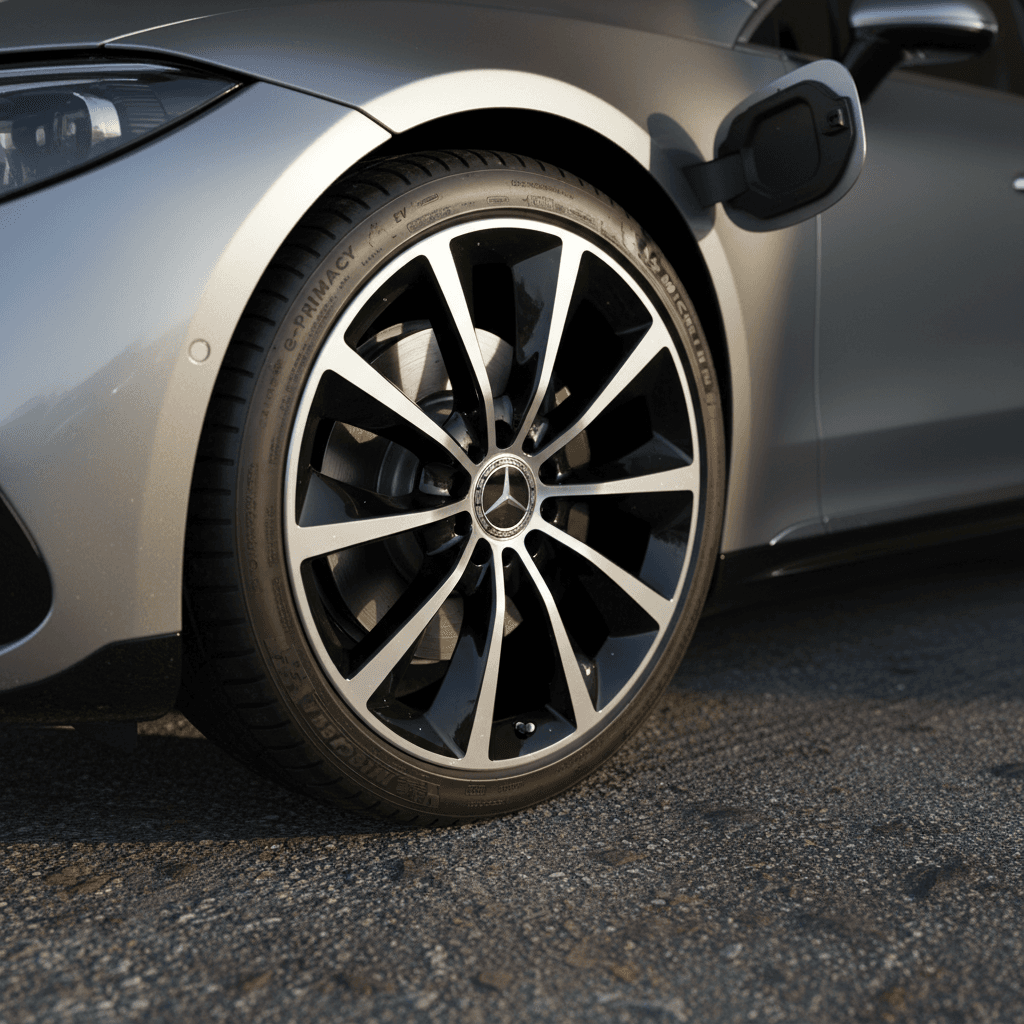
Like most modern luxury EVs, the EQS doesn’t ship with a conventional spare tire. You get sealant, an inflator, and a phone. For some owners that’s fine. For others, especially road‑trippers, that feels thin for a car on such pricey rubber.
How EQS owners handle flats
Deciding how much redundancy you want
OEM inflator + roadside
Use the factory sealant kit for small punctures and rely on Mercedes roadside assistance or your insurer for tows.
Pros: No extra cost or weight.
Cons: Useless for big sidewall damage; sealant can complicate TPMS service.
Compact spare kits
Aftermarket companies sell compact spares and jack kits tailored to the EQS platform.
Expect around $450–$700 for a ready‑to‑use kit, which is cheap peace of mind if you road‑trip often.
Road hazard coverage
Big tire retailers offer road‑hazard coverage for a modest fee per tire.
Pros: Protection without locking into dealer pricing.
Cons: Usually only for punctures, not cosmetic wheel damage.
What used Mercedes EQS shoppers should look for in tires
If you’re considering a used EQS, tires are a meaningful part of the total ownership equation. A car that “just needs tires” can quietly add $1,500–$2,000 to your first year of costs, while also telling you a lot about how the previous owner drove and maintained the car.
Used EQS tire checklist before you buy
1. Confirm tire age and brand
Check the four‑digit DOT date code on the sidewall (e.g., 2323 = 23rd week of 2023). Anything older than six years should be considered near end‑of‑life regardless of tread.
2. Measure tread depth across the width
Uneven wear from inside to outside can signal alignment issues, worn suspension bushings, or aggressive cornering. That’s a future cost beyond the tires themselves.
3. Verify all four match
Mismatched brands or models, especially on the same axle, can affect handling and traction. It’s also a sign the previous owner was cutting corners on maintenance.
4. Look for sidewall damage
Curb rash on 20–21" wheels often comes with sidewall scuffs or bubbles. Any bulges or deep cuts are non‑negotiable replacement items.
5. Factor replacement into your offer
If you’re staring at worn 21" tires, it’s reasonable to adjust your offer or request fresh rubber as part of the deal. You’re not haggling over floor mats; you’re negotiating a major wear item.
6. Ask for digital service records
Alignments and rotation history tell you whether the previous owner treated those expensive tires like consumables or like investments.
How Recharged helps on used EQS tires
Mercedes EQS tire cost: FAQ
Frequently asked questions about EQS tire costs
Bottom line: budget realistically for EQS tire costs
When you zoom out, Mercedes EQS tire replacement isn’t uniquely punishing compared with other big luxury EVs, it’s simply the going rate for heavy, powerful cars on 20–21" wheels. But because those costs show up in big, lumpy chunks every 20,000–30,000 miles, they’re easy to underestimate when you’re focused on the tech, comfort, and quiet.
If you assume $1,500–$2,000 every 2–3 years for tires, choose a wheel and tire package that matches your roads and driving style, and stay disciplined about rotations, pressures, and alignments, EQS tire costs become another manageable line item rather than an unpleasant surprise.
And if you’re cross‑shopping used EQS models against other premium EVs, use objective condition data to your advantage. At Recharged, every vehicle comes with a Recharged Score Report covering battery health, pricing, and tire condition, so you can compare total cost of ownership, not just monthly payments, before you commit.