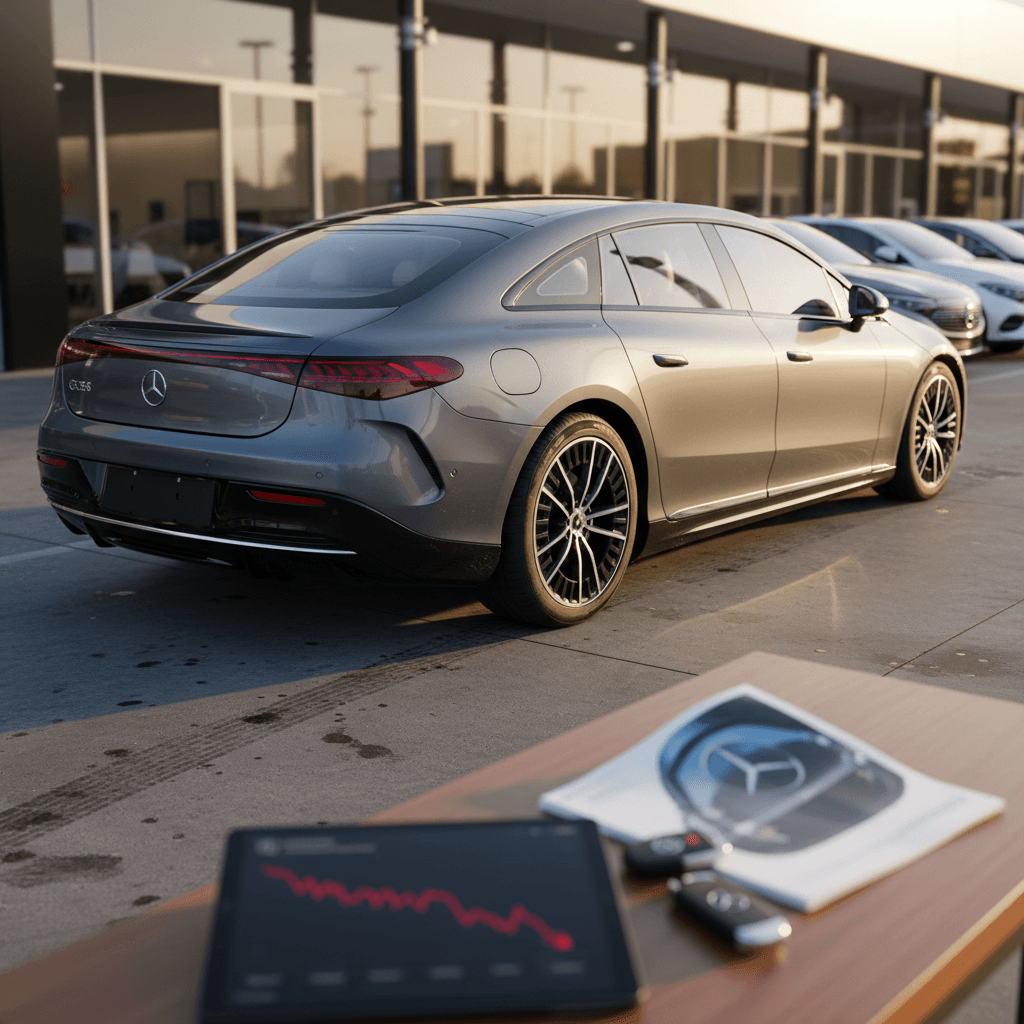
If you’re shopping a used Mercedes EQS in 2026, you’ve probably noticed two things: the original sticker prices were stratospheric, and the current asking prices… aren’t. The EQS is one of the most spectacular examples of modern luxury EV depreciation, which is bad news for first owners and fantastic news if you’re buying used. This 2026 Mercedes EQS resale value guide walks you through what these cars are actually worth now, why they dropped so hard, and how to buy (or sell) one without regret.
Quick take
Why the Mercedes EQS resale story matters in 2026
The EQS launched as Mercedes’ electric S‑Class, six‑figure MSRPs, cathedral‑quiet cabins, and enough ambient lighting to host a rave. Yet just a few years later, 2022–2024 EQS models are littering used sites with terrifying asking prices… in a good way, if you’re the buyer. In a 2025 analysis of EV values, the EQS was singled out as one of the worst five‑year performers among luxury EVs, retaining only about 31–40% of its original value after five years while some gas S‑Class models did considerably better.
This isn’t happening in a vacuum. Across the market, EVs are losing value faster than gas cars, an iSeeCars study in 2025 found electric vehicles were down almost 59% at five years, versus around 46% for gas models. The EQS is on the wrong side of that average. If you’re looking at resale value in 2026, you need to understand where this car sits: stunning to drive, brutal on original owners’ wallets, and potentially the used luxury bargain of the decade.
Mercedes EQS depreciation snapshot for 2026 shoppers
How hard does the EQS depreciate in 2026?
There are two ways to look at EQS depreciation in 2026: what’s happened so far, and what’s likely to happen if you buy one today and keep it for a few years.
- Independent value trackers estimate a 47–73% value loss over five years for the EQS, depending on trim and assumptions, among the steepest in the luxury EV space.
- Market‑wide EV data from 2025 showed EVs as a class dropping nearly 59% in five years, and the EQS has been an overachiever in the wrong direction.
- One real‑world data point: a 2024 EQS that stickered well into six figures was modeled by one guide to lose about $60,000 in five years, ending up in the mid‑$40k range.
Put another way: buy a brand‑new EQS today at, say, $115,000, and by 2031 there’s a non‑trivial chance it’s worth something in the low‑$40k range. That’s six‑figure S‑Class money, vanishing like dry ice in a rainstorm.
Why depreciation looks so extreme
Current used Mercedes EQS price ranges in 2026
Used EQS pricing moves weekly, but by early 2026 the market has settled into some recognizable bands. These are typical asking‑price ranges in the U.S. for clean‑title, average‑mileage examples; the cleanest low‑mile cars and the roughest high‑mile cars will sit outside these brackets.
Typical 2026 U.S. used Mercedes EQS asking prices
Approximate retail asking prices for EQS sedans and SUVs in early 2026. Actual values vary with mileage, options, condition, incentives and region.
| Model year | Body style | Trim examples | Typical miles | Typical 2026 asking range |
|---|---|---|---|---|
| 2022 | Sedan | EQS 450+, EQS 580 | 25k–45k | $44,000–$58,000 |
| 2023 | Sedan | EQS 450+, EQS 580, AMG EQS | 15k–35k | $50,000–$68,000 |
| 2024 | Sedan | EQS 450+, AMG EQS | Under 25k | $60,000–$80,000 |
| 2023 | SUV | EQS 450+, EQS 580 | 20k–40k | $55,000–$72,000 |
| 2024 | SUV | EQS 450+, EQS 580 | Under 25k | $65,000–$85,000 |
| 2025 (early used) | Sedan & SUV | Latest refresh trims | Under 15k | $75,000–$95,000 |
Treat these as ballpark ranges, not appraisals. A vehicle‑specific valuation (and battery health report) will do the real work.
How to sanity‑check an EQS price
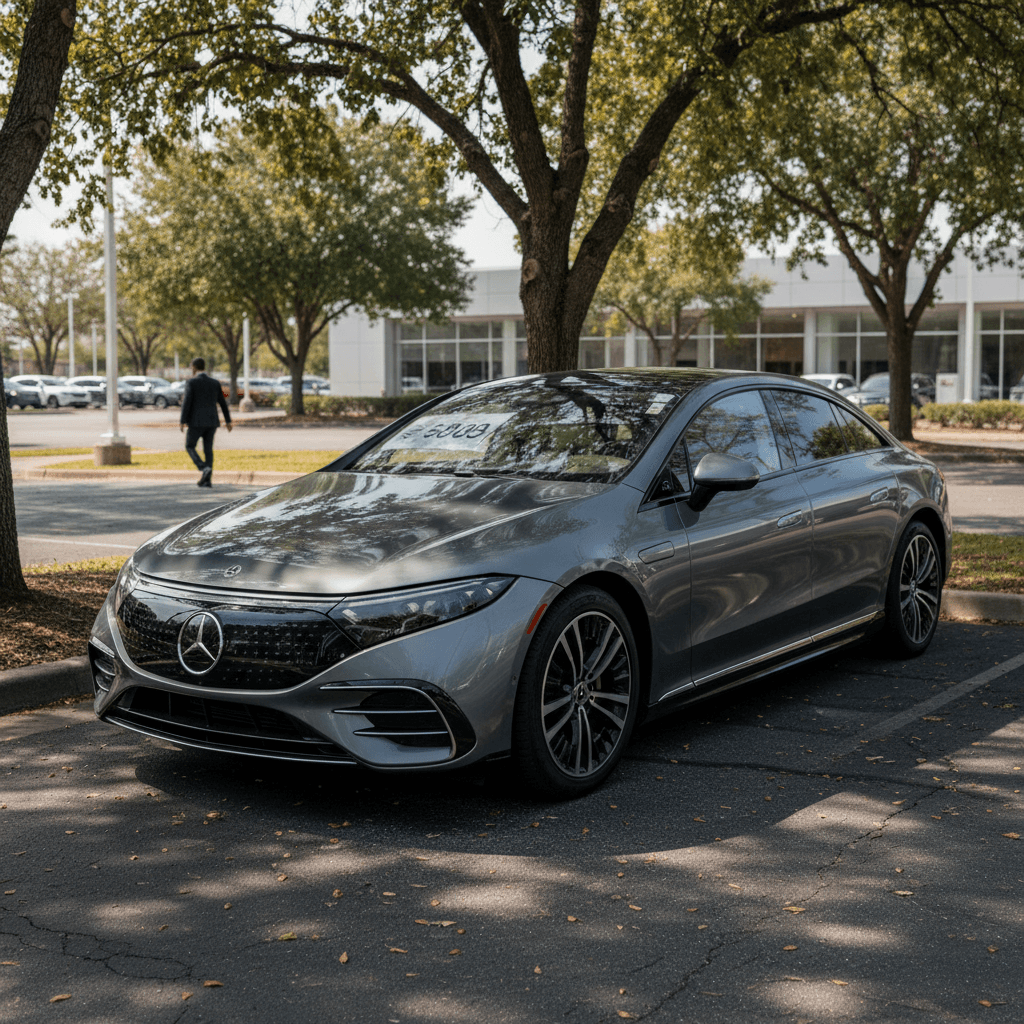
EQS sedan vs EQS SUV: how resale differs
EQS Sedan: the bigger resale fall
The EQS sedan was first out of the gate and took the full brunt of early‑adopter EV depreciation. Many 2022–2023 sedans have already burned through 50–60% of their original MSRP, and that pain shows up in today’s used prices. The upside is that the sedan is often the better value per dollar in 2026: more car, less money, especially if you don’t need three rows.
- Often the cheapest way into an EQS badge
- More inventory, more motivated sellers
- Depreciation curve has already done most of its worst work
EQS SUV: softer landing, still a big drop
The EQS SUV arrived later and rides the current three‑row luxury SUV wave, so it’s held on to slightly more of its value, but only slightly. Think of it as losing a few percentage points less than the sedan over the same window, with higher transaction prices to begin with.
- More practical layout and higher seating position
- Appeals to family and suburban buyers, which helps demand
- Still heavily discounted versus original MSRP, but not quite the bloodbath of the early sedans
Value sweet spot: late‑run sedans, early SUVs
Key factors that move EQS resale up or down
What actually changes EQS resale value in 2026?
It’s more than just mileage, spec and history matter.
Battery & charging health
Shoppers care less about 0–60 numbers and more about whether the battery still delivers real‑world range and charges as it should.
- Look for documented fast‑charging behavior
- Avoid cars with repeated high‑voltage or charging faults
- A third‑party battery health report, like a Recharged Score, is a major plus
Warranty, recalls & service history
The EQS is stuffed with software and sensors, and early cars saw multiple campaigns and recalls. Resale improves when:
- All software and recall work is up to date
- There’s a thick stack of dealer service records
- You still have remaining basic and battery warranty
Trim, options & interior condition
High‑spec cars like EQS 580 or AMG EQS lose more absolute money, but can be stronger values used. Condition still rules:
- AMG Line, big‑screen Hyperscreen and high‑end audio help value
- Smoked‑out or heavily modified examples hurt it
- Interior wear, seat stains and cracked trim are value killers
Quick checklist: what boosts (or hurts) your EQS’s value
1. Battery health proof
If you’re buying, insist on a <strong>battery health report</strong> that shows usable capacity and past fast‑charging behavior. Every Recharged EQS listing includes a Recharged Score with pack diagnostics, so you’re not guessing.
2. Clean, verifiable history
Accident history, title status and flood exposure all matter more on a tech‑heavy EV. Walk from anything with a branded title unless it’s deeply discounted and you understand the risk.
3. Fresh software and recall status
Verify that all EQS software updates, TSBs and recalls were performed. A car that’s been repeatedly in the shop for the same electronic gremlin will be harder to sell and worth less.
4. Conservative wheel and tire setup
Oversized wheels, budget tires and curb‑rashed rims telegraph abuse, and on a heavy EV they can also hurt ride quality and range. Factory‑size wheels with quality rubber help resale.
5. Remaining factory warranty
A car with at least a year of bumper‑to‑bumper coverage left will pull more money than an otherwise similar out‑of‑warranty EQS. Many buyers simply won’t touch a complex luxury EV without some warranty runway.
EQS vs Tesla Model S (and other rivals) on resale
Resale value doesn’t exist in isolation; buyers cross‑shop the EQS against Tesla’s Model S, Porsche Taycan, BMW i5/i7 and the Audi e‑tron GT. Among that group, the EQS lands toward the bottom of the class for retained value, despite Mercedes’ badge cachet.
How the EQS stacks up on estimated 5‑year value retention
Approximate five‑year depreciation performance for major luxury EV sedans, based on public value‑tracking data and 2025–2026 market observations.
| Model | Original MSRP (typical spec) | Estimated value after 5 yrs | Approx. value retained |
|---|---|---|---|
| Mercedes‑Benz EQS | $105,000 | $31,000–$42,000 | ≈27–40% |
| Tesla Model S | $90,000 | $31,000–$35,000 | ≈35% |
| Porsche Taycan | $115,000 | $58,000–$65,000 | ≈50–56% |
| BMW i5 / i7 (est.) | $80,000–$115,000 | $40,000–$70,000 | ≈45–55% |
These aren’t formal appraisals, but they capture the general pecking order of resale strength.
What this means if you buy new
If, however, you’re shopping used, the EQS’s resale problem becomes your opportunity. Mercedes‑level comfort and craftsmanship for well under $60,000, sometimes under $50,000, is precisely what the used market is for.
Is the Mercedes EQS a good used buy in 2026?
Short answer: yes, with conditions. As a used purchase in 2026, the EQS can be a brilliant value if you treat it less like a Toyota Camry and more like a lightly complicated piece of sculpture that occasionally needs software therapy.
Used EQS in 2026: the honest pros and cons
Why it can be a bargain, and when you should walk away.
Why a used EQS makes sense
- Huge depreciation already baked in, you’re avoiding the worst of the drop.
- Flagship‑level comfort, quiet and tech at midsize‑luxury pricing.
- Big battery and long‑legged highway manners make it a superb road‑trip car when charging is planned.
- Battery packs appear broadly robust so far, backed by a long high‑voltage warranty.
Why a used EQS might not be for you
- Complex electronics and driver‑assistance systems can mean more trips to the dealer than a simpler EV.
- Mercedes service costs are premium, and not every dealer is an EV whisperer.
- Resale from here is still uncertain; another round of price cuts or incentives could pull values lower.
- If you keep cars 10+ years, future tech and charging‑standard shifts may leave the EQS feeling older faster.
Where Recharged fits in
What to check before buying a used EQS
Treat EQS shopping like you’re buying a low‑flying business jet with a DMV registration. The mechanical bits have been solid so far, but the software stack and feature density require a more forensic pre‑purchase approach than a simple test‑drive around the block.
Buyer’s checklist: inspecting a used EQS in 2026
1. Run a full high‑voltage battery health scan
Don’t settle for “it charges fine.” Ask for a <strong>formal battery health report</strong> that shows usable capacity, pack temperature behavior and any logged high‑voltage errors. Recharged’s in‑house diagnostics and Recharged Score cover this automatically.
2. Inspect DC fast‑charging behavior
On a test drive, fast‑charge the car if possible. Watch whether it reaches the expected peak kW and whether the curve falls off sharply. Aggressively throttled charging can hint at pack or thermal issues you don’t want.
3. Verify all recalls and software updates
Ask the seller for a printout from a Mercedes dealer confirming that all recalls, campaigns and service bulletins are complete. Systems like MBUX, ADAS and charging controllers rely heavily on up‑to‑date software.
4. Test every electronic system
This is the tedious but essential part: doors, seats, massage, HUD, 360‑camera, parking assist, adaptive cruise, lane‑keeping, ambient lighting, rear‑wheel steering, everything. Glitches that are merely annoying to live with can be very expensive to fix.
5. Dig into the service records
Multiple visits for the <em>same</em> issue, especially collision‑assist errors, electrical gremlins or charging faults, are a red flag. A consistent relationship with one dealer is a plus; a trail of different shops suggests chronic problems.
6. Confirm warranty and extended coverage
Know exactly how much factory coverage is left on both the car and the battery. If you’re buying outside the new‑car warranty, get real quotes on extended coverage so you’re not surprised later.
Why independent inspection matters
Selling or trading an EQS in 2026
If you already own an EQS, the depreciation story may feel like a Greek tragedy. You probably can’t rewrite the ending, but you can at least negotiate a better third act. The goal in 2026 is to squeeze the maximum juice out of a soft market.
1. Decide whether to sell now or hold
If your EQS is still under warranty and you enjoy it, there’s an argument for driving it longer and amortizing the sunk cost. The steepest part of the curve is already behind you; the dollar‑per‑mile cost of keeping it another two years may be less than swapping into something newer.
On the other hand, if warranty expiration is near and your dealer visits are frequent, it can be smarter to exit while the car still has some protection to sweeten the deal for the next owner.
2. Choose your exit: trade‑in, instant offer, or consignment
With a niche model like the EQS, where condition and battery health make or break the deal, how you sell matters:
- Dealer trade‑in: Fast and easy, but often the lowest number.
- Instant offer: A quick way to get a nationwide bid without tire‑kickers.
- Consignment: You may net more by letting a specialist market your EQS to the right buyer.
Recharged offers trade‑ins, instant offers and consignment for EVs, with battery diagnostics baked in so you’re not leaving money on the table.
Steps to maximize your EQS’s sale or trade value
1. Fix small stuff and detail the car
Touch up curb rash, replace worn tires with a reputable brand, and have the interior professionally cleaned. A spotless EQS photographs and shows far better, and clean cars appraise higher.
2. Gather documentation
Service records, recall paperwork, charging receipts, purchase contracts, bundle it all. Documentation telegraphs that the car was loved, not merely tolerated.
3. Get a battery health report
Just as buyers should ask for it, sellers should provide it. A clean bill of health for the high‑voltage battery can justify a stronger asking price and speed up the sale. Recharged can provide this as part of our intake process.
4. Price with the market, not your memories
Your EQS might have been $125,000 new. The market does not care. Price against current nationwide comparables and be realistic; an over‑priced EQS will just age in your driveway.
FAQ: Mercedes EQS resale value in 2026
Frequently asked questions about EQS resale in 2026
Bottom line on Mercedes EQS resale value in 2026
In 2026, the Mercedes EQS is a paradox: a financial cautionary tale for first owners and a minor miracle for second ones. The resale numbers are undeniably ugly from new, five‑year losses that would make a CFO choke on their latte, but that’s exactly what makes a well‑chosen used EQS so compelling. You’re letting someone else pay for the privilege of being first.
If you’re buying, focus on battery health, warranty runway and service history, and use nationwide pricing data as your anchor, not the old window sticker. If you’re selling, presentation, documentation and honest pricing will matter more than heroic negotiation skills. And if you want help on either side of the transaction, Recharged exists precisely for this moment in the EV market: we test the batteries, decode the history and benchmark the prices so you can enjoy the wafting leather and silent torque, not lose sleep over spreadsheets.